Space Research Activities

Astronauts performing technical tasks in the International Space Station, focusing on biological and scientific research.

ISS032-E-010075 (22 July 2012) --- Russian cosmonauts Gennady Padalka (background), Expedition 32 commander; and Yuri Malenchenko, flight engineer, use still cameras at windows in the International Space Stations Zvezda Service Module during undocking activities of the unpiloted Progress 47 resupply spacecraft. The Progress temporarily undocked from the stations Pirs Docking Compartment on July 22, 2012 in order to perform a series of engineering tests during re-docking designed to verify an upgraded automated rendezvous system that will facilitate future dockings of Russian vehicles to the space station. Progress 47 separated from the station to a distance of about 100 miles and held position for 24 hours.
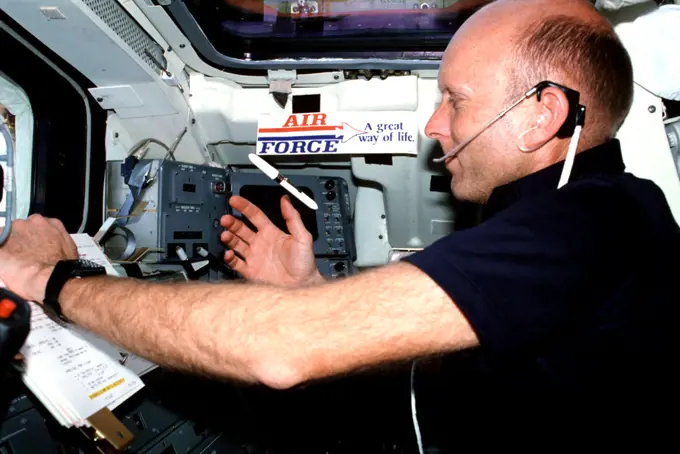
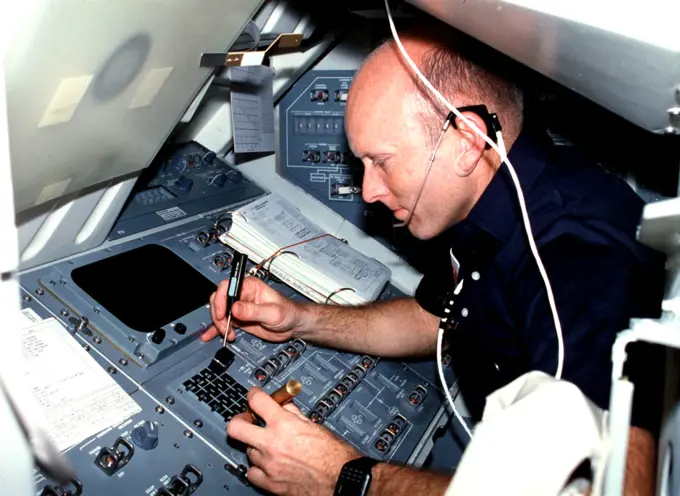
ISS020-E-031128 (16 Aug. 2009) --- Cosmonaut Gennady Padalka, Expedition 20 commander, performs a check on the Russian POTOK-150MK (150 micron) air filter unit of the Zvezda Service Modules SOGS air revitalization subsystem on the International Space Station.(22-30 March 1982) --- Pilot Gordon Fullerton, wearing communications kit assembly (assy) mini headset, watches freefloating pen during checklist procedures at Aft Flight Deck Onorbit Station. Taken from the aft flight deck starboard side, Fullerton is seen in front of panels A7 and A8 with W8 and a 'United States Air Force - a Great Way of Life' decal overhead.S127-E-006234 (16 July 2009) --- Canadian Space Agency astronaut Julie Payette, STS-127 mission specialist, reads a procedures checklist on the aft flight deck of Space Shuttle Endeavour during flight day two activities.STS081-E-5141 (13 Jan. 1997) --- Astronaut Brent W. Jett, Jr., pilot, goes over a check list of experiments and supplies in the shirtsleeve environment of the Spacehab Double Module (DM) affixed in the Space Shuttle Atlantis' cargo bay.  This image was recorded with an Electronic Still Camera (ESC) and was later downlinked to flight controllers in Houston, Texas.STS003-25-228 (22-30 March 1982) --- Pilot Fullerton, wearing communication kit assembly (ASSY) mini headset (HDST) and using a screwdriver and flashlight (penlight), replaces acknowledge (ACK) key on aft flight deck mission station control panel R12L keyboard.ISS030-E-093434 (23 Feb. 2012) --- Russian cosmonaut Oleg Kononenko, Expedition 30 flight engineer, performs a SPRUT-2 experiment run in the Zvezda Service Module of the International Space Station.KC-135 AIRPLANE FLIGHT AT LEWIS RESEARCH CENTER DURING WEEK OF AUGUST 17 THROUGH 22 1998ISS038-E-041425 (2 Feb. 2014) --- Japan Aerospace Exploration Agency astronaut Koichi Wakata, Expedition 38 flight engineer, gets a workout on the advanced Resistive Exercise Device (aRED) in the Tranquility node of the International Space Station.ISS022-E-011879 (16 Dec. 2009) --- NASA astronaut Jeffrey Williams, Expedition 22 commander, services the Advanced Plant Experiments on Orbit-Cambium (APEX-C) payload in the Minus Eighty Laboratory Freezer for ISS-2 (MELFI-2) in the Destiny laboratory of the International Space Station.T&R Discovery, Galley is ReinstalledNASA astronaut and Expedition 67 Flight Engineer Bob Hines conducts a robotics test using the U.S. Destiny laboratory module's robotics workstation aboard the International Space Station. The test is part of the Behavioral Core Measures investigation that explores how working on the surface of Mars might affect a crew members performance.JSC2010-E-006713 (5 Jan. 2010) --- NASA astronauts Alan Poindexter (background), STS-131 commander; Clayton Anderson and Stephanie Wilson, both mission specialists, participate in an undocking timeline training session in the Guidance and Navigation Simulator in the Mission Simulation Development Facility at NASA's Johnson Space Center.S106-E-5230 (14 September 2000) --- Astronaut Scott D. Altman, pilot, checks the crew activity timeline posted on the wall of the Zvezda service module during Flight Day 6 activity.iss056e158445 (Aug. 27, 2018) --- NASA astronaut Ricky Arnold is pictured working inside NASA's U.S. Destiny laboratory module on an experiment that extracts RNA from biological samples to help researchers decipher the changes in gene expression that take place in microgravity.iss064e014003 (Dec. 22, 2020) --- NASA astronaut and Expedition 64 Flight Engineer Michael Hopkins is pictured during science activities aboard the International Space Station's Kibo laboratory module from JAXA (Japan Aerospace Exploration Agency).NASA astronaut and Expedition 67 Flight Engineer Bob Hines works out on the Advanced Resistive Exercise Device (ARED) inside the International Space Station's Tranquility module. The ARED mimics the inertial forces generated when lifting free weights on Earth enabling crew members to experience load and maintain muscle strength and mass during a long-term space mission.ISS034-E-021230 (10 Jan. 2013) --- Russian cosmonaut Evgeny Tarelkin, Expedition 34 flight engineer, uses the Liulin-5 Electronic Block behind a panel in the Rassvet Mini-Research Module 1 (MRM1) of the International Space Station.. iss069e092048 (Sept. 25, 2023) --- NASA astronaut and Expedition 70 Flight Engineer Frank Rubio uses a glovebag and services the BioFabrication Facility, replacing and installing components inside the research device designed to print organ-like tissues in microgravity and learn how to manufacture whole, fully-functioning human organs in space.Astronaut Karen Nyberg,Expedition 37 flight engineer, assisted by astronaut Chris Cassidy, performs an Ocular Health (OH) Ultrasound 2 scan in the Destiny laboratory of the International Space Station.STS075-350-030 (22 Feb.-9 March 1996) --- Astronaut Franklin R. Chang-Diaz, STS-75 payload commander, holds food items at the galley on the middeck of the Earth-orbiting space shuttle Columbia.S106-E-5200 (13 September 2000) --- Cosmonaut Yuri I. Malenchenko, mission specialist representing the Russian Aviation and Space Agency, works aboard the Zvezda service module on the International Space Station (ISS).  Electrical work was the hallmark of this day as four of the mission specialists aboard ISS (temporarily docked with the Space Shuttle Atlantis) replaced batteries inside the Zarya and Zvezda modules while supply transfer continued around them. Astronaut Edward T. Lu, mission specialist, is out of frame at right.STS-106 Mission Specialist Daniel C. Burbank checks out a Russian foot restraint at SPACEHAB, part of the payload on the mission to the International Space Station. He and the other crew members Commander Terrence W. Wilcutt, Pilot Scott D. Altman, and Mission Specialists Edward T. Lu, Yuri I. Malenchenko, Boris V. Morukov and Richard A. Mastracchio are taking part in Crew Equipment Interface Test (CEIT) activities at SPACEHAB. Malenchenko and Morukov represent the Russian Aviation and Space Agency. On the 11-day mission, the seven-member crew will perform support tasks on orbit, transfer supplies and prepare the living quarters in the newly arrived Zvezda Service Module for the first long-duration crew, dubbed Expedition One,” which is due to arrive at the Station in late fall. STS-106 is scheduled to launch Sept. 8, 2000, at 8:31 a.m. EDT from Launch Pad 39BISS014-E-08055 (16 Nov. 2006) --- European Space Agency (ESA) astronaut Thomas Reiter, Expedition 14 flight engineer, takes inventory of hardware during an Information Management System (IMS) update in the Unity node of the International Space Station.iss064e027736 (Jan. 28, 2021) --- NASA astronaut and Expedition 64 Flight Engineer Shannon Walker collects leaf samples from plants growing inside the European Columbus laboratory. Space agriculture is key to the success and sustainability of future human missions to the Moon, Mars and beyond.61B-02-014 (26 Nov-3 Dec 1985) --- Payload Specialist Charles D. Walker works with the handheld protein growth experiment -- one of a series of tests being flown to study the possibility of crystallizing biological materials. Walker rests the experiment against the larger continuous flow electrophoresis systems experiment.NASA Administrator Charles Bolden, left, and SpaceX CEO and Chief Designer Elon Musk, view the historic Dragon capsule that returned to Earth on May 31 following the first successful mission by a private company to carry supplies to the International Space Station on Wednesday, June 13, 2012 at the SpaceX facility in McGregor, Texas.  Bolden and Musk also thanked the more than 150 SpaceX employees working at the McGregor facility for their role in the historic mission.iss048e038163 (7/17/2016) --- Roscosmos cosmonaut Anatoly Ivanishin displays Luch-2M Multipurpose Crystallization Cassette (УБК) No. 3 during Struktura-Luch-2M (Structure-Beam-2M) experiment hardware activation and deployment. Image was taken in the Zvezda Service Module (SM) aboard the International Space Station (ISS). Struktura is a study of protein crystallization processes and growth of single crystals which are suitable for X-ray structural analysis and structural decoding.ISS015-E-15616 (1 July 2007) --- Cosmonaut Oleg V. Kotov, Expedition 15 flight engineer representing Russia's Federal Space Agency, uses a computer in the Zvezda Service Module of the International Space Station.Expedition 43 Emergency Scenarios training in ISS mockups with Soyuz 41(Anton Shkaplerov, Samantha Cristoforetti, Terry Virts) and Soyuz 42 (Gennady Padalka, Mikhail Kornienko, Scott Kelly).  Photo Date: July 10, 2014.  Location: Building 9NW - ISS Mockups.ISS007-E-06455 (7 June 2003) --- Cosmonaut Yuri I. Malenchenko (left), Expedition 7 mission commander, and astronaut Edward T. Lu, NASA ISS science officer and flight engineer, share a meal in the Zvezda Service Module on the International Space Station (ISS). Malenchenko represents Rosaviakosmos.ISS015-E-07578 (13 May 2007) --- Astronaut Sunita L. Williams, Expedition 15 flight engineer, uses a computer in the Destiny laboratory of the International Space Station.ISS020-E-041515 (21 Sept. 2009) --- NASA astronaut Nicole Stott, Expedition 20 flight engineer, equipped with a bungee harness, exercises on the Treadmill Vibration Isolation System (TVIS) in the Zvezda Service Module of the International Space Station.S85-E-5011 (9 August 1997)  --- Astronaut Robert L. Curbeam, Jr., mission specialist, works with the Bioreactor Demonstration System (BDS) on the Space Shuttle Discovery's mid-deck.ISS029-E-040701 (8 Nov. 2011) --- Russian cosmonaut Sergei Volkov, Expedition 29 flight engineer, equipped with a bungee harness, exercises on the Treadmill Vibration Isolation System (TVIS) in the Zvezda Service Module of the International Space Station.S121-E-07694 (15 July 2006) --- Astronaut Stephanie D. Wilson, STS-121 mission specialist, works with the Mobile Service System (MSS) and Canadarm2 controls in the Destiny laboratory of the International Space Station while Space Shuttle Discovery was docked to the station.PHOTO DATE: 01-12-10LOCATION: SSTF AND FIX BASE BLDG 5SUBJECT: STS-131 crew member and JAXA astronaut Naoko Yamazaki training during TPS OBSS mission trainingWORK ORDER:  0090-JAXA-01-12-10ISS028-E-013758 (1 July 2011) --- Russian cosmonauts Sergei Volkov, Expedition 28 flight engineer; and Andrey Borisenko (mostly out of frame at left), commander, perform in-flight maintenance on the Treadmill Vibration Isolation System (TVIS) in the Zvezda Service Module of the International Space Station.NASA astronaut and Expedition 67 Flight Engineer Jessica Watkins checks out gifts she received for her 34th birthday aboard the International Space Station.iss048e045065 (7/27/2016) --- NASA astronaut Kate Rubins pauses for a photo while using the Microscope to conduct Heart Cells experiment operations. Effects of Microgravity on Stem Cell-Derived Cardiomyocytes (Heart Cells) studies the human heart, specifically how heart muscle tissue, contracts, grows and changes (gene expression) in microgravity and how those changes vary between subjects.iss059e034721 (4/23/2019) --- Canadian Space Agency (CSA) astronaut David Saint-Jacques is photographed in front of the Microgravity Science Glovebox (MSG) during the installation of the Space Fibers experiment hardware into the MSG work volume. Manufacturing Fiber Optic Cable in Microgravity (Space Fibers) evaluates a method for producing fiber optic cable from a blend of zirconium, barium, lanthanum, sodium and aluminum, called ZBLAN, in space. ZBLAN produces glass one hundred times more transparent than silica-based glass, exceptional for fiber optics. Microgravity suppresses two mechanisms that commonly degrade fiber, and previous studies showed improved properties in fiber drawn in microgravity compared to that fabricated on the ground.ISS037-E-006562 (3 Oct. 2013) --- NASA astronaut Michael Hopkins, Expedition 37 flight engineer, performs routine in-flight maintenance on the advanced Resistive Exercise Device (aRED) in the Tranquility node of the International Space Station.iss070e037585 (Dec. 11, 2023) --- NASA astronaut and Expedition 70 Flught Engineer Loral O'Hara shows off research hardware supporting the UMAMI, or Understanding of Microgravity on Animal-Microbe Interaction, space biology experiment. O'Hara is holdng the Avanced Space Experiment Processor (ADSEP) Fluid Processing Cassette (FPC) that supports the observation of the effects of spaceflight on the molecular and chemical interactions between beneficial microbes and their animal hosts.NASA astronaut and Expedition 67 Flight Engineer Kjell Lindgren prepares to enjoy a taco during dinner time aboard the International Space Station.Pre-Sat/Pharmasat practice/backup box Matt Piecini calibrating fluidic in labISS030-E-021036 (5 Jan. 2012) --- Russian cosmonaut Anatoly Ivanishin, Expedition 30 flight engineer, wears a communication system headset while using a computer in the Zvezda Service Module of the International Space Station.JSC2012-E-237330 (5 Nov. 2012) --- NASA astronaut Michael Hopkins, Expedition 37/38 flight engineer, uses virtual reality hardware in the Space Vehicle Mock-up Facility at NASA's Johnson Space Center to rehearse some of his duties on the upcoming mission to the International Space Station. This type of virtual reality training allows the astronauts to wear a helmet and special gloves while looking at computer displays simulating actual movements around the various locations on the station hardware with which they will be working.CAPE CANAVERAL, Fla. -  Inside the White Room on Launch Pad 39A at NASA's Kennedy Space Center in Florida, STS-128 Commander Rick Sturckow places a mission patch on part of the hatch for space shuttle Discovery.  The crew is at Kennedy for a launch dress rehearsal called the terminal countdown demonstration test, or TCDT, which includes emergency exit training and equipment familiarization, as well as a simulated launch countdown.  Discovery will deliver 33,000 pounds of equipment to the station, including science and storage racks, a freezer to store research samples, a new sleeping compartment and the COLBERT treadmill.CAPE CANAVERAL, Fla. - In Orbiter Processing Facility-1 at NASA's Kennedy Space Center in Florida, members of space shuttle Atlantis' STS-132 crew participate in training activities during the Crew Equipment Interface Test, or CEIT, for their mission. Here, Mission Specialist Piers Sellers reviews instructions on the operation of the hardware that will fly on Atlantis' middeck. Sellers is dressed in clean room attire, known as a bunny suit. CEIT provides the crew with hands-on training and observation of shuttle and flight hardware. The six-member crew of Atlantis' STS-132 mission will deliver an Integrated Cargo Carrier and the Russian-built Mini-Research Module-1 to the International Space Station. STS-132 is the 34th mission to the station and the 132nd space shuttle mission. Launch is targeted for May 14.