Space Research Activities

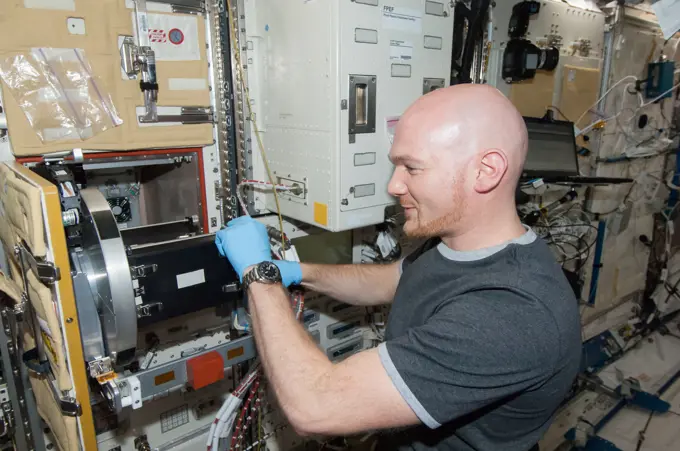
Astronauts performing technical tasks in the International Space Station, focusing on biological and scientific research.

ISS032-E-010075 (22 July 2012) --- Russian cosmonauts Gennady Padalka (background), Expedition 32 commander; and Yuri Malenchenko, flight engineer, use still cameras at windows in the International Space Stations Zvezda Service Module during undocking activities of the unpiloted Progress 47 resupply spacecraft. The Progress temporarily undocked from the stations Pirs Docking Compartment on July 22, 2012 in order to perform a series of engineering tests during re-docking designed to verify an upgraded automated rendezvous system that will facilitate future dockings of Russian vehicles to the space station. Progress 47 separated from the station to a distance of about 100 miles and held position for 24 hours.
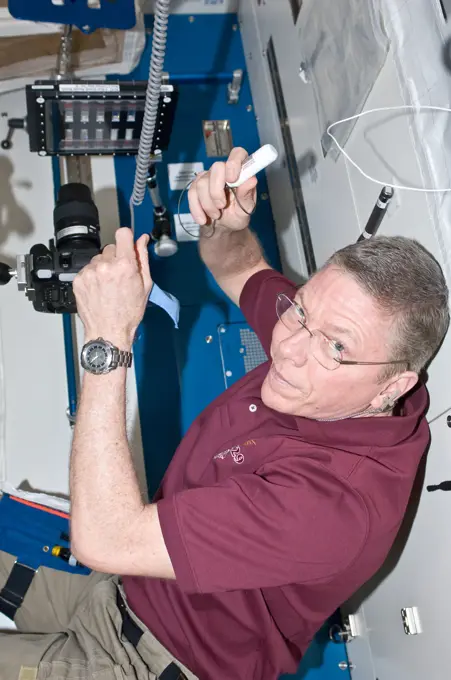
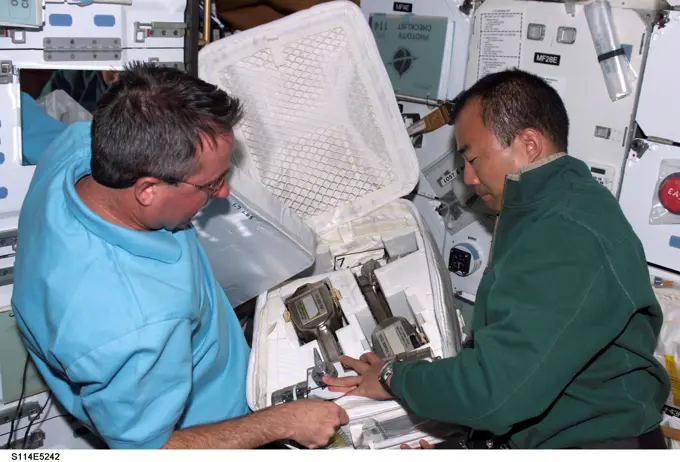
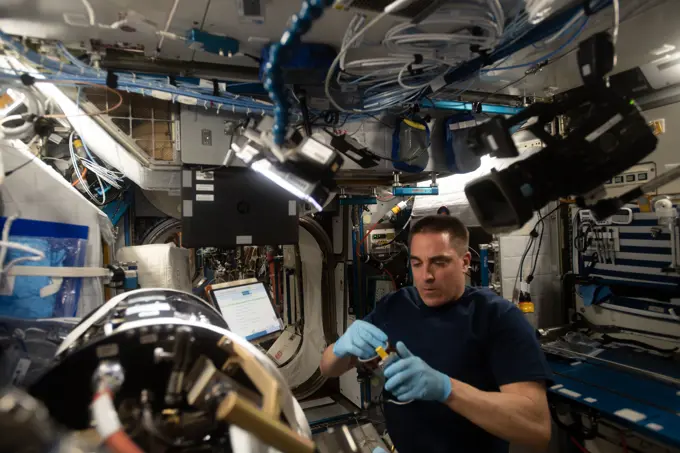
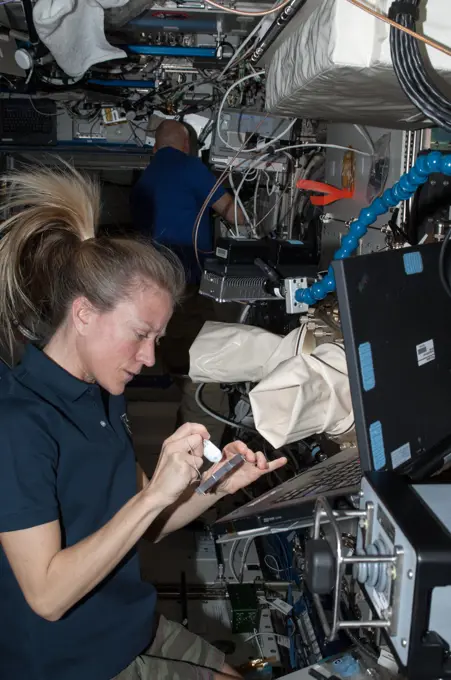
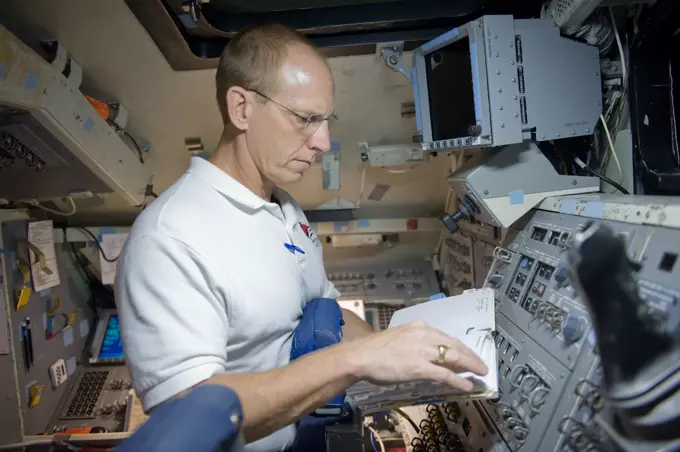
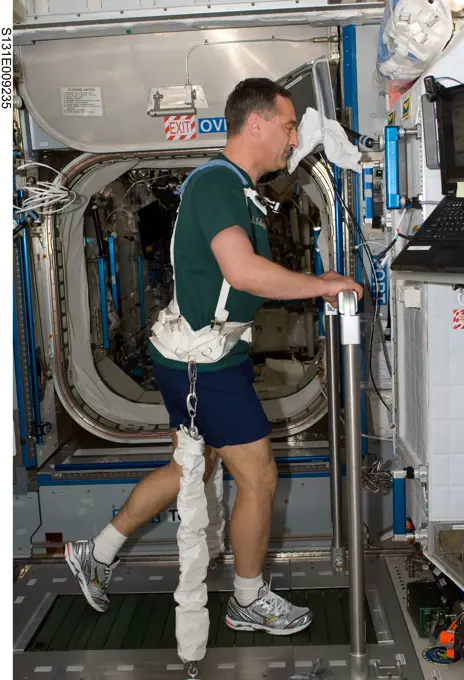
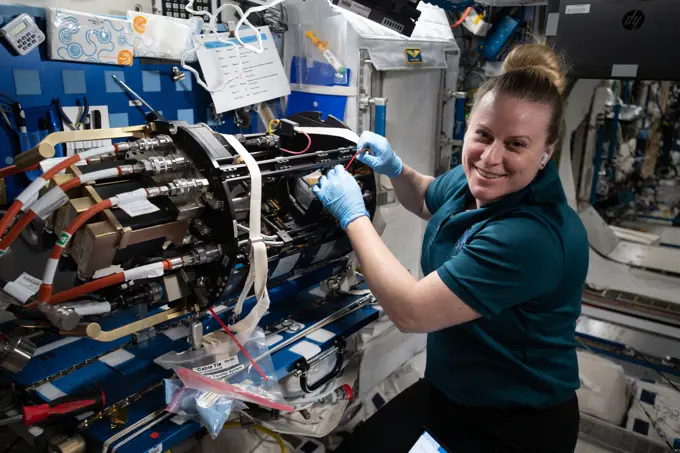
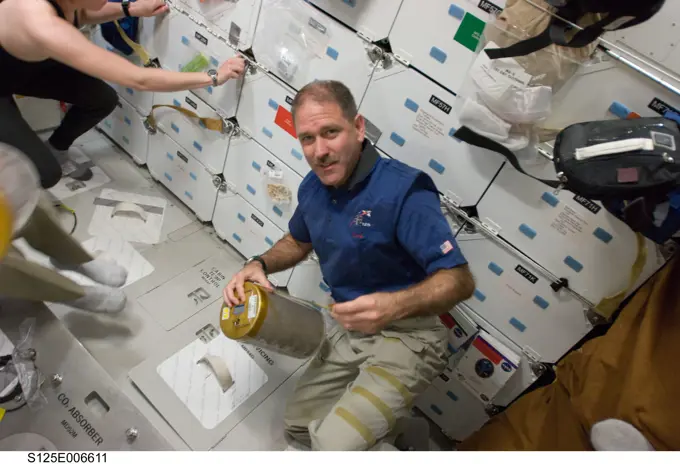
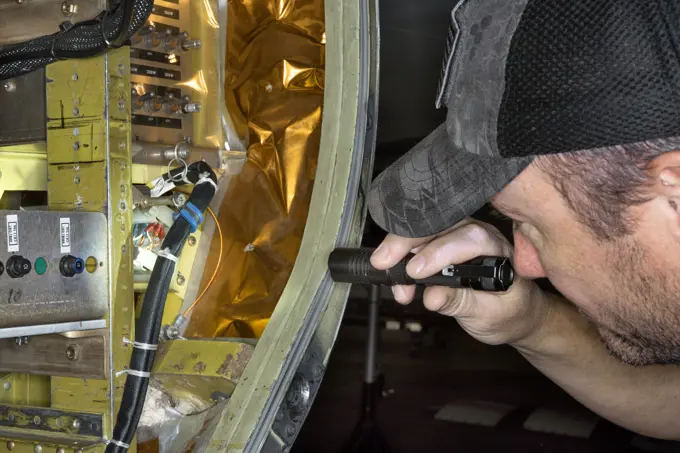
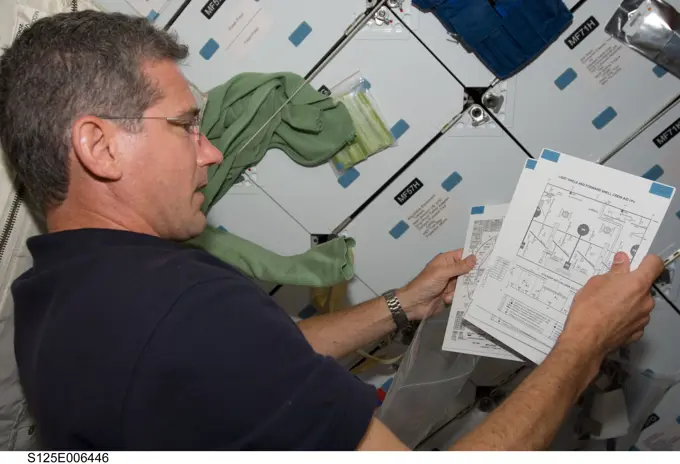
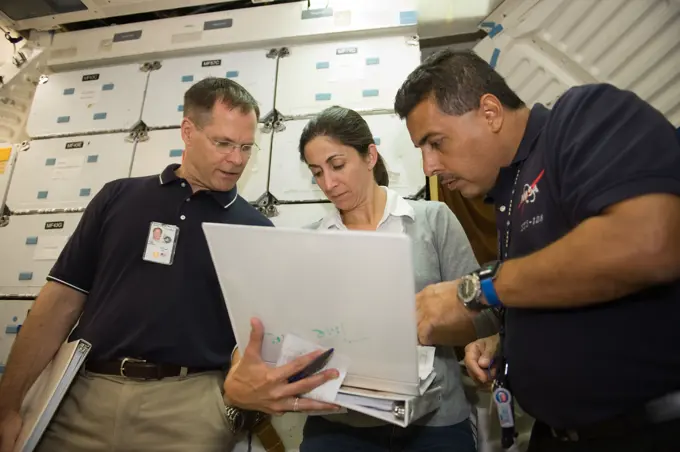
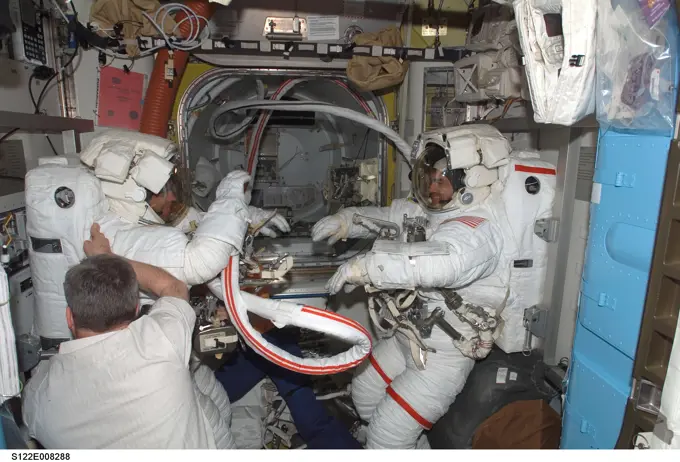
S122-E-008288 (13 Feb. 2008) --- Attired in their Extravehicular Mobility Unit (EMU) spacesuits, European Space Agency (ESA) astronaut Hans Schlegel (left) and NASA astronaut Rex Walheim, both STS-122 mission specialists, are pictured in the Quest Airlock of the International Space Station as the mission's second spacewalk draws to a close. NASA astronaut Steve Frick, commander, assisted Schlegel and Walheim.STS106-370-004 (8-20 September 2000) --- Astronaut Daniel C. Burbank, STS-106 mission specialist, looks over a procedures checklist on the aft flight deck of the Space Shuttle Atlantis. Burbank is marking his first space flight.ISS020-E-016095 (1 July 2009) --- Cosmonaut Gennady Padalka (background), Expedition 20 commander; and NASA astronaut Michael Barratt, flight engineer, use an onboard laptop-based simulator in the Zvezda Service Module of the International Space Station to prepare for the relocation of the Soyuz TMA-14 spacecraft from Zvezdas aft port to the Pirs Docking Compartment. Padalka and Barratt, along with Japan Aerospace Exploration Agency (JAXA) astronaut Koichi Wakata (out of frame), flight engineer, undocked the Soyuz spacecraft at 4:26 p.m. (CDT) and docked to the Pirs Docking Compartment at 4:54 p.m. on July 2, 2009.DATE: 1-24-13LOCATION: Bldg. 9NW - ISS Mockups SUBJECT: Expedition 38 crew members, Kotov, Ryazansky and Mike Hopkins during Emergency Scenarios Training in the ISS mockups.ISS023-E-030596 (1 May 2010) --- Russian cosmonaut Oleg Kotov (left foreground), Expedition 23 commander, is pictured at the manual TORU docking system controls in the Zvezda Service Module of the International Space Station shortly after conducting a manual control docking of the Progress 37 due to a jet failure on the Progress that forced a shutdown of the Kurs automated rendezvous system. Progress 37 docked to the Pirs Docking Compartment at 2:30 p.m. (EDT) on May 1, 2010, after a three-day flight from the Baikonur Cosmodrome in Kazakhstan. Also pictured are NASA astronauts Tracy Caldwell Dyson (left background) and T.J. Creamer; along with Russian cosmonaut Alexander Skvortsov (right foreground), all flight engineers.ISS007-E-14137 (31 August 2003) --- Cosmonaut Yuri I. Malenchenko, Expedition 7 mission commander, works at the Simvol-Ts workstation in the Zvezda Service Module on the International Space Station (ISS) during the docking approach of the Progress 12 spacecraft. Malenchenko represents Rosaviakosmos.S133-E-011319 (7 March 2011) --- NASA astronauts Steve Lindsey (center), STS-133 commander; Eric Boe (left), pilot; and Alvin Drew, mission specialist, work on the aft flight deck of space shuttle Discovery during flight day 12 activities.STS079-357-009 (16-26 Sept. 1996) --- Astronaut John E. Blaha, now a full-fledged crewmember of Mir-22, takes notes in the Priroda Module on one of the many experiments stored there. Shortly after assuming his new duties, Blaha's attention was directed toward a bio-reactor experiment, which he quickly repaired.ISS023-E-020666 (7 April 2010) --- Japan Aerospace Exploration astronaut Naoko Yamazaki (near frame center) joins NASA astronauts Stephanie Wilson (foreground), Alan Poindexter (blue jersey, standing) and T.J. Creamer in the "busy" Destiny laboratory aboard the International Space Station. Creamer is Expedition 23 flight engineer, Poindexter is STS-131 commander and Yamazaki and Wilson are mission specialists for STS-131.. iss069e056648 (Aug. 11, 2023) --- UAE (United Arab Emirates) astronaut and Expedition 69 Flight Engineer Sultan Alneyadi works on physics research inside the Destiny laboratory module's Microgravity Science Glovebox. The SUBSA-μgGA investigation seeks to create a superior graphene aerogel, a synthetic material with high porosity and low density, in microgravity benefitting both Earth and space industries such as power storage, environmental protection, and chemical sensing.S128-E-007115 (31 Aug. 2009) --- NASA astronauts Kevin Ford (foreground), STS-128 pilot; and Michael Barratt, Expedition 20 flight engineer; along with European Space Agency astronaut Christer Fuglesang (left), mission specialist, are busy with various tasks in the Destiny laboratory of the International Space Station while Space Shuttle Discovery remains docked with the station.iss064e024596 (Jan. 21, 2021) --- NASA astronaut and Expedition 64 Flight Engineer Shannon Walker inspects a science freezer that preserves biological samples for later analysis on Earth and on the International Space Station.ISS006-E-25286 (12 February 2003) --- Astronaut Kenneth D. Bowersox, Expedition Six mission commander, performs routine maintenance on the air handler system in the Unity node on the International Space Station (ISS).T2 Annual and Six-Month Maintenance Part 1. iss069e017995 (June 5, 2023) - NASA astronaut and Expedition 69 Flight Engineer Frank Rubio performs maintenance on the International Space Station's treadmill located in the Tranquility module.ISS029-E-032412 (24 Oct. 2011) --- NASA Mike Fossum, Expedition 29 commander, conducts a session with the Binary Colloidal Alloy Test-6 (BCAT-6) experiment in the Kibo laboratory of the International Space Station.iss061e020169 (Oct. 29, 2019) --- NASA astronaut Christina Koch works on orbital plumbing tasks as she replaces components inside the International Space Station's bathroom, the Waste and Hygiene Compartment, located in the Tranquility module.Boeing trainers conduct simulations inside the Boeing Exploration Habitat Demonstrator with astronauts to evaluate the internal layout and ergonomics, to support efficient work-life balance aboard a deep space ship.CAPE CANAVERAL, Fla. -- At Launch Pad 39A at NASA's Kennedy Space Center in Florida, Closeout Crew members Randy Bresnik (front) and Rene Arriens  prepare space shuttle Atlantis for the arrival of the STS-135 crew members who will be at the pad to participate in a launch countdown simulation exercise. The exercise is part of the Terminal Countdown Demonstration Test (TCDT) and related training. Atlantis and its crew are targeted to lift off July 8, taking with them the Raffaello multi-purpose logistics module packed with supplies and spare parts to the International Space Station. The STS-135 mission also will fly a system to investigate the potential for robotically refueling existing satellites and return a failed ammonia pump module to help NASA better understand the failure mechanism and improve pump designs for future systems. STS-135 will be the 33rd flight of Atlantis, the 37th shuttle mission to the space station, and the 135th and final mission of NASA's Space Shuttle Program.JSC2008-E-035885 (22 April 2008) --- Astronaut Michael T. Good (left), STS-125 mission specialist, participates in an Extravehicular Mobility Unit (EMU) spacesuit fit check in the Space Station Airlock Test Article (SSATA) in the Crew Systems Laboratory at NASA's Johnson Space Center. Astronaut John M. Grunsfeld, mission specialist, assisted Good.CAPE CANAVERAL, Fla. - In Orbiter Processing Facility-2 at NASAs Kennedy Space Center in Florida, United Space Alliance technicians clear the area in front of space shuttle Endeavours airlock before its hatch is closed for the final time during processing for the shuttles retirement. Endeavour is being prepared for public display at the California Science Center in Los Angeles. Its ferry flight to California is targeted for mid-September. Endeavour, designated OV-105, was the last space shuttle added to NASAs orbiter fleet. Over the course of its 19-year career, Endeavour spent 299 days in space during 25 missions.S124-E-006277 (4 June 2008) --- Japan Aerospace Exploration Agency (JAXA) astronaut Akihiko Hoshide, STS-124 mission specialist, works in the newly installed Kibo Japanese Pressurized Module (JPM) of the International Space Station while Space Shuttle Discovery is docked with the station.ISS021-E-023152 (8 Nov. 2009) --- European Space Agency astronaut Frank De Winne, Expedition 21 commander, works with Microgravity Science Laboratory (MSL) hardware in the Destiny laboratory of the International Space Station.iss057e132633 (12/13/2018) --- A photo of the Study of the Gravitys Effect on Bacteria (ICE Cubes Hydra-2 Bacteria Biomining) onboard the International Space Station (ISS). The ICE Cubes Hydra-2 Bacteria Biomining investigation studies the effects of microgravity on several strains of an ancient type of bacteria that does not use oxygen. The investigation is evaluating the use of these bacteria to produce methane on asteroids for use as a propellant or fuel. The Experiment Cube measures the size of the bacterial colonies in the growth chamber before and after flight.ISS028-E-020307 (2 Aug. 2011) --- NASA astronaut Ron Garan (foreground) and Japan Aerospace Exploration Agency astronaut Satoshi Furukawa, both Expedition 28 flight engineers, use computers in the International Space Stations Kibo laboratory to monitor the Japanese Experiment Module Remote Manipulator System (JEMRMS) located on the exterior of the station.iss070e030810 (Nov. 27, 2023) --- NASA astronaut and Expedition 70 Flight Engineer Jasmin Moghbeli works on the Materials Science Laboratory, a physics research facility, located in the International Space Station's Destiny laboratory module.ISS012-E-10233 (5 December 2005) --- Astronaut William S. (Bill) McArthur Jr., Expedition 12 commander and NASA space station science officer, performs in-flight maintenance (IFM) on the Volatile Organic Analyzer (VOA) in the Destiny laboratory of the International Space Station.Date: 03-13-12Location: Bldg 9NW, ISS AirlockSubject: Expedition 32 (Soyuz 31) crew members Aki Hoshide, Sunita Williams and Joe Acaba during ISS EVA planning and preparationISS030-E-210829 (6 April 2012) --- European Space Agency astronaut Andre Kuipers, Expedition 30 flight engineer, configures the Gas Control Panel (GCP) in the Automated Transfer Vehicle (ATV-3) currently docked with the International Space Station.STS107-E-05010 (17 January 2003) --- Astronaut Kalpana Chawla, STS-107 mission specialist, works in the SPACEHAB Research Double Module aboard the Space Shuttle Columbia.S89-E-5382 (29 Jan 1998) --- This Electronic Still Camera (ESC) image shows astronaut Joe F. Edwards, Jr., pilot, working on a lap-top computer at the commanders station on the flight deck of the Earth-orbiting Space Shuttle Endeavour.  This ESC view was taken on January 29, 1998, at 00:49:47 GMT.KENNEDY SPACE CENTER, FLA. - In the Space Station Processing Facility, technicians install the the Minus Eighty Degree Laboratory Freezer for ISS (MELFI) science rack into the Multi-Purpose Logisitics Module Leonardo. Leonardo will fly on Space Shuttle Atlantis on mission STS-121. The MELFI will provide cooling and storage for scientific experiment samples and perishable materials in four insulated containers, known as dewars, with independently selectable temperatures of -80 degrees Celsius, -26 degrees Celsius, and +4 degrees Celsius. MELFI will also be used to transport samples to and from the Station. MELFI is provided as laboratory support equipment by the European Space Agency. STS-121 is the second Return to Flight mission to the International Space Station. The launch window extends from Sept. 9 through Sept. 24.ISS022-E-097237 (14 March 2010) --- NASA astronaut Jeffrey Williams, Expedition 22 commander, uses a computer in the Destiny laboratory of the International Space Station.STS114-E-5242 (27 July 2005) --- Astronauts Stephen K. Robinson (left), and JAXA's Soichi Noguchi, both mission specialists, checks power tools on Discovery's mid deck.S133-E-008313 (2 March 2011) --- NASA astronaut Eric Boe, STS-133 pilot, works in the newly-installed Permanent Multipurpose Module (PMM) of the International Space Station while space shuttle Discovery remains docked with the station.ISS007-E-07897 (22 June 2003) --- Astronaut Edward T. Lu (at musical keyboard), Expedition 7 NASA ISS science officer and flight engineer, and cosmonaut Yuri I. Malenchenko, mission commander, share a light moment during off-shift time in the Destiny laboratory on the International Space Station (ISS). Malenchenko represents Rosaviakosmos.iss050e035314 (1/26/2017) --- A view of the Wireless Leak Detector Ultrasonic Sensor aboard the International Space Station (ISS). The Joint Leak Detection and Localization Based on Fast Bayesian Inference from Network of Ultrasonic Sensor Arrays in Microgravity Environment (Wireless Leak Detection) investigation compares signals received at various ultrasonic sensors to reveal the location of air leaks, which can then be repaired.ISS020-E-017933 (8 July 2009) --- Japan Aerospace Exploration Agency (JAXA) astronaut Koichi Wakata, Expedition 20 flight engineer, works with the Fluid Servicing System (FSS) and the Fluid Control Pump Assembly (FCPA) in the Columbus laboratory of the International Space Station.. iss068e020504 (Nov. 3, 2022) --- NASA astronaut and Expedition 68 Flight Engineer Frank Rubio is pictured inside the International Space Station's U.S. Destiny laboratory module.NASA astronaut and Expedition 67 Flight Engineer Bob Hines works to remove and replace the Material Science Laboratory's vacuum sensor inside the International Space Station's U.S. Destiny  laboratory module.S125-E-007339 (14 May 2009) --- Astronaut Mike Massimino, STS-125 mission specialist, looks over procedures checklists on the aft flight deck of Space Shuttle Atlantis during flight day four activities.NASA astronaut and Expedition 66 Flight Engineer Kayla Barron works on an orbital plumbing demonstration in the Harmony module observing fill and drain cycles on two different Collapsible Contingency Urinal designs.ISS040-E-010496 (11 June 2014) --- NASA astronaut Steve Swanson, Expedition 40 commander, works with the Multi-user Drop Combustion Apparatus (MDCA) inside the Combustion Integrated Rack (CIR) in the Destiny laboratory of the International Space Station. The MDCA contains hardware and software to conduct unique droplet combustion experiments in space.ISS012-E-06038 (31 October 2005) --- Astronaut William S. McArthur Jr., Expedition 12 commander and NASA science officer, conducts troubleshooting operations on the Trace Contaminant Control Subassembly (TCCS) in the Destiny laboratory of the international space station.iss052e079043 (Aug. 31, 2017) --- NASA astronaut Jack Fischer actuating four cansiters of the Biological Research in Canisters-22 (BRIC-22) experiment in the Japanese Experiment Module (JEM) Pressurized Module (JPM). BRIC-22 studies the stress response in plants by comparing 8 different variants of thale cress (Arabidopsis thaliana) in the microgravity environment.STS064-22-024 (9-20 Sept. 1994) --- With a manual and lap top computer in front of him, astronaut Carl J. Meade, STS-64 mission specialist, supports operations with the Trajectory Control Sensor (TCS) aboard the Earth-orbiting space shuttle Discovery. For this exercise, Meade temporarily mans the pilot's station on the forward flight deck. The TCS is the work of a team of workers at NASA's Johnson Space Center. Data gathered during this flight was expected to prove valuable in designing and developing a sensor for use during the rendezvous and mating phases of orbiter missions to the space station. For this demonstration, the Shuttle Pointed Autonomous Research Tool for Astronomy 201 (SPARTAN 201) was used as the target vehicle during release and retrieval operations.iss063e078755 (Aug. 27, 2020) --- NASA astronaut and Expedition 63 Commander Chris Cassidy replaces components inside the Combustion Integrated Rack to support a series of ongoing flame and fuel studies known as Advanced Combustion via Microgravity Experiments (ACME).iss057e074529 (Nov. 9, 2018) --- Expedition 57 Flight Engineer Serena Auñón-Chancellor is pictured mixing protein crystal samples to help scientists understand how they work. Proteins crystallized in microgravity are often higher in quality than those grown on Earth and present opportunities for the development of new drugs to treat disease.ISS036-E-035770 (18 Aug. 2013) --- NASA astronaut Karen Nyberg, Expedition 36 flight engineer, works with new test samples for the Advanced Colloids Experiment, or ACE, housed in the Light Microscopy Module (LMM) inside the Fluids Integrated Rack of the International Space Stations Destiny laboratory. Results from ACE will help researchers understand how to optimize stabilizers to extend the shelf life of products like laundry detergent, paint, ketchup and even salad dressing.S117-E-06653 (9 June 2007) --- Astronauts Lee Archambault (left), STS-117 pilot, and Patrick Forrester, mission specialist, work at the controls on the aft flight deck of the Space Shuttle Atlantis.ISS026-E-029677 (25 Feb. 2011) --- European Space Agency astronaut Paolo Nespoli (right) and Russian cosmonaut Alexander Kaleri, both Expedition 26 flight engineers, work in the newly-attached European Space Agency's "Johannes Kepler" Automated Transfer Vehicle-2 (ATV-2) of the International Space Station.S89-E-5285 (25 Jan 1998) --- This Electronic Still Camera (ESC) image shows mission specialist Bonnie J. Dunbar, payload commander, working in the Spacehab Module onboard the Space Shuttle Endeavour.  Dunbar is working with RME-1326, a Risk Mitigation Experiment (RME) at the Volatile Removal Assembly (VRA).  This ESC view was taken on January 25, 1998 at 13:16:22 GMT.iss051e034105 (May 2, 2017) --- Commander Peggy Whitson is working on the OsteoOmics bone cell study that utilizes the Microgravity Science Glovebox inside the U.S. Destiny laboratory. OsteoOmics investigates the molecular mechanisms that dictate bone loss in microgravity by examining osteoblasts, which form bone, and osteoclasts, which dissolves bone. This leads to better preventative care or therapeutic treatments for people suffering bone loss as a result of bone diseases like osteopenia and osteoporosis, or for patients on prolonged bed rest.ISS040-E-086654 (1 Aug. 2014) --- NASA astronaut Steve Swanson, Expedition 40 commander, uses a sound level meter in the Destiny laboratory of the International Space Station.ISS018-E-007623 (5 Nov. 2008) --- Cosmonaut Yury Lonchakov, Expedition 18 flight engineer, takes a moment for a photo while performing in-flight maintenance on the Komparus A3 System in the Zarya module of the International Space Station.NASA astronaut and Expedition 66 Flight Engineer Raja Chari replaces hardware inside the Combustion Integrated Rack that supports the ACME (Advanced Combustion via Microgravity Experiments) study. ACME is a series of six independent studies of gaseous flames seeking to improve fuel efficiency, reduce pollution, and promote spacecraft fire prevention.ISS031-E-069294 (24 May 2012) --- NASA astronaut Don Pettit, Expedition 31 flight engineer, takes pictures out one of Cupola windows on the International Space Station while the crew members were preparing for May 25's grapple and berthing of the SpaceX Dragon spacecraft.STS-131 crew training during deorbit prep training-Commander Alan Poindexter.  Photo Date: September 11, 2009.  Location: Building 5south, Fixed Base Trainer.iss053e105441 (Oct. 17, 2017) --- Flight Engineer Mark Vande Hei swaps out a payload card from the TangoLab-1 facility and places into the TangoLab-2 facility. TangoLab provides a standardized platform and open architecture for experimental modules called CubeLabs. CubeLab modules may be developed for use in 3-dimensional tissue and cell cultures.NASA African Monsoon Multidisciplinary Analyses (NAMMA) DC-8 deployment to Cape Verde, Sal island, AfricaGenes in Space 10 Freeze and Fly Run Experiment System Setup. iss069e031305 (July 13, 2023) -- NASA astronaut and Expedition 69 Flight Engineer Frank Rubio holds the Mini Polymerase Chain Reaction (miniPCR) system, that promotes DNA research on Earth and in space, set up inside the Columbus laboratory module.S118-E-06944 (12 Aug. 2007) --- Astronaut Alvin Drew, STS-118 mission specialist, works on the middeck of Space Shuttle Endeavour while docked with the International Space Station during flight day five activities.S131-E-009235 (12 April 2010) --- Russian cosmonaut Alexander Skvortsov, Expedition 23 flight engineer, equipped with a bungee harness, exercises on the Combined Operational Load Bearing External Resistance Treadmill (COLBERT) in the Harmony node of the International Space Station while space shuttle Discovery remains docked with the station.iss059e092719 (6/10/2019) --- Canadian Space Agency astronaut David Saint-Jacques is shown initializing the BioNutirents investigation by hydrating the growth packets onboard the International Space Station (ISS). The BioNutrients investigation demonstrates a technology that enables on-demand production of human nutrients during long-duration space missions. The process uses engineered microbes, like yeast, to generate carotenoids from an edible media to supplement potential vitamin losses from food that is stored for very long periods.ISS011-E-05509 (5 May 2005) --- Cosmonaut Sergei K. Krikalev, Expedition 11 commander representing Russia's Federal Space Agency, uses a power tool as he makes repairs to the Elektron oxygen generator in the Zvezda Service Module of the International Space Station (ISS).iss064e040953 (March 9, 2021) --- NASA astronaut and Expedition 64 Flight Engineer Kate Rubins replaces and cleans hardware supporting a suite of studies known as ACME, or Advanced Combustion via Microgravity Experiments, located in the Combustion Integrated Rack. Rubins performs the work on ACME's chamber insert in the Unity module's Maintenance Work Area.ISS017-E-017413 (17 Sept. 2008) --- Russian Federal Space Agency cosmonauts Sergei Volkov (left) and Oleg Kononenko, Expedition 17 commander and flight engineer, respectively, monitor data at the manual TORU docking system controls in the Zvezda Service Module of the International Space Station during the docking of the unpiloted Progress 30 supply vehicle. The Progress used the automated Kurs system to dock to Zvezda's aft port on Sept. 17.NASA astronaut Karen Nyberg,Expedition 36 flight engineer,works with the InSPACE-3 experiment in the Microgravity Science Glovebox (MSG) in the Destiny laboratory of the International Space Station. InSPACE-3 applies different magnetic fields to vials of colloids,or liquids with microscopic particles,and observes how fluids can behave like a solid. Also sent as Twitter message.KENNEDY SPACE CENTER, FLA. --  In the Orbiter Processing Facility bay 3 at NASA's Kennedy Space Center, members of the STS-124 crew inspect space shuttle Discovery during a crew equipment interface test.  Seen, top to bottom are Pilot Kenneth Ham and Mission Specialists Michael Fossum and Akihiko Hoshide, who represents the Japan Aerospace Exploration Agency, called JAXA.  On the mission, Discovery will transport the Kibo Japanese Experiment Module - Pressurized Module (JEM-PM) and the Japanese Remote Manipulator System (JEM-RMS) to the International Space Station to complete the Kibo laboratory.  The launch of Discovery is targeted for April 24.S125-E-006611 (13 May 2009) --- Astronaut John Grunsfeld, STS-125 mission specialist, works with lithium hydroxide (LiOH) canisters from beneath Space Shuttle Atlantis' middeck during flight day three activitiesS119-E-006924 (21 March 2009) --- Astronaut John Phillips, STS-119 mission specialist, prepares to eat a meal near the galley on the middeck of Space Shuttle Discovery while docked with the International Space Station.KENNEDY SPACE CENTER, FLA. -- Les Hanks (foreground) and Darlene Beville (background), with United Space Alliance,  prepare a window on Atlantis for removal.  The windows are being removed to inspect them for contaminants in the thermal seal.  Atlantis has been undergoing routine maintenance in the Orbiter Processing Facility for Return to Flight, on mission STS-114.ISS015-E-17710 (6 July 2007) --- Cosmonaut Oleg V. Kotov, Expedition 15 flight engineer representing Russia's Federal Space Agency, works on hardware transfer from a docked Progress vehicle and installation of the Russian Plants-1 Lada-module for the investigation of substrates (Lada-MIS) plant growth experiment, which is located in the Zvezda Service Module of the International Space Station.A ground crewman at NASAs Armstrong Flight Research Center in Palmdale, CA inspects the forward panel on the mid-body section of NASAs ER2s wingpod. The crew is preparing to fly the air-LUSI instrument aboard the ER2 to measure the Moon.S96-E-5080 (31 May 1999) --- Astronaut Daniel T. Barry, mission specialist, participates in the Flight Day 5 team effort to ready International Space Station (ISS) hardware. After ingressing the Pressurized Mating Adapter (PMA2), Barry and fellow crew members went into the Unity node to perform a variety of chores.  The scene was recorded with an electronic still camera (ESC) at 01:54:41 GMT, May 31, 1999.iss064e006452 (Nov. 27, 2020) --- NASA astronaut and Expedition 64 Flight Engineer Kate Rubins checks out radish plants growing for the Plant Habitat-02 experiment that seeks to optimize plant growth in the unique environment of space and evaluate nutrition and taste of the plants.ISS032-E-020817 (20 Aug. 2012) --- Japan Aerospace Exploration Agency astronaut Aki Hoshide, Expedition 32 flight engineer, wearing a communication headset, works in the Zarya Functional Cargo Block (FGB) of the International Space Station.S118-E-06268 (11 Aug. 2007) --- Astronaut Tracy Caldwell, STS-118 mission specialist, uses a communication system on the aft flight deck of Space Shuttle Endeavour during flight day four activities.ISS014-E-15349 (27 Feb. 2007) --- Assisted by the weightlessness of space, astronaut Sunita L. Williams, Expedition 14 flight engineer, hoists the Treadmill Vibration Isolation System (TVIS). She took a moment to pose for a photo during routine in-flight maintenance (IFM) on TVIS in the Zvezda Service Module of the International Space Station.Expedition 46 (Soyuz 45) crew members Tim Kopra, Tim Peake (ESA) and Yuri Malenchenko (RSA) with instructors Skyler LaBuff and Dave Wiedmeyer during Fire Scene Generic training in the Space Vehicle Mockup Training Facility (SVMTF) ISS mockups.  Photo Date: September 26, 2014.  Location: Building 9NW - ISS Mockups.S120-E-006092 (24 Oct. 2007) --- Astronauts Doug Wheelock (left) and Scott Parazynski, both STS-120 mission specialists, work among stowage bags on the middeck of Space Shuttle Discovery during flight day two activities.ISS040-E-076507 (25 July 2014) --- NASA astronaut Reid Wiseman, Expedition 40 flight engineer, conducts a session with the Binary Colloidal Alloy Test-C1, or BCAT-C1, experiment in the Kibo laboratory of the International Space Station. Results from this ongoing investigation of colloids  mixtures of small particles distributed throughout a liquid  will help materials scientists to develop new consumer products with unique properties and longer shelf lives.JSC2010-E-194295 (4 Dec. 2010) --- NASA astronaut Andrew Feustel, STS-134 mission specialist, participates in an ingress/egress training session in the Space Vehicle Mock-up Facility at NASA's Johnson Space Center.iss070e023971 (Nov. 13, 2023) --- NASA astronaut and Expedition 70 Flight Engineer Loral O'Hara uses a portable glovebag to replace components on a biological printer, the BioFabrication Facility (BFF), that is testing the printing of organ-like tissues in microgravity.KENNEDY SPACE CENTER, FLA. -   In the Orbiter Processing Facility, STS-114 Mission Specialist Wendy Lawrence looks at an reinforced carbon-carbon panel ready to be installed on Atlantis.  Lawrence is a new addition to the mission crew, who are at KSC to take part in crew equipment and orbiter familiarization.ISS022-E-018811 (2 Jan. 2010) --- NASA astronaut T.J. Creamer, Expedition 22 flight engineer, equipped with a bungee harness, exercises on the Combined Operational Load Bearing External Resistance Treadmill (COLBERT) in the Harmony node of the International Space Station.ISS029-E-008337 (22 Sept. 2011) --- NASA astronaut Mike Fossum, Expedition 29 commander, works with the Combustion Integrated Rack (CIR) Multi-user Drop Combustion Apparatus (MDCA) in the Destiny laboratory of the International Space Station.S125-E-006446 (12 May 2009) --- Astronaut Michael Good, STS-125 mission specialist, looks over charts on Atlantis mid deck during his second day in space. The next several days prove to be very busy for the entire crew, as five spacewalks, two of which will have Good leaving the shirt sleeved environment of the shuttle to perform work on the Hubble Space Telescope, are in the offing.ISS037-E-004959 (2 Oct. 2013) --- NASA astronaut Karen Nyberg, Expedition 37 flight engineer, performs the Multi-user Droplet Combustion Apparatus (MDCA) hardware replacement in the Harmony node of the International Space Station.iss053e102164 (Oct. 16, 2017) --- Astronaut Joe Acaba works on U.S. spacesuit gear inside the Quest airlock of the International Space Station.iss064e010944 (Dec. 8, 2020) --- NASA astronaut and Expedition 64 Flight Engineer Victor Glover is pictured inside Japan's Kibo laboratory module installing research gear that will develop a biological model to study the effects of spaceflight on musculoskeletal disease. The investigation could lead to drugs that will prevent the progression of the disease.PHOTO DATE: 06-26-09LOCATION: Bldg 9NW, FFTSUBJECT: STS-128 crew during space station ingress/egress timeline training with instructors Bob Behrendsen and Glenn Johnsoniss060e035160 (Aug. 12, 2019) --- Expedition 60 Flight Engineer Christina Koch of NASA conducts science operations inside Japan's Kibo laboratory module with a science freezer that preserves biological research samples for later analysis.iss057e074544 (Nov. 9, 2018) --- European Space Agency (ESA) astronaut Alexander Gerst configures the Light Microscopy Module (LMM) for the Advanced Colloids Experiment-Temperature-7 (ACE-T-7) experiment. ACE-T-7 involves the design and assembly of complex three-dimensional structures from small particles suspended within a fluid medium. These so-called self-assembled colloidal structures”, are vital to the design of advanced optical materials and active devices. In the microgravity environment, insight is provided into the relation between particle shape and interparticle interactions on assembly structure and dynamics: fundamental issues in condensed matter science.iss056e032034 (June 22, 2018) --- NASA astronaut Ricky Arnold is inside the Columbus laboratory module thinning plants for the Plant Habitat-1 experiment that is comparing plants grown in microgravity to those grown on Earth.ISS029-E-007893 (23 Sept. 2011) --- NASA astronaut Mike Fossum, Expedition 29 commander, works with the Water Recovery System (WRS) Fluids Control and Pump Assembly (FCPA) in the Destiny laboratory of the International Space Station.ISS041-E-045043 (27 Sept. 2014) --- European Space Agency astronaut Alexander Gerst, Expedition 41 flight engineer, works with a measurement experiment in the Kibo laboratory of the International Space Station.iss064e008215 (Nov. 30, 2020) --- NASA astronaut and Expedition 64 Flight Engineer Kate Rubins photographs radish leaves she cut from the bulb and harvested after a four week grow period for the Plant Habitat-02 experiment.CAPE CANAVERAL, Fla. - Engineers and technicians prepare the Project Morpheus prototype lander for an automated landing and hazard avoidance technology, or ALHAT, and laser test at a new launch site at the north end of the Shuttle Landing Facility at NASAs Kennedy Space Center in Florida. The launch pad was moved to a different location at the landing facility to support the next phase of flight testing. The seventh free flight test of Morpheus occurred on March 11. The 83-second test began at 3:41 p.m. EDT with the Morpheus lander launching from the ground over a flame trench and ascending to 580 feet. Morpheus then flew its fastest downrange trek at 30 mph, travelling farther than before, 837 feet. The lander performed a 42-foot divert to emulate a hazard avoidance maneuver before descending and touching down on Landing Site 2, at the northern landing pad inside the ALHAT hazard field. Morpheus landed within one foot of its intended target. Project Morpheus tests NASAs ALHAT and aniss045e035341 (9/29/2015) --- NASA astronaut Kjell Lindgren celebrates International Coffee Day aboard the International Space Station (ISS) with his first hand-brewed cup of coffee in space, brewed using the Capillary Beverage Cup.S118-E-06827 (11 Aug. 2007) --- Astronaut Barbara R. Morgan, STS-118 mission specialist, refers to a procedures checklist on the middeck of Space Shuttle Endeavour while docked with the International Space Station during flight day four activities.