Space Research Activities

Astronauts performing technical tasks in the International Space Station, focusing on biological and scientific research.

ISS032-E-010075 (22 July 2012) --- Russian cosmonauts Gennady Padalka (background), Expedition 32 commander; and Yuri Malenchenko, flight engineer, use still cameras at windows in the International Space Stations Zvezda Service Module during undocking activities of the unpiloted Progress 47 resupply spacecraft. The Progress temporarily undocked from the stations Pirs Docking Compartment on July 22, 2012 in order to perform a series of engineering tests during re-docking designed to verify an upgraded automated rendezvous system that will facilitate future dockings of Russian vehicles to the space station. Progress 47 separated from the station to a distance of about 100 miles and held position for 24 hours.
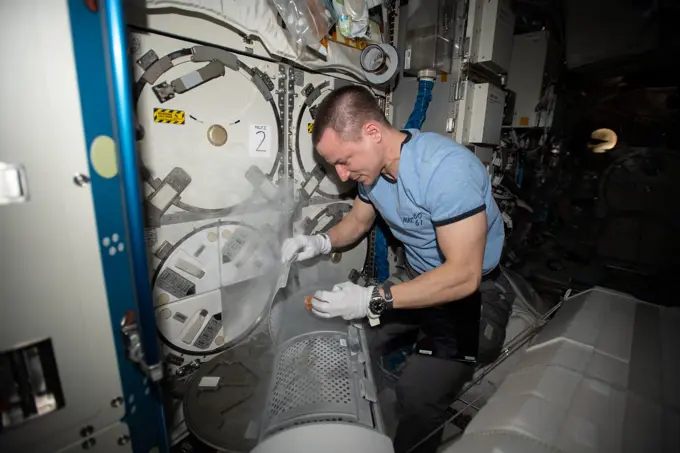
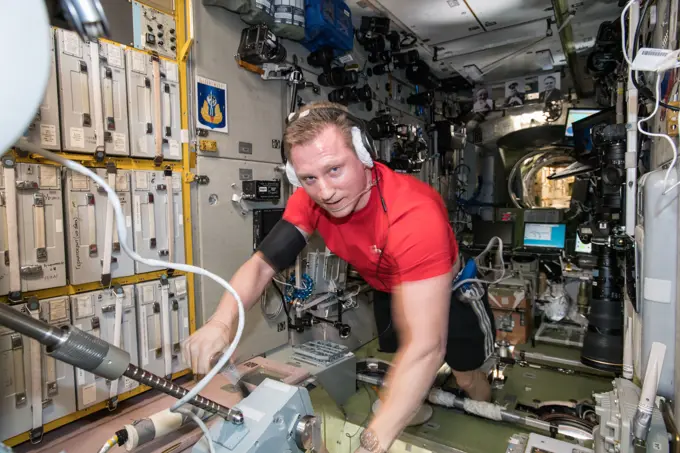
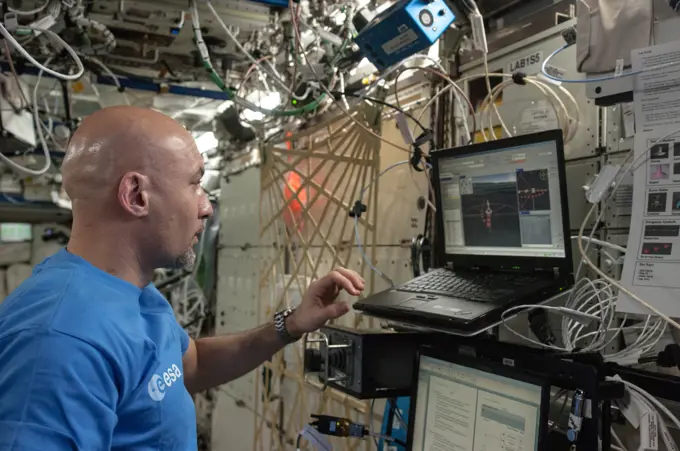
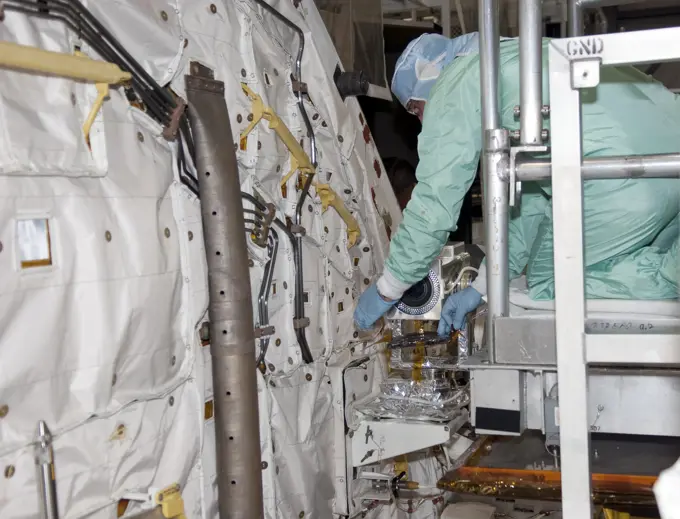
ISS005-E-17040 (10 October 2002) --- Astronauts Peggy A. Whitson (background), Expedition Five flight engineer, and Sandra H. Magnus, STS-112 mission specialist, work the controls of the Canadarm2 from inside the Destiny laboratory on the International Space Station (ISS).  Whitson and Magnus used the station’s robotic arm to lift the Starboard One (S1) Truss out of the Atlantis’ payload bay and move it into position on the starboard end of the S0 (S-Zero) Truss.ISS045E089495 (11/04/2015) --- NASA astronaut Kjell Lindgren uses a HAM radio to speak with operators down on Earth. The International Space Station is equipped with amateur radio equipment allowing astronauts to share the excitement of space exploration, inspire and ignite interest among students and others on the ground.ISS011-E-13361 (20 September 2005) --- Astronaut John L. Phillips, Expedition 11 NASA science officer and flight engineer, performs a Remote Power Control Module (RPCM) remove and replacement in the Unity node of the international space station.ISS012-E-12641 (16 Dec. 2005) --- Astronaut William S. (Bill) McArthur Jr., Expedition 12 commander and NASA space station science officer, stows the Space Linear Acceleration Mass Measurement Device (SLAMMD) hardware after conducting test operations. SLAMMD hardware was stowed in a stowage drawer on the Human Research Facility (HRF) rack in the Destiny laboratory of the International Space Station.ISS046e005678 (01/04/2016) ---- ESA (European Space Agency) astronaut Tim Peake works on the Advanced Colloids Experiment 2 (ACE H2) Hardware Configuration and Mix Part 1. Peake sent out a Twitter message with this image: Stirring samples using a bar magnet to turn a tiny metal rod - preparing for today's @ISS_Research. #Principia".iss056e033076 (June 25, 2018) --- Astronaut Alexander Gerst of ESA (European Space Agency) works on life support maintenance inside the International Space Station's Destiny laboratory module. Gerst was removing and replacing valves inside the Carbon Dioxide Removal Assembly.S133-E-008333 (3 March 2011) --- NASA astronaut Alvin Drew, STS-133 mission specialist, works on the middeck of space shuttle Discovery while docked with the International Space Station.ISS012-E-10792 (9 December 2005) --- Astronaut William S. (Bill) McArthur Jr., Expedition 12 commander and NASA space station science officer, prepares to remove the Avionics Air Assembly (AAA) from the Crew Health Care System (CHeCS) rack during in-flight maintenance (IFM) in the Destiny laboratory of the International Space Station.ISS023-E-042451 (10 May 2010) --- NASA astronaut T.J. Creamer, Expedition 23 flight engineer, services the Advanced Plant Experiments on Orbit-Cambium (APEX-Cambium) experiment in the Destiny laboratory of the International Space Station.ISS032-E-024283 (26 Aug. 2012) --- Japan Aerospace Exploration Agency astronaut Aki Hoshide, Expedition 32 flight engineer, uses the Space Linear Acceleration Mass Measurement Device (SLAMMD) in the Columbus laboratory of the International Space Station.iss062e105756 (March 23, 2020) --- NASA astronaut and Expedition 62 Flight Engineer Andrew Morgan retrieves gut microbe samples from a science freezer for the Rhodium Space Microbiome experiment to understand how microgravity enriches or depletes the microbes that affect astronaut health.ISS003-E-5200 (19 August 2001) --- Cosmonaut Mikhail Tyurin (left), Expedition Three flight engineer representing Rosaviakosmos, and astronaut James S. Voss, Expedition Two flight engineer, perform maintenance in the Zvezda Service Module on the International Space Station (ISS). This image was taken with a digital still camera.ISS028-E-047468 (12 Sept. 2011) --- NASA astronaut Ron Garan, Expedition 28 flight engineer, works behind the Microgravity Science Glovebox (MSG) rack located in the Destiny laboratory of the International Space Station.ISS030-E-021042 (5 Jan. 2012) --- Russian cosmonaut Anton Shkaplerov, Expedition 30 flight engineer, wears a communication system headset while working with a video display unit in the Zvezda Service Module of the International Space Station.ISS020-E-020303 (14 July 2009) --- Japan Aerospace Exploration Agency (JAXA) astronaut Koichi Wakata, Expedition 20 flight engineer, works with the Investigating the Structure of Paramagnetic Aggregates from Colloidal Emulsions (InSPACE) experiment in the Microgravity Science Glovebox (MSG) in the Columbus laboratory of the International Space Station.S119-E-006432 (17 March 2009) --- Japan Aerospace Exploration Agency (JAXA) astronaut Koichi Wakata (foreground), STS-119 mission specialist; NASA astronauts Lee Archambault, commander; Steve Swanson and Joseph Acaba, both mission specialists, enter the Harmony node shortly after Space Shuttle Discovery and the International Space Station docked in space and the hatches were opened on March 17, 2009. STS-119 crewmembers not pictured are astronauts Tony Antonelli, pilot; Richard Arnold and John Phillips, both mission specialists.iss053e047057 (Sept. 26, 2017) --- Flight Engineer Joe Acaba installs botany gear for the Veggie facility to demonstrate plant growth in space for the Veg-03 experiment. The botany study uses the Veggie plant growth facility to cultivate cabbage, lettuce and mizuna, which are harvested on-orbit with samples returned to Earth for testing.iss056e098196 (July 23, 2018) --- Expedition 56 Flight Engineer Sergey Prokopyev, from Roscosmos, works with Plasma Kristall-4 (PK-4) science hardware inside the International Space Station's Columbus laboratory module from ESA (European Space Agency). The space physics study is investigating complex plasmas consisting of low temperature gaseous mixtures composed of ionized gas, neutral gas, and micron-sized particles. The results could benefit future spacecraft design and impact industries on Earth.ISS022-E-020895 (11 Jan. 2010) --- Japan Aerospace Exploration Agency (JAXA) astronaut Soichi Noguchi, Expedition 22 flight engineer, works with Fluid Physics Experiment Facility/Marangoni Surface (FPEF MS) Core hardware in the Kibo laboratory of the International Space Station. The Marangoni convection experiment in the FPEF examines fluid tension flow in micro-G.ISS030-E-173931 (24 March 2012) --- European Space Agency astronaut Andre Kuipers, Expedition 30 flight engineer, closes a hatch in the International Space Station as crew members prepare to move to the appropriate Soyuz vehicles, due to the possibility that space debris could pass close to the station. Burbank, Shkaplerov and Ivanishin sheltered in the Soyuz TMA-22 spacecraft attached to the Poisk Mini-Research Module 2 (MRM2) while Kononenko, Kuipers and Pettit took to the Soyuz TMA-03M docked to the Rassvet Mini-Research Module 1 (MRM-1).ISS024-E-012647 (27 Aug. 2010) --- Russian cosmonaut Fyodor Yurchikhin, Expedition 24 flight engineer, works in the Poisk Mini-Research Module 2 (MRM2) of the International Space Station.ISS021-E-006219 (14 Oct. 2009) --- European Space Agency astronaut Frank De Winne, Expedition 21 commander, works with Materials Science Laboratory (MSL) hardware in the Destiny laboratory of the International Space Station.ISS006-E-07275 (16 December 2002) ---  Astronaut Kenneth D. Bowersox,          Expedition Six mission commander, works with an experiment in a portable glovebox facility called the Maintenance Work Area (MWA) in the Destiny laboratory on the International Space Station (ISS).iss061e013309 (Oct. 24, 2019) --- NASA astronaut Jessica Meir of Expedition 61 works on components of the Combustion Integrated Rack aboard the International Space Station's U.S. Destiny laboratory module.ISS031-E-140314 (18 May 2012) --- European Space Agency astronaut Andre Kuipers, Expedition 31 flight engineer, supports a ground-conducted health check on ESAs Biolab Glovebox in the Columbus laboratory of the International Space Station.S133-E-007740 (1 March 2011) --- NASA astronauts Eric Boe, STS-133 pilot; and Cady Coleman, Expedition 26 flight engineer, work controls at a robotic workstation in the Destiny laboratory of the International Space Station while space shuttle Discovery remains docked with the station.S125-E-013042 (21 May 2009) --- Occupying the commanders station, astronaut Gregory C. Johnson, STS-125 pilot, uses the Portable In-Flight Landing Operations Trainer (PILOT) on the flight deck of the Earth-orbiting Space Shuttle Atlantis. PILOT consists of a laptop computer and a joystick system, which helps to maintain a high level of proficiency for the end-of-mission approach and landing tasks required to bring the shuttle safely back to Earth. Astronaut Scott Altman, commander, looks on.iss057e074546 (Nov. 9, 2018) --- Russian cosmonaut and Expedition 57 Flight Engineer Sergey Prokopyev exercises inside the Zvezda Service Module, part of the International Space Station's Russian segment.. iss068e033456 (Dec. 27, 2022) - Expedition 68 Flight Engineer and NASA astronaut Josh Cassada is pictured cleaning hardware inside the International Space Station's Destiny laboratory module.ISS021-E-032003 (22 Nov. 2009) --- Canadian Space Agency astronaut Robert Thirsk, Expedition 21 flight engineer, removes a dewar tray from the Minus Eighty Laboratory Freezer for ISS (MELFI) in the Destiny laboratory of the International Space Station while space shuttle Atlantis (STS-129) remains docked with the station.S128-E-007122 (31 Aug. 2009) --- NASA astronaut Rick Sturckow (right), STS-128 commander, and Canadian Space Agency astronaut Robert Thirsk, Expedition 20 flight engineer, look over a checklist in the Quest airlock of the International Space Station while Space Shuttle Discovery remains docked with the station.ISS015-E-31816 (4 Oct. 2007) --- Cosmonaut Oleg V. Kotov, Expedition 15 flight engineer representing Russia's Federal Space Agency, uses a computer while working on a respiration experiment in the Zvezda Service Module of the International Space Station.ISS032-E-016881 (10 Aug. 2012) --- NASA astronauts Sunita Williams and Joe Acaba, both Expedition 32 flight engineers, work in the Destiny laboratory of the International Space Station.ISS017-E-012864 (12 Aug. 2008) --- NASA astronaut Greg Chamitoff, Expedition 17 flight engineer, performs in-flight maintenance on the Treadmill Vibration Isolation System (TVIS) in the Zvezda Service Module of the International Space Station.iss064e039273 (March 2, 2021) --- NASA astronaut and Expedition 64 Flight Engineer Michael Hopkins loads protein crystallography plates with protein solutions for the Phase II Real-time Protein Crystal Growth experiment, a space commercialization study, that could benefit the pharmaceutical and biotechnology industries.iss059e021373 (Aprill 16, 2019) --- Expedition 59 Flight Engineers David Saint-Jacques and Anne McClain use the robotics workstation inside the U.S. Destiny laboratory module to practice Canadarm2 robotics maneuvers and Cygnus spacecraft capture techniques.ISS036-E-025012 (26 July 2013) --- From the International Space Stations Destiny laboratory, European Space Agency astronaut Luca Parmitano, Expedition 36 flight engineer, uses a computer as he partners with Ames Research Center to remotely control a surface rover in California. The experiment, called Surface Telerobotics, will help scientists plan future missions where a robotic rover could prepare a site on a moon or a planet for a crew.ISS028-E-026400 (17 Aug. 2011) --- NASA astronaut Ron Garan, Expedition 28 flight engineer, works with the Combustion Integrated Rack (CIR) Fluids and Combustion Facility (FCF) in the Destiny laboratory of the International Space Station.ISS027-E-017249 (23 April 2011) --- European Space Agency astronaut Paolo Nespoli, Expedition 27 flight engineer, works with Anomalous Long Term Effects on Astronauts (ALTEA) Shield isotropic equipment in the Destiny laboratory of the International Space Station. ALTEA-Shield isotropic dosimetry uses existing ALTEA hardware to survey the radiation environment in the Destiny laboratory in 3D. It also measures the effectiveness and shielding properties of several materials with respect to the perception of anomalous light flashes.CAPE CANAVERAL, Fla. - Inside Orbiter Processing Facility-1 at Kennedy Space Center in Florida, a technician dressed in a clean room suit, installs a camera in the forward mid-body of shuttle Atlantis. Atlantis is being processed for the STS-132 mission targeted for launch May 14. The six-member crew will deliver an Integrated Cargo Carrier and a Russian-built Mini Research Module to the International Space Station.Date: 11-28-12Location: Bldg 9NW, ISS MockupsSubject:  Expedition 36 crew (Cassidy, Vinogradov, Misurkin) during Routine Ops AC 2 training in ISS mockupsISS036-E-029877 (9 Aug. 2013) --- NASA astronaut Chris Cassidy, Expedition 36 flight engineer, is pictured at the robotic workstation in the Cupola of the International Space Station during rendezvous operations with the approaching unpiloted Japanese "Kounotori" H2 Transfer Vehicle-4 (HTV-4).S119-E-005027 (15 March 2009) --- Astronaut Joseph Acaba, STS-119 mission specialist, works the controls of Space Shuttle Discoverys remote manipulator system (RMS) robotic arm on the aft flight deck during flight day one activities.ISS040-E-031397 (2 July 2014) --- NASA astronaut Reid Wiseman, Expedition 40 flight engineer, works with a combustion experiment known as the Burning and Suppression of Solids (BASS) in the Microgravity Science Glovebox (MSG) in the Destiny laboratory of the International Space Station. The experiment seeks to provide insight on how flames burn in space compared to Earth which may provide fire safety benefits aboard future spacecraft.ISS034-E-035764 (28 Jan. 2013) --- In the International Space Stations Poisk Mini-Research Module 2 (MRM2), Russian cosmonaut Roman Romanenko, Expedition 34 flight engineer, works with the Coulomb Crystal experiment, which gathers data about charged particles in a weightless environment.ISS044E007995 (07/05/2015) ---NASA astronaut Scott Kelly in the Unity (Node 1) module enjoying some fresh fruit and vegetables brought up to the International Space Station by the recent Russian Progress 60 spacecraft.ISS013-E-67495 (19 Aug. 2006) --- European Space Agency (ESA) astronaut Thomas Reiter, Expedition 13 flight engineer, wears a communication system while using a computer in the Zvezda Service Module of the International Space Station.Date: 08-23-13Location: Bldg 9NW, ISS Airlock MockupSubject: Expedition 38 crew members Rick Mastracchio and Koichi Wakata during INC-38 ISS EVA Prep & Post #2 training in the ISS Airlock mockup with instructors Megan Murphey, Michael Dino and Tamara York. In addition, non-assigned astronaut Jeanette Epps is participatingISS019-E-009840 (23 April 2009) --- Astronaut Michael Barratt, Expedition 19/20 flight engineer, performs in-flight maintenance on the Treadmill Vibration Isolation System (TVIS) in the Zvezda Service Module of the International Space Station.ISS040-E-000298 (16 May 2014) --- NASA astronaut Steve Swanson, Expedition 40 commander, works with the General Laboratory Active Cryogenic ISS Experiment Refrigerator (GLACIER) in the Destiny laboratory of the International Space Station.S128-E-006287 (29 Aug. 2009) --- Astronaut John Danny” Olivas, STS-128 mission specialist, works on the middeck of Space Shuttle Discovery during flight day two activities.ISS036-E-024880 (29 July 2013) --- Russian cosmonaut Pavel Vinogradov, Expedition 36 commander, reads a procedures checklist in the Zvezda Service Module of the International Space Station.ISS006-E-13995 (2 January 2003) --- Astronaut Donald R. Pettit, Expedition Six NASA ISS science officer, performs the Human Research Facility (HRF) Ultrasound functional checkout in the Destiny laboratory on the International Space Station (ISS).. iss068e076275 (March 24, 2021) - NASA astronaut and Expedition 68 Flight Engineer Woody Hoburg works in a glove bag attached to the BioFabrication Facility (BFF). Hoburg installed a tissue cassette in the BFF to evaluate using bio-inks and cells for a study exploring printing knee cartilage tissue to treat injuries in space and in remote environments on Earth.ISS040-E-088800 (5 Aug. 2014) --- European Space Agency astronaut Alexander Gerst, Expedition 40 flight engineer, removes hardware for the combustion experiment known as the Burning and Suppression of Solids (BASS-II) from the Microgravity Science Glovebox (MSG) in the Destiny laboratory of the International Space Station. The experiment seeks to provide insight on how flames burn in space compared to Earth which may provide fire safety benefits aboard future spacecraft. NASA astronaut Reid Wiseman, flight engineer, looks on.iss040e123621 (9/4/2014) --- Photographic documentation of final installation of MAGVECTOR hardware in the Columbus module aboard the International Space Station (ISS). MAGVECTOR qualitatively investigates the interaction between a moving magnetic field and an electrical conductor. The set up will provide initial insights regarding the principal feasibility on board the ISS,future improvements and phenomenological trends and dependencies. The expected changes in the magnetic field structure on the Ram and Wake side of the electrical conductor are of interest for technical applications as well as for astrophysical research.. iss068e043103 (Jan. 12, 2023) - NASA astronaut and Expedition 68 Flight Engineer Josh Cassada tends to thale cress plants growing for the Plant Habitat-03 space botany study that explores how plants genetically adapt to microgravity. Cassada removed the plants from the Advanced Plant Habitat located in the Kibo laboratory module and conducted the research activities in the Harmony module's maintenance work area.STS095-E-5226 (4 Nov. 1998) --- Astronaut Pedro Duque, STS-95 mission specialist representing the European Space Agency (ESA), talks with ground controllers while checking on an experiment in the Spacehab facility aboard the Space Shuttle Discovery. The picture was taken with an electronic still camera (ESC) at 03:01:28 GMT, Nov. 4.ISS013-E-10231 (26 April 2006) --- Astronaut Jeffrey N. Williams (foreground), Expedition 13 NASA space station science officer and flight engineer, and cosmonaut Pavel V. Vinogradov, commander representing Russia's Federal Space Agency, monitor data in the Zvezda Service Module as Progress 21 supply vehicle approaches the International Space Station.ISS014-E-12565 (24 Jan. 2007) --- Cosmonaut Mikhail Tyurin, Expedition 14 flight engineer representing Russia's Federal Space Agency, works with an Extravehicular Mobility Unit (EMU) spacesuit in the Quest Airlock of the International Space Station.S122-E-008626 (14 Feb. 2008) --- Astronaut Steve Frick, STS-122 commander, works in the Harmony module of the International Space Station while Space Shuttle Atlantis is docked with the station.ISS047e048133 (04/01/2016) --- NASA astronaut Tim Kopra prepares a U.S. Extravehicular Mobility Unit (EMU) spacesuit for cooling loop maintenance. Spacesuits on-board the International Space Station get routine maintenance between spacewalks.ISS020-E-020259 (8 July 2009) --- NASA astronaut Michael Barratt, Expedition 20 flight engineer, works at a rotated rack in the Destiny laboratory of the International Space Station during in-flight maintenance (IFM) to adjust the periodic flow rate of manual flow control valves for coolant loops.ISS038-E-032828 (14 Jan. 2014) --- Russian cosmonaut Oleg Kotov, Expedition 38 commander, looks at a computer monitor in the Zvezda Service Module of the International Space Station.JSC2011-E-215226 (5 Dec. 2011) --- Canadian Space Agency astronaut Chris Hadfield, Expedition 34 flight engineer and Expedition 35 commander, participates in an emergency scenario training session in an International Space Station mock-up/trainer in the Space Vehicle Mock-up Facility at NASA's Johnson Space Center.ISS040-E-026307 (1 July 2014) --- NASA astronaut Steve Swanson, Expedition 40 commander, performs in-flight maintenance behind a rack in the Tranquility node of the International Space Station.ISS040-E-091966 (13 Aug. 2014) --- European Space Agency astronaut Alexander Gerst, Expedition 40 flight engineer, is pictured in the newly-attached "Georges Lemaitre" Automated Transfer Vehicle-5 (ATV-5) of the International Space Station.iss056e142871_alt (8/13/2018) - Astronaut Ricky Arnold prepares samples for the Barrios Protein Crystal Growth (Barrios PCG) experiment in the Maintenance Work Area (MWA) of the International Space Station (ISS). The Barrios PCG experiment defined an approach for optimizing protein crystallization conditions on orbit, eliminating the need to return samples to the ground during the optimization phase, which has the potential for saving substantial time and money on future PCG investigations in microgravity.ISS006-E-41733 (1 April 2003) --- Astronaut Donald R. Pettit, Expedition Six NASA ISS science officer, works with the InSpace (Investigating the Structure of Paramagnetic Aggregates from Colloidal Emulsions) experiment in the Microgravity Science Glovebox (MSG) in the Destiny laboratory on the International Space Station (ISS).iss056e005017 (6/5/2018) --- The International Commercial Experiment Cubes (ICE Cubes) Facility located in the Columbus European Physiology Module (EPM) rack is a capable experiment platform that offers flexibility to host many different experiments for research, technology demonstration or educational objectives.ISS013-E-69249 (21 Aug. 2006) --- Astronaut Jeffrey N. Williams, Expedition 13 NASA space station science officer and flight engineer, works with the dust and aerosol measurement feasibility test (DAFT) in the Destiny laboratory of the International Space Station.ISS039-E-014665 (23 April 2014) --- Cosmonaut Artemyev, Expedition 39 flight engineer representing Russia's Federal Space Agency (Roscosmos) replaces the telemetry storage unit in a Russian experiment inside the Zvezda service module of the International Space Station.090 iss tvis repair 249ISS020-E-037855 (2 Sept. 2009) --- NASA astronaut Michael Barratt, Expedition 20 flight engineer, works inside a newly installed crew quarters compartment in the Kibo laboratory of the International Space Station while Space Shuttle Discovery (STS-128) remains docked with the station.ISS040-E-070859 (22 July 2014) --- Russian cosmonaut Alexander Skvortsov, Expedition 40 flight engineer, practices manual docking techniques with the TORU, or telerobotically operated rendezvous system, in the Zvezda Service Module of the International Space Station in preparation for the docking of the Progress 56 spacecraft. Skvortsov, using the Simvol-TS screen and hand controllers, could manually dock the Progress to the station in the event of a failure of the Kurs automated docking system. The Progress 56 craft is scheduled to complete its automated docking to the Pirs docking compartment at 11:30 p.m. (EDT) on July 23, 2014.ISS031-E-157783 (15 May 2012) --- European Space Agency astronaut Andre Kuipers, Expedition 31 flight engineer, collects a water sample from the Potable Water Dispenser (PWD) in the Destiny laboratory of the International Space Station.ISS040-E-099850 (18 Aug. 2014) --- NASA astronaut Reid Wiseman, Expedition 40 crew member, performs routine in-flight maintenance in the Tranquility node of the International Space Station.STS062-10-010 (4-18 March 1994) --- Astronaut John H. Casper, mission commander, takes stock of paraphenalia used to support medical testing onboard Columbia's middeck. Casper was poind by four other veteran astronauts for 14 days of variegated research in earth orbit.Expedition 27 crew payload training on DECLIC with instructor Wayne Wright and Astronaut Ron Garan.  Photo Date: July 14, 2010.  Location: Building 5, RBUA/Rm. 1120B.ISS040-E-007682 (5 June 2014) --- NASA astronaut Reid Wiseman, Expedition 40 flight engineer, uses a computer while working with an Extravehicular Mobility Unit (EMU) spacesuit in the Quest airlock of the International Space Station.ISS007-E-10457 (14 July 2003) --- Astronaut Edward T. Lu, Expedition 7 NASA ISS science officer and flight engineer, works in the Destiny laboratory on the International Space Station (ISS).iss050e020100 (12/28/2016) --- European Space Agency (ESA) astonaut Thomas Pesquet preparing to take Crew Earth Observations (CEO) photos from the Service Module (SM) window. Cosmonaut Oleg Novitskiy is visible in the background. CEO imagery provides researchers on Earth with key data to understand the planet from the perspective of the ISS. Crew members have been photographing Earth from space since the early Mercury missions beginning in 1961. The images taken from the ISS ensure this record remains unbroken.S127-E-011291 (28 July 2009) --- Astronauts Tom Marshburn (left) and Christopher Cassidy, both STS-127 mission specialists, look through an overhead window on the aft flight deck of Space Shuttle Endeavour during flight day 14 activities. Cassidy is holding a handheld laser ranging device -- designed to measure the range between two spacecraft.ISS036-E-015521 (5 July 2013) --- NASA astronaut Karen Nyberg, Expedition 36 flight engineer, services the Combustion Integrated Rack (CIR) Multi-user Droplet Combustion Apparatus (MDCA) in the International Space Station's Destiny laboratory.STS110-E-5067 (9 April 2002) --- Astronaut Michael J. Bloomfield, STS-110 mission commander, occupying the commander’s station, checks data on the cockpit displays on the forward flight deck of the Space Shuttle Atlantis. The image was taken with a digital still camera.ISS018-E-044134 (31 March 2009) --- Japan Aerospace Exploration Agency (JAXA) astronaut Koichi Wakata, Expedition 18/19 flight engineer, uses a computer at the Japanese Remote Manipulator System (JEM-RMS) work station in the Kibo laboratory of the International Space Station.. iss068e012479 (Oct. 5, 2022) --- NASA astronaut and Expedition 68 Flight Engineer Kjell Lindgren signs his name around the OFT-2 (Orbital Flight Test-2) mission insignia sticker affixed to the Harmony module's vestibule. Lindgren was aboard the International Space Station when Boeing's CST-100 Starliner spacecraft docked to Harmony's forward port on May 19, 2022, for a six-day uncrewed test mission.STS081-E-05126 (13 Jan. 1997) --- Astronaut Michael A. Baker, mission commander, uses a 35mm camera to photograph a target of opportunity on Earth from the Space Shuttle Atlantis' aft flight deck.  Baker and five crew mates will dock with Russia's Mir Space Station around the middle of the week.  This image was recorded with an Electronic Still Camera (ESC) and was later downlinked to flight controllers in Houston, Texas.  A second ESC, devoted to an educational, geographic project called Kidsat, is mounted in the viewing port above Baker's head.iss062e098371 (March 17, 2020) --- NASA astronaut and Expedition 62 Flight Engineer Andrew Morgan conducts cardiac research activities inside the portable glovebag. Morgan was servicing heart cell samples for the Multi-use Variable-g Platform-02 Cell-03 experiment. The investigation induces stem cells to generate heart precursor cells and cultures those cells on the space station to analyze and compare with cultures grown on Earth. Results may help treat spaceflight-induced cardiac abnormalities and accelerate development and reduce costs of drug therapies on Earth.KENNEDY SPACE CENTER, FLA. - STS-114 Mission Specialist Soichi Noguchi looks at tile on the underside of the orbiter Discovery.  Noguchi is with the Japanese Aerospace and Exploration Agency.   He and other crew members are at KSC becoming familiar with Shuttle and mission equipment. The mission is Logistics Flight 1, which is scheduled to deliver supplies and equipment plus the external stowage platform to the International Space Station.Date: 09-30-14Location: Bldg 9NW, ISS MockupSubject: Expedition 46/47 (Soyuz 45) crew members Tim Kopra, Timothy Peake, Yuri Malenchenko with instructor Wyatt Smith during Routine Ops training in the Space Vehicle Mockup Training Facility's ISS mockupsISS019-E-010120 (26 April 2009) --- Cosmonaut Gennady Padalka, Expedition 19/20 commander, exercises using the advanced Resistive Exercise Device (aRED) in the Unity node of the International Space Station.ISS026-E-018751 (18 Jan. 2011) --- NASA astronaut Catherine (Cady) Coleman, Expedition 26 flight engineer, performs a Capillary Flow Experiment (CFE) Interior Corner Flow 2 (ICF-2) test. The CFE is positioned on a Maintenance Work Area in the Destiny laboratory of the International Space Station. CFE observes the flow of fluid, in particular capillary phenomena, in microgravity.NASA astronaut and Expedition 66 Flight Engineer Kayla Barron refills water and cleans the Plant Habitat Facility that supports space botany research inside the International Space Station's Kibo laboratory module.ISS024-E-012296 (19 Aug. 2010) --- Russian cosmonaut Fyodor Yurchikhin, Expedition 24 flight engineer, works with High Definition Video (HDV) camera equipment in the Zvezda Service Module of the International Space Station.KARL ROTH IN THE LABORATORY TRAINING COMPLEX, A FACILITY USED TO SUPPORT TRAINING OF EXPERIMENT OPERATIONS ONBOARD THE INTERNATIONAL SPACE STATIONS130-E-006288 (9 Feb. 2010) --- Astronaut Stephen Robinson, STS-130 mission specialist, is pictured near the galley on the middeck of the Earth-orbiting space shuttle Endeavour during flight day two activities.iss057e074507 (Nov. 9, 2018) --- Flight Engineer Serena Auñón-Chancellor practices the maneuvers she will use to capture the U.S. Cygnus space freighter from Northrop Grumman with the Canadarm2 robotic arm when it arrives at the International Space Station on Monday Nov. 19, 2018.ISS027-E-017843 (28 April 2011) --- NASA astronaut Ron Garan, Expedition 27 flight engineer, supports the Dynamism of Auxin Efflux Facilitators responsible for Gravity-regulated Growth and Development in Cucumber (CsPINs) experiment in the Kibo laboratory of the International Space Station. CsPINs studies the phenomenon of tropism, i.e., the growth or turning movement of a biological organism, usually a plant, in response to an environmental stimulus. Specifically focusing on gravity, the new JAXA life science experiment investigates how plants sense gravity as an environmental signal and use it for governing their morphology and growth orientation.ISS040-E-091940 (13 Aug. 2014) --- Russian cosmonaut Alexander Skvortsov, Expedition 40 flight engineer, prepares to remove the docking mechanism to gain access to the hatch of the newly attached "Georges Lemaitre" Automated Transfer Vehicle-5 (ATV-5).