Buddhist Deities and Art

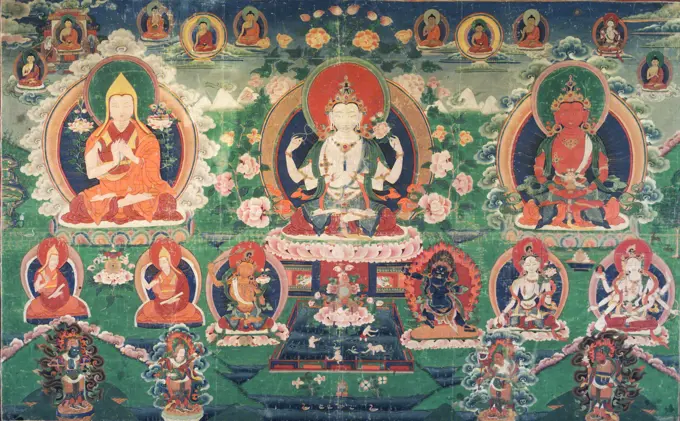
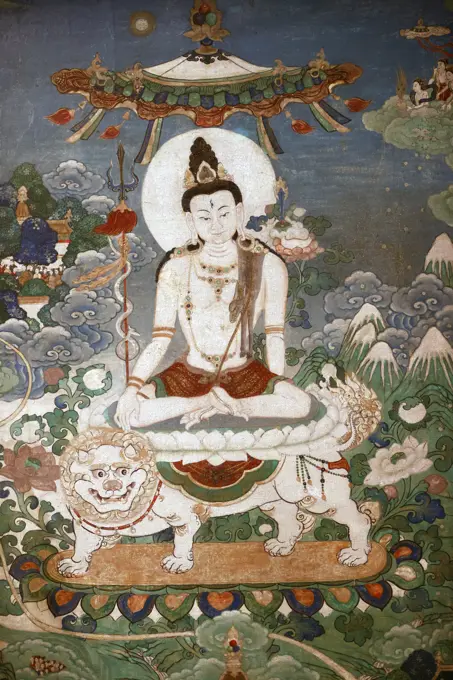
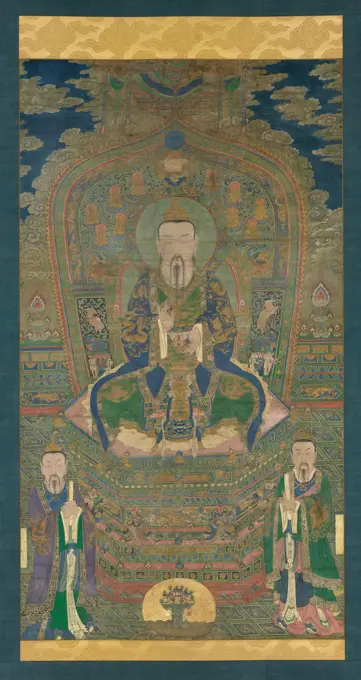
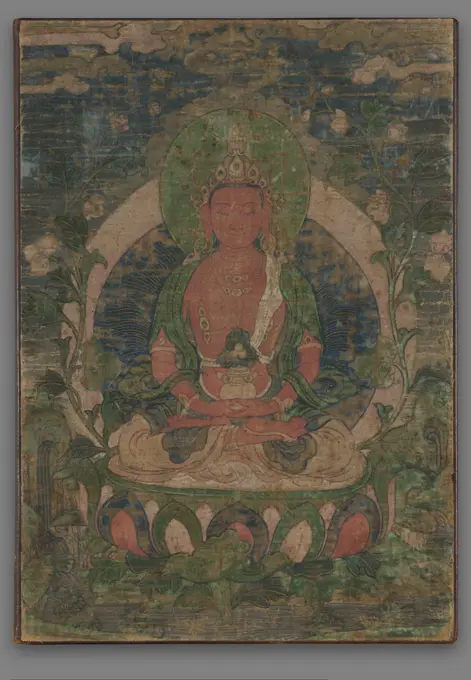
Richly colored religious paintings of Buddhist figures like Tara and Manjushri, showcasing intricate details and symbolism in Tibetan and Mongolian traditions.
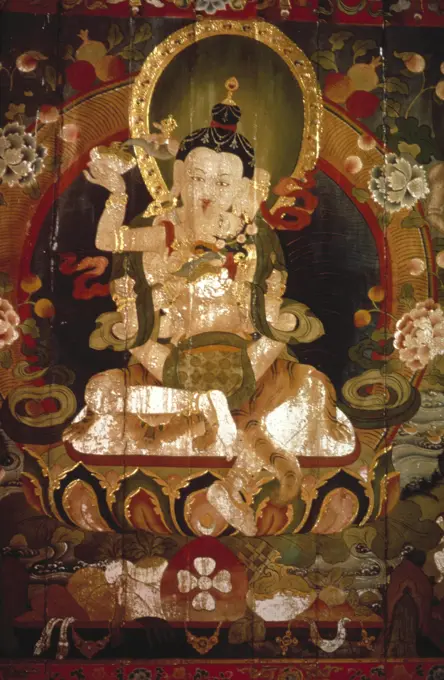
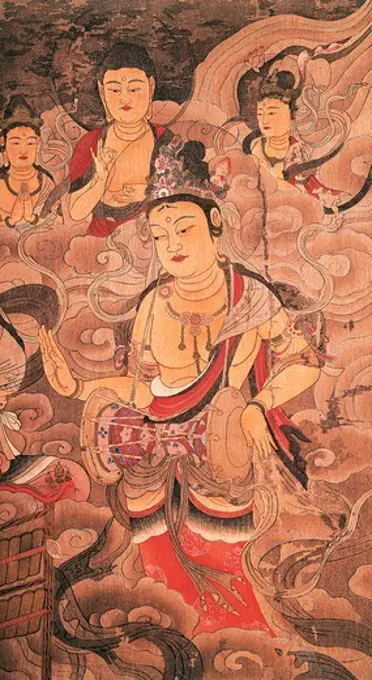
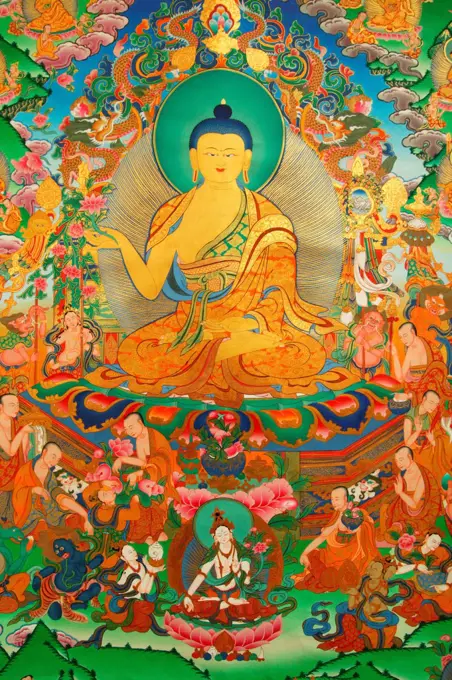
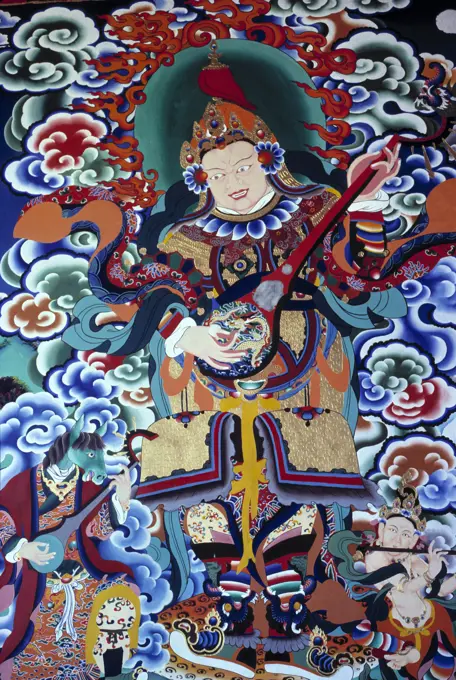
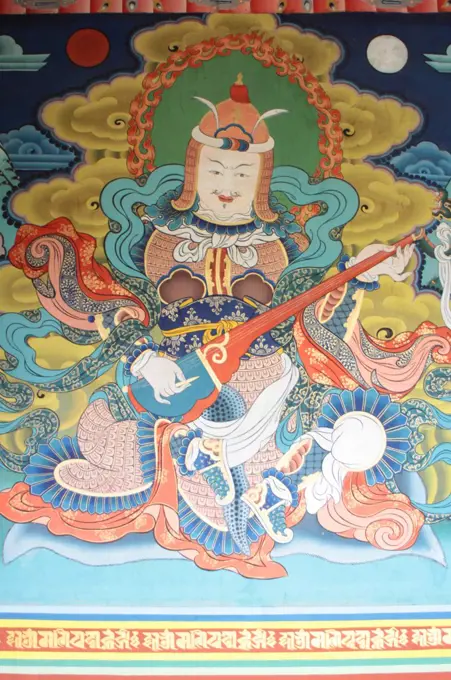
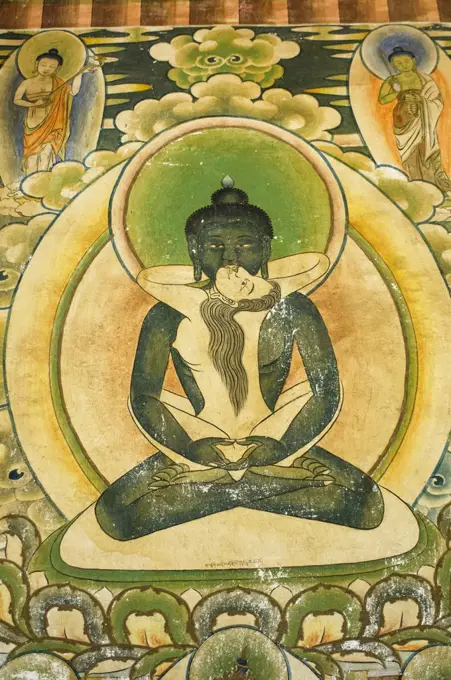
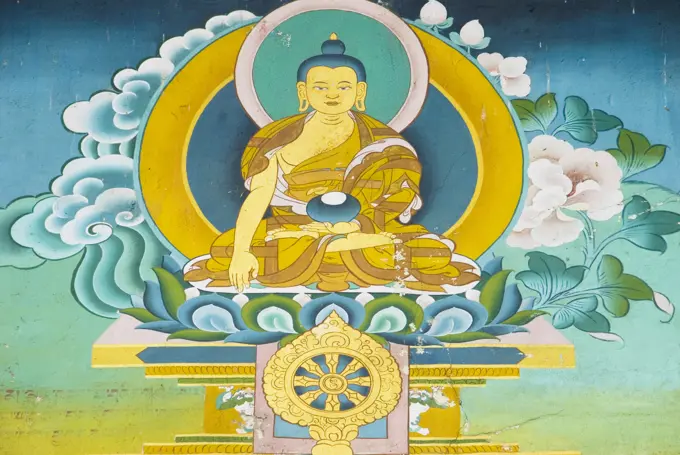
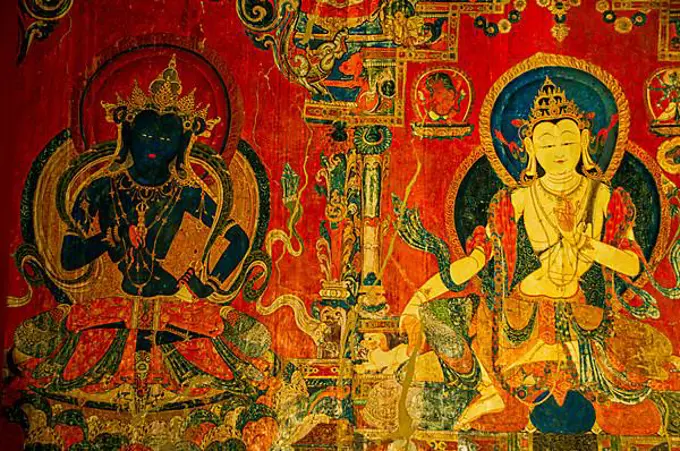
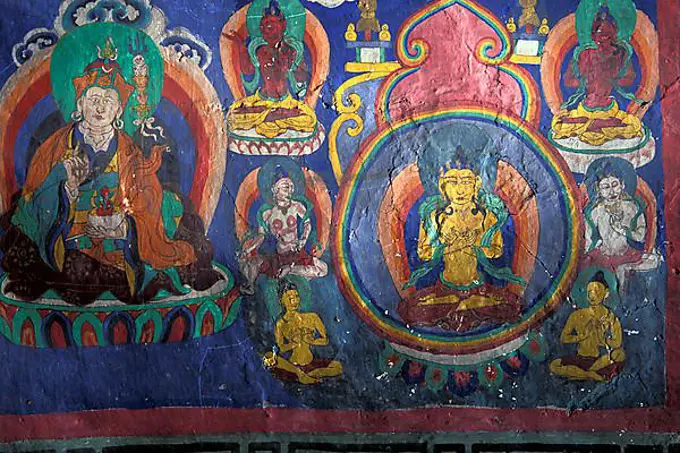
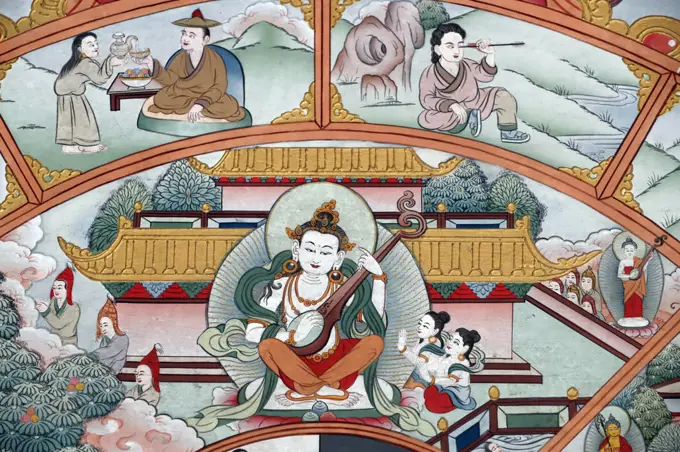
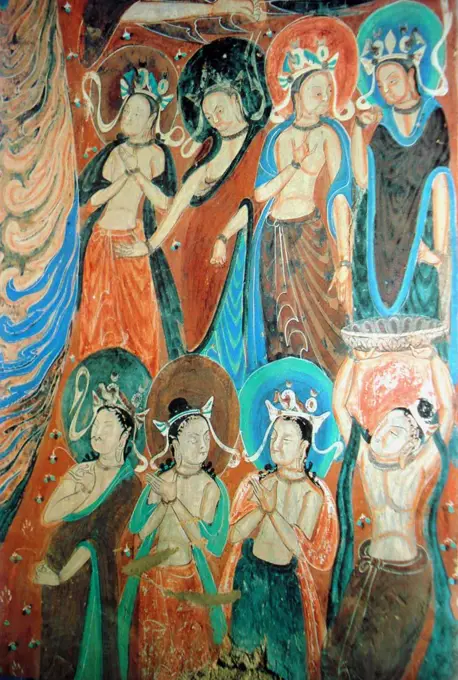
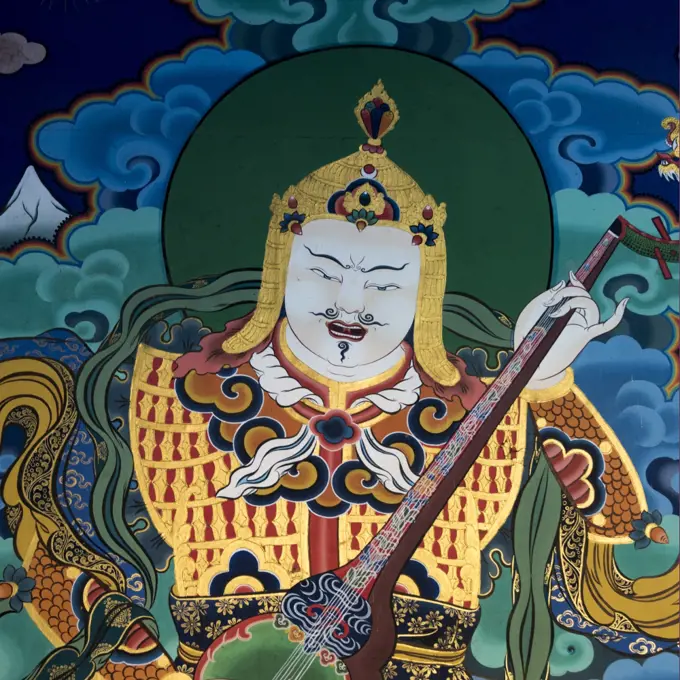
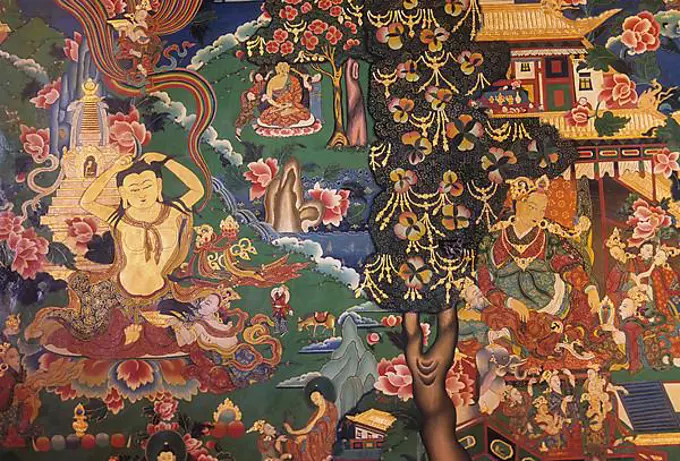
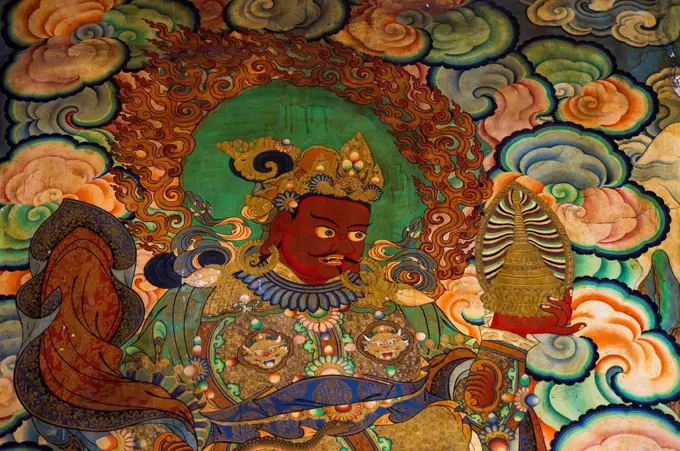
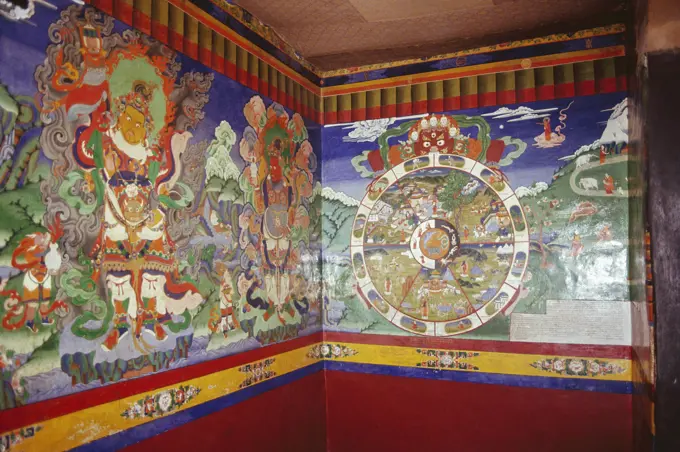
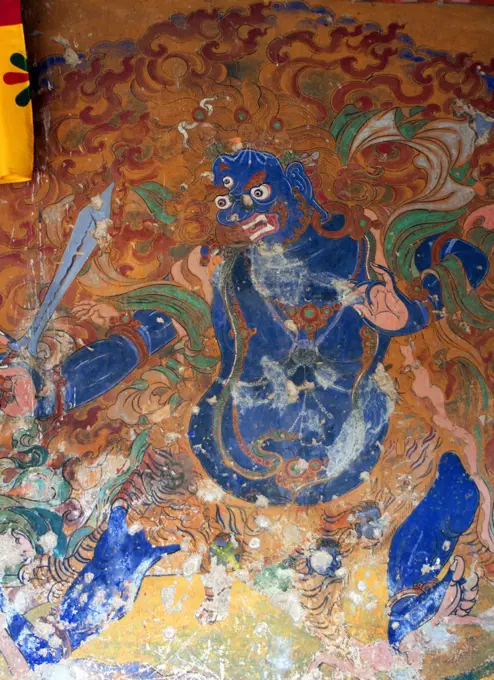
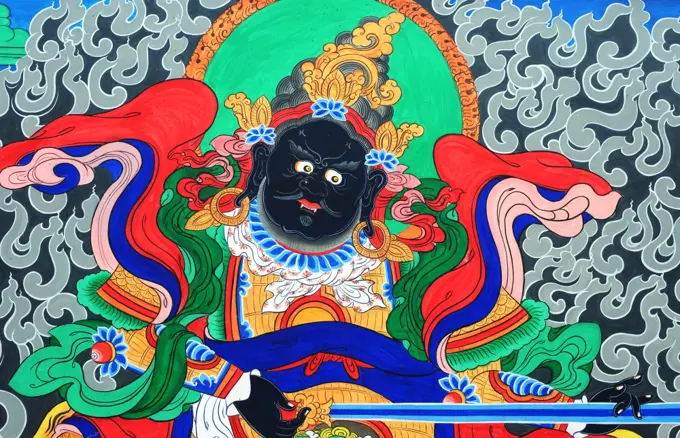
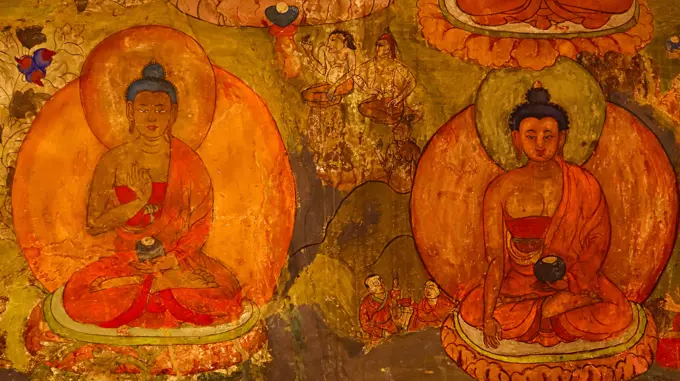
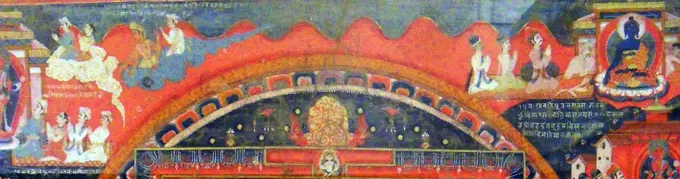
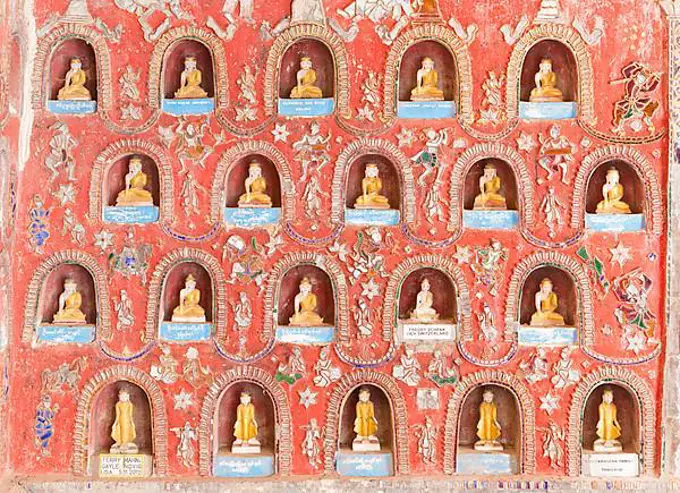
religious painting in monastery, pemyangtse, sikkim, Copyright: xAshaxAdatia/DinodiaxPhotox

Assets in this Story

1899-18792149
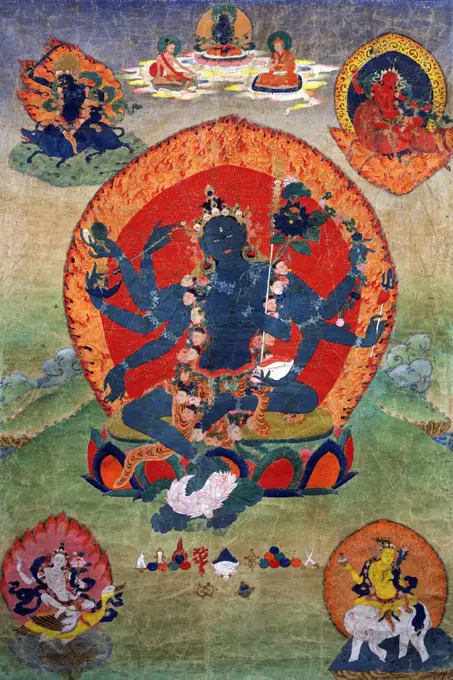
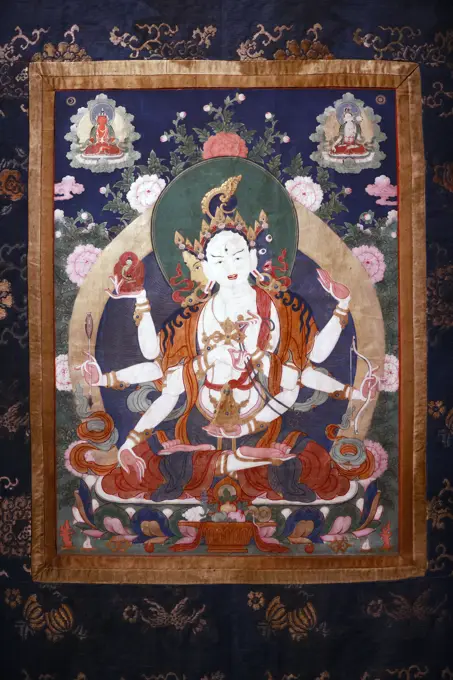
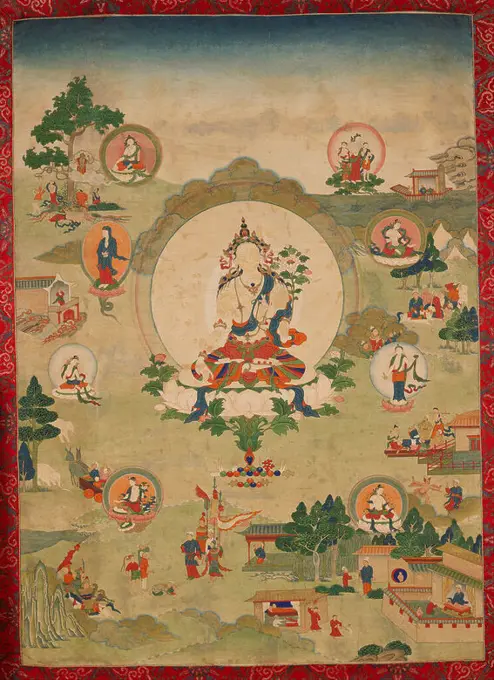
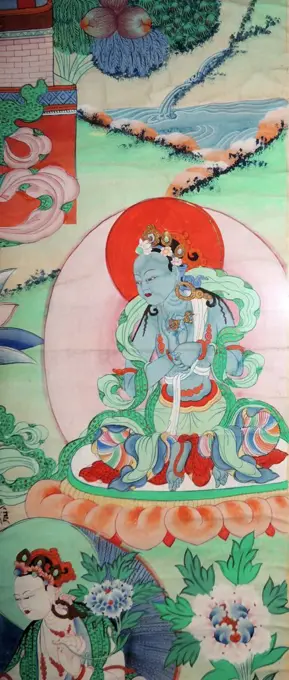
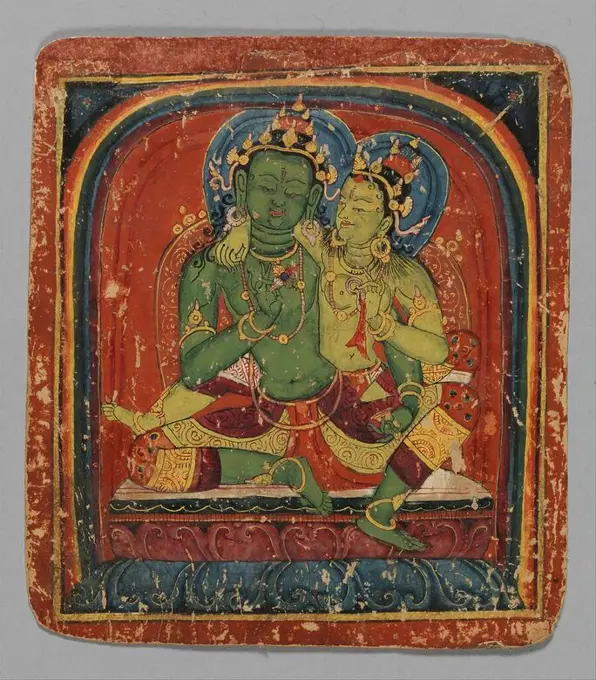
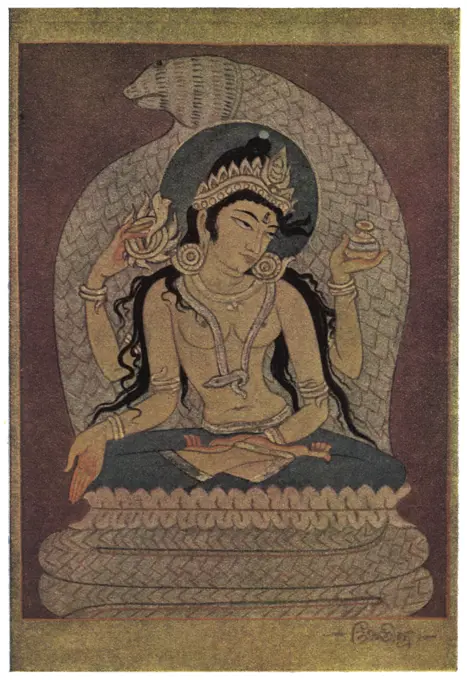
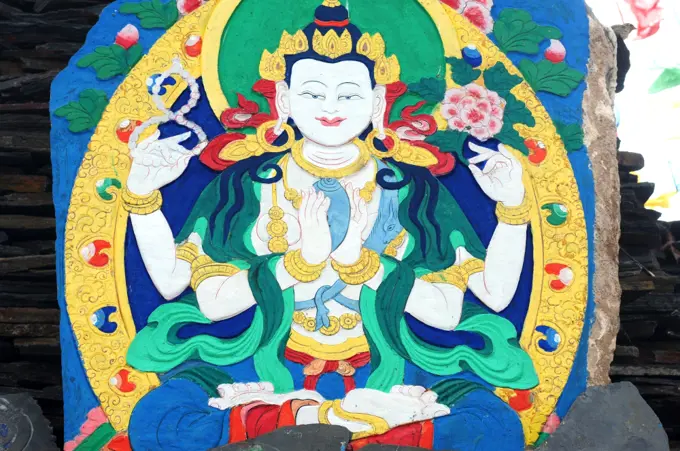
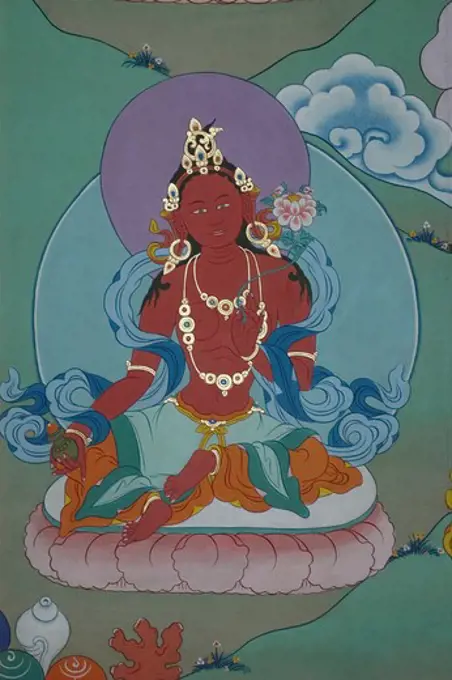
Tara (Sanskrit: ारा, tārā) or Ārya Tārā, also known as Jetsun Dolma (Tibetan: Rje btsun sgrol ma) in Tibetan Buddhism, is a female Bodhisattva in the Mahayana tradition who appears as a female Buddha in Vajrayana Buddhism. She is known as the 'mother of liberation', and represents the virtues of success in work and achievements. In Japan she is known as Tarani Bosatsu, and less well known as Tuoluo in Chinese Buddhism. Tara is a tantric meditation deity whose practice is used by practitioners of the Tibetan branch of Vajrayana Buddhism to develop certain inner qualities and understand outer, inner and secret teachings about compassion and emptiness. Tara is actually the generic name for a set of Buddhas or bodhisattvas of similar aspect. These may more properly be understood as different aspects of the same quality, as bodhisattvas are often considered metaphoric for Buddhist virtues.
4409-17573820
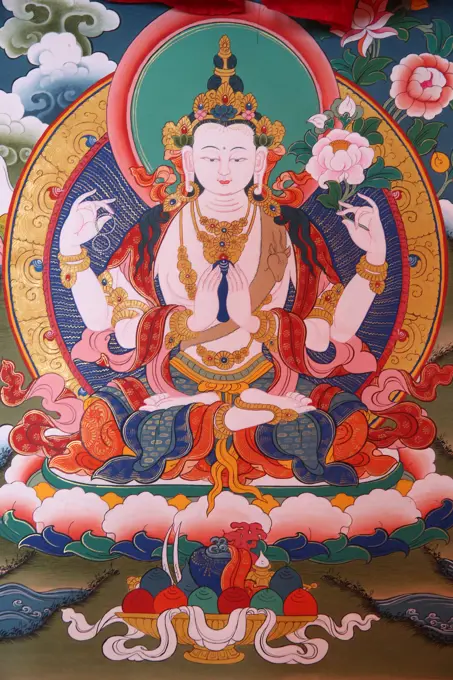
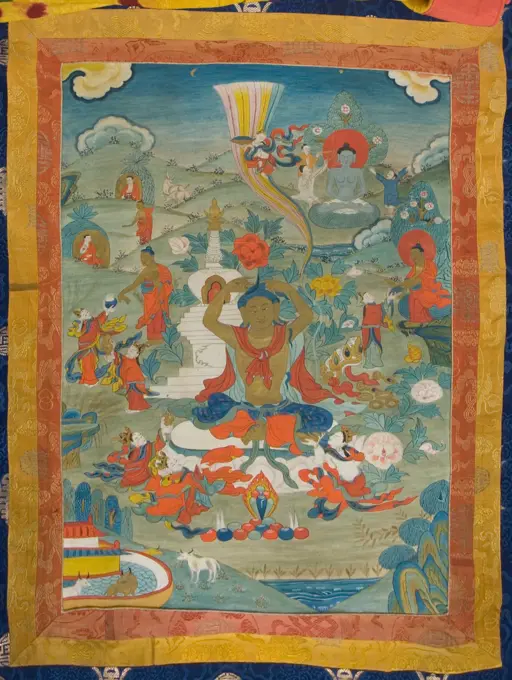
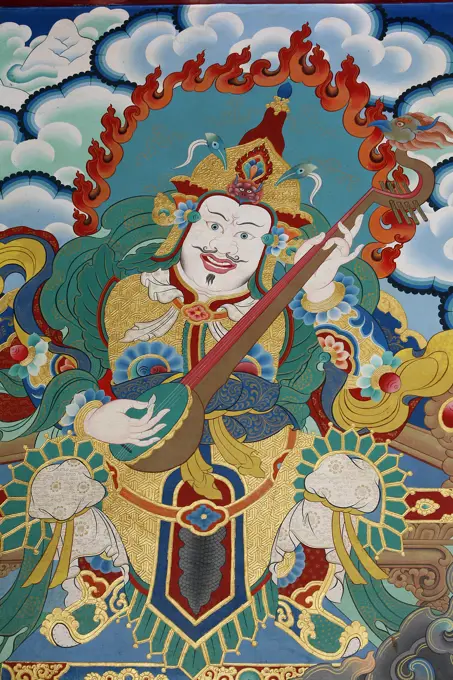
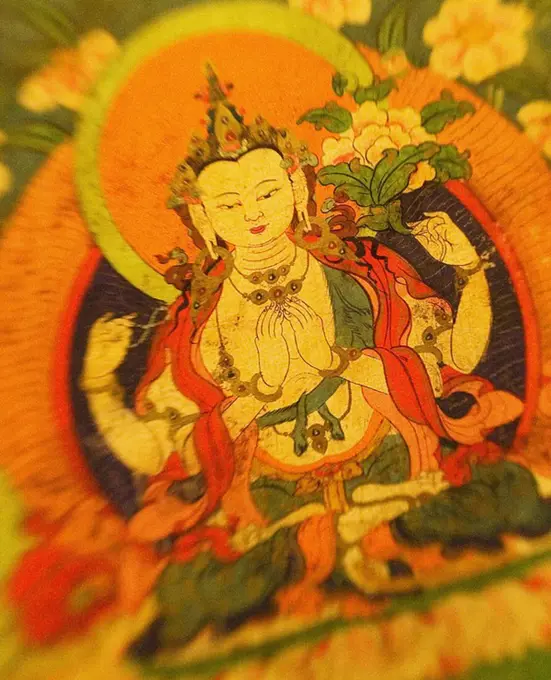
'Bodhisattva Manjushri'. Mongolia, 19th century. Dimensions: 60x38 cm. Museum: State Hermitage, St. Petersburg.
4409-17576791
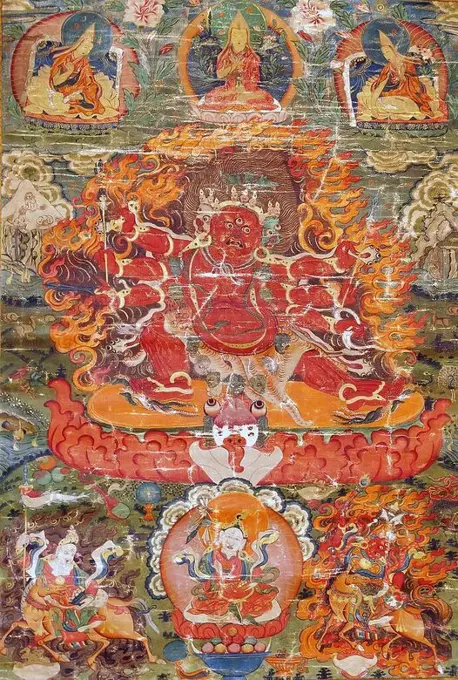
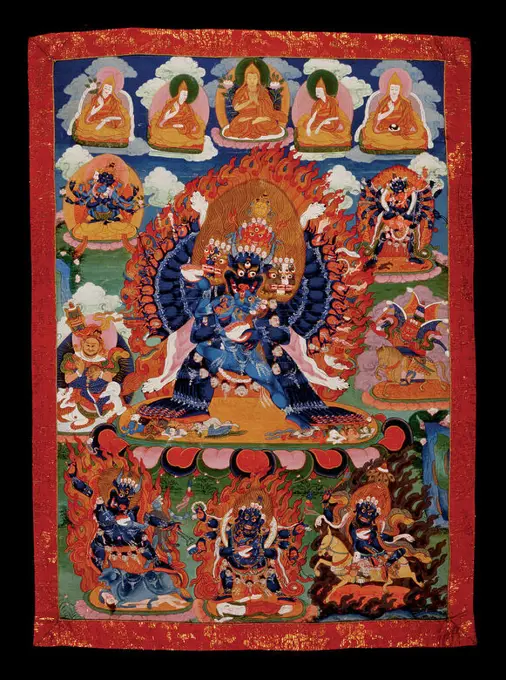
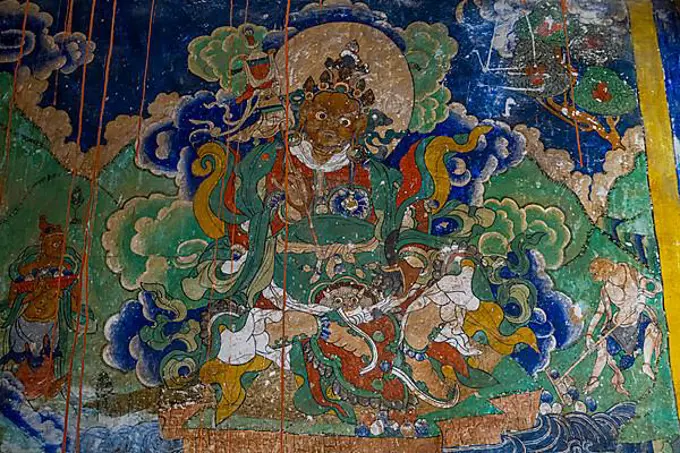
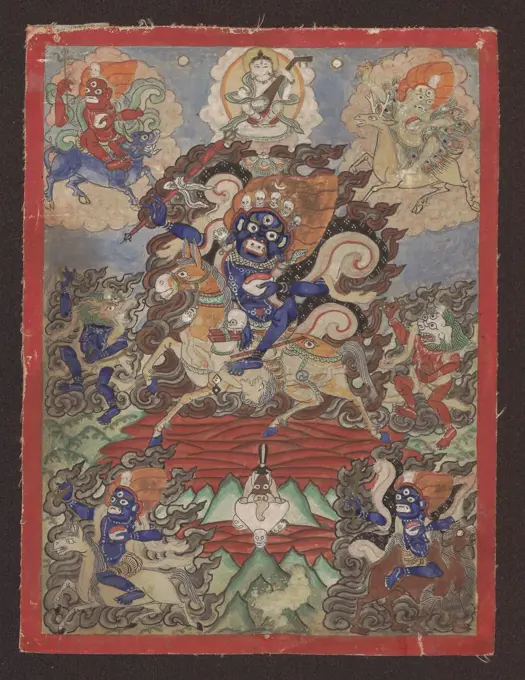
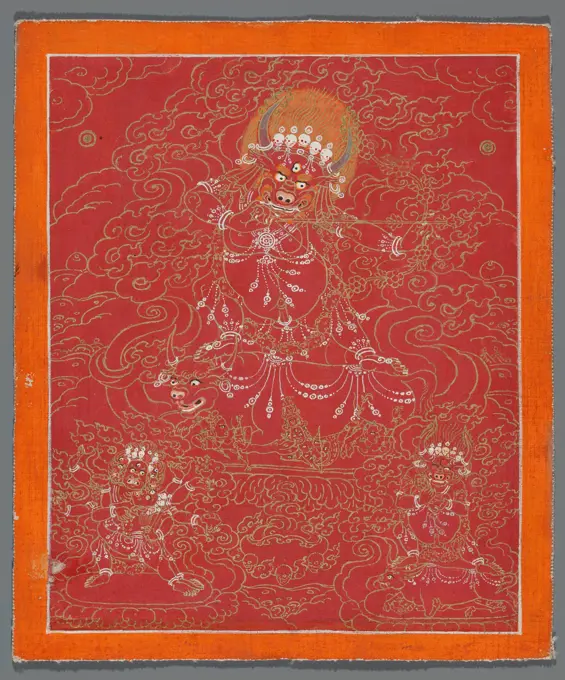
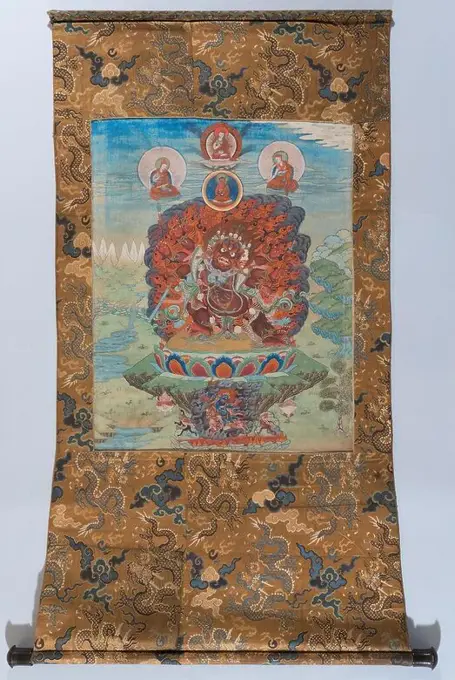
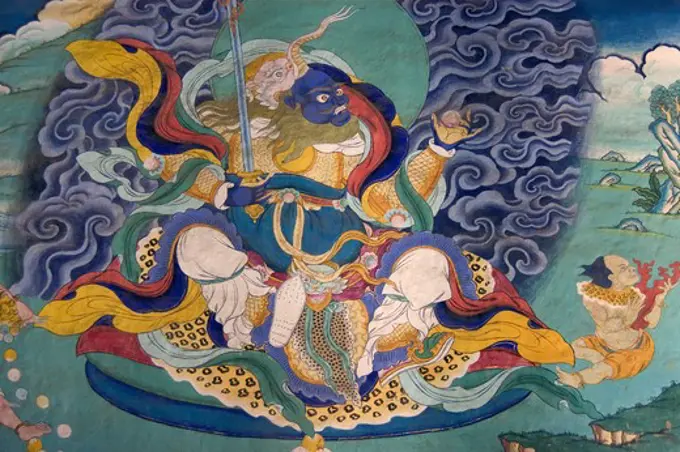
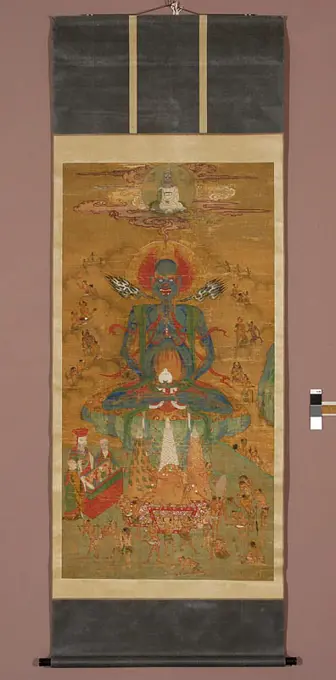
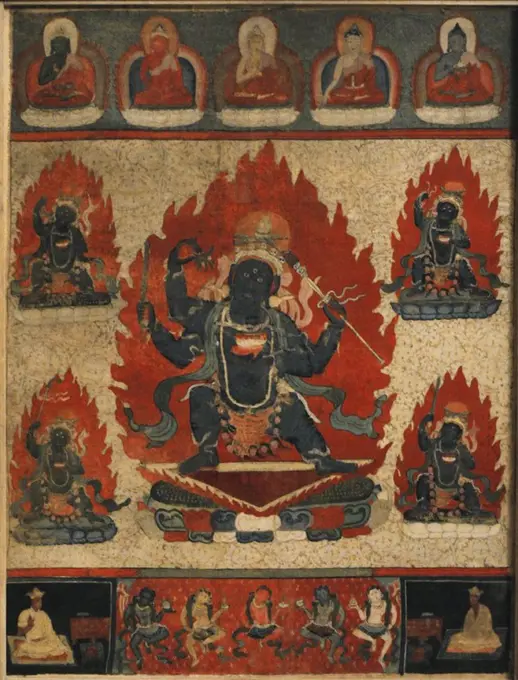
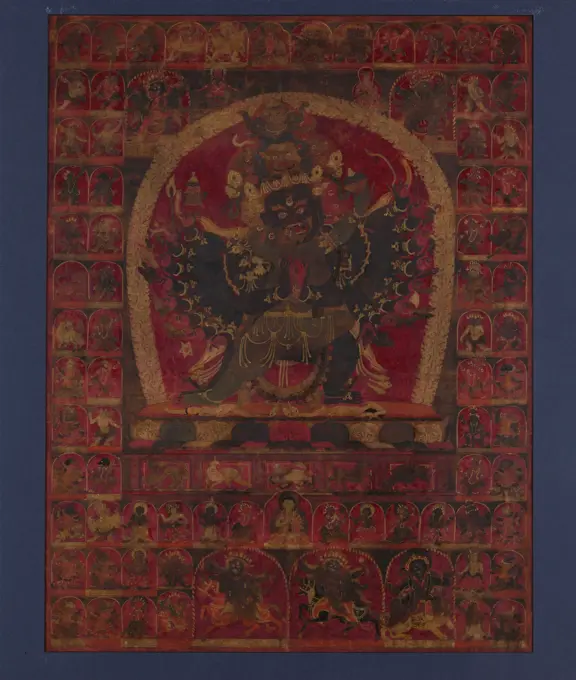
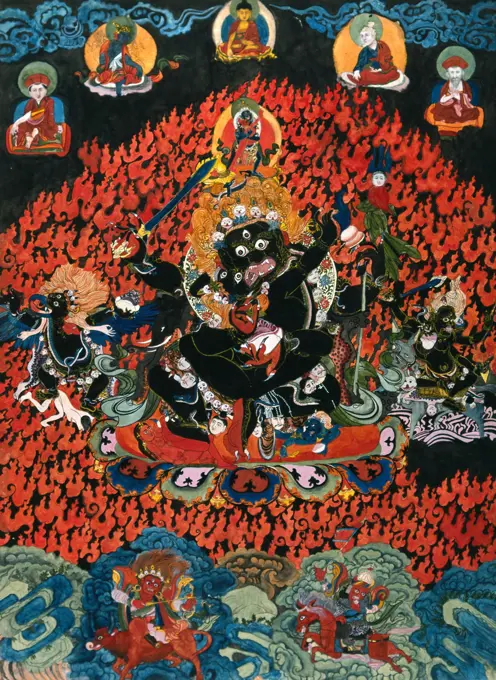
'Hayagriva with his Retinue'. Tibet, Early 19th century. Dimensions: 66x46 cm. Museum: State Hermitage, St. Petersburg.
6188-64595439
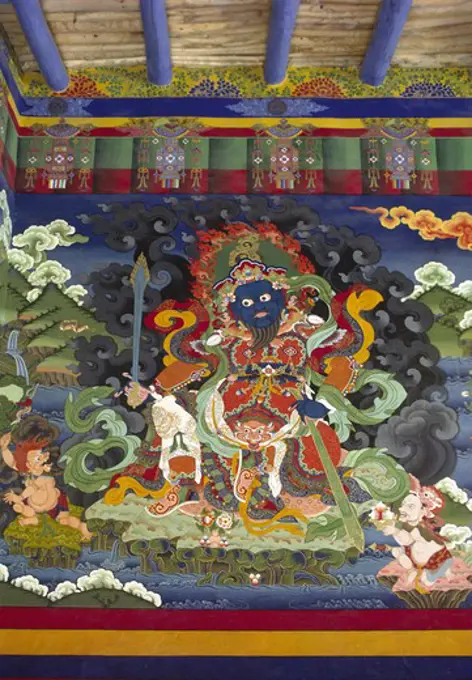
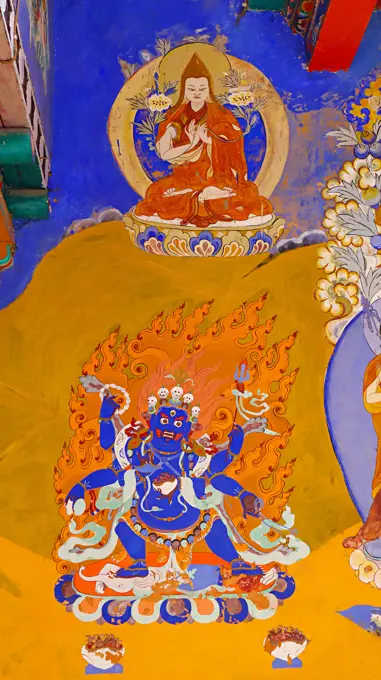
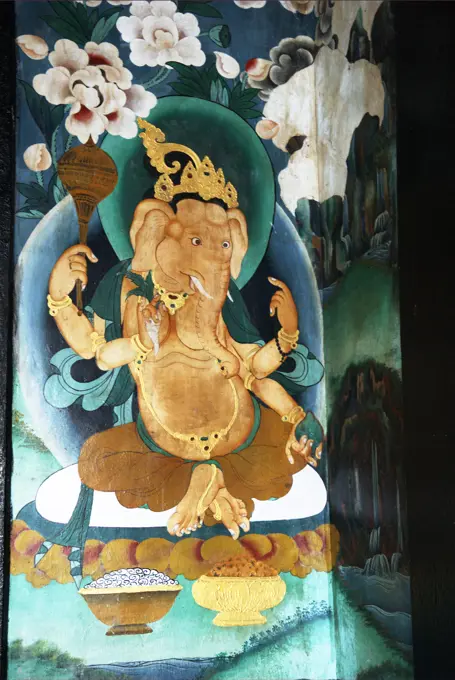
religious painting in monastery, pemyangtse, sikkim, Copyright: xAshaxAdatia/DinodiaxPhotox
6145-29129540
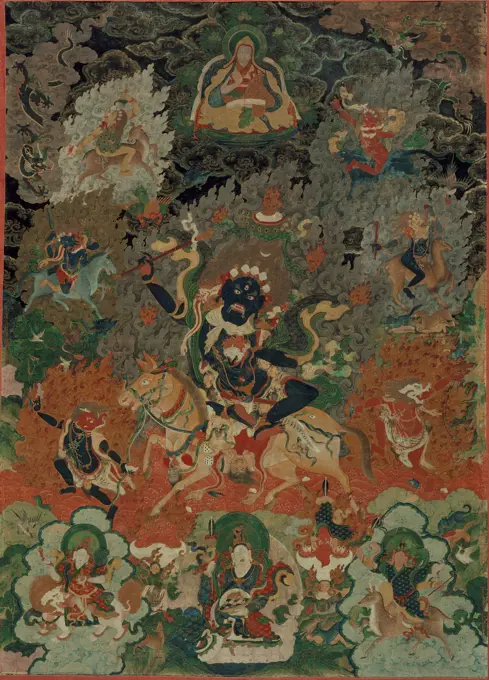
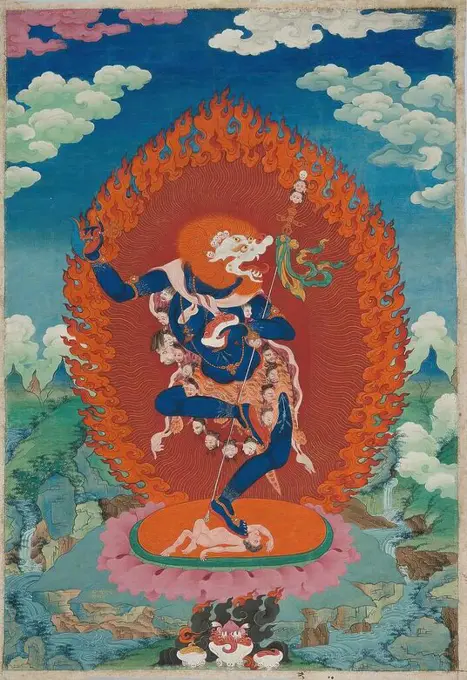
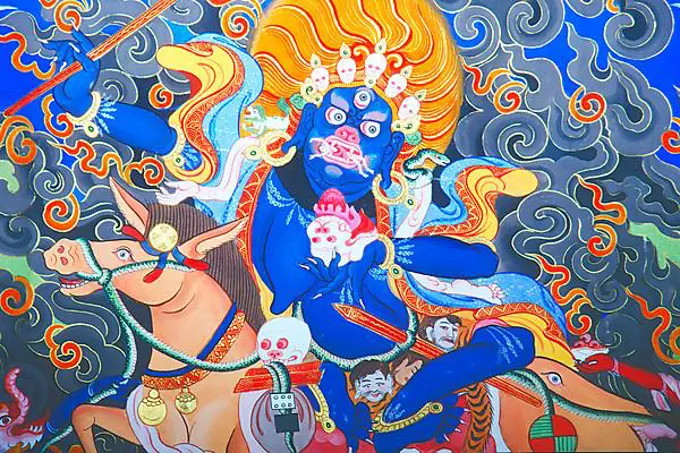
Shri (Palden Lhamo). Central Tibet, circa 1750-1850. Paintings. Mineral pigments and gold on cotton cloth
4409-17576265
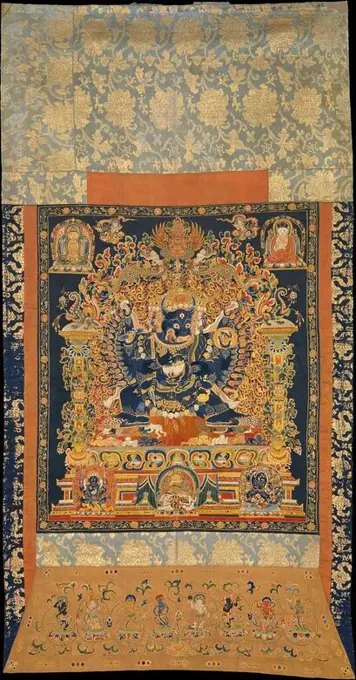
'Vajrapani with his Retinue'. Tibet, Early 19th century. Dimensions: 73x48 cm. Museum: State Hermitage, St. Petersburg.
6176-67076406
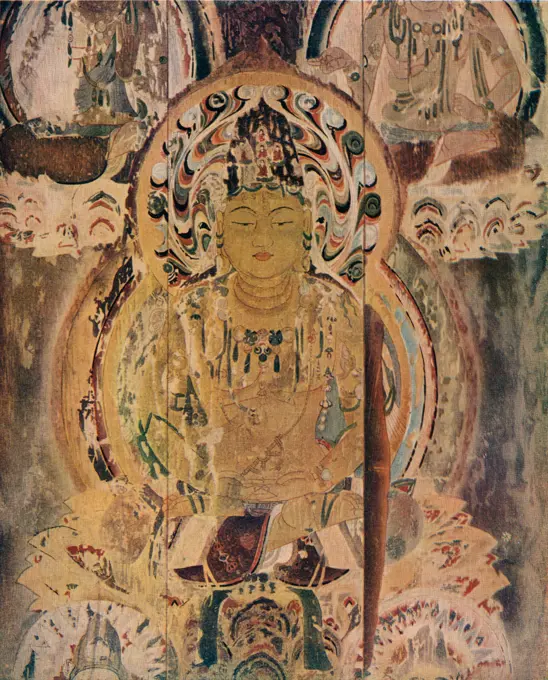
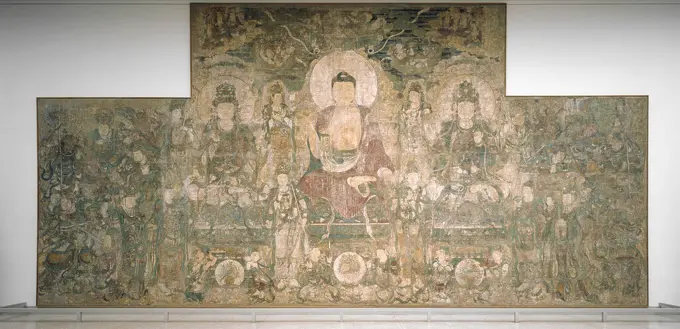
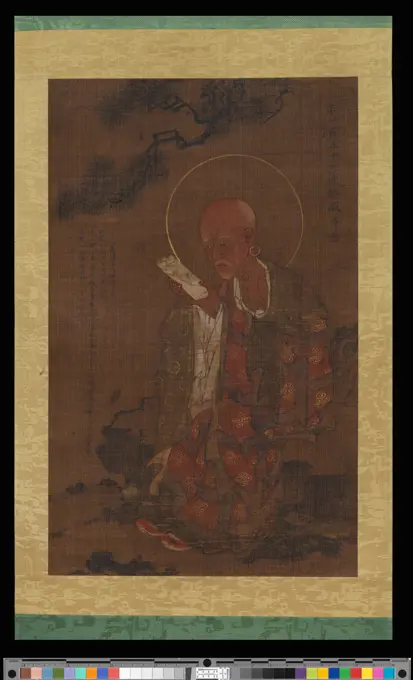
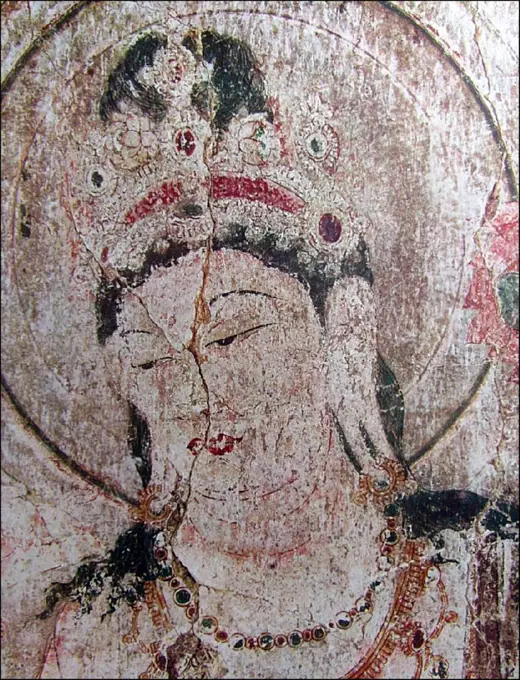
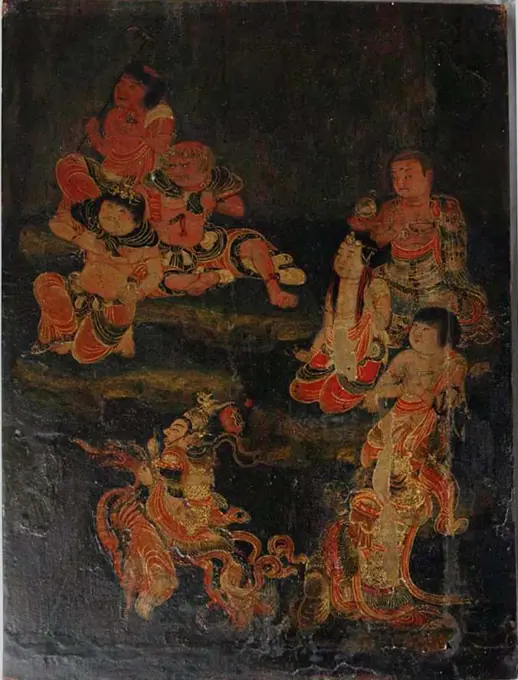
'A painting on the core pillar of the Pagoda at the Daigoji Monastery', c13th century. Artist: Unknown.
6145-30377339
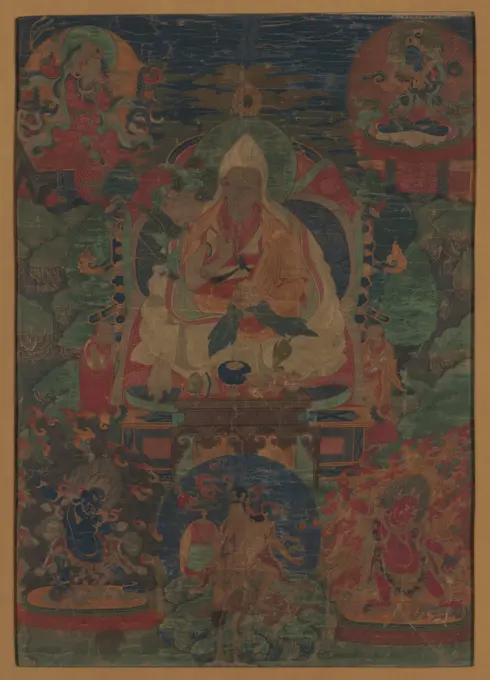
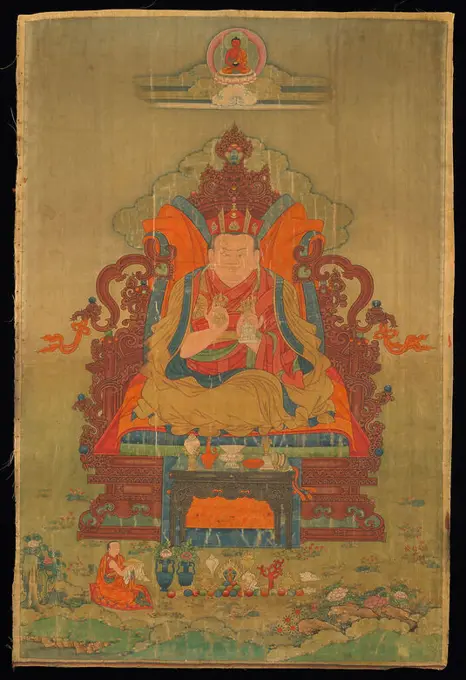
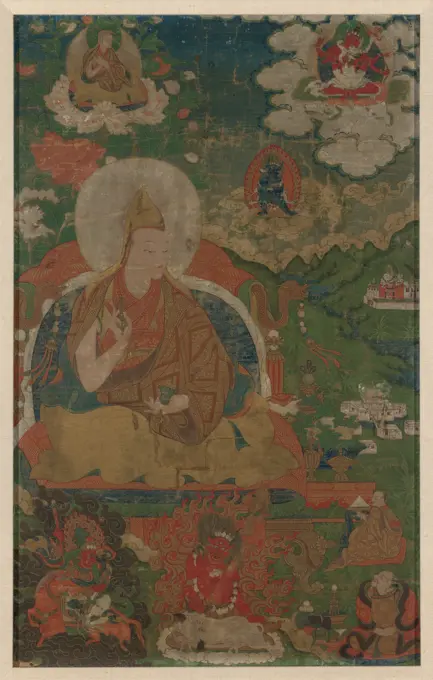
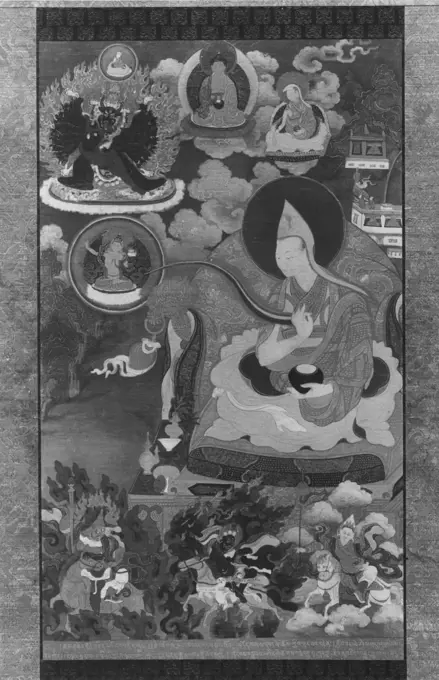
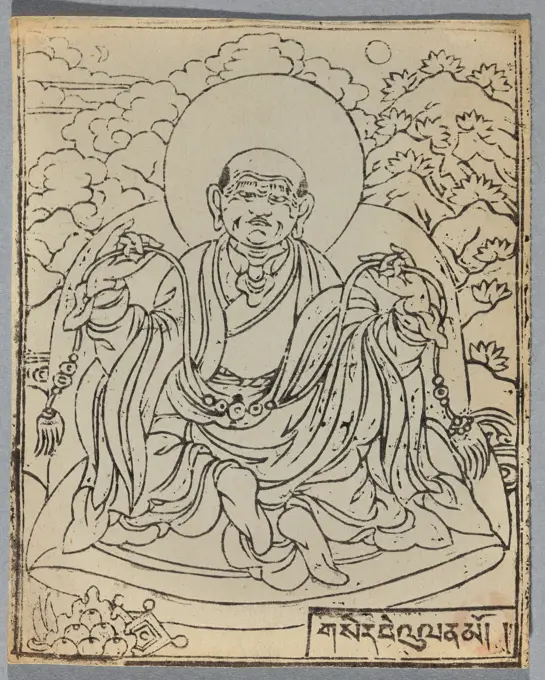
The Fifth Dalai Lama, NgawangLobzang
6145-29151860
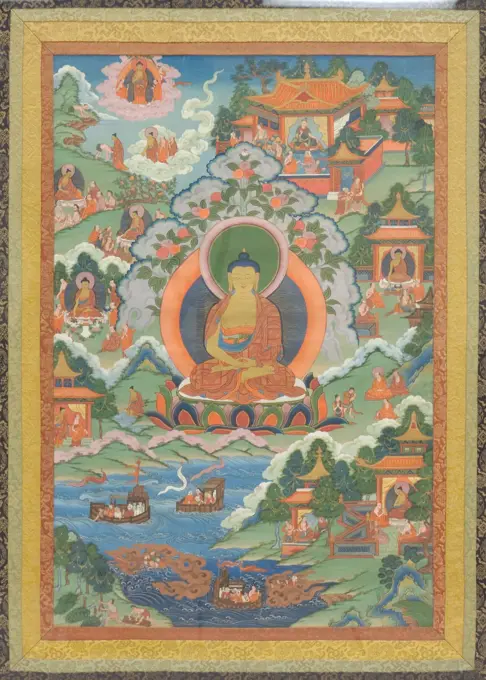
Thanka with Buddha 19th century Tibet. Thanka with Buddha. Tibet. 19th century. Distemper on cloth. Paintings
4292-16830
Nepal, Katmandu. Thanka Treasure
1746-19665814
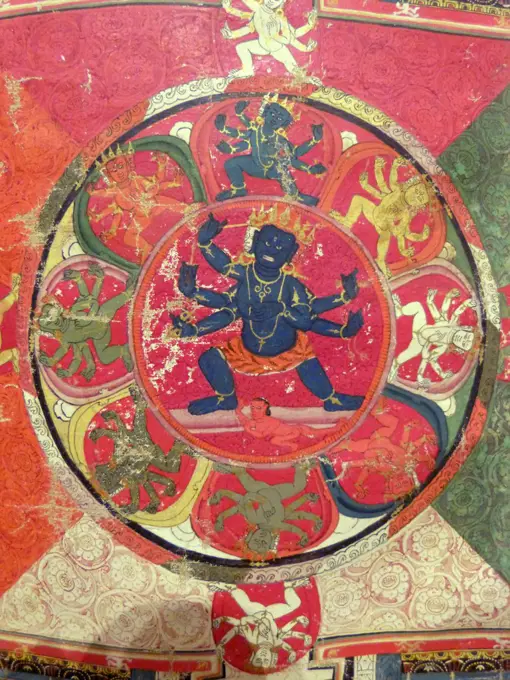
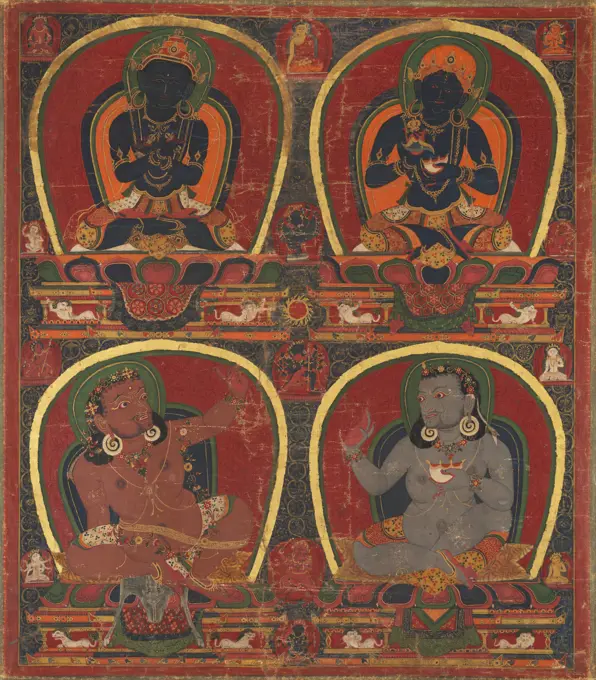
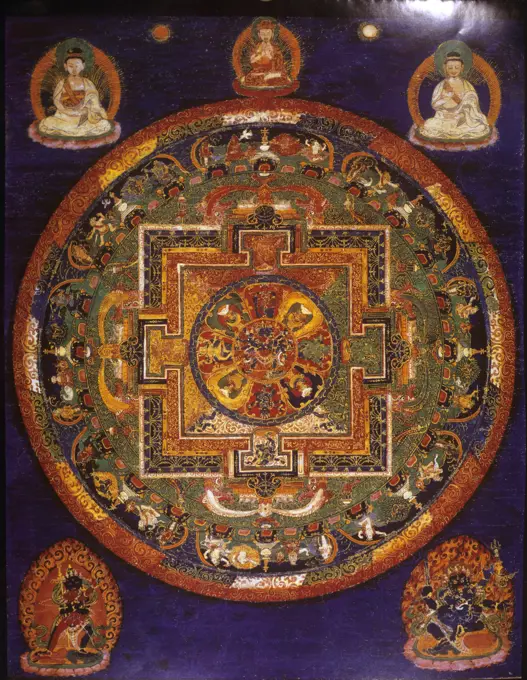
Scroll Painting (Thangka) with Four Mandalas 1400-1500. Each of these four mandalas, or ritual diagrams, represents a sacred space.
7155-70377353
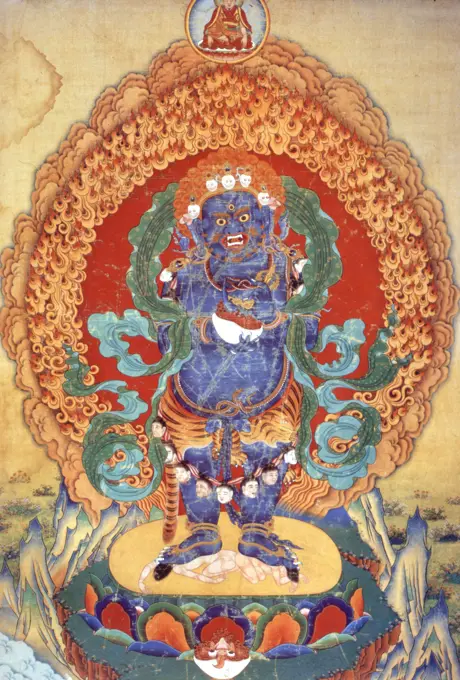
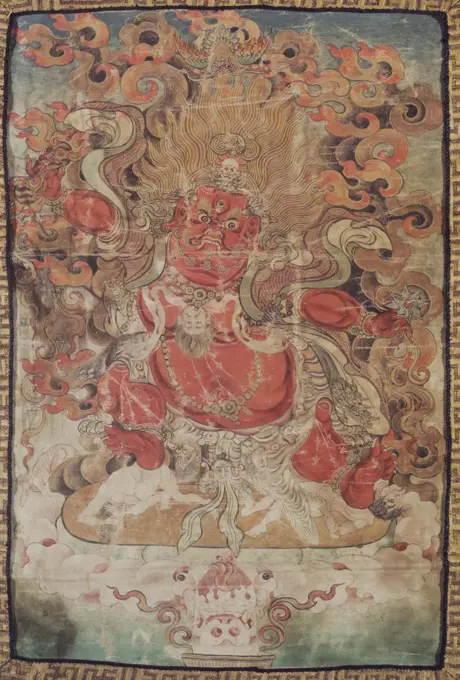
Yidam Mahakala, protector of Dharma, 19th cent. Wear skulls- symbols of power, manuscript. TIBET.
6145-29135147
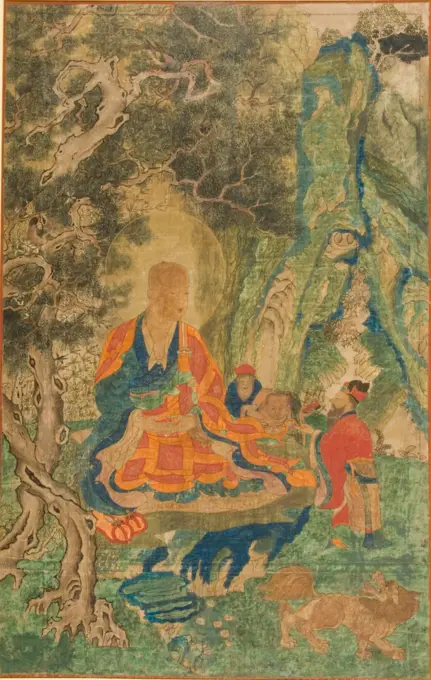
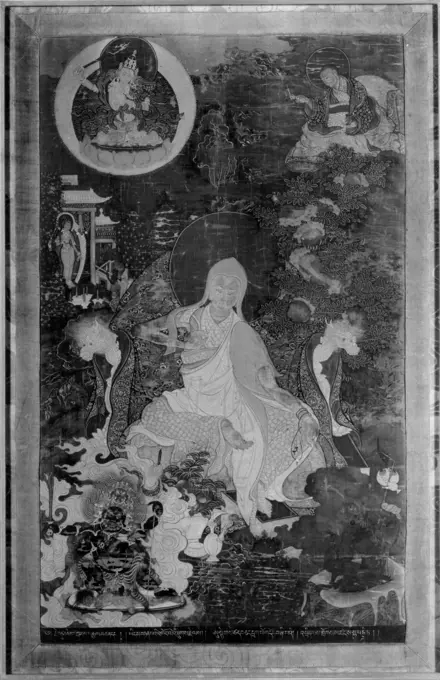
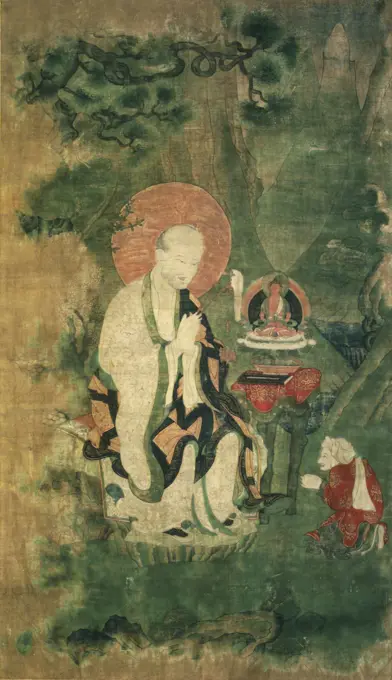
The Arhat Chudapantaka. Eastern Tibet, Kham region, a Trungpa Monastery in Surmang (), circa early 17th century. Paintings. Mineral pigments and gold on silk
6188-64598557
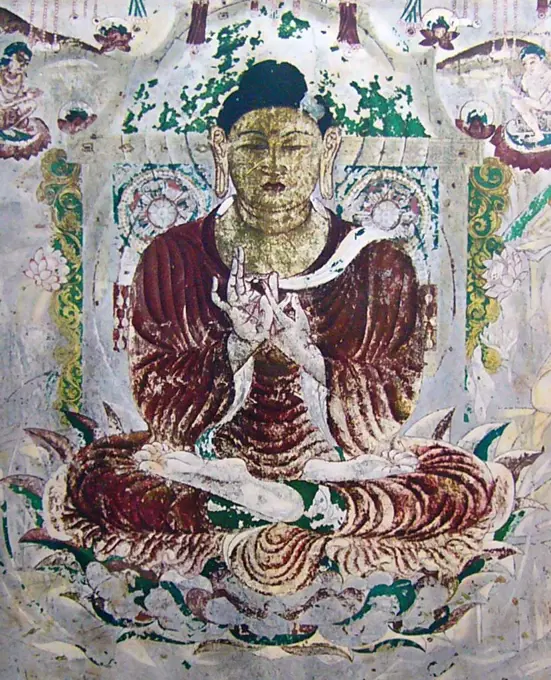
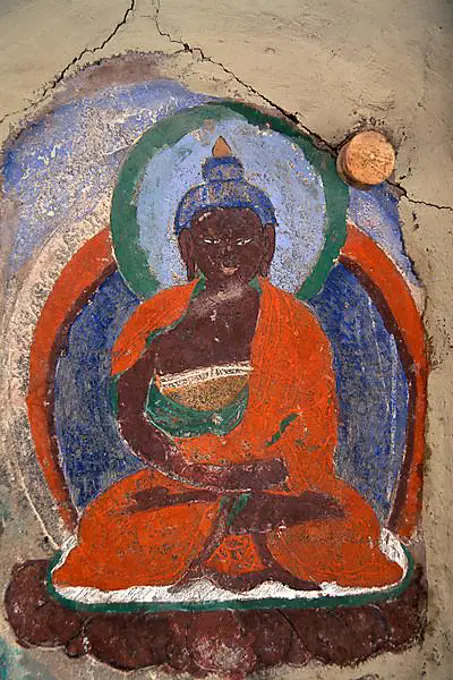
wall painting of lord buddha, stok monastery, ladakh, Jammu and Kashmir, india Copyright: xNxSharma/DinodiaxPhotox
4430-3249
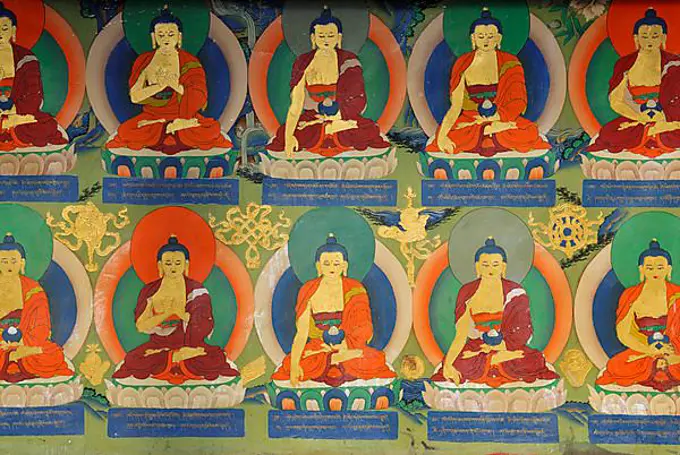
fine arts, Tibet, painting, Thangka, Dhyani Buddhas, silk, 18th/19th century, Ethnological Collection, Zuerich University,
4443-28742521
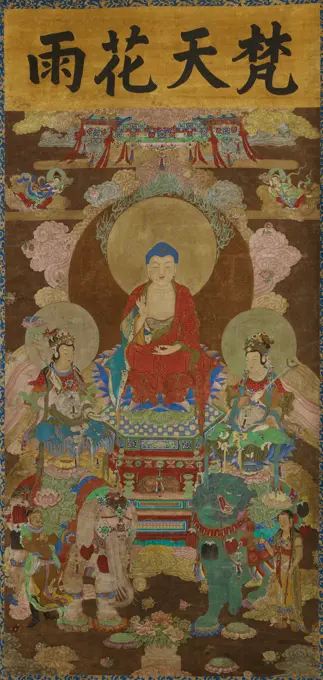
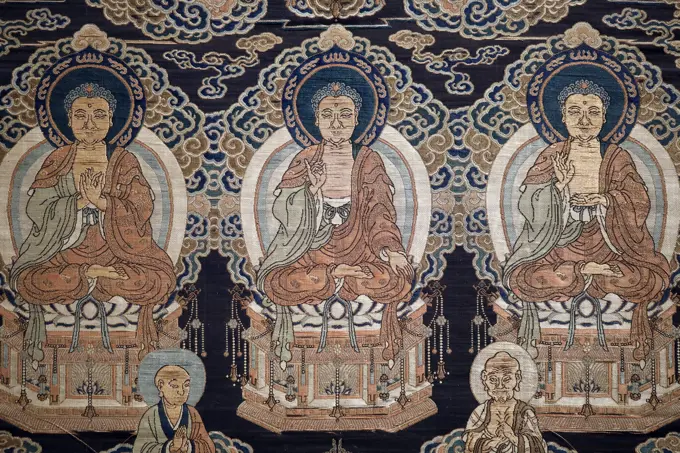
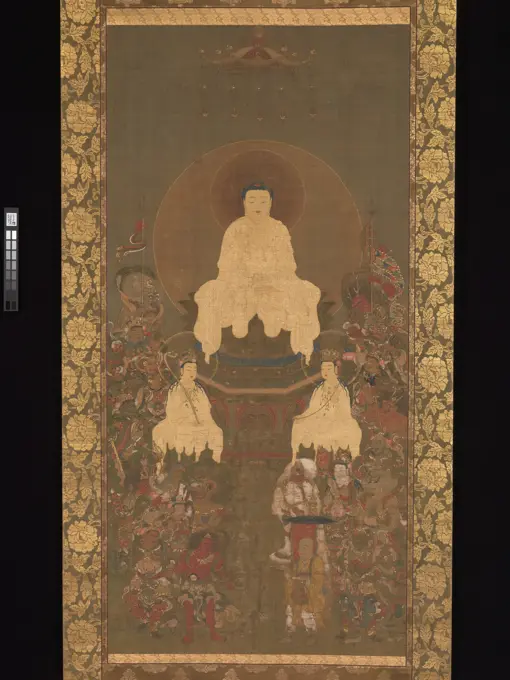
Buddhist trinity of Vairocana, Manjusri and Samantabhadra, late 16th-17th century, 90 13/16 x 33 3/4 in. (230.66 x 85.73 cm) (image, and text)121 3/8 x 37 in. (308.29 x 93.98 cm) (without roller), Ink, colors, and gold on silk, China, 16th-17th century, This painting depicts Buddha Vairocana seated on a lotus-flower throne in heaven. Buddha Vairocana is an iconic figure in Mahayana, one of the major branches of Buddhism. He is seen as a universal Buddha and the matrix from which all phenomena emerge. On either side are Buddha Vairocanas typical attendants, the bodhisattvas of wisdom and benevolence: Manjusri, on a lion, and Samantabhadra, on a six-tusked elephant. A bodhisattva is a being that is able to reach enlightenment but delays doing so to help those suffering on earth. In China, this group of three is known as the Three Saints of Huayan and is described in the influential Flower Garland sutra (scripture), so called because the Buddhas enlightenment is like a floral crown, or
1788-41881
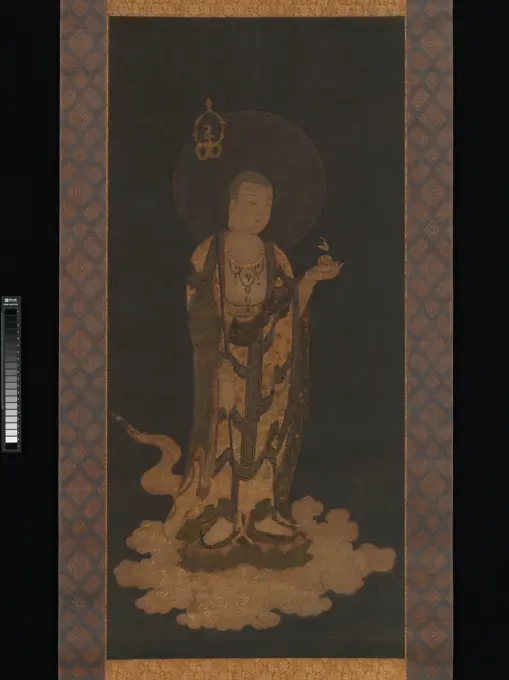
Bodhisatva a descendant of Amida, woodcut, Japan. Japanese Civilisation, Fujiwara period, 10th-11th century.
6145-51823359
Avalokiteshvara and Deities , late 18th-early 19th century. Watercolors and gold on cotton, 40 x 63 3/4 in. (101.7 x 162.0 cm).   Asian Art late 18th-early 19th century
1899-17319596
The Pure Land of Buddha Amitabha. Tangut State of the Western Xia (982-1227). Khara-Khoto. 12th century.  Tangka; colours on cotton. The State Hermitage Museum. Saint Petersburg. Russia.
1886-53097
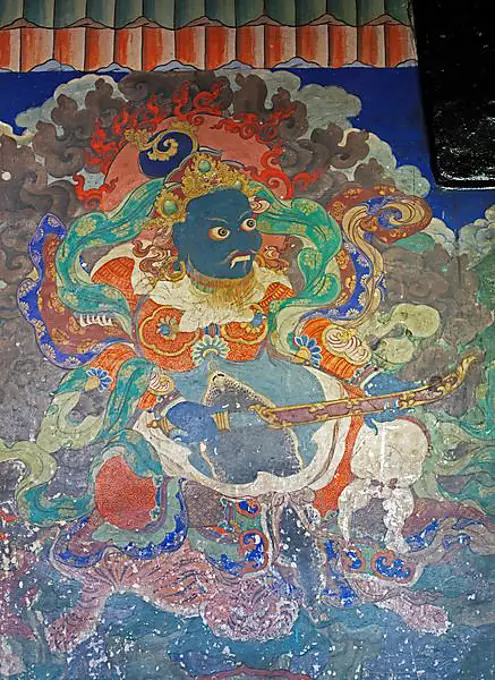
GAURDIAN OF THE SOUTH (originally Bon deity), WALL FRESCO to protect gompa (monastery) entrance, LAMAYURU - LADAKH
1899-18792125
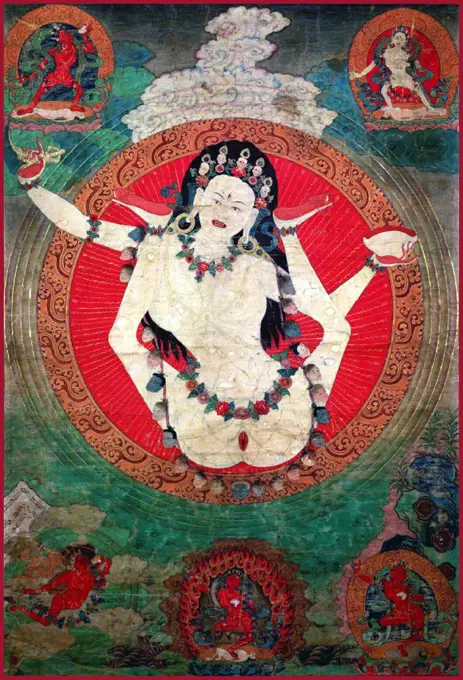
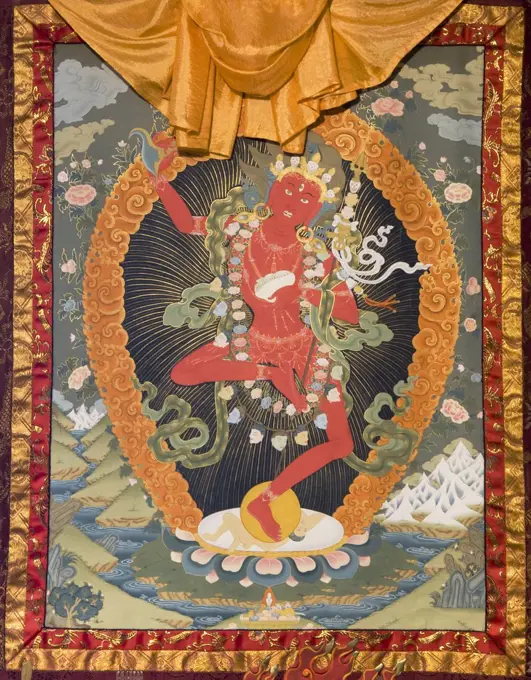
A dakini (Sanskrit: ḍākinī; Tibetan: khandroma) is a tantric deity described as a female embodiment of enlightened energy. In the Tibetan language, dakini is rendered khandroma which means 'she who traverses the sky' or 'she who moves in space'. Sometimes the term is translated poetically as 'sky dancer' or 'sky walker'. The dakini, in all her varied forms, is an important figure in Tibetan Buddhism. She is so central to the requirements for a practitioner to attain full enlightenment as a Buddha that she appears in a tantric formulation of the Buddhist Three Jewels refuge formula known as the Three Roots. Most commonly she appears as the protector, alongside a guru and yidam (enlightened being). Although dakini figures appear in Hinduism and in the Bön tradition, dakini are particularly prevalent in Vajrayana Buddhism and have been particularly conceived in Tibetan Buddhism where the dakini, generally of volatile or wrathful temperament, act somewhat as a muse for spiritual practice.
1899-55266286
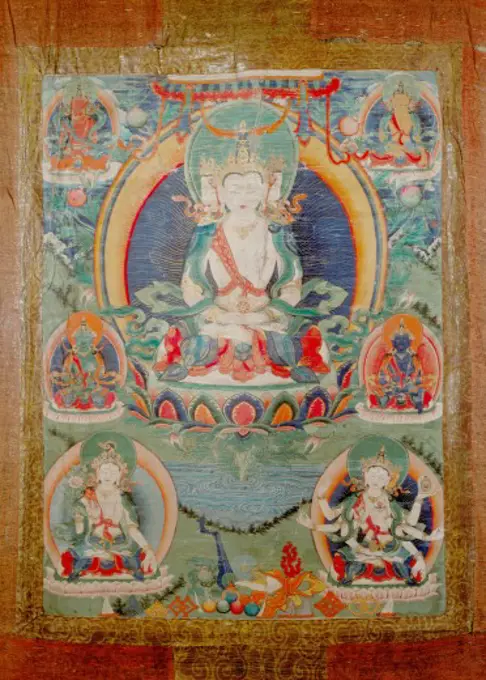
Guimet museum. Usnisavijaya is a buddha of longevity in Buddhism. Tibet 18 th Century. Paris. France.
6145-29731915
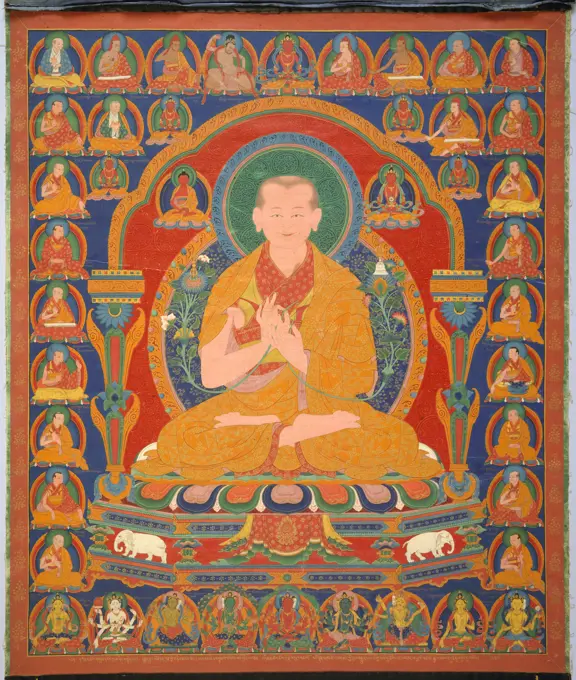
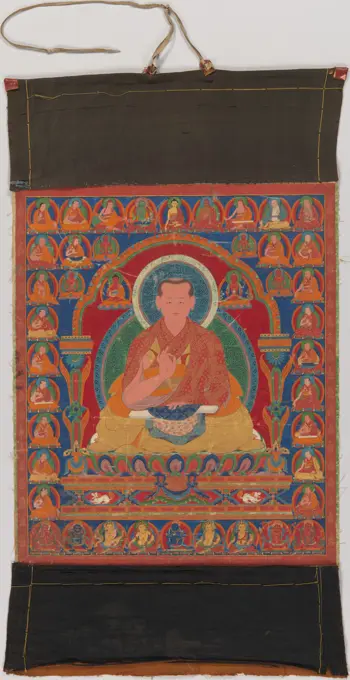
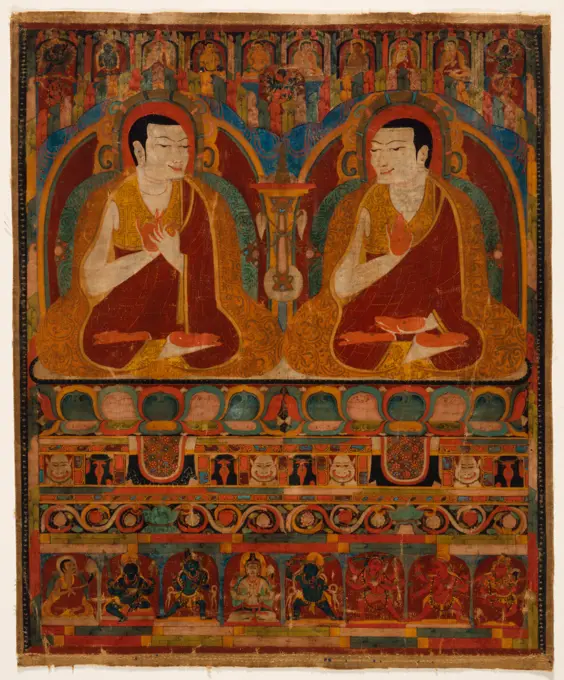
Yong Zin Khon Shogpel: Seventh Abbot of Ngor Monastary 16th century Tibet This painting is one of two in the collection from a set depicting the abbots of Ngor monastery, which follows the teachings of the Sakya school. Tibetan Buddhism assigns exceptional prestige and reverence to abbots, who are seen to be living embodiments of enlightenment. Ngor monastery is famously associated with an important set of mandalas painted by a group of itinerant Nepalese artists shortly after the monasterys foundation in 1429. This tangka is painted in a style predominantly influenced by Nepalese precedents but shows a new awareness of Chinese art, seen in such details as the throne base and the naturalistic treatment of the drapery. The upper registers contain the Sakya order lineage, and the lower show a group of protective and auspicious deities.. Yong Zin Khon Shogpel: Seventh Abbot of Ngor Monastary 37816
6145-29135149
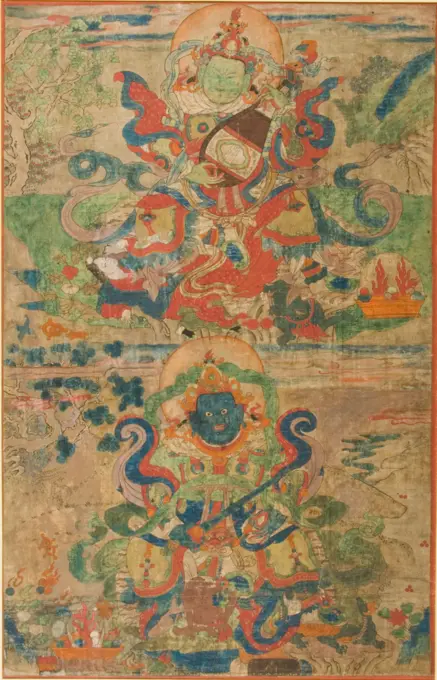
The Guardian Generals of the Directions (Lokapalas) Dhritarashtra (East) top and Virudhaka (South) bottom. Eastern Tibet, Kham region, a Trungpa Monastery in Surmang (?), circa early 17th century. Paintings. Mineral pigments and gold on silk
1890-12756700
White Tara, Tibetan thanka, Shedub Choekhor Ling Monastery, Mont Saleve, Haute-Savoie, France, Europe
1899-55266287
Guimet museum. Bodhisattva Avalokiteshvara or Simhanada Avalokiteshvara. China 18 th century. Paris. France.
4443-28740295
The Three Purities, one of three, late 16th century, 61 9/16 x 34 1/8 in. (156.37 x 86.68 cm) (image)95 1/8 x 39 3/4 in. (241.62 x 100.97 cm) (without roller), Ink, colors and gold on silk, China, 16th century, These three paintings depict the Three Purities, the supreme deities of religious Daoism, who were identified as the source of all Daoist teachings and as rulers of the Daoist universe. They are painted like enthroned emperors with meticulous detail in the colorful outline style associated with traditional Buddhist painting and court portraiture. Presented are the Celestial Worthy of the Primordial Beginning (in blue robe), a teacher and patriarch of the highest scriptural tradition; the Celestial Worthy of the Numinous Treasure (black robe), patron of the second scriptural tradition, the Cavern of Mystery; and the Celestial Worthy of the Way and its Power (green robe), better known as Laozi, patriarch of the third scriptural tradition. Although images of the Three Purities woul
4409-17573340
'Yama and the Underworld'. Tibet, Early 20th century. Dimensions: 90x61 cm. Museum: State Hermitage, St. Petersburg.
4409-17504782
Two-sided Festival Banner. Date/Period: 17th century. Painting. Pigments on cloth. Author: UNKNOWN.
6145-46805419
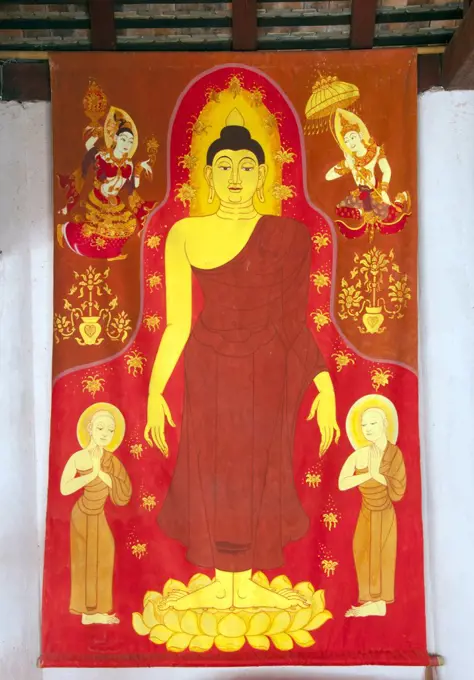
Buddha
1899-20090693
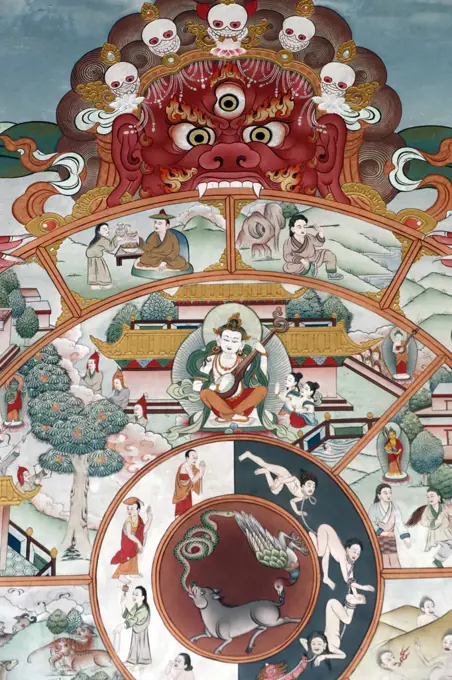
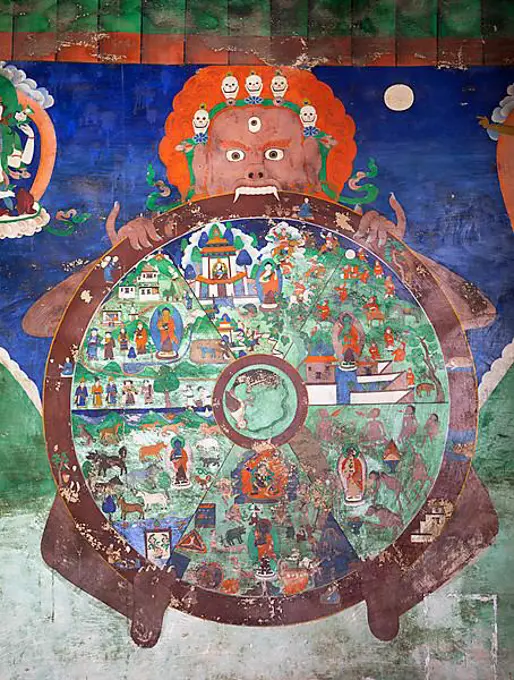
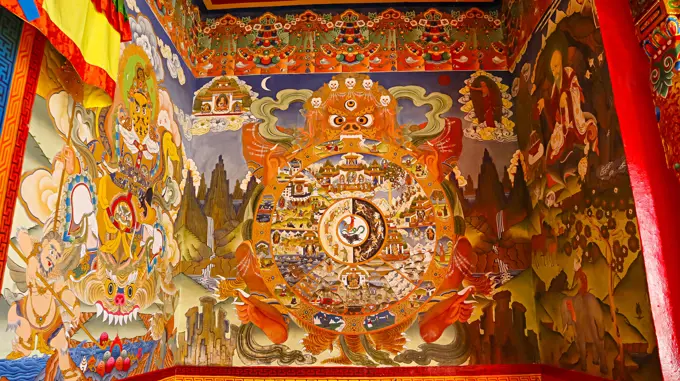
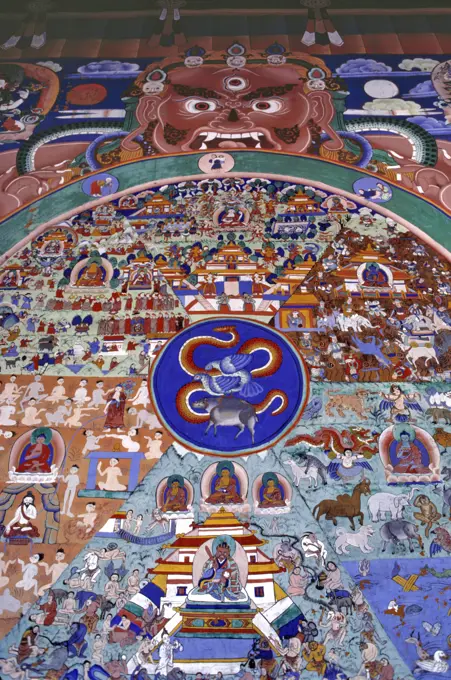
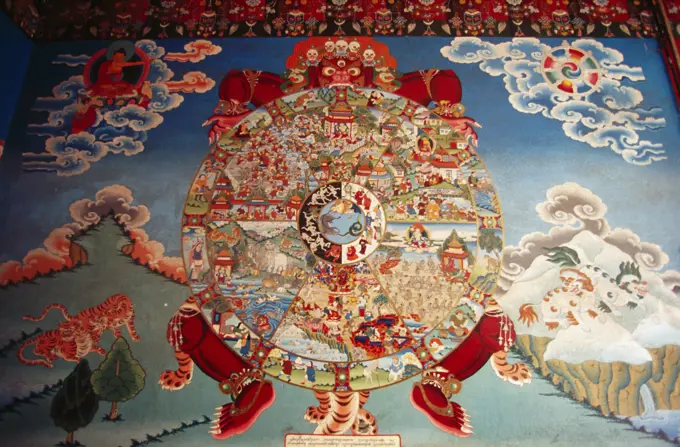
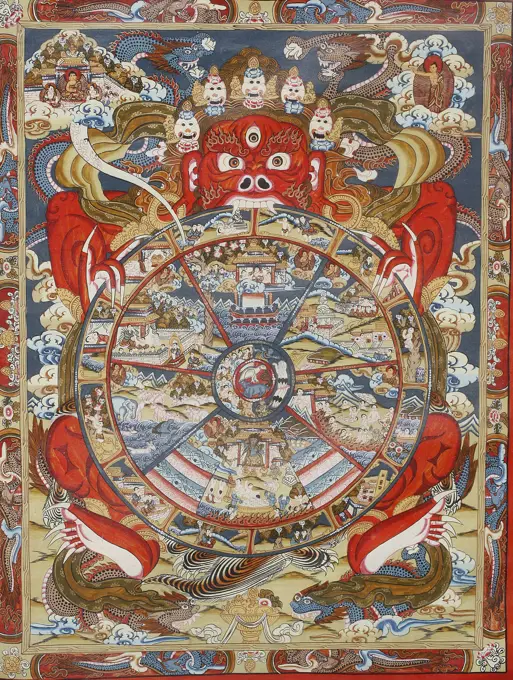
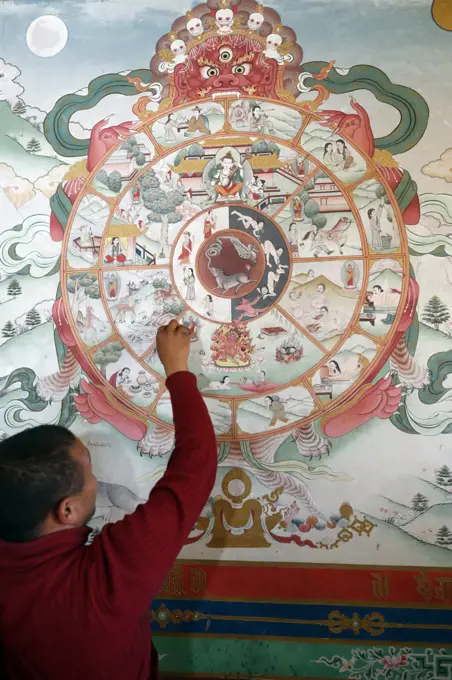
Pema Osel Ling Monastery.  The wheel of life or the bhavacakra  is a symbolic representation of saṃsara.  Wall painting..
4409-17581333
'Simhavaktra'. Tibet, Early 19th century. Dimensions: 62x44 cm. Museum: State Hermitage, St. Petersburg.
4409-17492162
Section of Yamantaka Thanka (memorial). Date/Period: 18th century. Ethnological object. Height: 1,200 mm (47.24 in); Width: 640 mm (25.19 in). Author: TIBET.
7176-70562987
Thangka painting at Dashchoilon Khiid Monastery
1899-71042
Nepalese tangka
4409-20999760
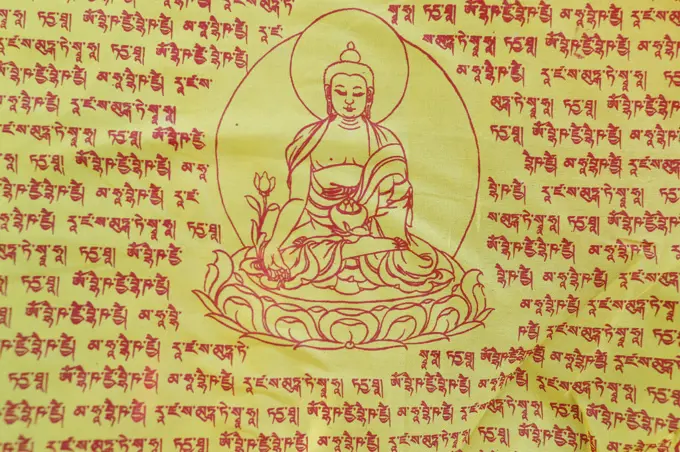
Bhaisajyaguru, the Medicine Buddha. Tangut State of the Western Xia (982-1227). Khara-Khoto. Late 12th-13th century. Tangka: colours on cotton.The State Hermitage Museum. Saint Petersburg. Russia.
6145-58826108
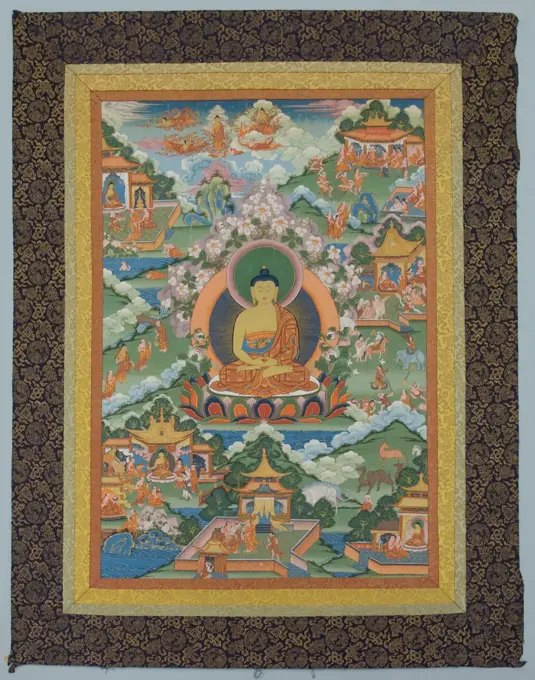
Sakyamuni, Anonymous, 1700 - 1800 Painting on canvas (tangka), a central figure is Sakyamuni. Tibet cotton (textile). dye. ink Painting on canvas (tangka), a central figure is Sakyamuni. Tibet cotton (textile). dye. ink
6145-51821780
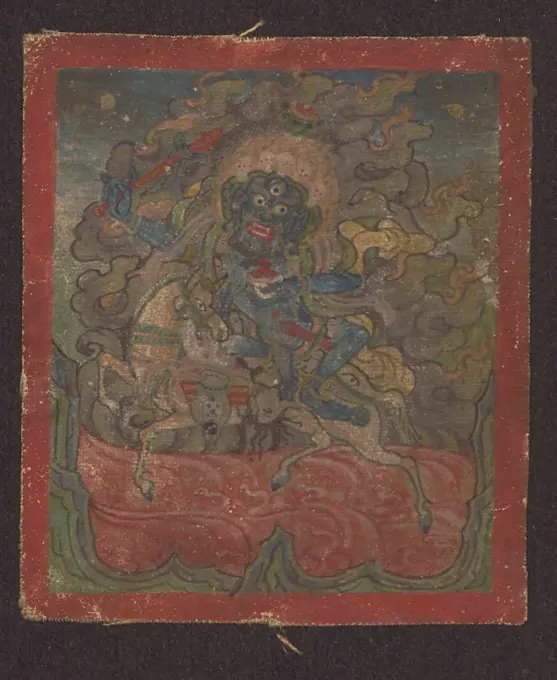
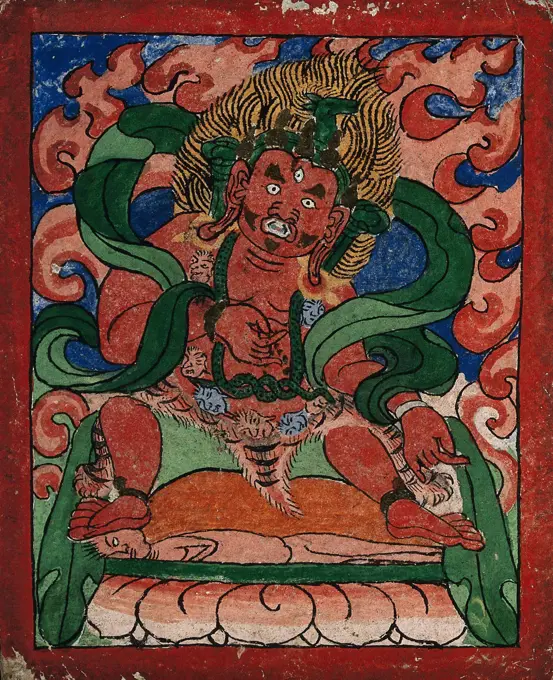
Wrathful Deity , late 18th-19th century. Hanging scroll, gouache on linen, 9 1/2 x 6 1/2 in. (24.1 x 16.5 cm).   Asian Art late 18th-19th century
6145-29066040
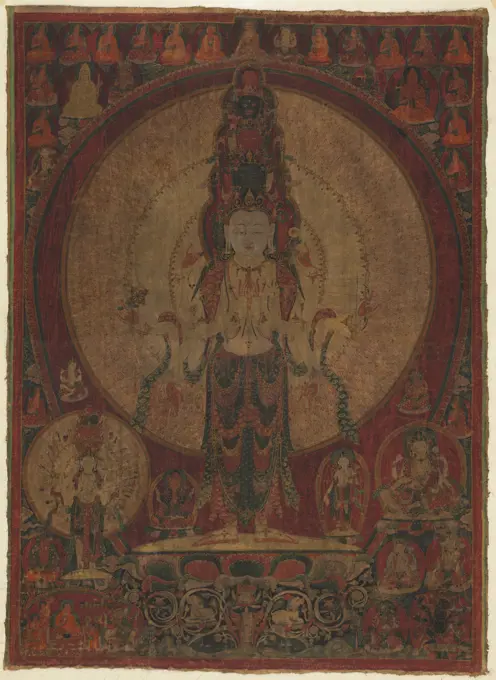
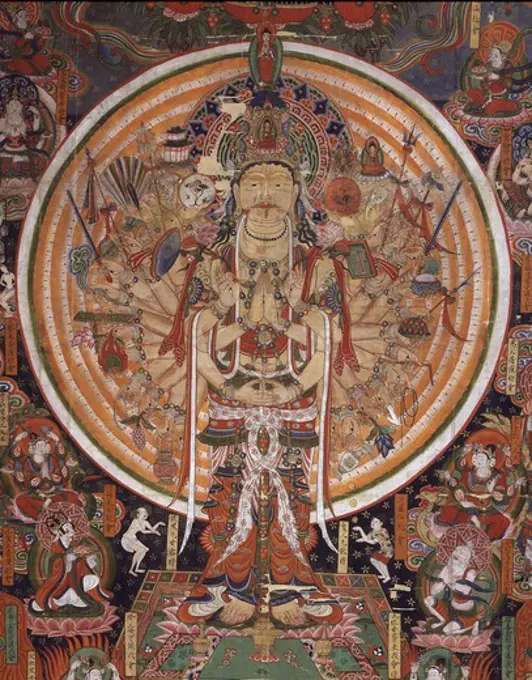
Eleven-Headed, Thousand-Armed Bodhisattva of Compassion (Avalokiteshvara), c. 1500. Western Tibet. Opaque watercolor and ink on cotton; overall: 94.6 x 69.2 cm (37 1/4 x 27 1/4 in.).
4201-22080988
Mural of Buddhist guardian on hotel door, Ulan Baatar, Mongolia
6145-43638957
Buddha the Healer/ The Buddha of Healing. Pracownia przyklasztorna, painter
6145-29068233
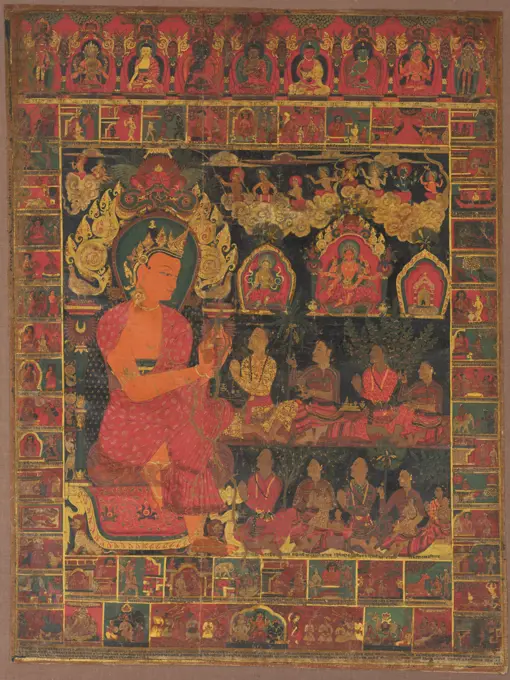
Thangka with Bejeweled Buddha Preaching, 1648. Nepal. Color on cloth; overall: 109.5 x 82.5 cm (43 1/8 x 32 1/2 in.).
1899-18855396
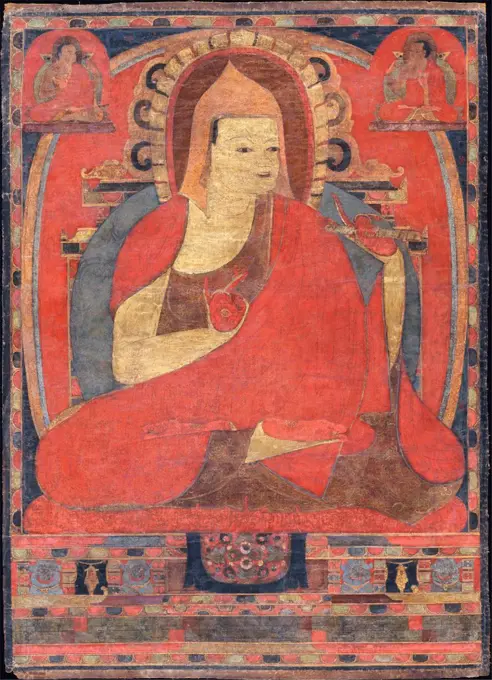
Atiśa Dīpaṃkara Śrījñāna (Bengali: তীশ দীপঙ্কর শ্রীজ্ঞান Ôtish Dipôngkor Srigên, Sanskrit: अतिश दीपङ्कर श्रीज्ञान[ ; Atiśa Dīpaṃkara- śrījñāna; Chinese: 燃燈吉祥智; pinyin: Rándēng Jíxiángzhì) (980-1054 CE) was a Buddhist teacher from the Pala Empire in Bengal. Atisa was one of the major figures in the spread of 11th-century Mahayana Buddhism in Asia and inspired Buddhist thought from Tibet to Sumatra. Revered as one of the great figures of classical Buddhism, Atisa was a key figure in the establishment of the Sarma schools of Tibetan Buddhism.
6145-29151864
The Great Renunciation of Siddhartha 20th century Tibet. The Great Renunciation of Siddhartha. Tibet. 20th century. Ink and color on paper. Paintings
1848-54566091
Interior of the Garphu monastery, Garphu, Kingdom of Mustang, Nepal, Asia
7099-70351828
Sikkim, Gangtok. One of Rumtek Monastery's many brilliantly detailed paintings, Gangtok, Sikkim. (Editorial Usage Only)
6188-62333088
Colorful paintings of Buddhist deities in Thiksey Monastery, Thiksey, Leh, Ladakh, India. Colorful paintings of Buddhist deities in Thiksey Monastery, Thiksey, Leh, Ladakh, India. Copyright: xZoonar.com/RealityImagesx 22018001
6145-48517962
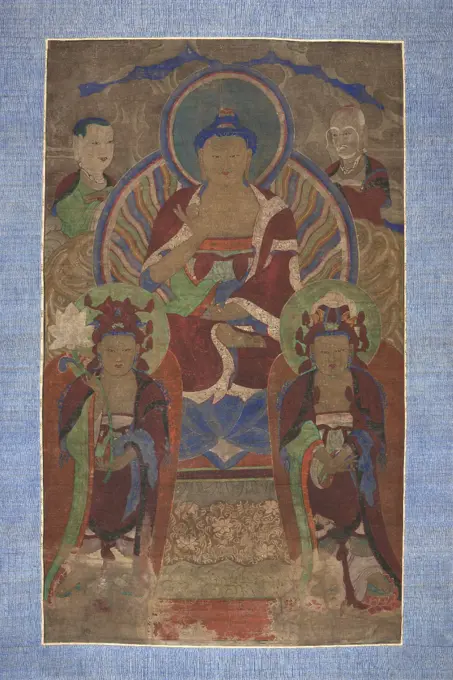
Buddha Sakyamuni with Maudgalyayana and Sariputra. unknown, painter
4409-17504886
White Tara. Date/Period: 19th century. Painting. Ground mineral pigment on cotton Ground mineral pigment on cotton. Height: 749.30 mm (29.50 in); Width: 536.70 mm (21.12 in). Author: UNKNOWN.
6145-59075762
Tsakli miniature with a presentation of a white tary ();  19th century (1801-00-00-1900-00-00);
6145-51823197
Amitabha in the Western Paradise , late 15th century. Color and gold on cloth, Image: 26 1/2 x 22 in.   Asian Art late 15th century
4409-17485988
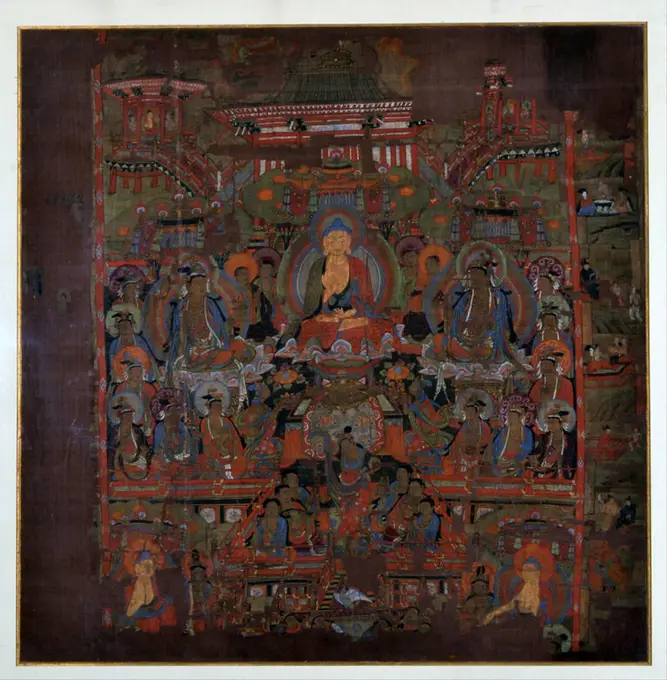
Paradise of Bhaisajyaguru. Date/Period: 7th century - 8th century. Silk Painting. Height: 1,190 mm (46.85 in); Width: 1,175 mm (46.25 in). Author: UNKNOWN.
6145-48527959
Zwój malarski thangka z wizerunkiem lamajskiego bóstwa Palden Lhamo (Śri Devi). unknown, painter
4220-4390
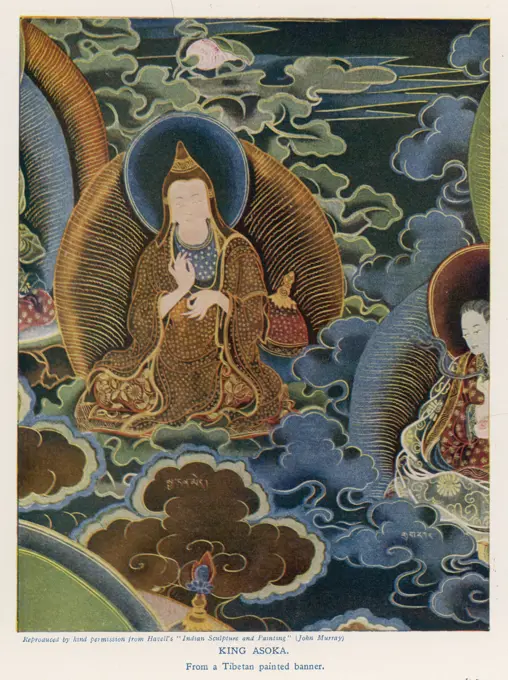
ASOKA, ruler of India  Buddhist, noted for his edicts
6145-29803333
Tangka with Buddha 19th century Tibet. Tangka with Buddha. Tibet. 19th century. Distemper on cloth. Paintings
1899-18788223
The Yulin Caves are a Buddhist cave temple complex in Guazhou County, Gansu Province, China. The site is located some 100 km east of the oasis town of Dunhuang and the Mogao Caves. It takes its name from the eponymous elm trees lining the Yulin River, which flows through the site and separates the two cliffs from which the caves have been excavated. The forty-two caves house some 250 polychrome statues and 4,200 square metres of wall paintings, dating from the Tang Dynasty to the Yuan Dynasty (7th to 14th centuries). The site was among the first in China to be designated for protection in 1961 as a Major National Historical and Cultural Site. In 2008 the Yulin Grottoes were submitted for future inscription on the UNESCO World Heritage List as part of the Chinese Section of the Silk Road.
1899-19189222
The Punakha Dzong, also known as Pungtang Dewa chhenbi Phodrang ('the palace of great happiness or bliss') was built in 1637 - 1638 by the 1st Zhabdrung Rinpoche and founder of the Bhutanese state, Ngawang Namgyal (1594 - 1651). It is the second largest and second oldest dzong (fortress) in Bhutan, located at the confluence of the Pho Chhu (father) and Mo Chhu (mother) rivers in the Punakha-Wangdue valley. Punakha Dzong is the administrative centre of Punakha District, and once acted as the administrative centre and the seat of Bhutan's government until 1855, when the capital was moved to Thimphu, though it still acts as the winter capital for the head of the Bhutanese clergy. It houses sacred relics from the southern Drukpa Lineage of the Kagyu school of Tibetan Buddhism.
1899-18792217
Mikyö Dorje (1507-1554), also Mikyo Dorje, was the eighth Gyalwa Karmapa, head of the Kagyu School of Tibetan Buddhism. Mikyö Dorje was born in Satam, Kham. According to the legend, he said after being born: 'I am Karmapa', and was recognized by Tai Situpa. In this case there was another child from Amdo who also claimed to be Karmapa. Gyaltsab Rinpoche, the regent of the region, thought of a test to decide who was the real Karmapa. This was the first time that a test was used to determine a reincarnation. Later this became the standard method for all major lamas. Mikyö Dorje left numerous Buddhist writings on Madhyamaka, Abidharma, Tantric and Mahamudra texts, poetry (verses of profound wisdom) and even linguistics. He introduced special Guru yoga in four sessions, which is very basic for Karma Kagyu today. He was also a skillful painter and metal craftsman producing many famous thangkas and statues.
6145-43654859
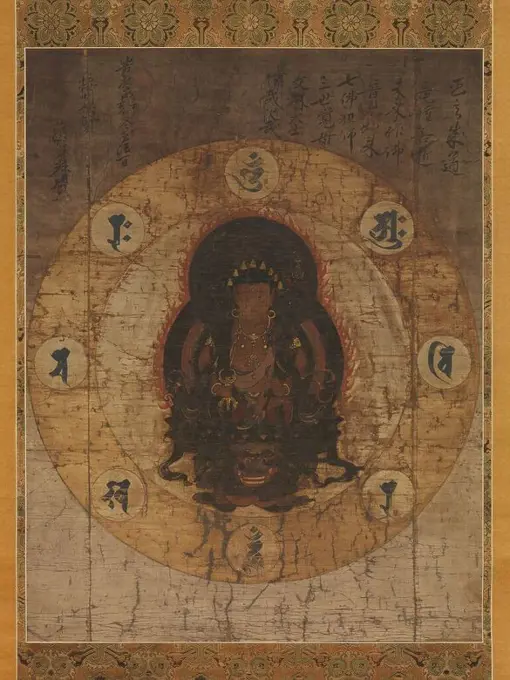
Mandala Ichiji Kinrin (One-Syllable Golden Wheel). unknown, painter
6145-29124462
A Buddha with a Pancharaksha Goddess, Folio from a Pancharaksha (The Five Protective Charms). Nepal, late 18th century. Manuscripts. Opaque watercolor and ink on paper
6188-64591281
wall painting at hemis gompa the most famous and rich gompa built in 17th century, leh, ladakh, Jammu and Kashmir, india Copyright: xSunilxKapadia/DinodiaxPhotox
1848-54753388
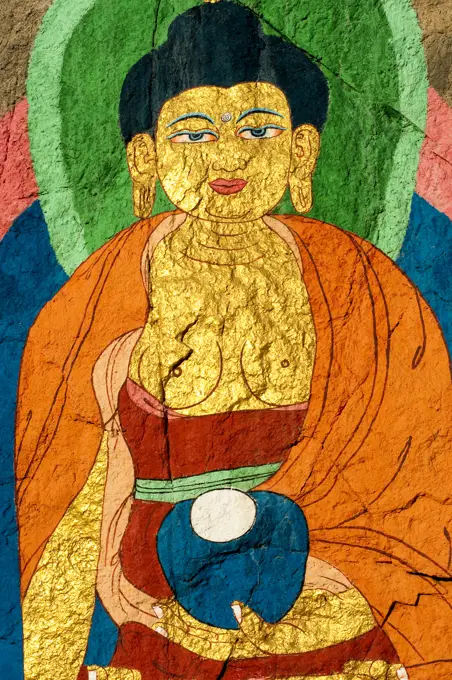
Tibetan fresco of a Bodhisattva covered with gold leaf, Hemis Monastery, Ladakh, Indian Himalayas, Jammu and Kashmir, northern India, India, Asia
4409-17577242
'Buddha Amitabha () and Two Bodhisattvas'. China, Tangut State of Xi -Xia, Khara-Khoto, 13th - 14th century. Dimensions: 46x33 cm. Museum: State Hermitage, St. Petersburg.
1848-50142645
Mural painting, Likir Monastery or Likir Gompa, Ladakh, India, Asia
6145-29296334
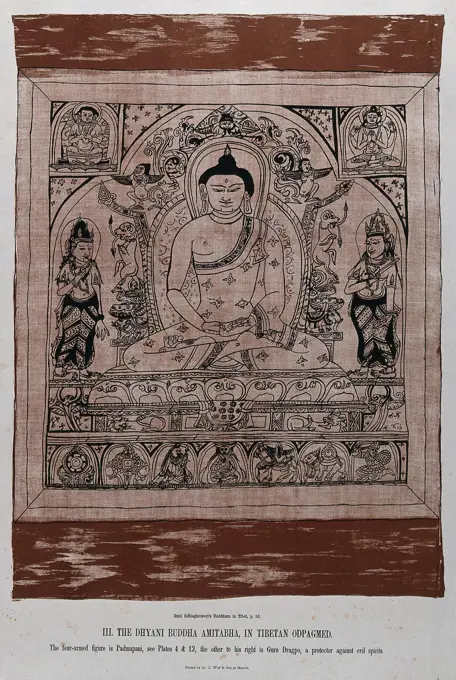
The Dhyani Buddha Amitabha. Chromolithograph.
6188-64599701
wall painting, likir monastery, ladakh, Jammu and Kashmir, india Copyright: xRxMakharia/DinodiaxPhotox
6145-59055230
Jama protective deity;  19th century (1801-00-00-1900-00-00);Himalayan (culture), Art of Tibetan Buddhism, Himalayan art, Mongolian art, purchase (provenance)
4443-28742857
Taishakuten one of a set of Twelve Devas, 14th-15th century, Unknown Japanese, 38 x 15 1/2 in. (96.52 x 39.37 cm), Ink, color, gold, and cut gold leaf (kirikane) on silk, Japan, 14th-15th century
6145-29810750
Folio from a Buddhist Manuscript of Pancavimsatisahasrika Prajnaparamita ca. 1090 India (Bengal) or Bangladesh. Folio from a Buddhist Manuscript of Pancavimsatisahasrika Prajnaparamita 37977
1899-18720874
The Bezeklik Thousand Buddha Caves (Bozikeli Qian Fo Dong) are complex of Buddhist cave grottos dating from the 5th to the 9th centuries. There are 77 rock-cut caves at the site. Some ceilings are painted with a large Buddha surrounded by other figures, including Indians, Persians and Europeans. The quality of the murals vary with some being artistically naive while others are masterpieces of religious art.
6145-29823995
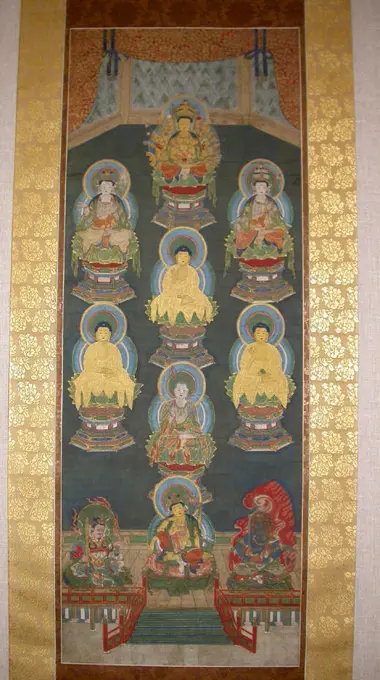
Mandala of the Sannō Shrine Deities 17th century Japan This mandala gives concrete visual expression to the Japanese Buddhist concept of original ground and flowing traces” (honji-suijaku) in which Japanese deities, known as kami, are considered to be manifestations (flowing traces”) of Buddhist deities (original ground”). The concept satisfied the desire of early medieval Japanese Buddhists to reconcile preexisting kami worship with the Buddhist tradition. Here, in an early premodern iteration of the theme, the seven kami of the Upper Sannō shrines are depicted in their original Buddhist forms along with three kami from the Middle Sannō shrines along the bottom. The Sannō (literally, "mountain king") shrine complex is situated in the eastern foothills of Mt. Hiei, northeast of Kyoto, overlooking Lake Biwa. The name refers to the tutelary kami of the Enryakuji Temple on Mt. Hiei, where Saichō (767-822), founder of the Tendai School of Buddhism, established his headquarters.. Mandala
6145-59075759
Ritual miniature tsakali with the imagination of the deity - guard Begtsse;  19th century (1801-00-00-1900-00-00);
1850-20461821
Bhutan, Lhuentse Dzong, Erotic mandala of Tshokey Dorji in the entrance to the Monastery.
1899-19137063
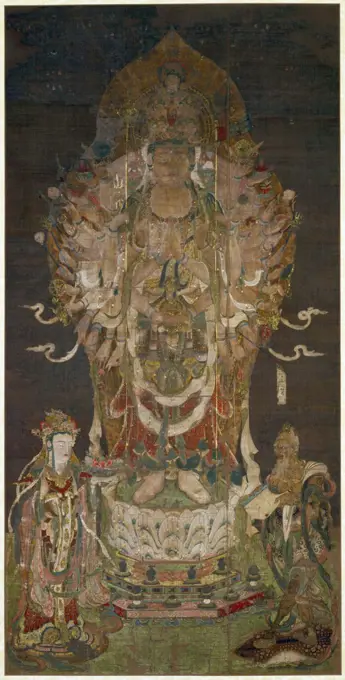
Japan: Senju Kannon (Sahasrabhuja, 'Thousand-Armed Avalokitesvara'), hanging scroll, painting on silk, Heian Period (12th Century), Tokyo National Museum
6145-29129510
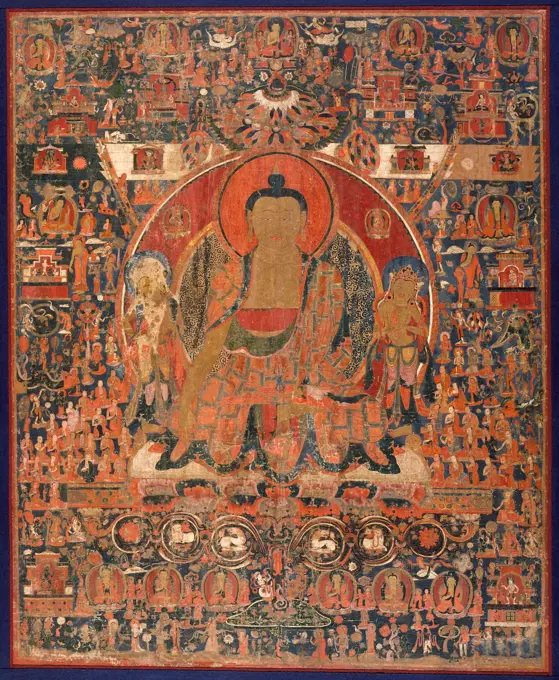
The Buddha of Unshakable Resolve (Akshobhya) in His Eastern Paradise (Abhirati). Western Tibet, Guge, 15th century. Paintings. Mineral pigments and gold on cotton cloth
6145-48527947
Miniatura rytualna tsakali z wyobrażeniem żeńskiego bóstwa Palden Lhamo (Śri Devi). unknown, painter
1890-103971
Painting of Green Tara, Buddhist symbol of prosperity, Kopan monastery, Kathmandu, Nepal, Asia
6145-45315724
Mandala of Pure Earth / Jodo Mandara unknown
1848-54994494
Painted wall, Buddha figures, Tashilhunpo Monastery, Shigatse, Tibet, China, Asia
6145-29781329
Portrait of Munchen Sangye Rinchen, the Eighth Abbot of Ngor Monastery late 16th century Tibet This tangka belongs to a set of portraits entitled the Path with the Fruit Gurus and Ngor Abbots.” Munchen Sangye Rinchen, the abbot of Ngor monastery (1513-16), holds a book and sits on a lion throne under a lobed arch studded with lotus buds. Immediately above is the Buddha attaining enlightenment, accompanied by additional Buddhist deities and patriarchs of the Sakya monastic lineage. In the lower register are red and blue wrathful protective deities and the four lokapalas, or guardian kings, shown in yellow. During this abbot’s tenure, the monastery was at the zenith of its power, holding political control over the Ü and Tsang provinces of central and western Tibet.. Portrait of Munchen Sangye Rinchen, the Eighth Abbot of Ngor Monastery 37817
6145-29065255
Tantric Buddha Vairochana as Vajrasattva, c. 1150-1200. Central Tibet. Gum tempera, ink, and gold on cloth; overall: 111 x 73 cm (43 11/16 x 28 3/4 in.).
6145-51833842
Amita Buddha Preaching Korean. Amita Buddha Preaching, early 19th century. Hanging scroll: color on cloth, Overall: 86 1/2 × 35 1/2 in. (219.7 × 90.2 cm).   Asian Art early 19th century
6145-29294164
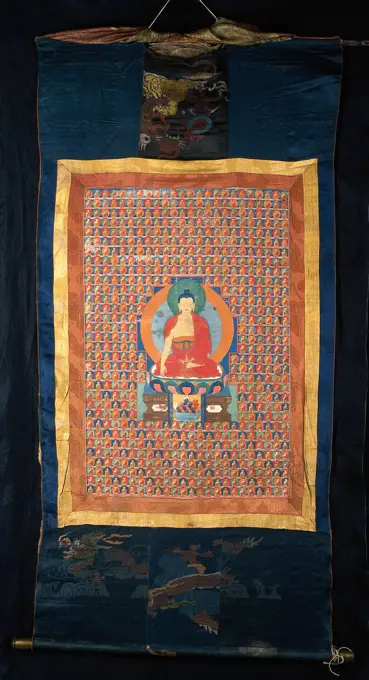
The Buddha Aksobhya surrounded by six hundred and ten replicas of himself. Distemper painting by a Tibetan painter.
4069-6433
Bodhisattva Avalokitesvara with 1000 hands and 1000 eyes, painting on silk, c.983 AD, Song Dynasty, from caves at Mogao (Gansu), Dunhuang, detail
1890-105352
The Life of Buddha, Seoul, South Korea, Asia
4409-17520996
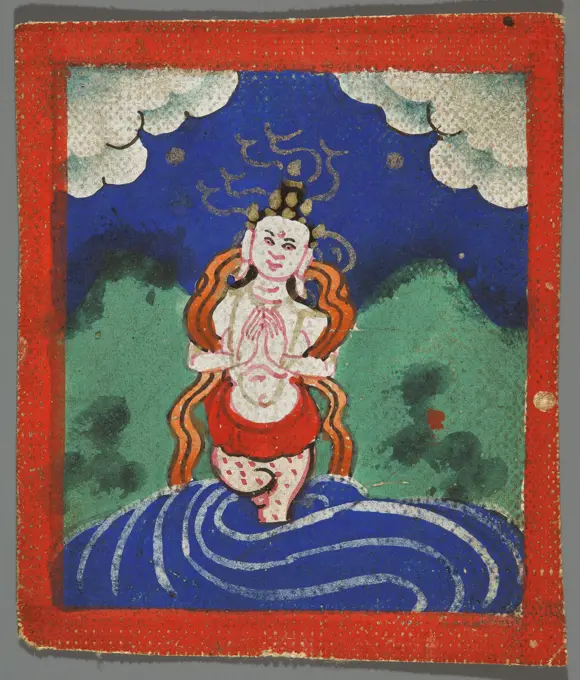
Image from a Set of Initiation Cards (Tsakali). Southern Tibet. Date: 1301-1500. Dimensions: 16 x 14.5 cm (6 1/4 x 5 3/4 in.). Ink and watercolor on paper. Origin: Tibet. Museum: The Chicago Art Institute, Chicago, USA.
4409-17578843
'Guhyasadhana Hayagriva'. Tibet, 18th century. Dimensions: 46x36,5 cm. Museum: State Hermitage, St. Petersburg.
4409-17504527
Tenth Shamarpa, Mipam Chodrup Gyatso (1742-1792). Date/Period: 19th century. Painting. Pigments on cloth Pigments on cloth. Height: 635 mm (25 in); Width: 406.40 mm (16 in). Author: UNKNOWN.
1746-19692123
Tibetan thankas, (Buddhist temple paintings) - they were painted by different lama artists employed by the Norwegian missionary Theo Sorensen and came to the museum in 1922. The thankas with their rich iconography present Buddhist teaching and dogmas, both systematically and historically from Buddha's time to the development of Tibetan variation.
4272-32432
Sera Monastery.  Along Sera's kora, or pilgrimage circuit, a monk bows before a rock-painted image of Yama Dharmaraja, a bull-headed protector deity favoured by the Gelugpa school.   Behind rises a slender building from which a giant thangka, or religious painting, is unfurled during festivals.
7062-70065023
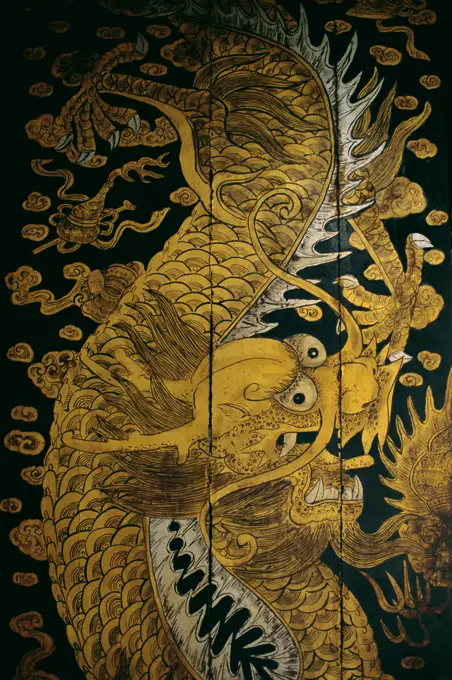
Dragon embroidery inside Tagong Monastery, Tagong, western Sichuan, China
6145-29217831
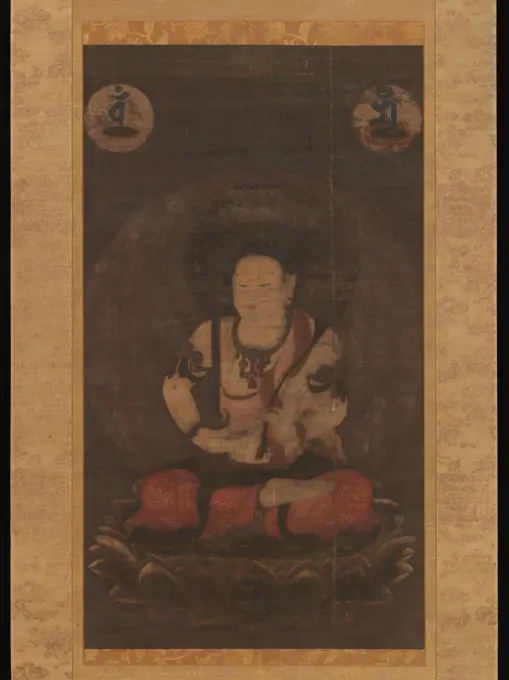
The Bodhisattva Monju (Manjushri) with Five Topknots 13th century Japan This variant form of the bodhisattva Monju, a deity associated with wisdom, is called Monju with Five Topknots (Gokei Monju). Imagined as a boy sitting cross-legged on a lotus pedestal, he holds his usual attributes: a sword and sacred text. A pair of Sanskrit letters above him stands for Dainichi, the buddha at the center of the Buddhist cosmos.. The Bodhisattva Monju (Manjushri) with Five Topknots. Japan. 13th century. Hanging scroll; ink and color on silk. Kamakura period (1185-1333). Paintings
6145-29250934
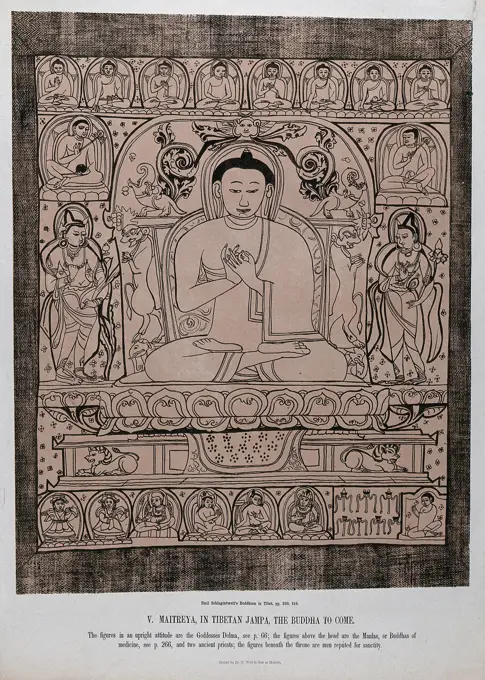
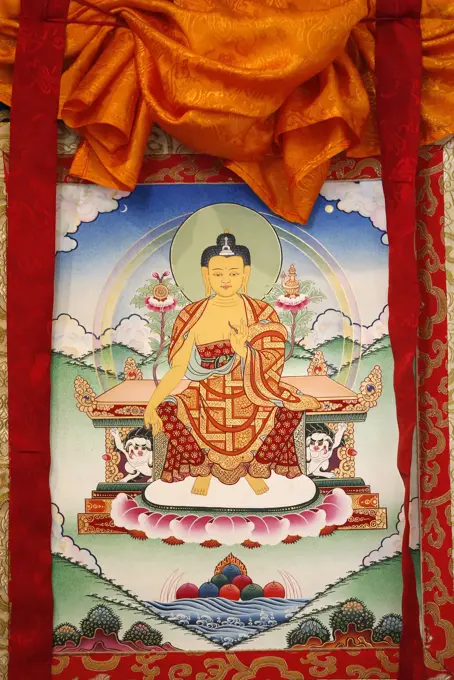
Maitreya, in Tibetan Jampa, the Buddha to come. Chromolithograph.
7222-71299025
India, Jammu and Kashmir, Ladakh, Leh. Colorful fresco-like images of the Buddha dot the rocky hills above Old Leh and serve as devotional offerings or informal shrines for the local Buddhist population.
4409-17430179
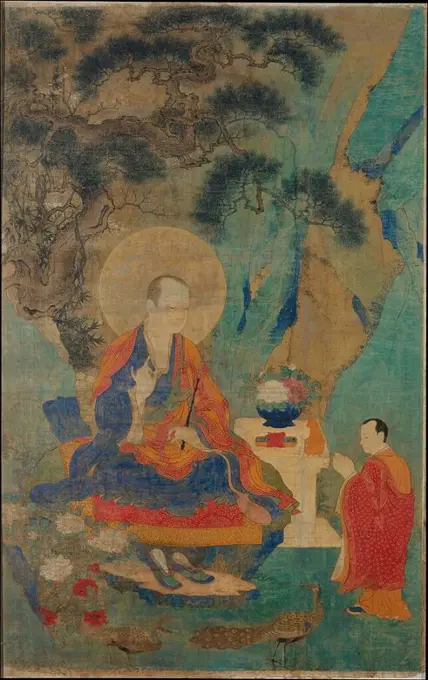
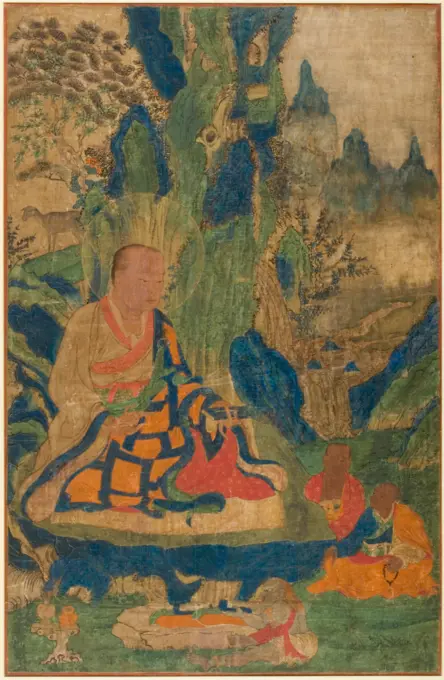
The Arhat Vajraputra. Artist: Unidentified Artist Sino-Tibetan, 15th century. Culture: Tibet. Dimensions: Image: 32 x 20 in. (81.3 x 50.8 cm). Date: 15th century.Tibetan Buddhism, imported in China by Mongol rulers in the thirteenth century, enjoyed further patronage from fifteenth-century emperors of the early Ming period. This work vividly demonstrates how hieratic Tibetan imagery was transformed under Chinese influence into a more naturalistic style, witnessed most strongly in the Sinicized treatment of landscapes. This painting, originally part of a set depicting the sixteen arhats (Buddhist saints), portrays Vajraputra, his hand raised in the teaching gesture (vitarkamudra), expounding dharma to a devotee. Tibetan inscriptions appear on the lower left margin and on the reverse. Museum: Metropolitan Museum of Art, New York, USA.
1760-30819
Thailand, Ayuthaya, Wat Suwan Daram, Close-up of beautifully detailed murals
1899-18792206
In Tibetan Buddhism, Dorje Pakmo (pronounced 'Dorje Phakmo'; Sanskrit: Vajravarahi, a form of Vajrayogini; Wylie Tibetan script transliteration: Rdo-rje phag-mo; English: 'The Diamond Sow'), also known as Sera Kandro, is believed to be the reincarnation of the consort of the wrathful deity Demchok (Heruka). She is the highest female incarnation in Tibet and the third-highest ranking person in the Lamaist hierarchy after the Dalai Lama and the Panchen Lama. She was listed among the highest-ranking reincarnations at the time of the Fifth Dalai Lama, recognized by the Tibetan government and acknowledged by the emperors of Qing China. Her seat, Samding (literally, 'the temple of soaring meditation') was in many ways unique in that about half of the inhabitants were monks and the other half were nuns, while the head of the monastery with all its branches was (and still is) a woman. It is a Geluk Ani gompa (or nunnery) - which also housed some monks - and is built on a hill on a peninsula ju
6145-29068786
Vajradhara, Nairatmya, and Mahasiddhas Virupa and Kanha, c. 1450. Central Tibet, Ngor monastery. Gum tempera and gold on cotton; framed: 74.8 x 59.8 cm (29 7/16 x 23 9/16 in.); overall: 57.5 x 50.2 cm (22 5/8 x 19 3/4 in.).
6145-29122295
Yantra of Panchanguli. India, Rajasthan, Dilwara (), circa 1425. Drawings; watercolors. Opaque watercolor, ink, and gold on cotton
6145-51818787
Three Illustrated Palm Leaves from a Pancharaksha Manuscript Three Illustrated Palm Leaves from a Pancharaksha Manuscript, 11th-12th century. Opaque watercolors and ink on palm leaves, Each: 2 1/2 x 12 3/4 in. (6.4 x 32.4 cm).   Asian Art 11th-12th century
6145-51822240
Magzor Gyalmo , 18th-19th century. Ink, color, gold, silver on cotton, 12 1/4 x 9 7/8 in.   Asian Art 18th-19th century
6188-64578515
Painting of god Buddha in Rumtek monastery, Sikkim, India Copyright: xAshaxAdatia/DinodiaxPhotox
1848-55000112
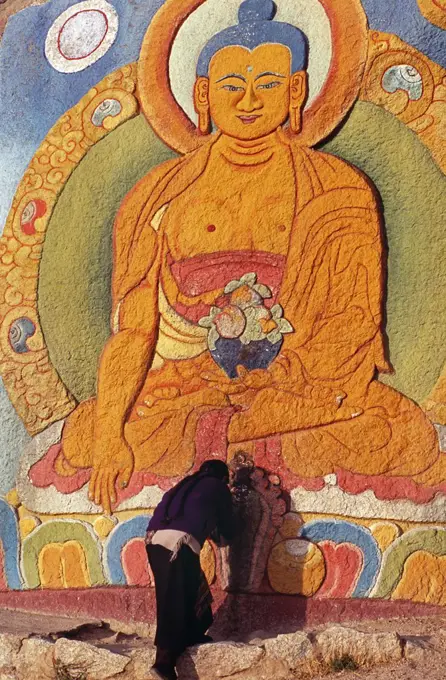
The Blue Buddha in Lhasa, Tibet, Asia
1890-103950
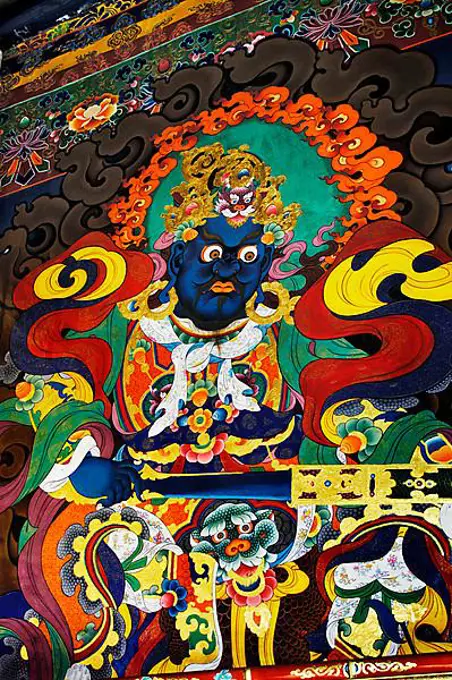
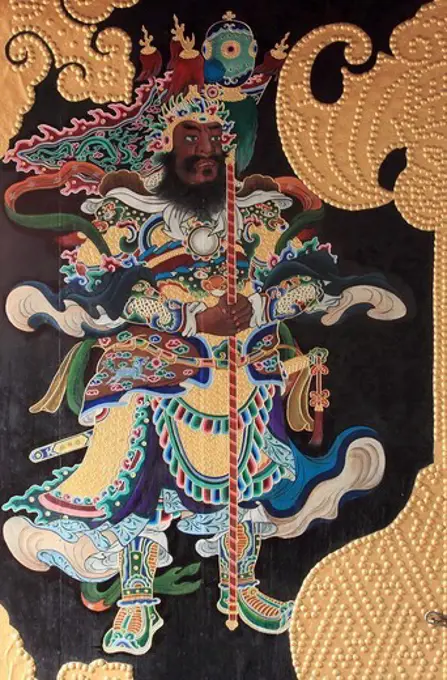
Temple guardian guarding the East and spring, named Dhritarashtra, Kopan monastery, Kathmandu, Nepal, Asia
1899-71247
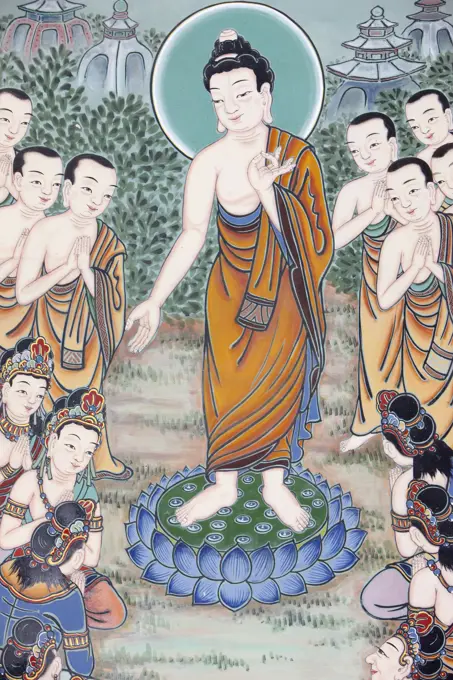
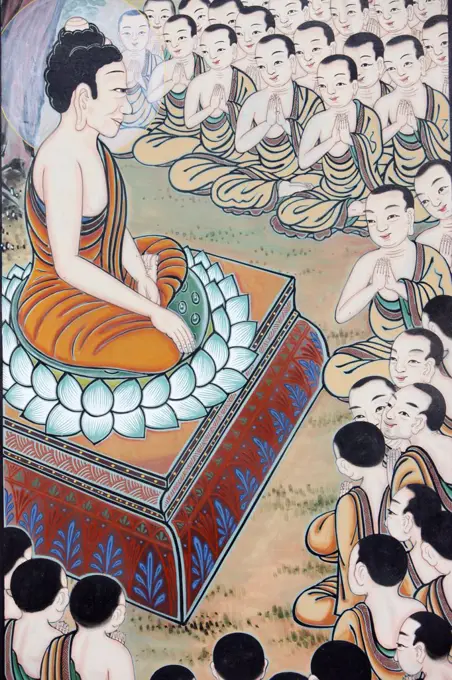
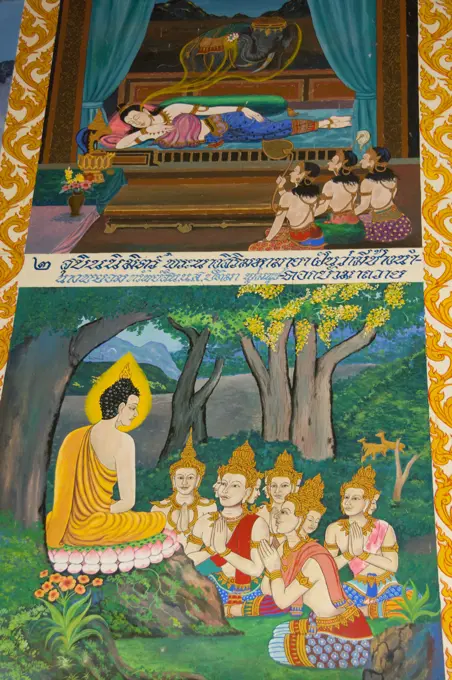
Life of Buddha. The Buddha gained many followers. On one occasion 1250 monks gathered spontaneously to hear his teaching. (This day is commemorated as a holiday in Buddhist countries.)
1886-52598
Virudhaka, the gaurdian King of the south, Tagong  Monastery (Lhagang Gompa) - Kham (E. Tibet), Sichuan Province, China
4409-28962035
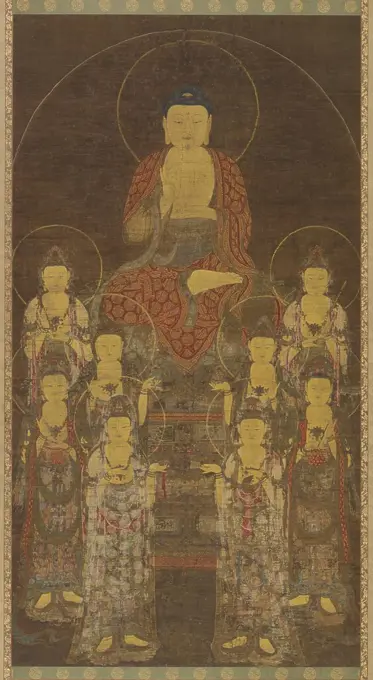
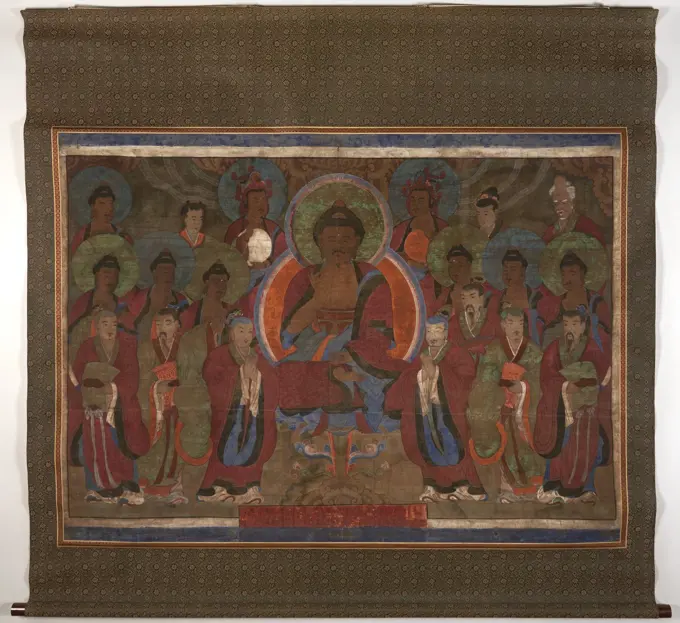
Buddha and eight disciples. The Buddha is seated on a lotus throne aloft, in the attitude of teaching. His throne rests upon an alter decorated in lotus motive, and before this and at his sides are eight Bodhisattvas, the "Beings of Enlightenment", depicted in beauty and brilliantly garbed. Each, like the Buddha himself, has a nimbus. The Bodhisattvas are standing, in groups of four. Silk a deep dark brown, considerably worn and showing some cracks. Vestiges of seal marks at lower left, unreadable. Origin: Korea. Ink, color, and gold on silk. Date: mid-late 14th century. Period: Late Goryeo period. Museum: Freer Gallery of Art and Arthur M. Sackler Gallery.
1760-23894
asian art, close-up of exotic textile
6145-43638966
Mianran accepts/receiving offerings. Pracownia przyklasztorna, painter
4409-17381088
Vajrabhairava. Culture: China. Dimensions: 57 1/2 x 30 in. (146.1 x 76.2 cm)Mount (including backboard and bonnet): 63 1/4 × 34 9/16 × 3 5/8 in. (160.7 × 87.8 × 9.2 cm). Date: early 15th century.The powerful protective deity Vajrabhairava became important in Tibet and ultimately played an role in Buddhist practice at the Chinese court. In the upper right hand corner is almost certainly the Gelugpa lama Shakya Ye shes, who visited the court of the Ming Yongle-period emperor Chengzu, when he conducted Vajrayana rituals in 1415-16. In conjunction with Shaka Ye shes's return to Tibet, where he ultimately became the first abbot of the Sera Monastery, the emperor Chengzu sent gifts. These included an inscribed embroidered tangka from the same workshop, possibly explaining the origins of this work. This extraordinary example of the embroiderer's art employs extremely fine silk floss and achieves brilliant gradations of color; the use of horsehair underneath creates three-dimensional effects
6145-46805342
Third Dalai Lama, Sonam Gyatso(1543-1588)
6145-29117709
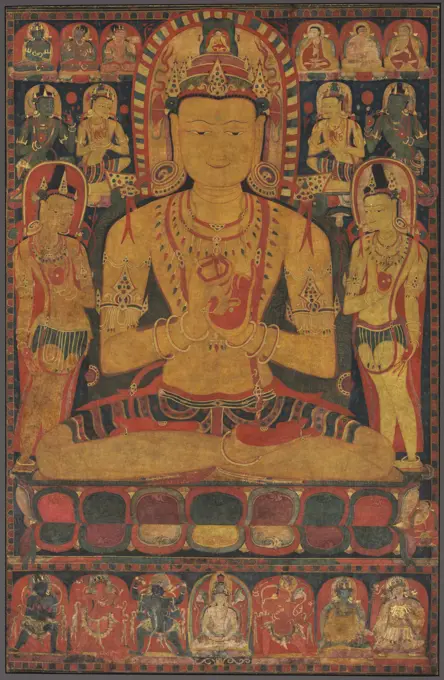
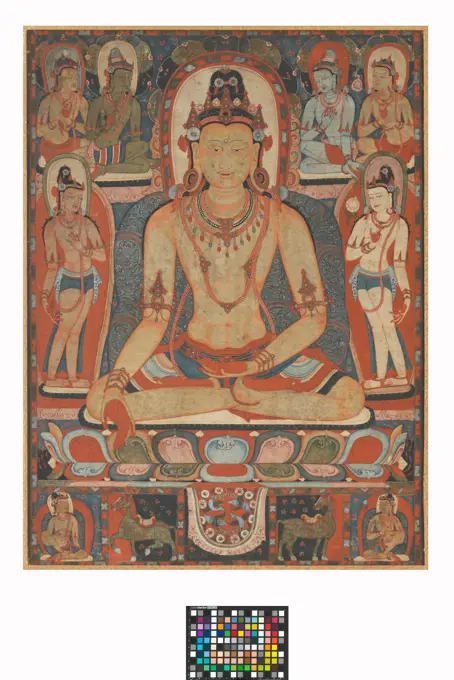
The Jina Buddha Ratnasambhava. Central Tibet, a Kadampa Monastery, circa 1150-1225. Paintings. Mineral pigments on cotton cloth
6188-60053821
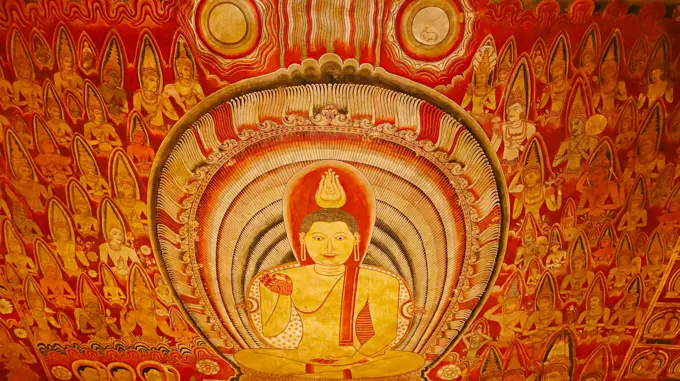
Mural painting of Lord Buddha inside Cave 1 Deva Raja Viharaya  The Cave of  Lord of the Gods. , Cave Temple of Dambulla, 1st Century BCE, Sri Lanka. UNESCO world heritage site Mural painting of Lord Buddha inside Cave 1 Deva Raja Viharaya  The Cave of  Lord of the Gods. , Cave Temple of Dambulla, 1st Century BCE, Sri Lanka. UNESCO world heritage site Copyright: xZoonar.com/RealityImagesx 21646295
1848-49529903
Old wall painting in a tibetan tempel in the kingdom of Guge, Western Tibet, Asia
1899-18712569
Horyu-ji (Temple of the Flourishing Law) is a Buddhist temple in Ikaruga, Nara Prefecture, Japan. Its full name is Horyu Gakumonji, or Learning Temple of the Flourishing Law, the complex serving both as a seminary and a monastery. In 1993, Horyu-ji was inscribed as a UNESCO World Heritage Site under the name Buddhist Monuments in the Horyu-ji Area. The Japanese government lists several of its structures, sculptures and artifacts as National Treasures. The kondo, or great hall of the temple, dating in part to the 7th century, is famous for its 7th century Buddhist murals. Unfortunately, on January 26, 1949, a fire in the kondo caused very severe damage to the murals, many of which were destroyed. The murals of the kondo comprise fifty walls; four larger walls, eight mid-sized walls and thirty-eight small wall areas inside the building. The original murals were removed after the fire incident in 1949 and are kept in storage. Twenty small wall paintings that escaped the fire remain in pla
1848-54718162
Fresco, Lalung Monastery or Gompa, Lahaul and Spiti district, Himachal Pradesh, Indian Himalayas, North India, Asia
6188-65543504
Captivating painting of the Buddhist life wheel life-chakra on the monastery wall, Tawang, Arunachal Pradesh, India. Captivating painting of the Buddhist life wheel life-chakra on the monastery wall, Tawang, Arunachal Pradesh, India.
1899-18720865
The Bezeklik Thousand Buddha Caves (Bozikeli Qian Fo Dong) are complex of Buddhist cave grottos dating from the 5th to the 9th centuries. There are 77 rock-cut caves at the site. Some ceilings are painted with a large Buddha surrounded by other figures, including Indians, Persians and Europeans. The quality of the murals vary with some being artistically naive while others are masterpieces of religious art.
7155-70377356
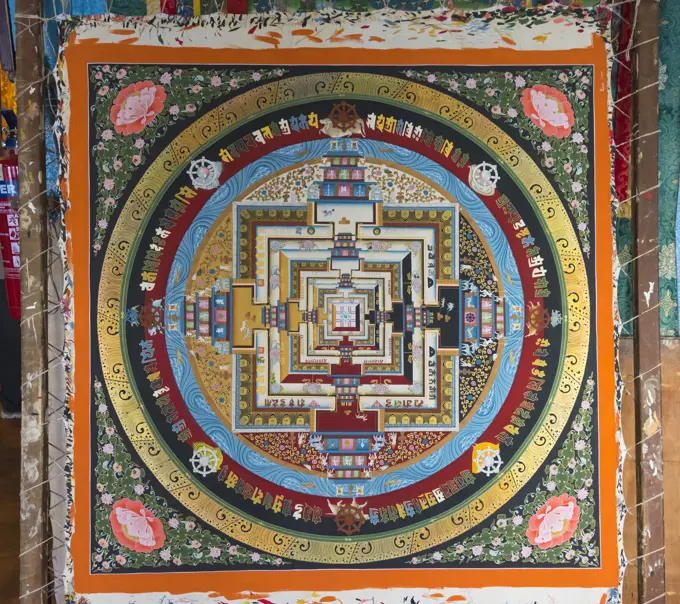
Asia, Tibet. Samyara Mandala, represents detachment and impermanence. Tibet.
1899-19189218
The Punakha Dzong, also known as Pungtang Dewa chhenbi Phodrang ('the palace of great happiness or bliss') was built in 1637 - 1638 by the 1st Zhabdrung Rinpoche and founder of the Bhutanese state, Ngawang Namgyal (1594 - 1651). It is the second largest and second oldest dzong (fortress) in Bhutan, located at the confluence of the Pho Chhu (father) and Mo Chhu (mother) rivers in the Punakha-Wangdue valley. Punakha Dzong is the administrative centre of Punakha District, and once acted as the administrative centre and the seat of Bhutan's government until 1855, when the capital was moved to Thimphu, though it still acts as the winter capital for the head of the Bhutanese clergy. It houses sacred relics from the southern Drukpa Lineage of the Kagyu school of Tibetan Buddhism.
1899-20090701
Pema Osel Ling Monastery.  The wheel of life or the bhavacakra  is a symbolic representation of saṃsara.  Wall painting..
6188-62333182
Painting of Buddhist deities on Phyang Monastery, Leh, Ladakh, India. Painting of Buddhist deities on Phyang Monastery, Leh, Ladakh, India. Copyright: xZoonar.com/RealityImagesx 22018179
7062-70065508
Buddhist mural inside the grotto, Mati Temple Scenic Area. Zhangye, Gansu Province, China.
6145-29742357
Sakya Pandita (1182-1242) late 17th-early 18th century Tibet. Sakya Pandita (1182-1242) 37831
1746-57662341
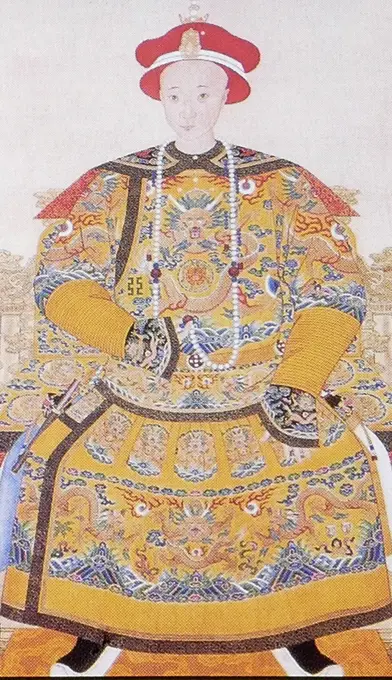
Aisin-Gioro Zai Chun, Emperor Muzong of the Qing Dynasty
7155-70375191
Buddha, teacher and pupils, Uigar period , Silk Road from Ming-oi, 8th cent. CHINA.
1899-18716679
The Mogao Caves, or Mogao Grottoes (Chinese: mogao ku), also known as the Caves of the Thousand Buddhas and Dunhuang Caves, form a system of 492 temples 25 km (15.5 miles) southeast of the center of Dunhuang, an oasis strategically located at a religious and cultural crossroads on the Silk Road, in Gansu province, China. The caves contain some of the finest examples of Buddhist art spanning a period of 1,000 years. The first caves were dug out 366 CE as places of Buddhist meditation and worship. The Mogao Caves are the best known of the Chinese Buddhist grottoes and, along with Longmen Grottoes and Yungang Grottoes, are one of the three famous ancient sculptural sites of China. The caves also have famous wall paintings.
6145-29066455
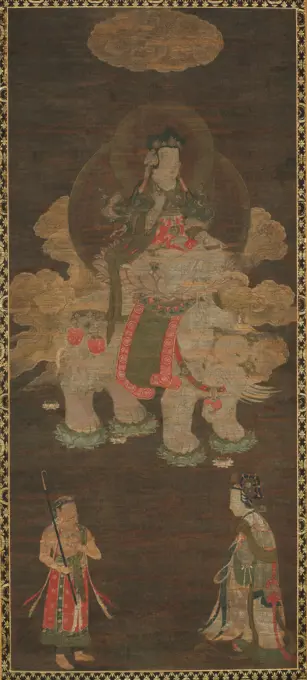
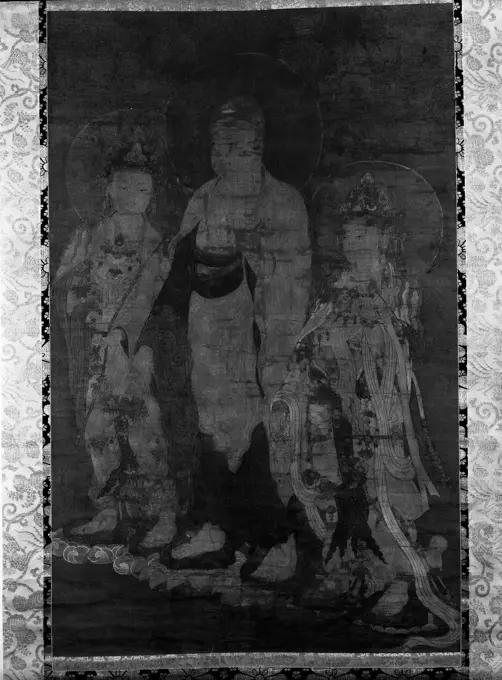
Shakyamuni Triad: Buddha Attended by Manjushri and Samantabhadra (Bodhisattva with Elephant), late 1300s. China, Fuzhou, Fujian Province, Yuan dynasty (1271-1368). Hanging scroll, ink and color on silk; overall: 106.9 x 46.4 cm (42 1/16 x 18 1/4 in.).
6145-59055232
Miniature with the image of one of the naked kings named Padma;  2. PO. XIX W.-1. after. 20th century (1851-00-00-1950-00-00);Deposits, the art of Tibetan Buddhism
1890-94976
Subodharama Temple, dating from the mid 19th century, Dehiwala, Colombo, Sri Lanka, Asia
4409-17351908
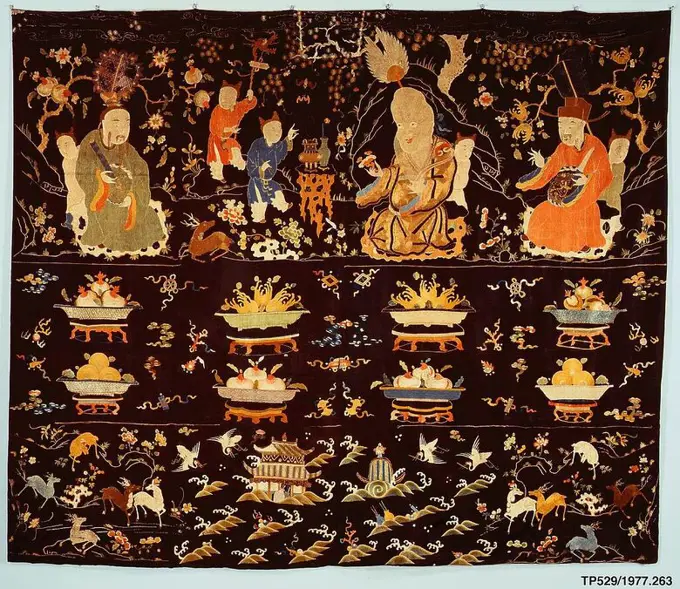
Three Stars of Happiness. Culture: China. Dimensions: 81 × 95 in. (205.7 × 241.3 cm). Date: late 17th century-early 18th century.This embroidered altar hanging is organized into three registers. The top and most important register features three auspicious figures known as the Three Stars of Happiness: Happiness (fu), Emoluments and Official Preferments (lu) and in the center, Longevity (shou). They are shown with attendants and various attributes in a garden setting. The middle section, with offering bowls, possibly lay on the horizontal atop an altar table, and the lowest register may have hung down in front of the table.One kay to the dating of this textile is the fact that each of the two flanking figures on the hanging wears a rank badge bearing a single bird and prominent sun, a style that came into being in the Qing dynasty. Museum: Metropolitan Museum of Art, New York, USA.
6145-29135142
The Arhat Abheda. Eastern Tibet, Kham region, a Trungpa Monastery in Surmang (), circa early 17th century. Paintings. Mineral pigments and gold on silk
1899-18789465
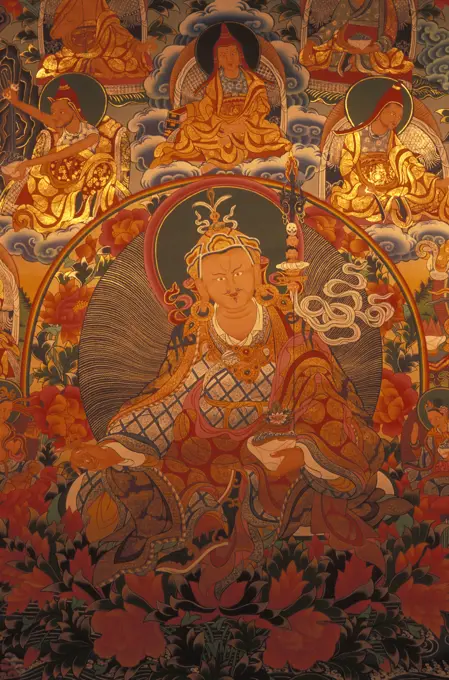
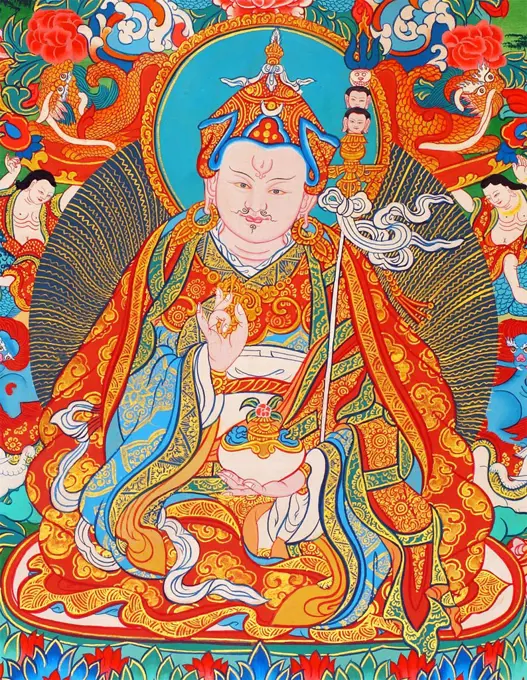
Padmasambhava, (Sanskrit Padmakara; Tibetan Pemajungne; Chinese Lianhuashang) or 'Lotus Born', was a guru from Oddiyana (modern Swat) who is said to have transmitted Vajrayana Buddhism to Bhutan and Tibet and neighbouring countries in the 8th century. In those lands he is better known as Guru Rinpoche ('Precious Guru') or Lopon Rinpoche, or, simply, Padum in Tibet, where followers of the Nyingma school regard him as the second Buddha. His Pureland Paradise is Zangdok Palri (the Copper-coloured Mountain). He is further considered an emanation of Buddha Amitabha and traditionally even venerated as a second Buddha. He was born into a Brahmin family of Northwest India.
1899-18791696
It is estimated that between two thirds and three quarters of the Bhutanese population follow Vajrayana Buddhism, which is also the state religion. About one quarter to one third are followers of Hinduism. Buddhism was introduced to Bhutan in the 7th century AD. According to legend, Guru Rinpoche ordered the Tibetan king Trisong Detsen to have 108 temples built all over the Himalayas. Doing so would aid in subduing a demoness and allow for the construction of Samye Temple in neighbouring Tibet.
4409-45442
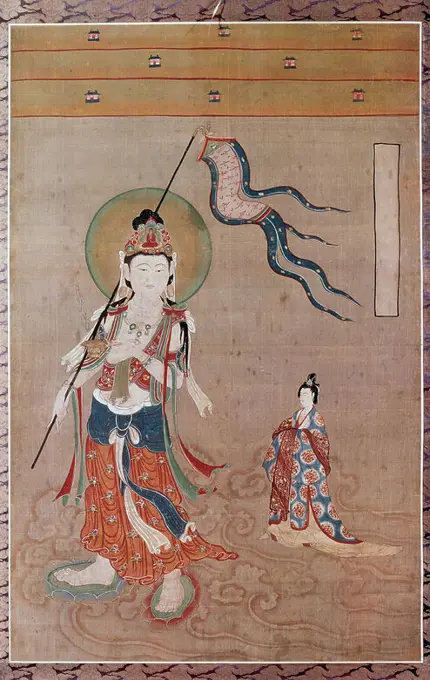
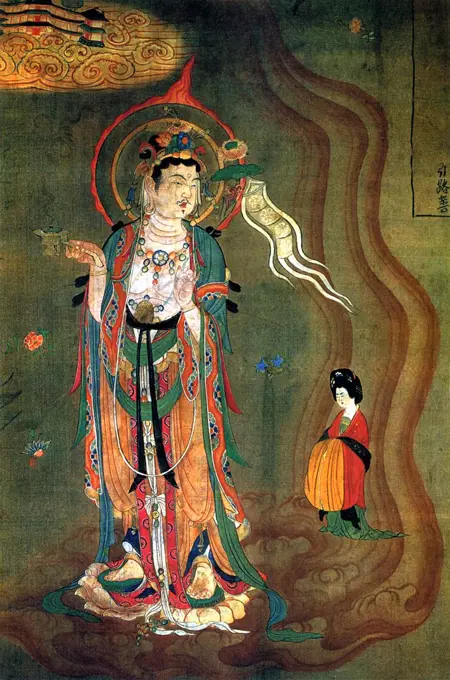
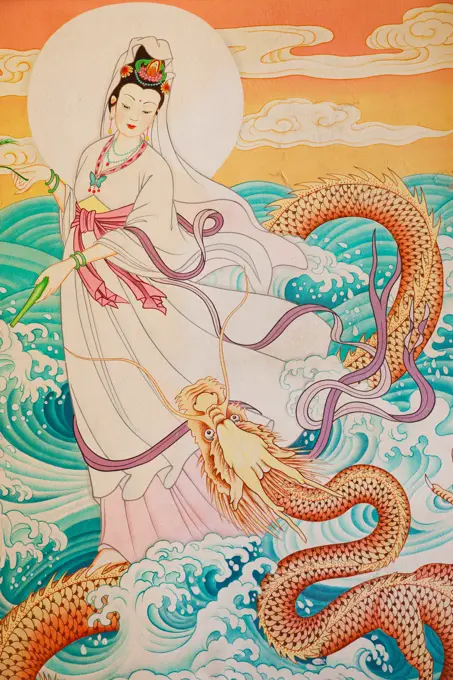
Chinese Art. 10th century. Guanyin guiding a soul as an Oriental version of the myth of Charon. It is probably a copy made in the Ming period of another painting of the Tang period disappeared.
1899-18792222
Vajrayoginī (Sanskrit: Vajrayoginī; Tibetan: Dorje Naljorma, Wylie: Rdo rje rnal byor ma; Mongolian: Огторгуйд Одогч, Нархажид, Chinese: 瑜伽空行母 Yújiā kōngxíngmǔ) is the Vajra yoginī, literally 'the diamond female yogi'. She is a Highest Yoga Tantra Yidam (Skt. Iṣṭha-deva), and her practice includes methods for preventing ordinary death, intermediate state (bardo) and rebirth (by transforming them into paths to enlightenment), and for transforming all mundane daily experiences into higher spiritual paths. Vajrayoginī is a generic female yidam and although she is sometimes visualized as simply Vajrayoginī, in a collection of her sādhanas she is visualized in an alternate form in over two thirds of the practices. Her other forms include Vajravārāhī (Tibetan: Dorje Pakmo, Wylie: rdo-rje phag-mo; English: the Vajra Sow) and Krodikali (alt. Krodhakali, Kālikā, Krodheśvarī, Krishna Krodhini, Sanskrit; Tibetan: Troma Nagmo; Wylie: khros ma nag mo; English: 'the Wrathful Lady' or 'the Fierce Bl
1848-50142624
Mural painting, Sankar Monastery or Gompa, Leh, Ladakh, India, Asia
6145-29263457
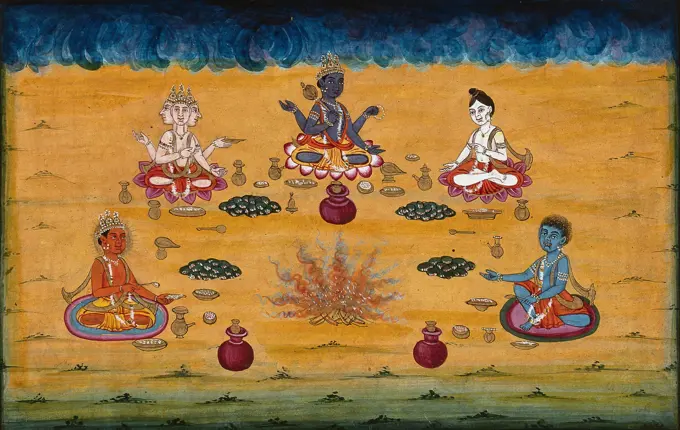
Vishnu, Brahman and three other deities perform a yagna, a fire sacrifice, an old vedic ritual where offerings are made to the god of fire, Agni. Gouache painting by an Indian artist.
6145-51822225
Arhat Angaja (One of Nine Tibetan Ritual Paintings of Arhats) , 17th century. Opaque watercolor on silk mounted on a paper and wood frame, Each painting: 43 x 25 1/2 in.   Asian Art 17th century
7062-70067673
Thangka painting, Kathmandu, Nepal
4409-17408636
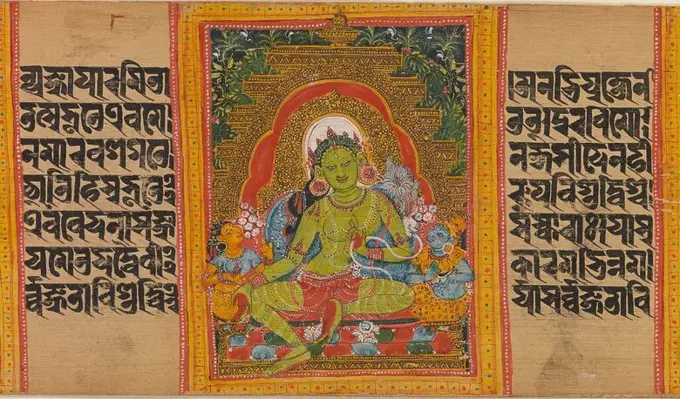
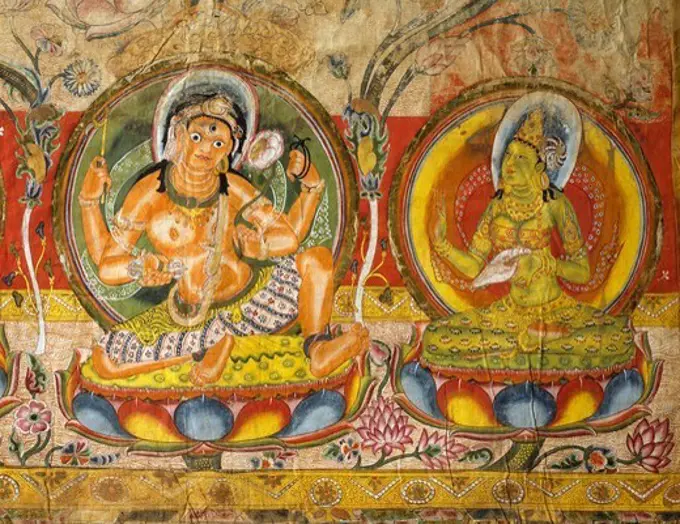
Green Tara, Folio from a dispersed Ashtasahasrika Prajnaparamita (Perfection of Wisdom) Manuscript. Culture: India (Bengal) or Bangladesh. Dimensions: 2 3/4 x 16 1/2 in. (7 x 41.9 cm). Date: early 12th century.Enshrined image of seated Green Tara with pendant leg and blue lotus, with two female attendants, one holding a vajra; the other, Mahakali, holding a flaying knife and skullcup (kapala). Museum: Metropolitan Museum of Art, New York, USA.
1525-20801126
Mural on wall, Rinpung Dzong, Paro District, Bhutan
4409-20999761
Acala. Tangut State of the Western Xia (982-1227). Khara-Khoto. Late 12th-14th century. Tangka: colours on silk .The State Hermitage Museum. Saint Petersburg. Russia.
4409-17420850
Initiation Card (Tsakalis): Vajrapani. Culture: Tibet. Dimensions: Each: 6 1/4 x 5 3/4 in. (16 x 14.5 cm). Date: early 15th century.Tsakali cards were used by itinerant teachers moving from one monastery to another in order to evoke Vajrayana Buddhist deities. When laid on the ground in the form of a mandala, as seen here, they functioned to create a fixed sacred space like that of a temple. The deities shown on these initiation cards include the Tathagata Buddhas, various bodhisattvas, fierce protectors, and the six possible realms of rebirth seen across the bottom. They probably were made by a Nepali artist for a Tibetan patron of the Nyingma school of Tibetan Buddhism.Tsakali cards were used individually to align a disciple with a deity from the vast pantheon. First, the disciple sought permission from the deity, either through a dream or under the guidance of a teacher. The associated ritual involved visualizing the deity as described in recited mantras (incantations) and with an
4409-17576136
'Buddha Amitabha'. China, Tangut State of Xi -Xia, Khara-Khoto, 14th century. Dimensions: 46,5x36 cm. Museum: State Hermitage, St. Petersburg.
1899-18712573
Horyu-ji (Temple of the Flourishing Law) is a Buddhist temple in Ikaruga, Nara Prefecture, Japan. Its full name is Horyu Gakumonji, or Learning Temple of the Flourishing Law, the complex serving both as a seminary and a monastery. In 1993, Horyu-ji was inscribed as a UNESCO World Heritage Site under the name Buddhist Monuments in the Horyu-ji Area. The Japanese government lists several of its structures, sculptures and artifacts as National Treasures. The kondo, or great hall of the temple, dating in part to the 7th century, is famous for its 7th century Buddhist murals. Unfortunately, on January 26, 1949, a fire in the kondo caused very severe damage to the murals, many of which were destroyed. The murals of the kondo comprise fifty walls; four larger walls, eight mid-sized walls and thirty-eight small wall areas inside the building. The original murals were removed after the fire incident in 1949 and are kept in storage. Twenty small wall paintings that escaped the fire remain in pla
2003-602758
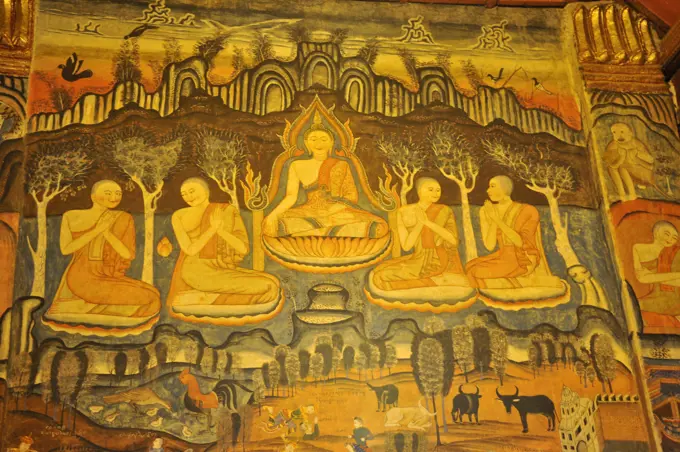
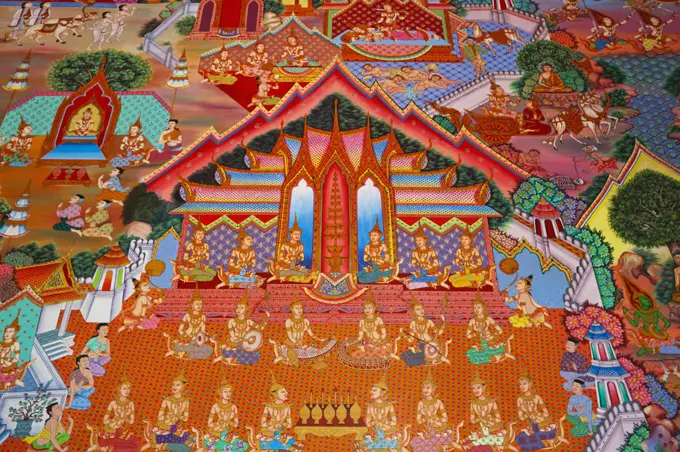
Thailand, Nan, Mural of Buddha and Followers on inside wall of Wat Pumin, Buddhist monastery
6145-29276227
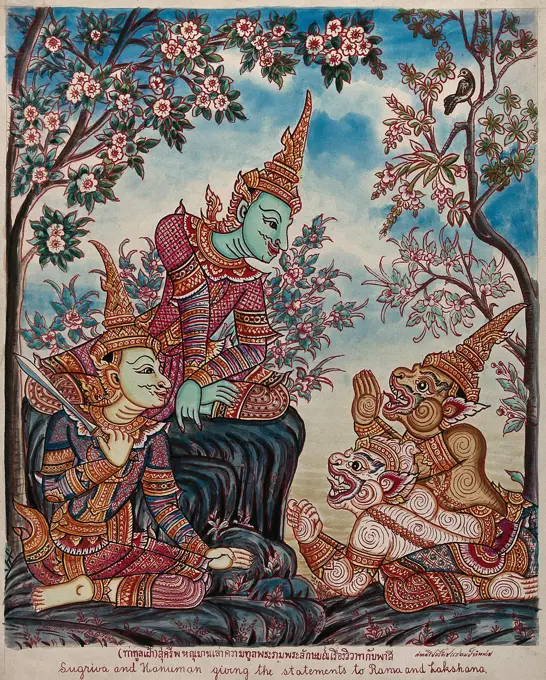
A scene from Ramayan: Sugriva and Hanuman giving the statements to Rama and Lakshana. Gouache painting by a Thai artist.
1788-41882
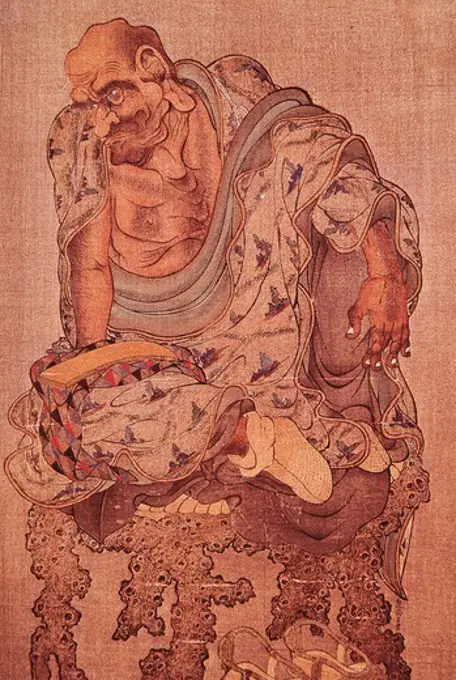
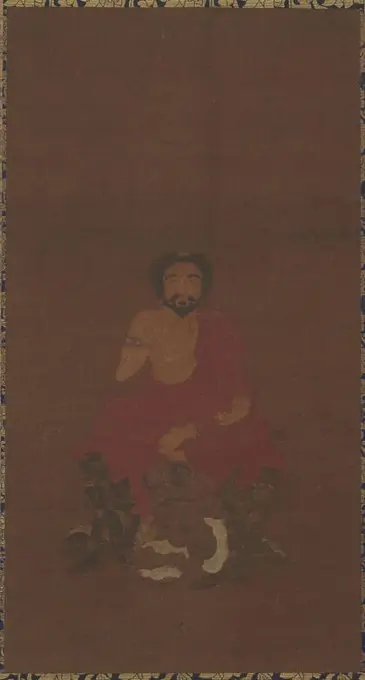
Lohan, ascetic monk, by Guanxiu (832-912), China. Chinese Civilisation, 10th century.
1899-18711441
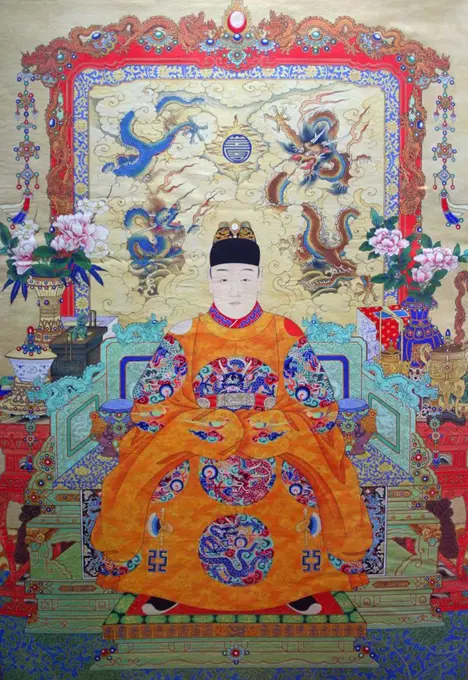
Emperor Chongzhen, 17th ruler of the Ming Dynasty (r. 1627-1644). Personal Name: Zhu Youjian, Zhu Yóujian. Posthumous Name: Zhuangliemin, Zhuanglièmin. Temple Name: Sizong, Sizong. Reign Name: Ming Chongzhen, Ming Chóngzhen. The Chongzhen Emperor was the last emperor of the Ming Dynasty in China. He reigned from 1627 to 1644, under an era name that means 'Honorable and Auspicious'. The decline of the Ming intensified during Chongzhen's reign. Popular uprisings broke out throughout China, including those of Zhang Xianzhong and the more important Li Zicheng. These could not be put down by the already hard-pressed Ming armies, who had to contend with the Manchu threat to the north. In April 1644, Li prepared to take the Ming capital of Beijing. Rather than face capture and probable execution at the hands of the newly-proclaimed Shun Dynasty, Chongzhen arranged a feast and gathered all members of the imperial household aside from his sons. Using his sword, he killed all of them there. All
7177-70564270
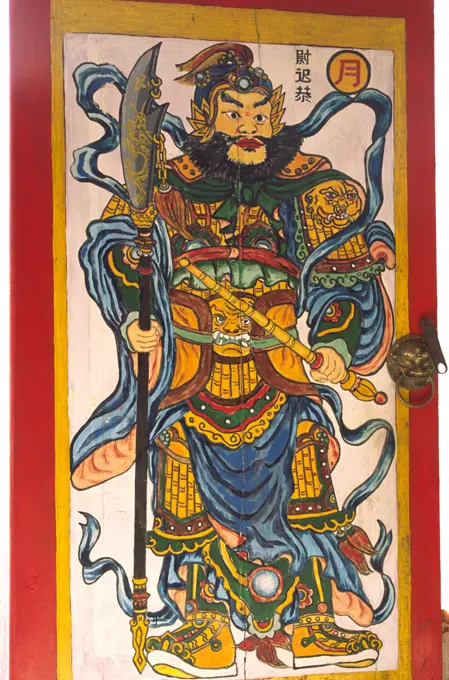
China, Yunnan, Nujiang Prefecture, Liuku. Door painting of immortal; Sand Mt. Buddhist Temple
1899-18711412
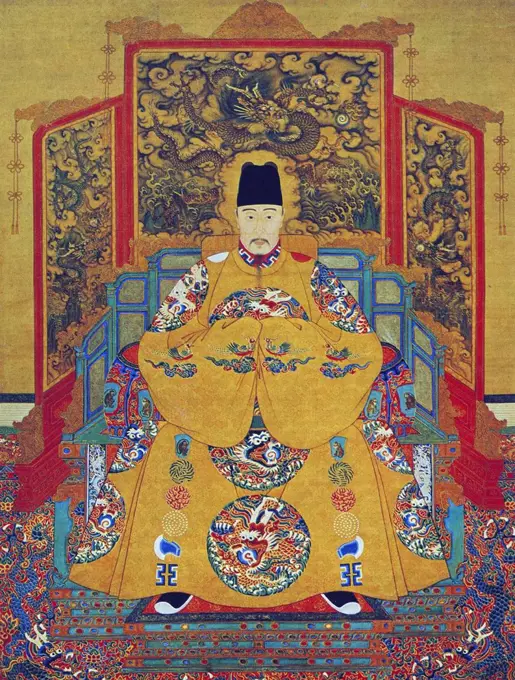
Emperor Jiajing, 12th ruler of the Ming Dynasty (r. 1521-1567). Personal Name: Zhu Houcong, Zhū Hòucōng. Posthumous Name: Sudi, Sùdì. Temple Name: Shizong, Shìzōng. Reign Name: Ming Jiajing, Ming Jiājìng. The Jiajing Emperor was the 12th Ming Dynasty Emperor of China who ruled from 1521 to 1567. His era name means 'Admirable Tranquility'. After 45 years on the throne (the second longest reign in the Ming Dynasty), Emperor Jiajing died in 1567 - possibly due to mercury overdose - and was succeeded by his son, the Longqing Emperor. Though his long rule gave the dynasty an era of stability, Jiajing's neglect of his official duties resulted in the decline of the dynasty at the end of the 16th century.
1899-19135928
China/Tibet: A Tibetan Manjuvajra Mandala featuring 43 deities, thangkha painting, tempera on cotton, 15th century, held at the Museo d'Arte Orientale, Turin/Torino
6176-67043205
'The Birth of Ganga', 1920. The river Ganges, considered sacred and pure is personified by the goddess Ganga. From "Myths of the Hindus & Buddhists", by The Sister Nivedita and Ananda K. Coomaraswamy. George G. Harrap & Company Ltd, London, 1920
1848-56095812
Wall painting, monastery of Ganden, Tibet
1889-86517
China, Xizang, Colorful painted image at Sera Monastery; Lhasa
4220-21887974
Manasa Devi (Padma), the  Goddess of snakes. She was the  daughter of Shiva & a mortal  woman.
6145-29792025
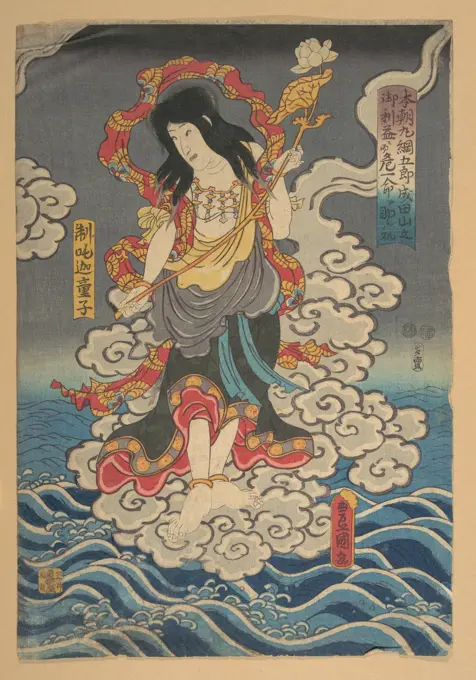
Maruami Gor Saved by Fud's (Acala) Attendant Seitaka from Narita Shrine 19th century Utagawa Kunisada Japanese. Maruami Gor Saved by Fud's (Acala) Attendant Seitaka from Narita Shrine. Utagawa Kunisada (Japanese, 1786-1864). Japan. 19th century. Woodblock print; ink and color on paper. Edo period (1615-1868). Prints
1899-20090690
Pema Osel Ling Monastery.  Tibetan Prayer Flag for Faith, peace, wisdom, compassion, and strength..
6145-29281619
China
6145-51833816
Painting of the Seven Stars (Chil Sung) Korean. Painting of the Seven Stars (Chil Sung), early 19th century. Hanging scroll: color on cloth, 81 × 75 in. (205.7 × 190.5 cm).   Asian Art early 19th century
1848-54753384
Image of a dark-skinned Buddha, fresco, Hemis Monastery, Ladakh, Indian Himalayas, Jammu and Kashmir, northern India, India, Asia
6145-29197200
The Wrathful Bon Deity Walse Ngampa, One of the Five Fortress Meditational Deities early 15th century Tibet. The Wrathful Bon Deity Walse Ngampa, One of the Five Fortress Meditational Deities. Tibet. early 15th century. Ink, gold and opaque watercolor on cloth. Paintings
6145-46819109
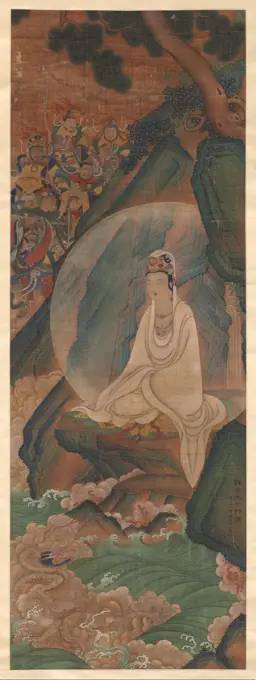
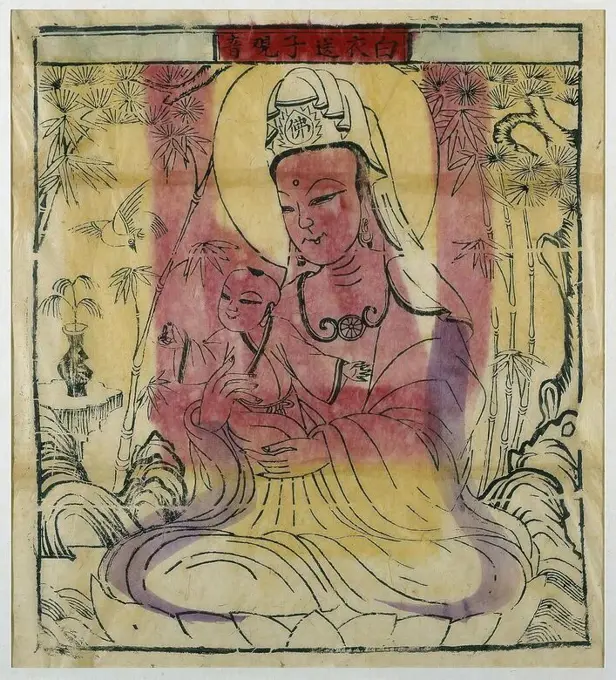
Bodhisattva Avalokiteshvara in the White-Robed Manifestation (BaiyiGuanyin).  Artist: Yena Yuanxian, Chinese, active 16th century
4409-17578839
'Goddess of Mercy Guanyin in White Chiton, The Child Giver'. China, late 19th - early 20th century. Dimensions: 40x47,5 cm. Museum: State Hermitage, St. Petersburg.
1848-50774346
Paintings in the Tibetan Monastery at Bodh Gaya, Bihar, India, Asia
1525-22529261
Ancient wall painting art of buddha in a historic Tibetan lamasery
6145-29274490
Tibetan fortune telling card. Watercolour, Tibet.
1558-15612975
Tibet, Shigatse, mural painting in the Tashi Lhunpo Monastery
6188-64536889
God Ganpati painting, Pastanga, Sikkim, India Copyright: xDinodiaxPhotox
1525-22529259
Ancient wall painting art of buddha in a historic Tibetan lamasery
6145-29738560
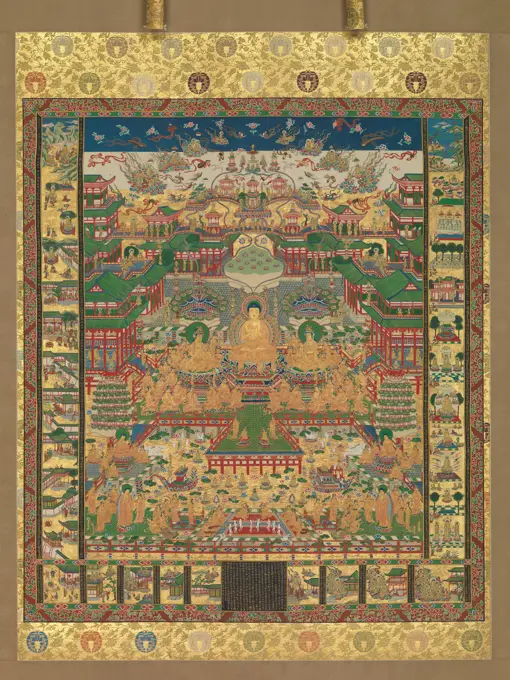
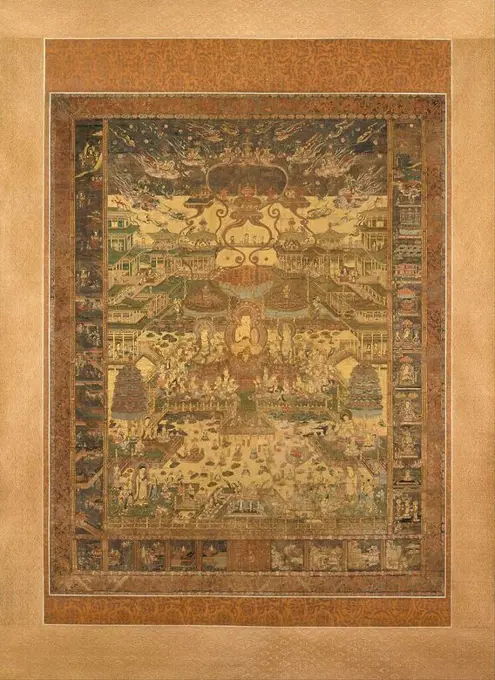
Taima Mandala 1750 Japan The Taima Mandala represents the Pure Land of the Buddha Amida (Sanskrit: Amitābha) bordered on three sides by parables from the Sutra on the Meditation on the Buddha of Infinite Life (Kanmuryōjukyō). This text, portions of which appear in the boundaries between scenes, recounts the promise at the core of Pure Land School teaching: that those who concentrate on the Buddha Amida during life, and recite his name, will be escorted to his Pure Land, known as the Western Paradise, at the final moment of death. The painting depicts an enormous palace with a golden pond presided over by Amida and his retinue.Musicians, dancers, and thirty-seven different types of celestial beings fill the skies and pavilions, surrounding the pond in the foreground. Those being born into the Pure Land emerge from lotus buds growing up through the water. The parables tell the story of Queen Vaidehi, who achieved birth there by performing sixteen meditations presented to her by Amida. Th
4409-28962823
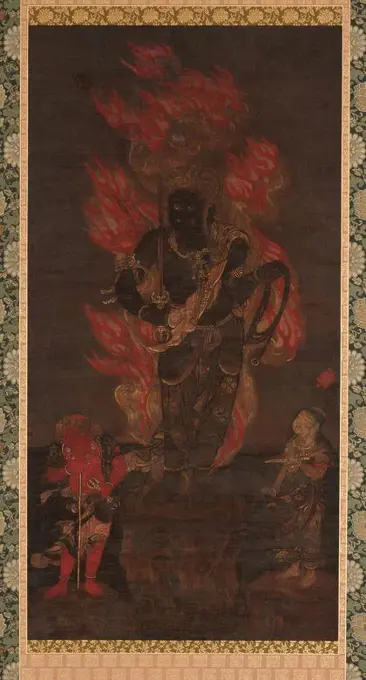
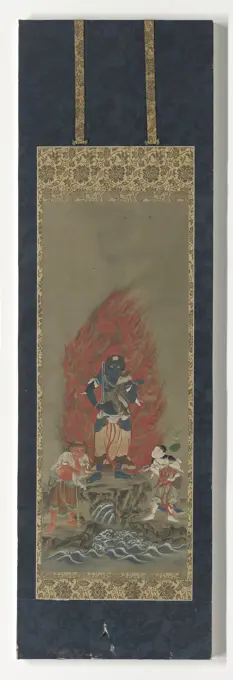
Fudo Myo'o and two attendants. Date: 14th century. Origin: Japan. Ink, color, and gold on silk. Period: Kamakura period. Museum: Freer Gallery of Art and Arthur M. Sackler Gallery.
4028-21746687
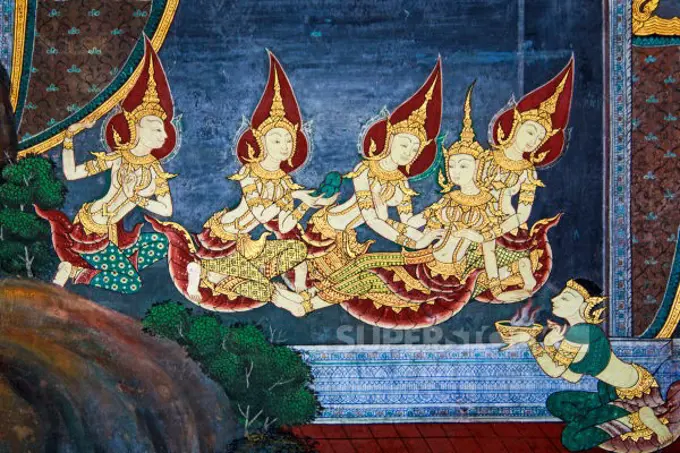
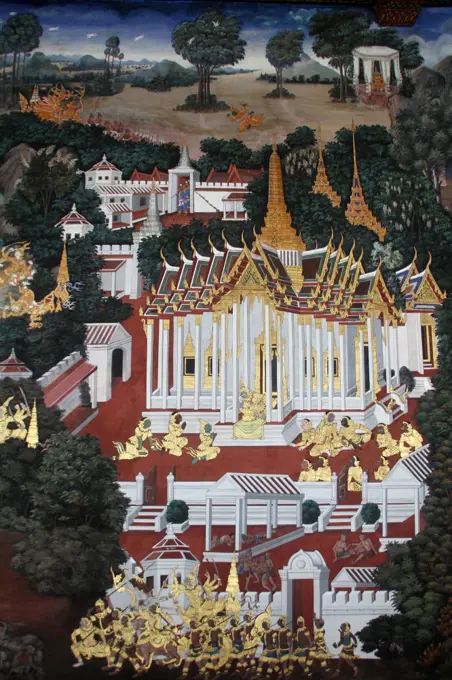
Bangkok, Thailand, Ancient fresco depicting Thai Courtesans, Ramakien Gallery, Wat Phra Kaew, Grand Palace, Temple of the Emerald Buddha
4409-17575119
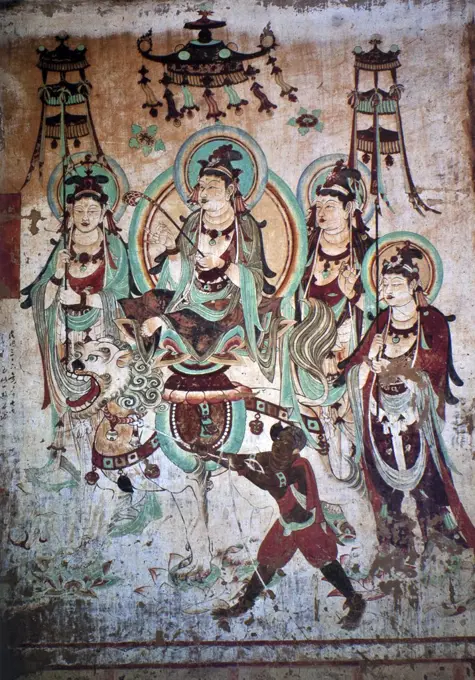
'Bodhisattva Avalokitesvara (Guanyin)'. Dunhuang, 10th century. Dimensions: 142x165,5 cm. Museum: State Hermitage, St. Petersburg.
1848-51333449
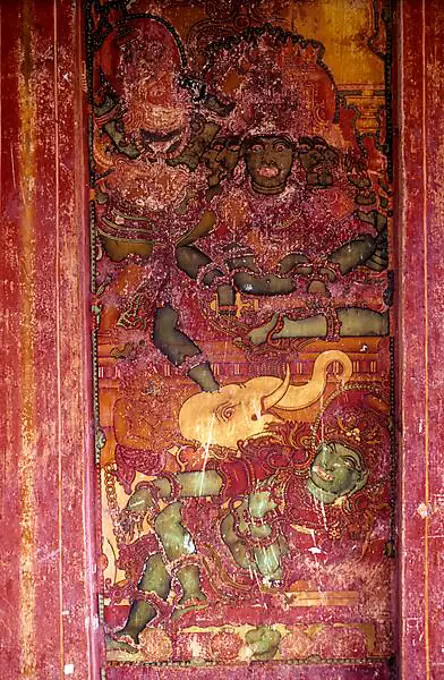
Murals fresco painting in Sri Thodeekkalam Siva temple in Kannavam near Thalassery, Kerala, South India, India, Asia
4409-17485251
Buddha of Medicine Bhaishajyaguru (Yaoshi fo). Date/Period: Ca. 1319. Painting. Water-based pigments over foundation of clay mixed with straw. Height: 751.8 cm (24.6 ft); Width: 1,511.3 cm (16.5 yd). Author: UNKNOWN.
442-37388
Thailand,Trat Province,Koh Chang,Salak Phet Bay,Wat Salak Phet,Interior Wall Decoration
6188-64559916
Hinduism, hindu art, himalayan academy art, religion, spirituality, artist S. Rajam, saint, worship, linga, sadhu, flowers, saivite, sivalinga, abhishekam Copyright: xHimalayanxAcademy/DinodiaxPhotox
7099-70351584
Bhutan, Punaka. A Wheel of Life painting covers a wall at Punakha Dzong in Bhutan.
6137-28991044
Buddhist painting. Buddhist temple. France.
4409-17486235
Scenes from the Life of an Unidentified Throne Holder of the Sakya School. Date/Period: 17th century. Painting. Ground mineral pigment on cotton. Height: 1,524 mm (60 in); Width: 812.80 mm (32 in). Author: UNKNOWN.
4409-17485681
Goddess Ushnishavijaya in Stupa. Date/Period: 15th century. Painting. Pigments on cloth Pigments on cloth. Author: UNKNOWN.
6145-29129285
Portrait of Two Taklung Lamas. Central Tibet, Taklung Monastery, 13th century. Paintings. Mineral pigments and gold on cotton cloth
6145-59274906
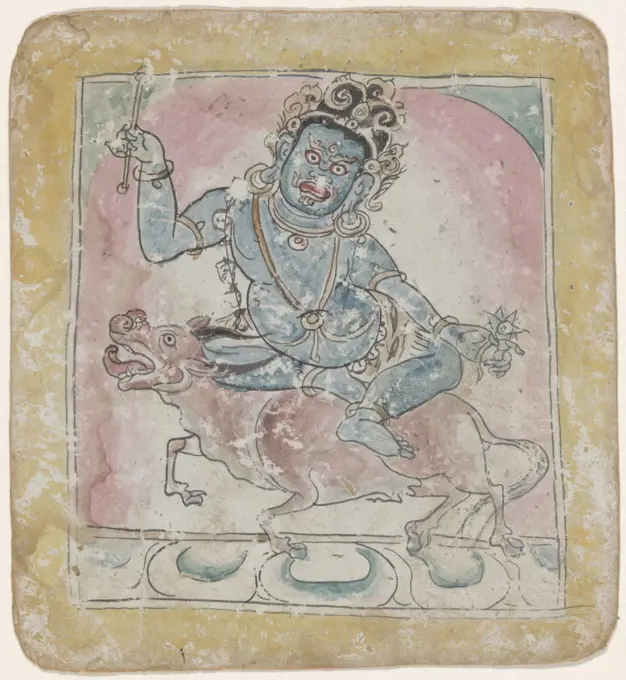
Yama, anonymous, 1900 - 1970 Indian miniature. drawing A male figure on a buffalo, in his lifted right hand he holds a stick, a flower in his left hand. An image from a series of three on which Buddhist gods occur. Tibet paper brush
6137-28690631
Asian Civlisations Museum. Thangka. Buddha of infinite life. Detail. China. 18th century. Silk.  Singapore.
1848-50791709
Thangka of Shri Devi, Female tantric Buddhist deity, Manjusri Monastery, Ulaanbaatar, Mongolia, Asia
6145-29265563
Chinese deities (). Gouache painting by a Chinese painter.
1848-56628535
Statue at a buddhist temple, Nepal, Asia
5514-69430677
A relief on a wall of the Kopan Monastery describes Buddhist philosophy
1890-12598426
Tangka of the Buddha Shakyamuni, Tu An Buddhist Temple, Saint-Pierre-en-Faucigny, Haute Savoie, France, Europe
6145-30157441
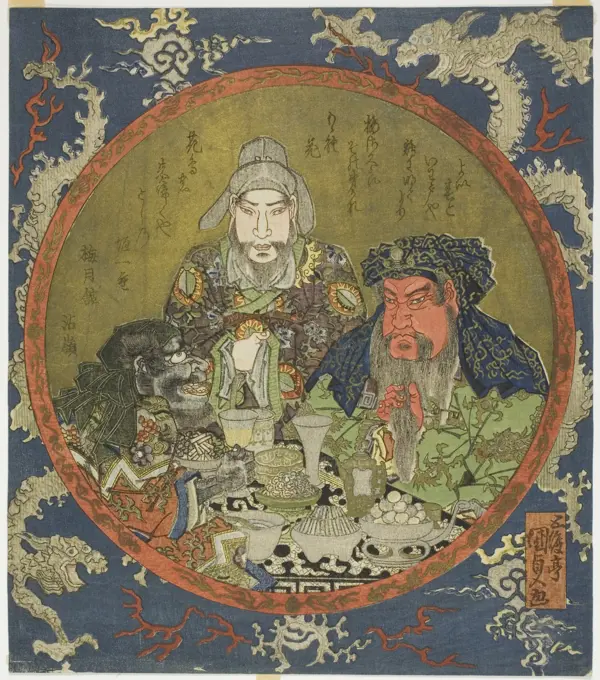
Guan Yu, Liu Bei, and Zhang Fei 1825 Japan. Color woodblock print; shikishiban, surimono . Utagawa Kunisada I (Toyokuni III)
1788-42078
Mandala of the Five-deity Amoghapasha, the infallible laccio, painting on silk from the Mogao Caves in Dunhuang, Gansu Province, China. Chinese Civilisation, Tang Dynasty, 7th-10th century.
4409-28962032
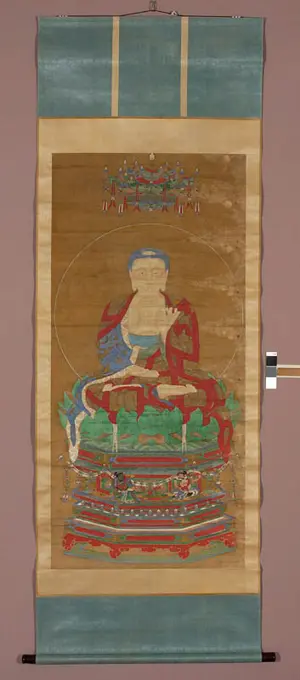
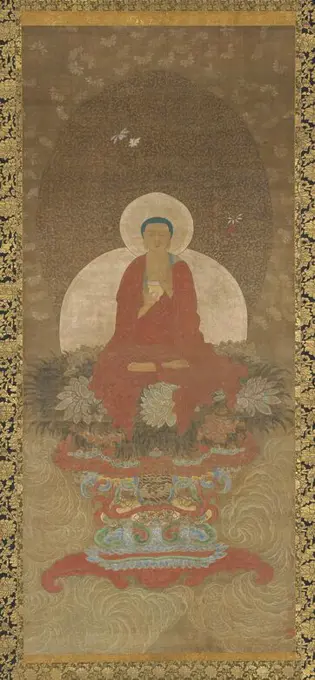
Depicts the Buddha, wearing a red robe, seated on an elaborate throne of multi-colored lotus blossoms with a multi-colored base amid clouds and before a wave-patterned ground and background scattered with lotus flowers. Five seals, no inscriptions, or labels. Date: 17th century. Origin: China. Period: Ming or Qing dynasty. Ink and color on silk. Museum: Freer Gallery of Art and Arthur M. Sackler Gallery.
6145-29770452
Tsong Khapa 18th century Tibet. Tsong Khapa 37832
6145-30154995
Figure Seated on Lotus, from a Set of Initiation Cards (Tsakali) 1299-1499 Tibet. Ink and watercolor on paper .
6145-29165954
Page of a Pilgrims Visiting Album late 17th-18th century? Japan. Page of a Pilgrims Visiting Album 57364
1899-18716722
The Mogao Caves, or Mogao Grottoes (Chinese: mogao ku), also known as the Caves of the Thousand Buddhas and Dunhuang Caves, form a system of 492 temples 25 km (15.5 miles) southeast of the center of Dunhuang, an oasis strategically located at a religious and cultural crossroads on the Silk Road, in Gansu province, China. The caves contain some of the finest examples of Buddhist art spanning a period of 1,000 years. The first caves were dug out 366 AD as places of Buddhist meditation and worship. The Mogao Caves are the best known of the Chinese Buddhist grottoes and, along with Longmen Grottoes and Yungang Grottoes, are one of the three famous ancient sculptural sites of China. The caves also have famous wall paintings.
7155-70375133
Dragon on Silk Robe, 19th century. Embroidery. CHINA.
6145-29790172
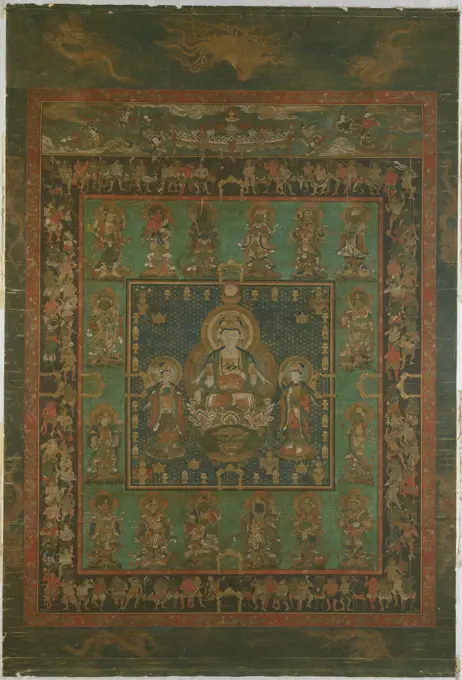
Mandala of the Bodhisattva Hannya (Prajnaparamita) 14th century Japan The bodhisattva at the center of this mandala personifies the perfection of wisdom,” a supreme understanding of the nature of things that is fundamental to Mahayana Buddhist teachings. The mandala would have been used during sutra recitations and other rituals. The bodhisattva, holding a scripture, is attended by Bonten and Taishakuten (Sanskrit: Brahma and Indra), major Hindu deities adopted into the Buddhist pantheon as protectors of the faith.The mandala imagines a tiered space with a series of gates leading from the outside in through increasingly sacred registers. A monk near a gate at the bottom is a reminder of the material world. At the periphery are dragons, a phoenix, and apsaras playing music. Dozens of demigods in the gray register serve as protectors of the Sixteen Benevolent Deities in the green area, and the holiest sector features the central triad on a blue platform.. Mandala of the Bodhisattva Hann
4409-17437611
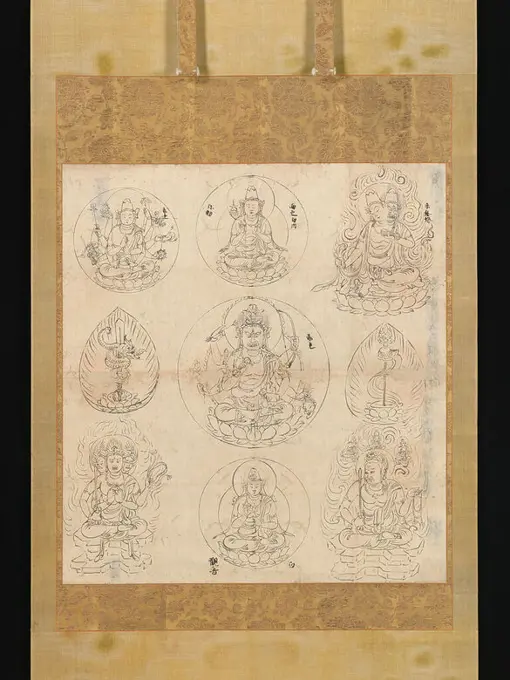
Aizen Mandala. Culture: Japan. Dimensions: Image: 23 × 21 in. (58.4 × 53.3 cm)Overall with mounting: 55 13/16 × 24 7/16 in. (141.7 × 62 cm)Overall with knobs: 55 13/16 × 26 9/16 in. (141.7 × 67.4 cm). Date: Kasho 2 (1107).This ink drawing from the early twelfth century appears to have been made as a guide for creating a painted mandala--a schematic diagram of an array of Buddhist deities used for rituals. The central figure is Aizen Myoo, who represents the sublimation of carnal desire into spiritual energy and is always depicted in a fierce aspect. In this drawing, a supervisor of the mandala painting project indicated next to the central figure that it should be red; the image of the bodhisattva Kannon beneath it was to be white. A dated inscription on the reverse tells us the drawing was copied by a monk at Shoren'in Temple in Kyoto from a model passed down from Choen (1016-1081), a monk-scholar of the Tendai sect who specialized in Esoteric Buddhist rituals. Museum: Metropolita
4409-17424389
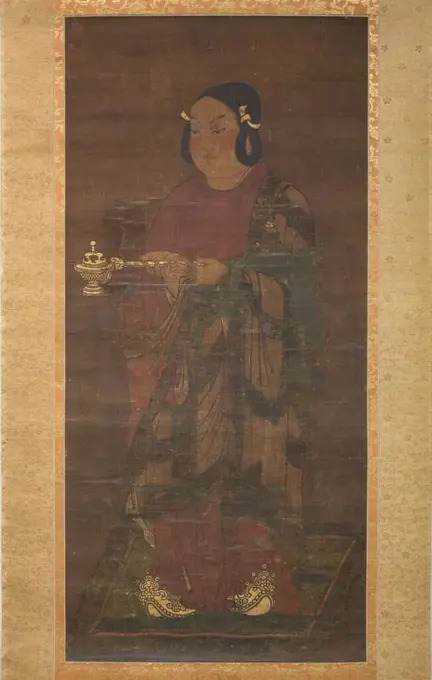
Prince Shotoku at Age Sixteen. Artist: In the Style of Toba Sojo (Japanese, 1053-1140). Culture: Japan. Dimensions: Image: 32 1/2 × 20 9/16 in. (82.6 × 52.2 cm). Date: 14th century.Imaginary portraits and legends about the life of Prince Shotoku (574-622), the champion of Japanese Buddhism, emerged immediately after his death in 622. This painting of Shotoku is based on his biography, which was edited in the mid-Heian period and portrays him as a supernatural being. Painted or sculpted koyo-zo (portraits of filial piety), such as this example, characterize nearly half of the extant portraits of Shotoku. Here, the young prince prays for the recovery from illness of his father, the emperor. He is shown in three-quarter view; dressed incongruously like a monk, he stands on a thin carpet and holds an incense burner. Museum: Metropolitan Museum of Art, New York, USA.
1886-52547
Kubera (Jambala) the god of prosperity, Tagong (Lhagang) Monastery - Kham (E. Tibet), Sichuan Province, China
1899-20090706
Pema Osel Ling Monastery.  Citipati: The Protectors of Cemetery (Tibetan Budddhist). Two squeletons.  Wall painting..
1850-28646647
Myanmar, Yangon, Painting depicting the life of Buddha on a prayer hall wall, Shwedagon Pagoda.
6145-29135400
Mountain Deity. Korea, Korean, Joseon (1392-1910), 19th century. Paintings. Panel, ink and color on cotton
6145-29061283
The Bodhisattvas of the Ten Stages in Attaining the Most Perfect Knowledge; The Eight Hosts of Deva, Naga, and Yakshi, 1454. China, Ming dynasty (1368-1644). Pair of hanging scrolls; ink and color on silk; overall: 140 x 79.5 cm (55 1/8 x 31 5/16 in.). The grandest of the Buddhist mortuary rites is the Water-Land (shuilu) ritual. This esoteric ceremony is conducted for the salvation of all souls of the dead on land and sea.” The ostentatious ritual was performed for imperial ancestors and high officials from the Song (960-1279) to the Ming dynasties and drew large crowds. On the second day of the weeklong ceremony, paintings are hung in the inner altar. These two scrolls belong to a set of 36 Water-Land ritual paintings that are the finest works of their types known from the Ming period. With their bright, opaque color and fine-line gilt decoration intact and unfaded, both paintings share a remarkable state of preservation.In the upper right corner of each painting is an imperial sea
4409-28962839
One of the twelve deva: Nit'-ten (Surya). Origin: Japan. Date: late 15th-early 16th century. Period: Muromachi period. Color and gold on paper. Museum: Freer Gallery of Art and Arthur M. Sackler Gallery.
4409-17400738
Page of a Pilgrim's Visiting Album. Culture: Japan. Dimensions: 15 1/2 × 10 1/2 in. (39.4 × 26.7 cm). Date: late 17th-18th century. Museum: Metropolitan Museum of Art, New York, USA.
4409-17420014
Mandala of Hannya Bosatsu. Culture: Japan. Dimensions: Image: 64 1/2 x 48 5/8 in. (163.8 x 123.5 cm)Overall with painted mounting: 83 1/4 x 57 3/4 in. (211.5 x 146.7 cm)Overall with mounting: 126 x 65 1/16 in. (320 x 165.2 cm)Overall with knobs: 126 x 69 11/16 in. (320 x 177 cm). Date: 14th century.The bodhisattva Hannya, an emanation of the Cosmic Buddha Dainichi as the embodiment of ultimate knowledge and perfect wisdom, is depicted in the center of the painting, seated on a lotus pedestal and mounted on the back of a lion. The deity is attended by Bonten (Sanskrit: Brahma) and Taishakuten (Sanskrit: Indra) and surrounded in alternating registers by figures from the Buddhist pantheon: bodhisattvas, guardian deities, demons, and heavenly musicians. A monk makes an offering before the second gate at the bottom of the outermost register, reminding the viewer of the world of causes and conditions. The painting is an example of a "single deity mandala" (besson mandara), which focuses
1899-19136194
Thailand: Image 18 of the Phra Malai Manuscript, c. 1860-1880, Los Angeles County Museum of Art, Los Angeles
4449-58640
Buddha statue, Wat Suthat, Bangkok, Thailand, Asia
6145-29117715
Deoksewi, 153rd of the 500 Nahans (Arhats). Korea, Seoul, Mount Samgak (Samgaksan), Hyangnim, Korean, Joseon (1392-1910), dated 1562. Paintings. Hanging scroll; ink and color on silk
1899-77936796
Tibetan Buddhist monastery. Temple of the Thousand Buddhas. Column decorated with a dragon. La Boulaye. France.
1848-50681844
Hindu images on the pillars and walls of Nanpaya Pagoda, Bagan, Myanmar, Asia
1890-72618
Temple doors, Thian Hock Keng Temple, the oldest and most important Hokkien temple in Singapore, known as the Temple of the Goddess of the Sea, Singap...
1899-18712561
Horyu-ji (Temple of the Flourishing Law) is a Buddhist temple in Ikaruga, Nara Prefecture, Japan. Its full name is Horyu Gakumonji, or Learning Temple of the Flourishing Law, the complex serving both as a seminary and a monastery. In 1993, Horyu-ji was inscribed as a UNESCO World Heritage Site under the name Buddhist Monuments in the Horyu-ji Area. The Japanese government lists several of its structures, sculptures and artifacts as National Treasures. The kondo, or great hall of the temple, dating in part to the 7th century, is famous for its 7th century Buddhist murals. Unfortunately, on January 26, 1949, a fire in the kondo caused very severe damage to the murals, many of which were destroyed. The murals of the kondo comprise fifty walls; four larger walls, eight mid-sized walls and thirty-eight small wall areas inside the building. The original murals were removed after the fire incident in 1949 and are kept in storage. Twenty small wall paintings that escaped the fire remain in pla
6188-64562634
Painting of saint Copyright: xHimalayanxAcademy/DinodiaxPhotox
4409-17433084
Monju Bosatsu with Eight Sacred Sanskrit Syllables. Culture: Japan. Dimensions: Overall: 40 7/8 x 25 1/8 in. (103.8 x 63.8 cm). Date: mid- to late 14th century.Monju (Sanskrit: Manjushri), the Bodhisattva of Wisdom, is seated on a lion against an ovoid nimbus edged with flames. He wears a crown decorated with eight miniature Buddhas and holds a sword and a long stemmed lotus flower supporting a vajra--a pronged implement with origins in Indian weaponry. In other manifestations of the bodhisattva, Monju's lotus typically supports a Buddhist scripture, but here the vajra is an emblem of wisdom. Monju is surrounded by eight Sanskrit seed syllables, or sacred utterances symbolizing the eight guardian youths) from a mantra invoking him. Inscribed in the upper part of the painting is a verse praising Monju, dated to 1371 on the day following the arrival of winter. It says, "In the past, you were the bodhisattva Ryushu, and in the future, you will become the Buddha Fuken, the patriarch of th
6188-64591278
wall painting of spituk gompa 900 year old the head gompa of leh, ladakh, Jammu and Kashmir, india Copyright: xSunilxKapadia/DinodiaxPhotox
6145-29813263
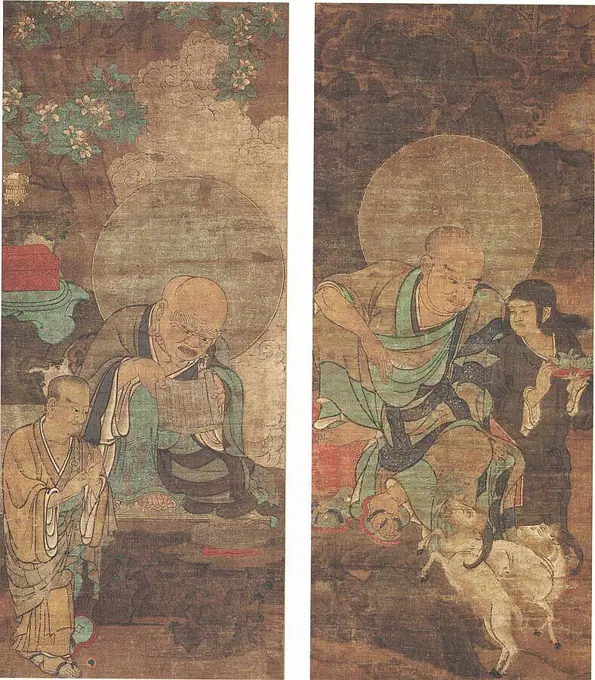
Rakan Japan Arhats (known in Japanese as rakan) are legendary disciples of the historical Buddha, Shakyamuni. Following his example, they attained enlightenment through their own efforts. Like the disciples of Jesus, they remain in the world to preserve the teachings of the historical Buddha until the coming of the future Buddha, Maitreya. They are invariably portrayed in outdoor settings, often attended by animals both familiar and fantastic. Images of rakan hold a special place in Zen Buddhism, where they are honored as exemplars of the individual spiritual quest. They are usually envisioned in groups of sixteen, eighteen, or five hundred and are hung flanking an image of Shakyamuni. These two can be presumed to have come from a set of sixteen, the most common format. They are closely modeled on paintings (now in the Tokyo National Museum) that were signed by a Chinese professional painter, Jin Dashou, at the end of the twelfth century in Ningbo, the port in Zhejiang Province through
6188-60053799
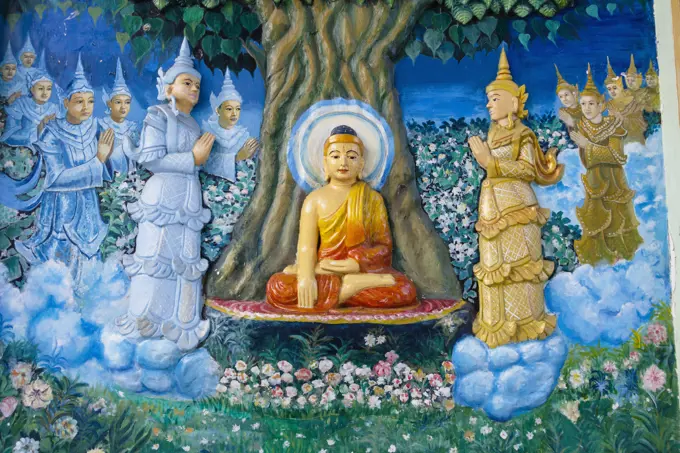
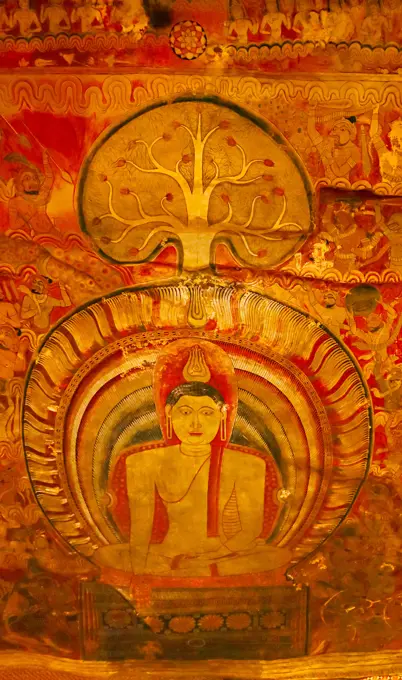
Ancient Painting of Lord Buddha Sitting Under BodhiVriksha, Cave Temple, Dambulla, Sri Lanka. UNESCO world heritage site. Cave 2 Maha Raja Viharaya  The Cave of Great Kings Ancient Painting of Lord Buddha Sitting Under BodhiVriksha, Cave Temple, Dambulla, Sri Lanka. UNESCO world heritage site. Cave 2 Maha Raja Viharaya  The Cave of Great Kings Copyright: xZoonar.com/RealityImagesx 21646257
4409-17379465
Descent of Eleven-Headed Kannon. Artist: Unidentified Artist. Culture: Japan. Dimensions: Image: 36 1/2 × 15 1/2 in. (92.7 × 39.4 cm)Overall with mounting: 70 × 22 7/16 in. (177.8 × 57 cm)Overall with knobs: 70 × 24 in. (177.8 × 61 cm). Date: mid-late 16th century.The bodhisattva Kannon (Sanskrit: Avalokiteshvara) is one of two bodhisattvas who flank the Buddha Amida (Sanskrit: Amitabha) when he descends to deliver those who call his name to his Pure Land. Here, Kannon in his eleven-headed form descends alone upon a bank of clouds to meet the believer. His right hand is held open to bestow compassion and is encircled by crystal prayer beads, while his left hand holds a lotus in a vase, representing the healing power of the Buddhist Law. Diminutive heads atop his own signal the manifold ways in which he hears, observes, and meets every need of the faithful. The haloed topmost head is that of Amida. Kannon's attendant relationship to this Buddha of Infinite Light is explicit here in t
1746-21103161
God between two assessors, cambodian, 18th century
1899-19189068
Tamzhing / Tamshing Lhundrup Monastery was built in 1501 by Bhutanese saint Pema Lingpa (1450-1521) and is a temple complex in Bumthang District, central Bhutan. Tamzhing Monastery is the most important Nyingma gompa in Bhutan, a Tibetan Buddhist ecclesiastical place of learning that is a mix of a fortification, a vihara (monastery) and a university.
1899-18793692
Wat Lai Hin Kaew Chang Yuan (Temple of the Standing Elephant with the Stone Shoulder) was originally constructed in 1683.
6145-29276167
Mahakala with Shakti. Gouache painting by a Tibetan artist.
7143-70482196
China, Yunnan Province, Northwestern Yunnan, Shangri-La, Songzanlin Monastery. Restored murals at the gate of the monastery.
6145-29195270
Eight Attendants of Fud My 15th century Japan Fud's youthful attendants, numbering two, four, eight, or sixteen, were thought to be multiples of his name, the many from one. Servants of the pantheon of Buddhist deities and equipped with supernatural powers, they increasingly became objects of religious interest during the Middle Ages in Japan. Portable shrines, or zushi as they are known in Japan, have been part of religious accoutrements from the very earliest years of Japanese Buddhism. The oldest extant example dates to the mid-seventh century and is housed in Hry-ji temple in Nara. This panel was most likely one of a pair of doors flanking a carved statue of Fud.. Eight Attendants of Fud My. Japan. 15th century. Door of a portable shrine; ink, color, and gold on lacquered wood. Muromachi period (1392-1573). Paintings
6176-66907202
Vision of the angelic hierarchy - 12th century
6188-64595134
Tibetan wheel of life, north Sikkim, at phodong monastery, north Sikkim, india Copyright: xBxPxMaiti/DinodiaxPhotox
1848-50791952
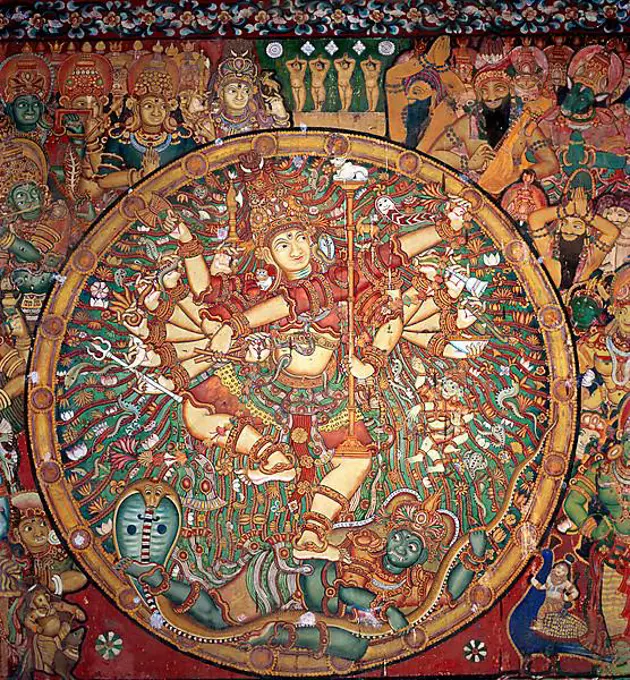
Nataraja, Wandgemaelde aus dem 16. Jahrhundert in der Wand des Ettumanr Siva Tempels, Kerala, Indien
1889-86548
China, Xizang, Wall painting; Lhasa, Drepung Monastery
4443-28725658
Katen one of a set of Twelve Devas, 14th-15th century, Unknown Japanese, 38 x 15 1/2 in. (96.52 x 39.37 cm), Ink, color, gold, and cut gold leaf (kirikane) on silk, Japan, 14th-15th century
6145-55182430
The thirty-seven nats 3. Hnamádawgyí nat. 4. Shwe Nabé nat.. Illustrations. 1906. General Research Division. Religion , Burma, Elephants , Burma
1525-22529262
Ancient wall painting art of buddha in a historic Tibetan lamasery
1886-53016
Mural of Red Tara in a Tibetan Monastery in Dabpa County, Kham - Sichuan Province, China, (Tibet)
6145-30157128
The Buddha Amida, from the triptych Approach of the Amida Trinity 1201-1300 Japan. Hanging scroll; ink, colors, and cut gold on silk .
4409-17504911
Yantra Painting. Date/Period: 1700/1800. Painting. Gouache, silk. Width: 93 cm. Height: 139 cm (Complete). Author: UNKNOWN.
6145-29256974
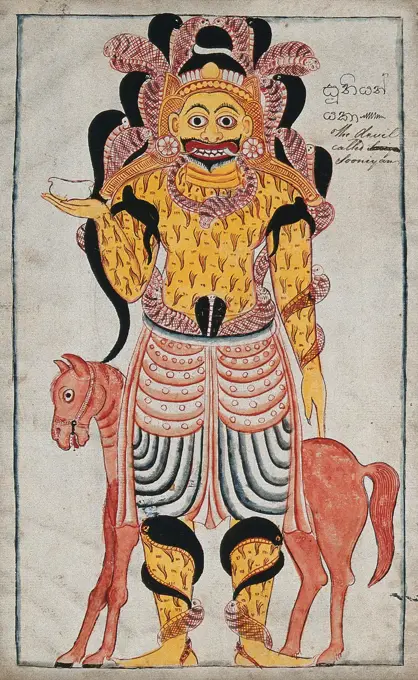
A Sinhalese devil standing before a red horse with numerous snakes wrapped around his body and head. Gouache painting by a Sri Lankan artist.
1848-53934806
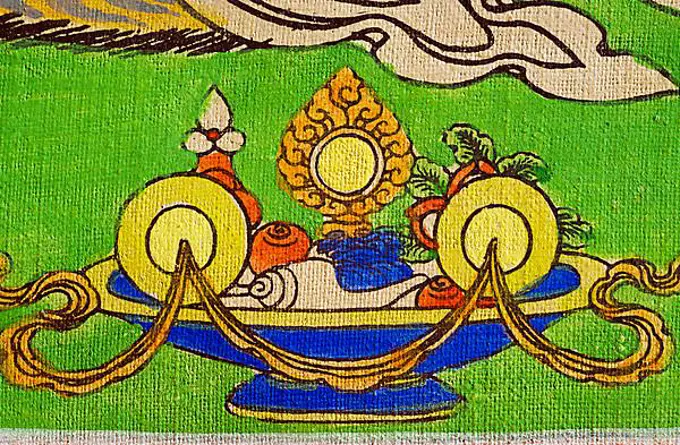
Offering bowl with ingredients to symbolize the five senses, representation on a thangka, scroll painting of Tantric Buddhism, meditation, mandala
6145-51819395
Buddha Rising From Clouds Buddha Rising From Clouds, 14th-15th century. Painting on silk, 41 5/16 x 52 3/16 in. (105 x 132.5 cm).   Asian Art 14th-15th century
1886-52901
Mural of dragon creature at Lhakhang Karpo in Litang Chode Monastery, Kham - Sichuan Province, China, (Tibet)
442-21984377
England, London, The Wellcome Collection, 19th century Tibetan Watercolour Painting depicting a Bloodletting Chart
1890-103957
Wheel of life wheel of Samsara, Kopan monastery, Bhaktapur, Nepal, Asia
6145-30164488
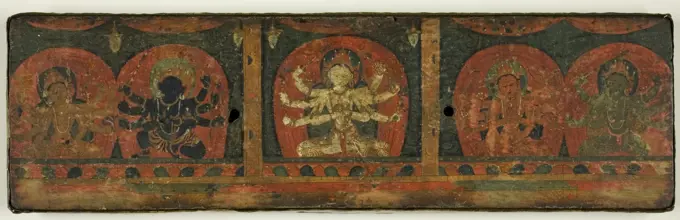
Manuscript Cover from the Five Protectors (Pancharaksha) 1201-1300 Nepal. Pigments, metallic paint on wood, and metal .
4445R-8939
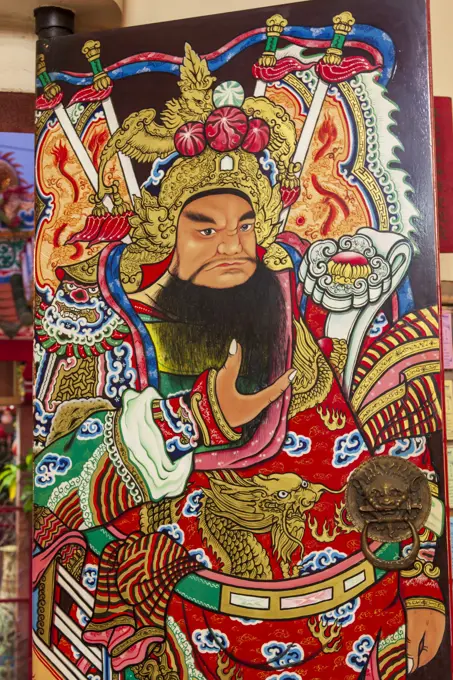
Door depicting a god
6145-29801424
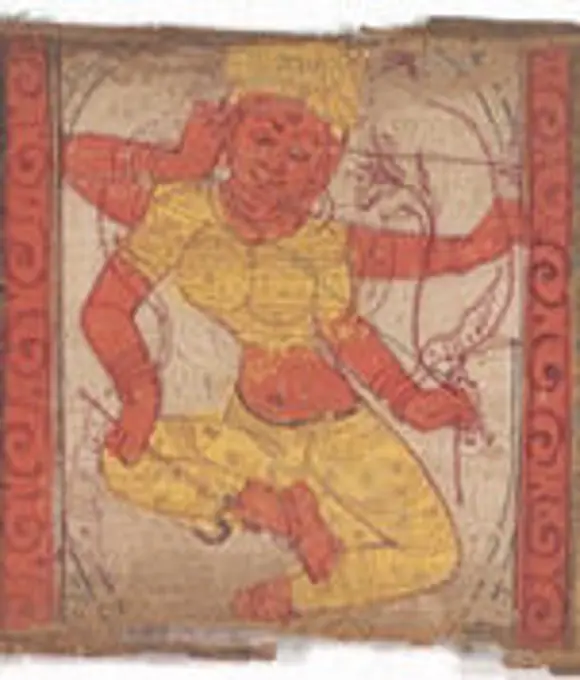
Dancing Female Goddess, Firing an Arrow from Her Bow and Holding an Elephant Goad ", Leaf from a dispersed Ashtasahasrika Prajnaparamita (Perfection of Wisdom) Manuscript 12th century India (Bihar or West Bengal) Dancing female goddess, firing an arrow from her bow and holding an elephant goad (ankusa), symbolizing the deity's intense activity.. Dancing Female Goddess, Firing an Arrow from Her Bow and Holding an Elephant Goad ", Leaf from a dispersed Ashtasahasrika Prajnaparamita (Perfection of Wisdom) Manuscript. India (Bihar or West Bengal). 12th century. Ink and color on palm leaf. Pala period. Paintings
6145-54038155
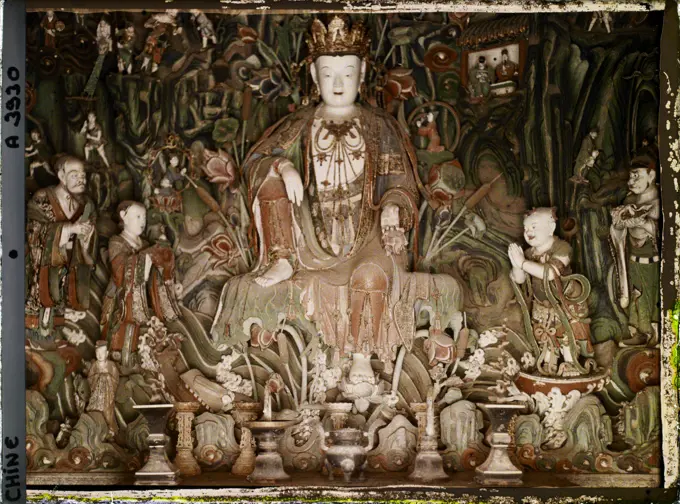
Beijing, China Xiangshan ("fragrant mountains") , 1913 - China - Stéphane Passet (French - Pékin , Chine Xiangshan ( « montagnes Parfumées » )). Statue, Buddhism, sculpture, monastery, object of worship, bodhisattva, stucco, religious architecture, Religion , Art , Habitat , Architecture, Py-Yen-Seu, a Buddhist altar
6137-28691527
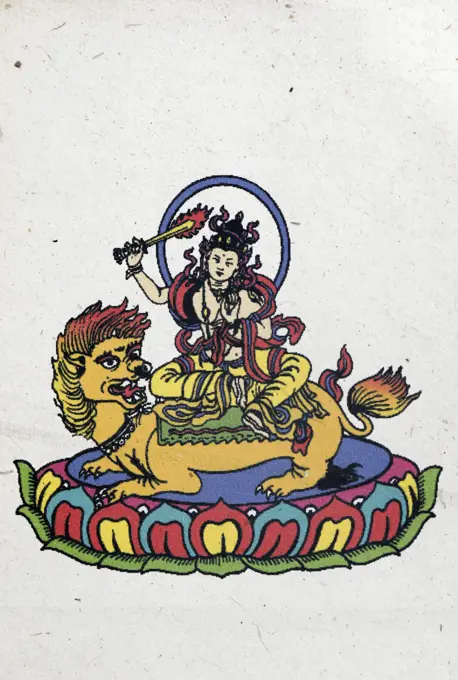
Manjushri  is a meditational deity and considered a fully enlightened Buddha.
6145-59274908
Buddhist Deity, Anonymous, 1900 - 1970 Indian miniature. drawing A male figure clamped by a woman, in his left hand he holds a small ax, in the right another object. Tibet paper brush
6137-28990717
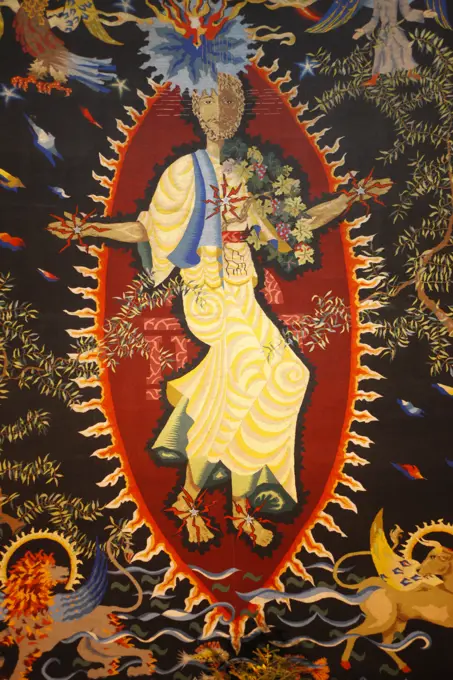
Christ In his Glory. Tapestry in the church of les Gets.
4409-17409007
Taima Mandala. Culture: Japan. Dimensions: Image: 36 1/8 x 28 5/8 in. (91.8 x 72.7 cm)Overall with mounting: 74 1/2 x 36 3/4 in. (189.2 x 93.3 cm)Overall with knobs: 74 1/2 x 38 3/8 in. (189.2 x 97.5 cm). Date: 14th century.The Taima Mandala represents the Pure Land of the Buddha Amida (Sanskrit: Amitabha) bordered on three sides by parables from the Sutra on the Meditation on the Buddha of Infinite Life (Kanmuryo jukyo ). This text, portions of which appear in the boundaries between scenes, recounts the promise at the core of Pure Land School teaching: that those who concentrate on the Buddha Amida during life, and recite his name, will be escorted to his Pure Land, known as the Western Paradise, at the final moment of death. The painting depicts an enormous palace with a golden pond presided over by Amida and his retinue. Musicians, dancers, and thirty-seven different types of celestial beings fill the skies and pavilions, surrounding the pond in the foreground. Those being born i
1899-18712572
Horyu-ji (Temple of the Flourishing Law) is a Buddhist temple in Ikaruga, Nara Prefecture, Japan. Its full name is Horyu Gakumonji, or Learning Temple of the Flourishing Law, the complex serving both as a seminary and a monastery. In 1993, Horyu-ji was inscribed as a UNESCO World Heritage Site under the name Buddhist Monuments in the Horyu-ji Area. The Japanese government lists several of its structures, sculptures and artifacts as National Treasures. The kondo, or great hall of the temple, dating in part to the 7th century, is famous for its 7th century Buddhist murals. Unfortunately, on January 26, 1949, a fire in the kondo caused very severe damage to the murals, many of which were destroyed. The murals of the kondo comprise fifty walls; four larger walls, eight mid-sized walls and thirty-eight small wall areas inside the building. The original murals were removed after the fire incident in 1949 and are kept in storage. Twenty small wall paintings that escaped the fire remain in pla
6188-62332595
Paintings of Lord Buddha in Thiksey Monastery, Leh, Ladakh, India. Paintings of Lord Buddha in Thiksey Monastery, Leh, Ladakh, India. Copyright: xZoonar.com/RealityImagesx 22016169
6188-64519853
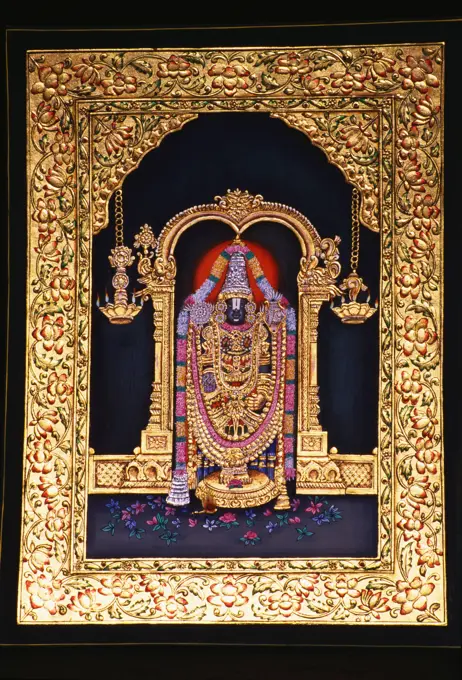
Tirupati Tripati Balaji miniature painting on paper with golden embossing Copyright: xBhagwandasxRupani/DinodiaxPhotox
6145-30174435
Manuscript Cover from the Glorification of the Great Goddess (Devimahatmya) 1701-1800 Nepal. Pigments on wood .
6145-59056653
ARhat Kanakawaca;  20th century () (1890-00-00-1910-00-00);
6145-29214973
Jiz Bosatsu 15th century Japan As veneration of Jiz and reliance on him became widespread during the Kamakura period, he came to be depicted as a single figure descending to aid the suffering and to guide them to paradise. Derived from the raig images of Amida Buddha descending to welcome a dying believer in the company of this many bodhisattvas, which usually included Jiz, the single-image Jiz raig portrays him standing in a walking posture, emphasized by the postition of this feet on double lotus pedestals atop a cloud that trails behind as he traverses the Six Realms of Existence. His monk's robe is beautifully decorated with intricate patterns of cut gold. He carries the wish-granting jewel and the golden shakuj, or staff with six jangling rings to announce his arrival. Now barely visible, double lines of gold rays once fanned out around his halo, heightening the gorgeous effect that was part of the vision promised to believers.. Jiz Bosatsu. Japan. 15th century. Hanging sc
6145-29162258
Shaka (Shakyamuni), the Historical Buddha, with Two Attendant Bodhisattvas and Sixteen Benevolent Deities late 14th century Unidentified artist This devotional image would have been hung in a temple during recitations of the Great Perfection of Wisdom Sutra. At center, Shaka sits atop a lotus pedestal, flanked by attendant bodhisattvas, Fugen and Monju. Their radiant bodies are meticulously described using a combination of gold paint and strips of cut gold foil, a technique called kirikane. They are surrounded by a diverse group of benevolent deities charged with protecting the Sutra itself and all those who recite it.The lengthy Great Perfection of Wisdom Sutra was translated from Sanskrit into Chinese by the prolific translator Xuanzang (602-664), who appears at bottom right carrying a scroll and brush, and wearing a portable chest containing scriptures. The fierce red deity opposite him is the Great General of the Desert (Jinja Daishō), who is said to have protected Xuanzang during
4220-21856446
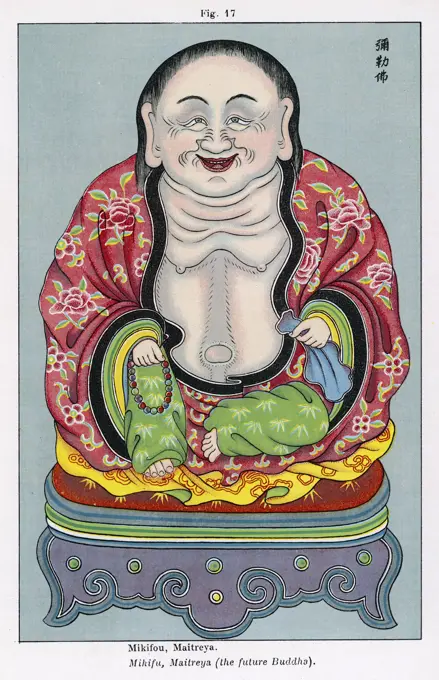
MAITREYA (or MIKIFU) the Buddha of the future
1890-161873
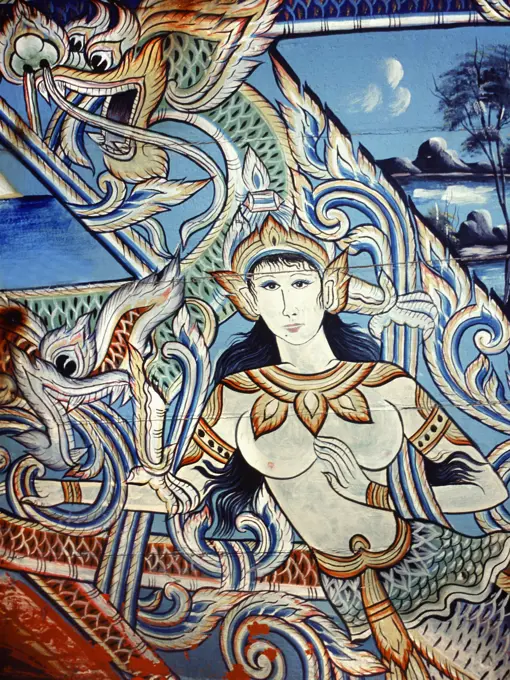
Decorations on a boat, Ko Samui, Thailand, Southeast Asia, Asia
1899-55266428
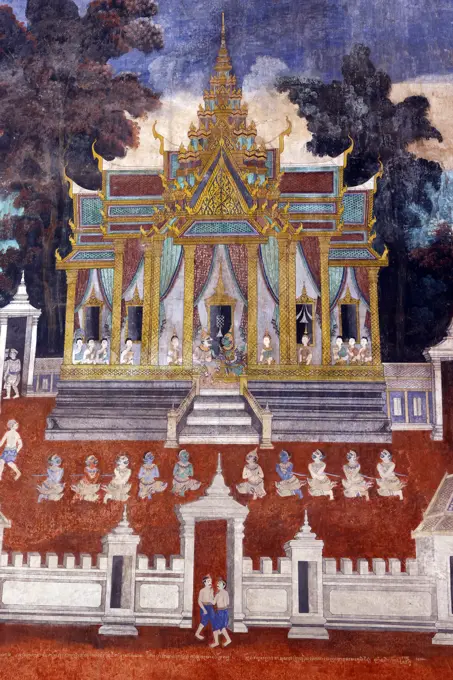
Royal palace complex. Murals of scenes from the Khmer (Reamker) version of the classic Indian epic Ramayana. Phnom Penh; Cambodia.
4409-17414826
Manuscript Cover with Avalokiteshvara (The Bodhisattva of Infinite Compassion). Culture: Nepal (Kathmandu Valley). Dimensions: 2 3/32 x 17 7/16 in. (5.3 x 44.3 cm). Date: 12th century. Museum: Metropolitan Museum of Art, New York, USA.
6145-43638772
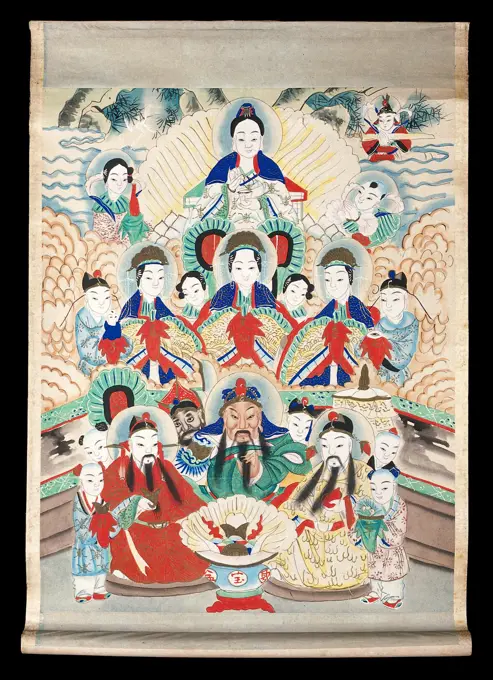
Pantheon of Taoist deities. unknown, painter
6145-29253012
A Chinese lucky charm representing a man in a circle with Chinese lettering above. Hand tinted woodcut by a Chinese artist.
1606-187974
China,Hong Kong,Tsuen Wan,Yuen Yuen Institute,Ceiling Decoration
6145-51822136
Protector of the Sakya-pa Sect Protector of the Sakya-pa Sect, 19th century. Opaque watercolors on coarse canvas, 27 1/8 x 16 1/2 in. (68.9 x 41.9 cm).   Asian Art 19th century
7155-70375193
Buddhist scribe, Uigar period , Silk Road from Ming-oi, 8th cent. CHINA.
1899-18714355
Wat Phra Mahathat Woramahawihan, generally shortened to Wat Mahathat, or Temple of the Great Chedi’ is the most revered and important temple in Nakhon Si Thammarat and indeed in southern Thailand. It is considered to have been built at the time of the founding of the town, and is said to contain a tooth relic of the Lord Buddha. Southern Thai lore records that the founders of the temple were Prince Thanakuman and his Queen Hemchala, who brought Buddha relics to Hat Sai Kaeo and built a small pagoda to mark the location. Subsequently, in the 13th century, King Si Thamma Sokharat founded the city of Nakhon Si Thammarat and built a new temple around the great chedi.
1606-72863
France, Saône et Loire, Toulon sur Arroux, Wheel of Samsara. Temple of the Thousand Buddhas.
6145-29135151
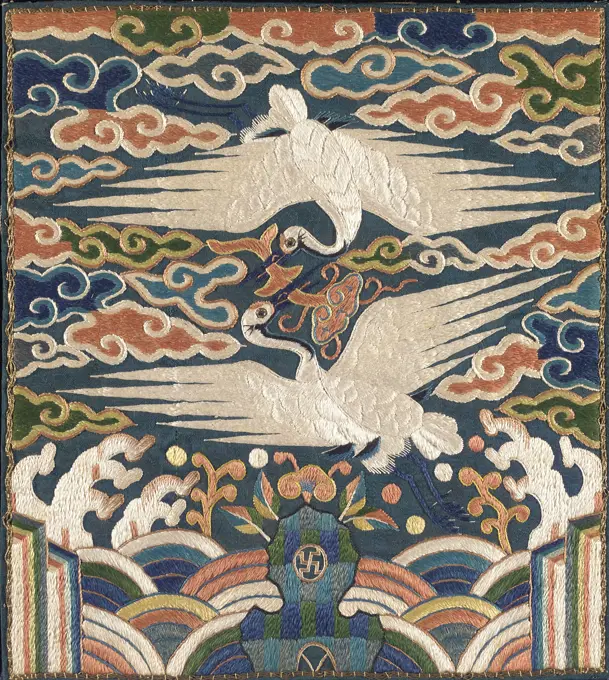
Badge (Hyungbae) of Upper Civil Rank with Two Cranes. Korea, Joseon dynasty (1392-1910), second half of 19th century. Jewelry and Adornments; badges. Silk damask with silk and metallic-thread embroidery
6145-29825659
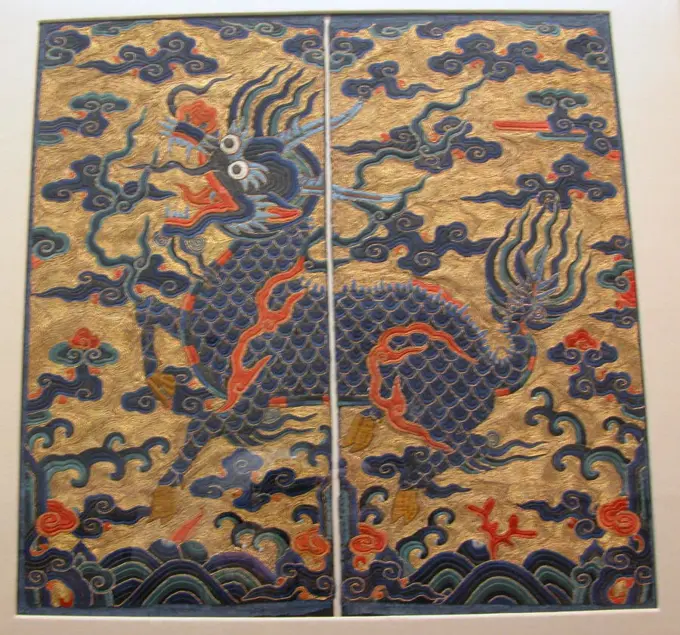
Rank Badge with Qilin late 17th century China The qilin is a fantastic animal shown here in its conventional form. The flames shooting from the creature's body signify its supernatural powers. After 1662 the qilin became the insignia of military officials of the first rank; before that time it was worn by nobles.. Rank Badge with Qilin 69079
1848-56112235
Sri Raman, painted strucco work in Sri Karpaga Vinayakar Temple Nagara Viduthi choultry wall in Pillaiyarpatti, Tamil Nadu, South India, India, Asia
1899-18720836
The Naxi or Nakhi are an ethnic group inhabiting the foothills of the Himalayas in the northwestern part of Yunnan Province, as well as the southwestern part of Sichuan Province in China. The Naxi are thought to have come originally from Tibet and, until recently, maintained overland trading links with Lhasa and India. The Naxi form one of the 56 ethnic groups officially recognized by the People's Republic of China. The Naxi are traditionally followers of the Dongba religion. Through both Han Chinese and Tibetan cultural influences, they adopted Tibetan Buddhism and, to a lesser extent, Taoism, in the 10th century.
6145-29199554
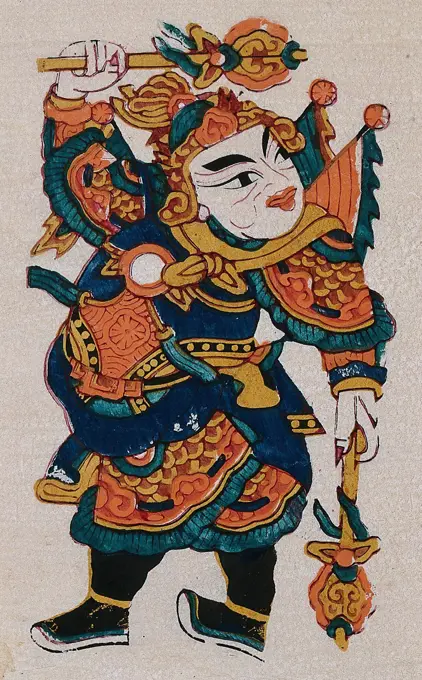
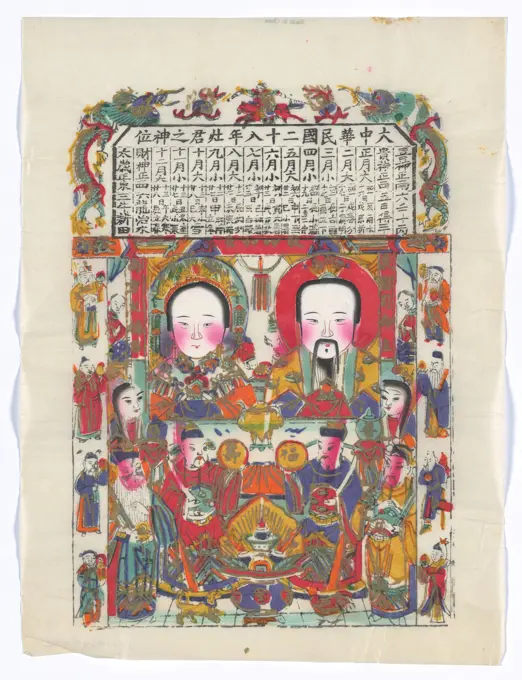
Various New Years pictures and door gods early 20th century Unidentified. Various New Years pictures and door gods. Unidentified artist(s), early 20th century. China. early 20th century. Woodblock print; ink and color on paper. Republic period (1912-49). Prints
1899-77936036
Enlightenment in Bodh Gaya. Buddha sitting in meditation under the Bodhi Tree. Luang Prabang. Laos.
4409-17490298
Seated Avalokiteshvara with Lotus. Date/Period: 1935. Japanese Painting. Ink and light color on paper / hanging scroll. Height: 506 mm (19.92 in); Width: 298 mm (11.73 in). Author: MURAKAMI KAGAKU.
1746-19664521
Avalokitesvara Mandala depicting the Bodhisattva of compassion in her aspect as Amoghapasa. Nepal 1860
4409-28963131
Sakyamuni Seated Upon Three Demon-like Creatures. Origin: China. Date: 14th-15th century. Ink and color on silk. Period: Possibly Yuan to early Ming dynasty. Museum: Freer Gallery of Art and Arthur M. Sackler Gallery.
1746-19627153
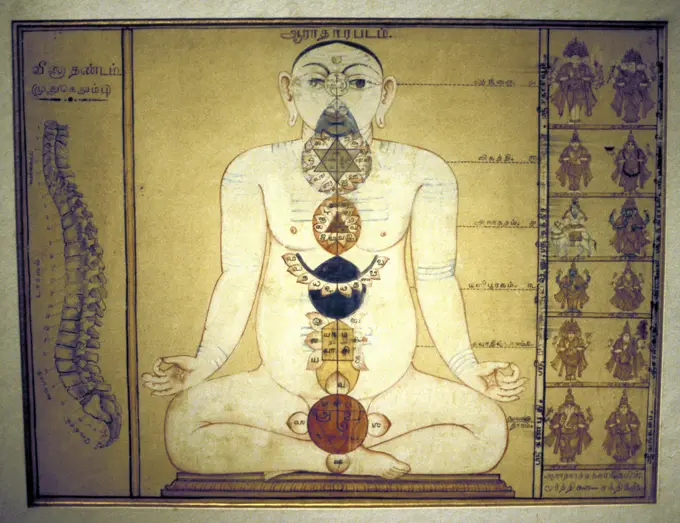
Six Chakras representing the plexuses of the human body. Hindu. Tanjore, Tamil Nadu, c1850.
6188-64559844
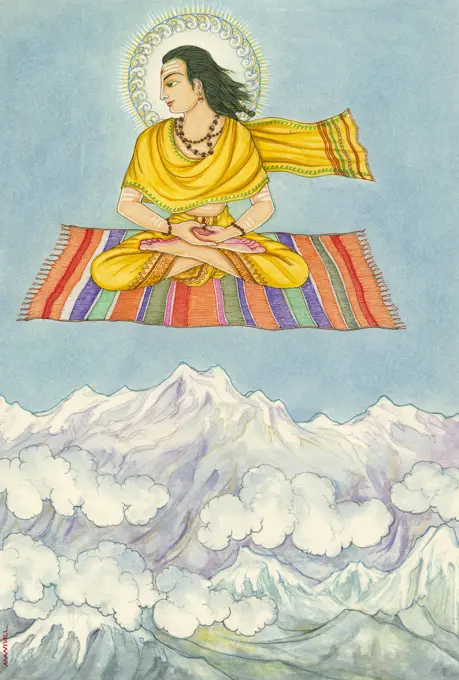
Artist Manivelu, saint, sadhu, swami, sannyasin, hindu belief, hindu, hinduism, meditation, art, yoga, himalayan academy art, samadhi, aura, halo Copyright: xHimalayanxAcademy/DinodiaxPhotox
6145-30157536
Hindu Manuscript Cover with Ganesha, Brahma, Shiva and Parvati, Vishnu, and Karttikeya 1467-1533 Nepal. Pigments and metallic paint on wood .
1746-21103166
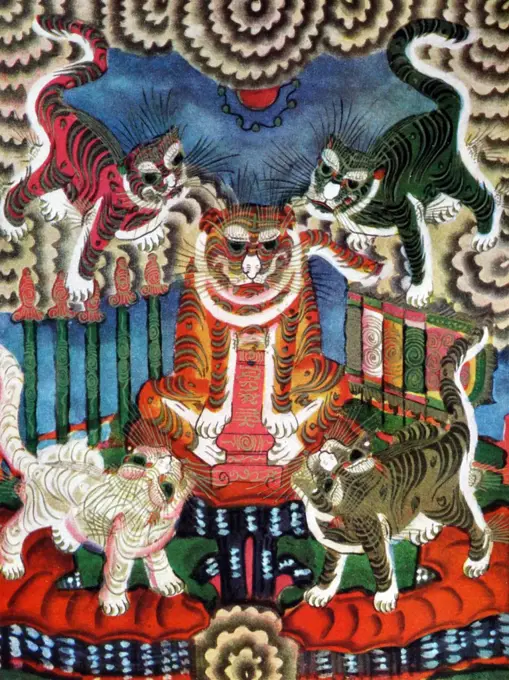
sacred tigers of annam, vietnam 19th century painting
1899-77936050
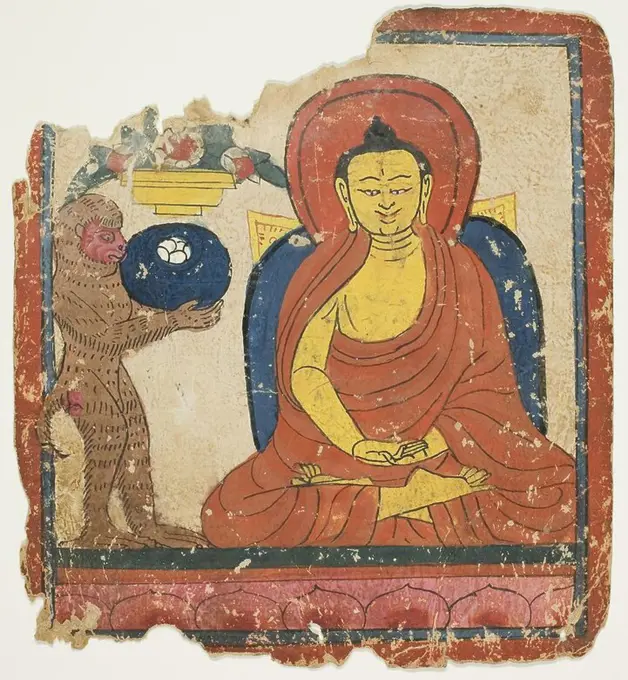
Wat Manorom Buddhist temple. The Buddha in retreat  attended by a monkey and elephant with offerings. Luang Prabang. Laos.
4272-36586
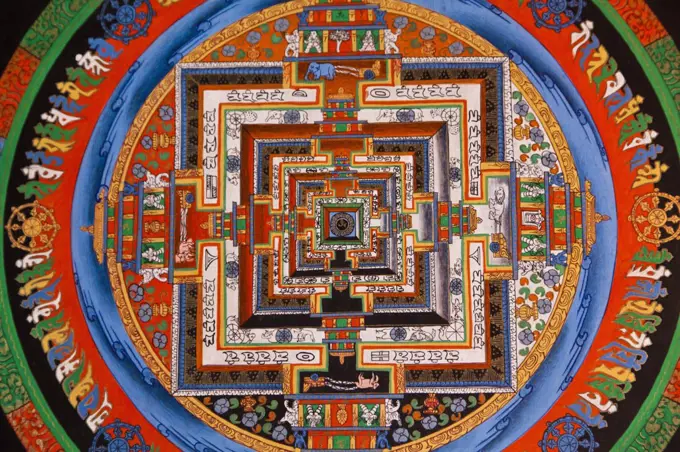
Mandala painting for sale in a shop in Jakar, Bumthang Valley.
4409-17575095
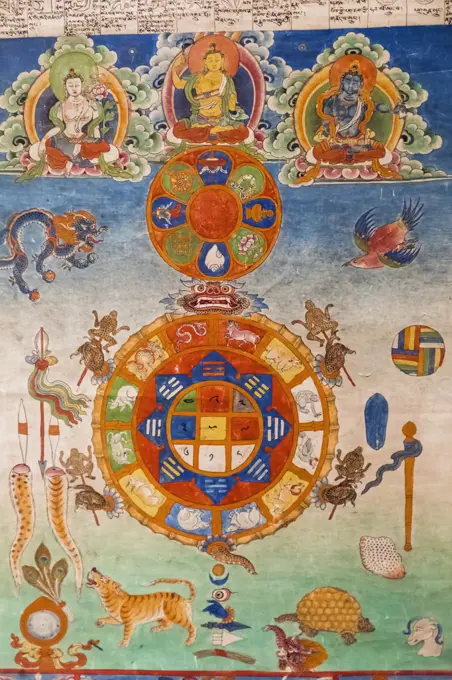
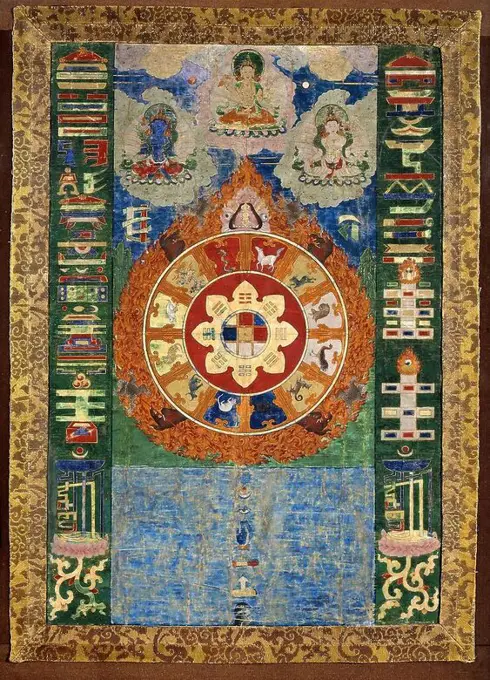
'Astrological Table Showing Animals of the Twelve-Year Cycle of the Zodiac'. Tibet, 18th century. Dimensions: 53x41 cm. Museum: State Hermitage, St. Petersburg.
1848-55342837
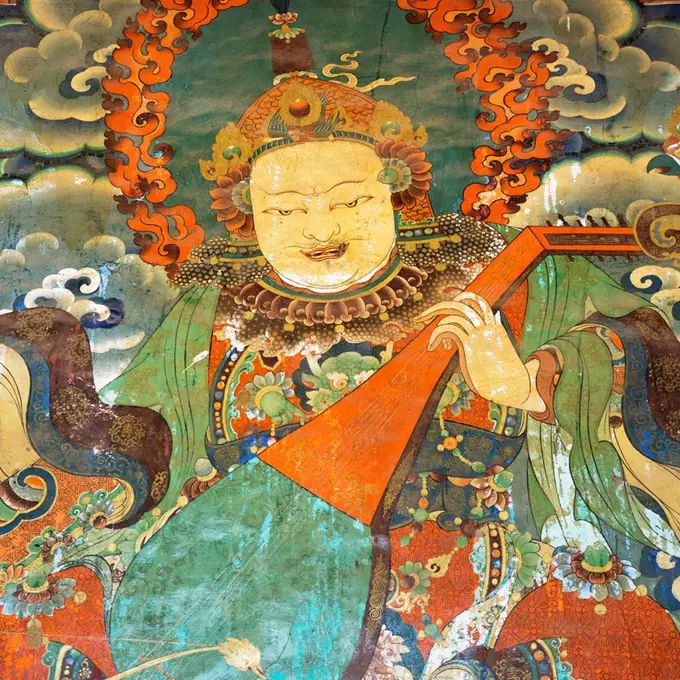
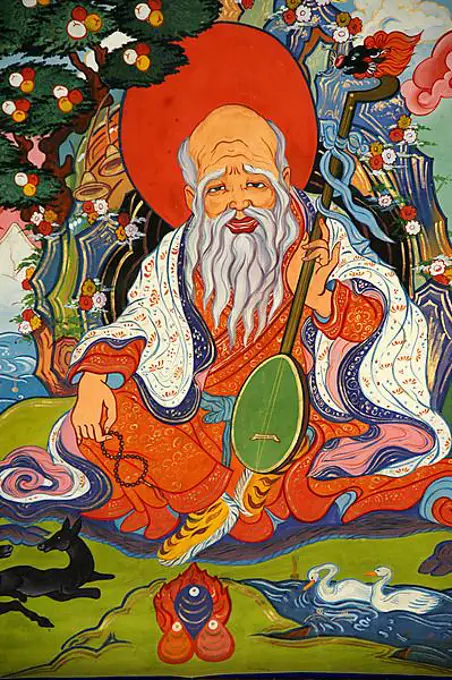
Musician, Mongolian style painting of a holy man making music, Mongolia, Asia
1525-22316059
Long Song Temple mosiac, Nha Trang, Vietnam
6145-29812089
Sutra Cover 17th century China. Sutra Cover 69827
1899-18792363
Nasir ud-din Muhammad Humayun (Persian: نصیر الدین محمد همایون; full title: Al-Sultan al-'Azam wal Khaqan al-Mukarram, Jam-i-Sultanat-i-haqiqi wa Majazi, Sayyid al-Salatin, Abu'l Muzaffar Nasir ud-din Muhammad Humayun Padshah Ghazi, Zillu'llah; 7 March 1508 - 22 February 1556) was the second Mughal Emperor who ruled present day Afghanistan, Pakistan, and parts of northern India from 1530-1540 and again from 1555-1556. Like his father, Babur, he lost his kingdom early, but with Persian aid, he eventually regained an even larger one. On the eve of his death in 1556, the Mughal empire spanned almost one million square kilometers. He succeeded his father in India in 1530, while his half-brother Kamran Mirza, who was to become a rather bitter rival, obtained the sovereignty of Kabul and Lahore, the more northern parts of their father's empire. He originally ascended the throne at the age of 22 and was somewhat inexperienced when he came to power. Humayun lost his Indian territories to the P
1899-55266461
Mongkol Serei Kien Khleang Pagoda. Life of Siddhartha Gautama, the Buddha. Phnom Penh; Cambodia.
7227-71362985
Pung Tao Gong Ancestral Temple, Chiang Mai, Thailand
7012-69862549
Thailand, Ko Samui (aka Koh Samui). Wat Plai Laem aka Plai Laem Temple, inside prayer house. Colorful wall mural depicting life of Buddha. (Editorial Usage Only)
4435-5842
Yoga position. Hindu art. Miniature Painting. ITALY. VENETO. Venice. Biblioteca nazionale marciana (St. Mark's Library).
1890-90356
Painting of a man meditating
6145-51830238
Amit'a Triad Amit'a Triad, 14th century. Ink, color and gold on silk, 51 1/4 x 32 1/4in. (130.2 x 81.9cm).   Asian Art 14th century
1525-25321681
Ramakien picture on the wall, column and roof of temple
6145-58826987
FUDōmyōōōōōōōōōōs with attendans Konga Dōji and Seitaka Dōji, 1700 - Hanging roll painting in ink and color on silk with an image of the deity Fudōmyōō                                                           . Japan paper. dye Hanging roll painting in ink and color on silk with an image of the deity Fudōmyōō                                                           . Japan paper. dye
1848-50163563
Chinese depiction of Sakya-muni, Buddha, ca 500 BC, founder of Buddhism, Historical, digital reproduction of a 19th century original
1899-18789473
Shennong (Vietnamese: Than Nong), also known as the Emperor of the Five Grains (Wugu xiandi), was a ruler of China and cultural hero who lived some 5,000 years ago and who taught the ancient Chinese the practice of agriculture. Appropriately, his name means' Divine Farmer'. He is also believed to have discovered tea.
4409-28962843
One of the twelve deva: Sui-ten (Varuna). Origin: Japan. Date: late 15th-early 16th century. Period: Muromachi period. Color and gold on paper. Museum: Freer Gallery of Art and Arthur M. Sackler Gallery.
1848-51141872
Wall with small Buddhas and leaded glass figures, Shwe Yaunghwe Kyaung Monastery, Nyaungshwe, Inle Lake, Myanmar, Asia
7222-71294491
Wall painting in Trongsa Dzong. Trongsa Dzong, built on a spur overlooking the gorge of the Mangde River, is the largest dzong fortress in Bhutan.
1606-189744
Thailand, Bangkok, Chinatown, Thian Fa Chinese Medicine Hospital, Wall Mural Depicting Chinese Mythology in the Kuan Yim Temple
1899-20090691
Pema Osel Ling Monastery.  The wheel of life or the bhavacakra  is a symbolic representation of saṃsara.  Wall painting..