Spacecraft Transport and Processing

Images of spacecraft components being transported or processed in preparation for launches at aerospace facilities.
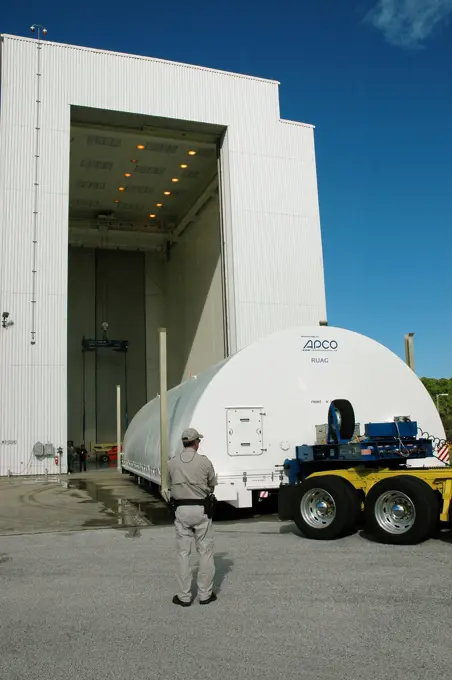
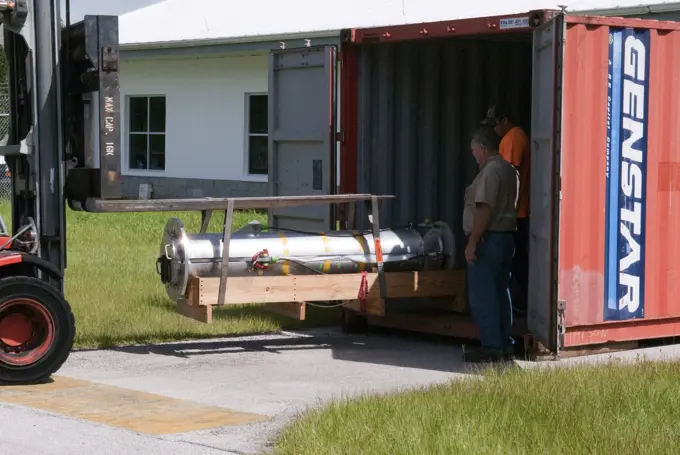
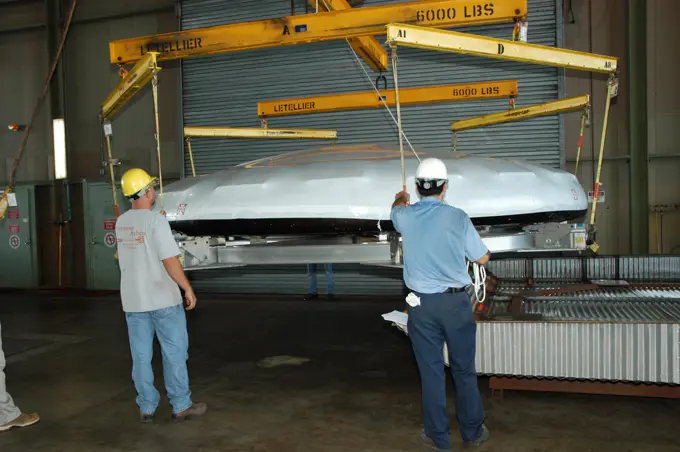
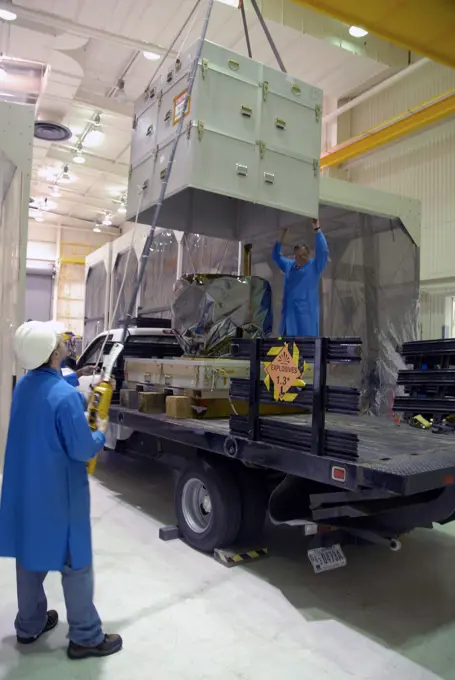
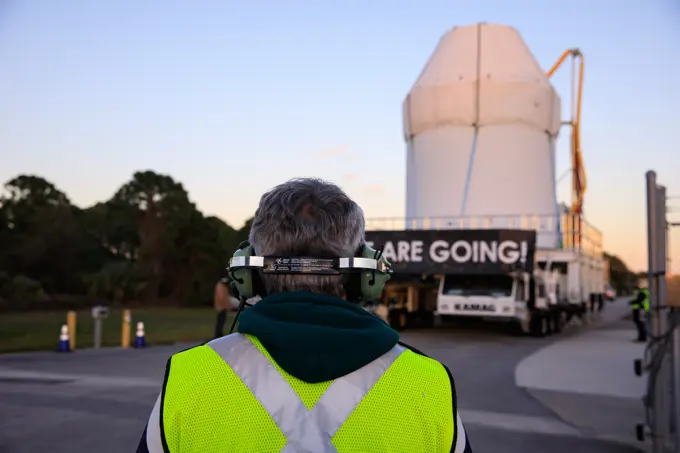
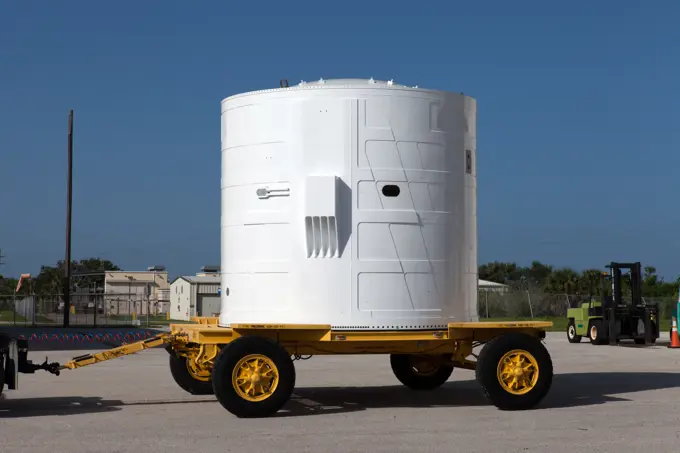
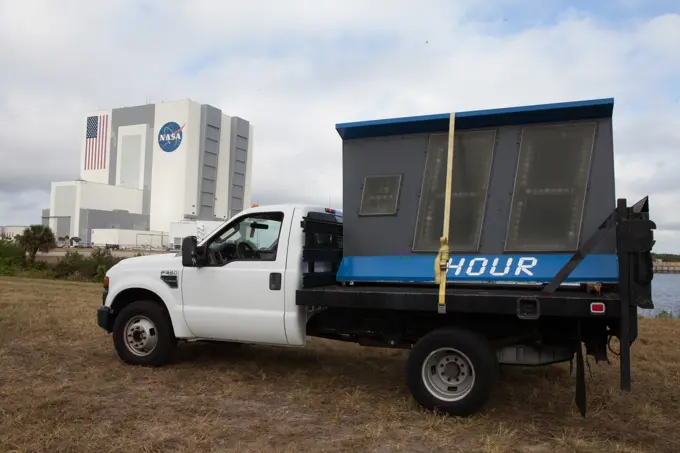
KENNEDY SPACE CENTER, FLA. -   One of the fairing halves for the Lockheed Martin Atlas V rocket arrives at the Payload Hazardous Service Facility airlock.  The Atlas V is the launch vehicle for the New Horizons spacecraft.  The fairing will encapsulate the spacecraft to protect it during launch and flight through the atmosphere.  Once out of the atmosphere, the fairing is jettisoned. New Horizons is designed to make the first reconnaissance of Pluto and Charon - a "double planet" and the last planet in our solar system to be visited by spacecraft. The mission will then visit one or more objects in the Kuiper Belt region beyond Neptune. New Horizons is scheduled to launch in January 2006, swing past Jupiter for a gravity boost and scientific studies in February or March 2007, and reach Pluto and its moon, Charon, in July 2015.
KENNEDY SPACE CENTER, FLA. - One of the fairing halves for the Lockheed Martin Atlas V rocket arrives at the Payload Hazardous Service Facility airlock. The Atlas V is the launch vehicle for the New Horizons spacecraft. The fairing will encapsulate the spacecraft to protect it during launch and flight through the atmosphere. Once out of the atmosphere, the fairing is jettisoned. New Horizons is designed to make the first reconnaissance of Pluto and Charon - a "double planet" and the last planet in our solar system to be visited by spacecraft. The mission will then visit one or more objects in the Kuiper Belt region beyond Neptune. New Horizons is scheduled to launch in January 2006, swing past Jupiter for a gravity boost and scientific studies in February or March 2007, and reach Pluto and its moon, Charon, in July 2015.
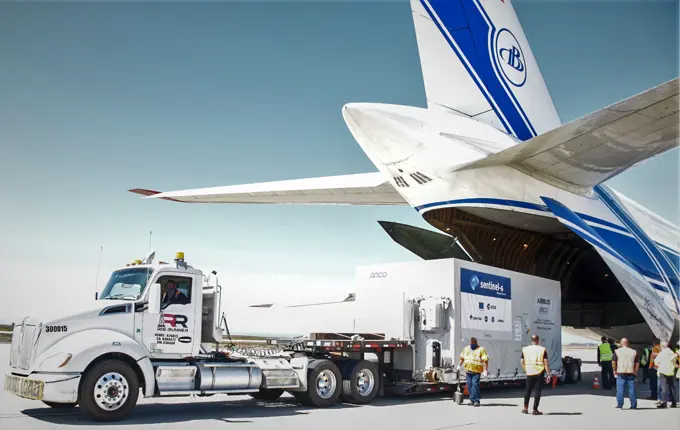
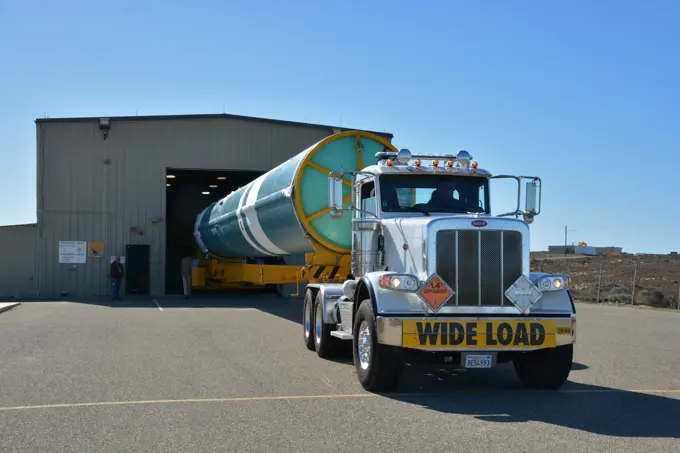
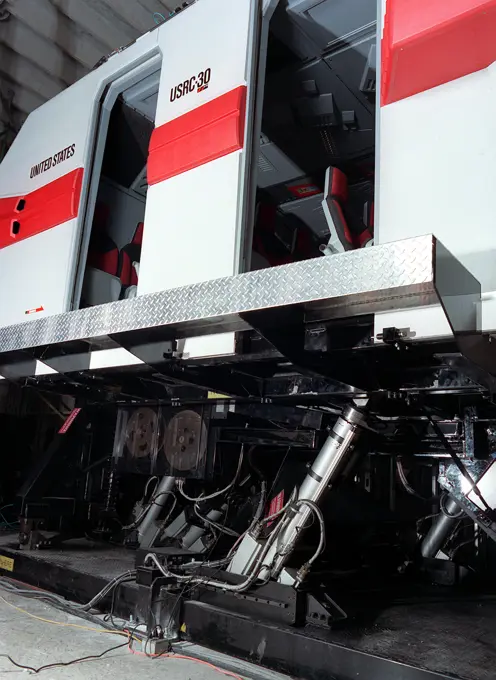
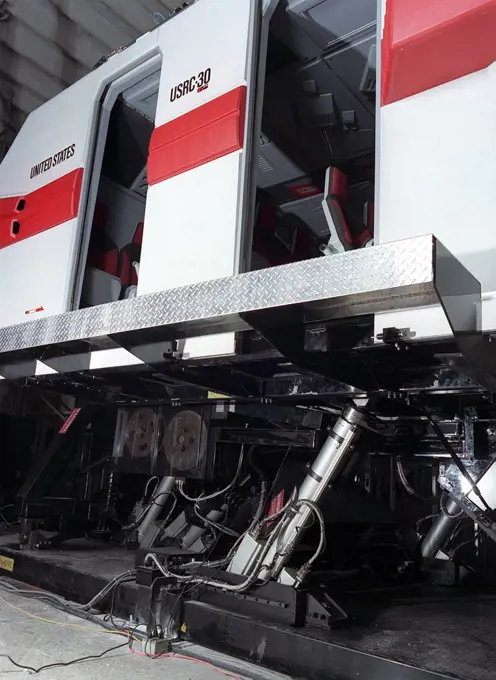
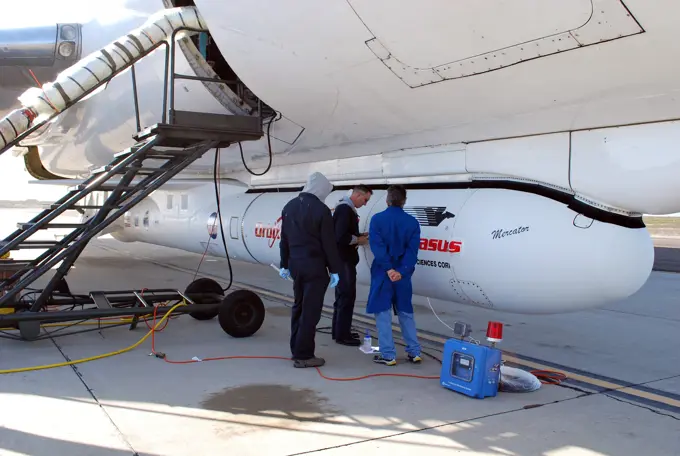
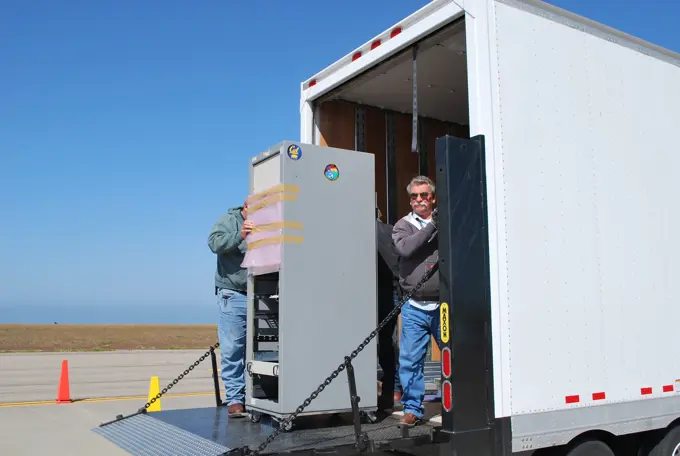
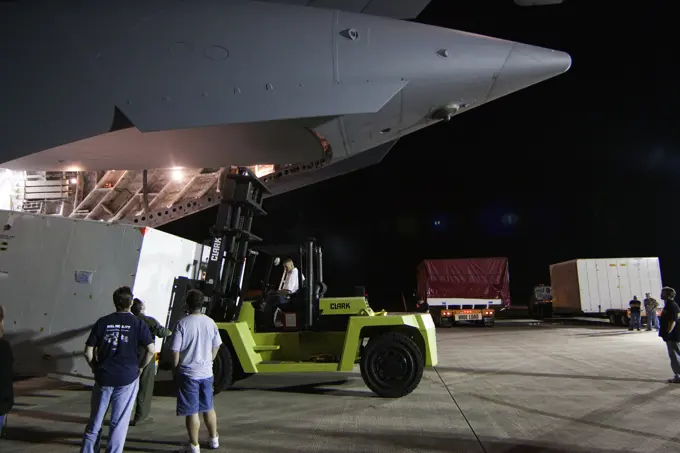
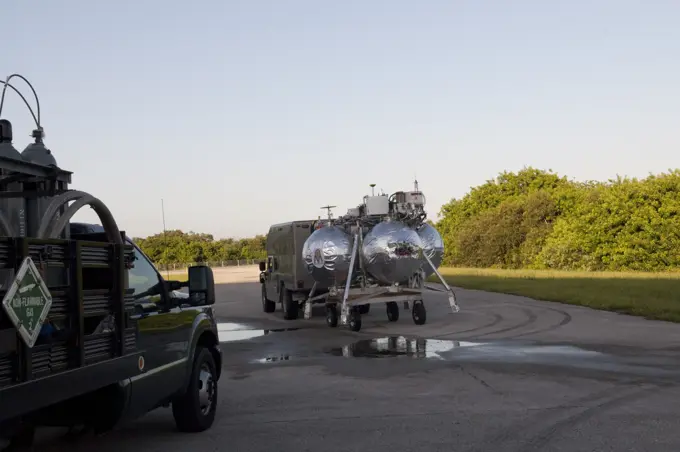
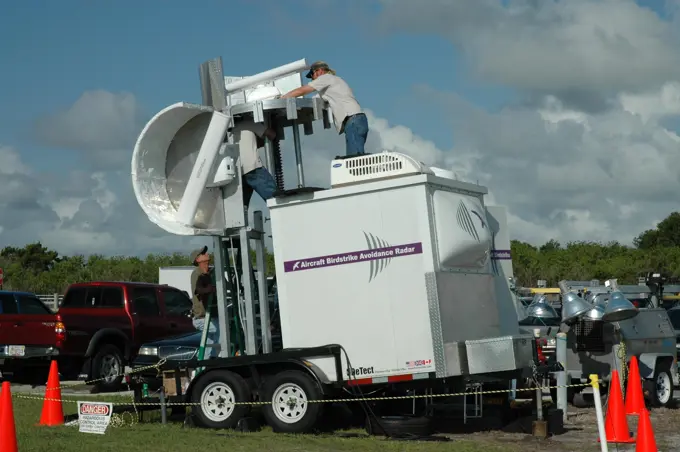
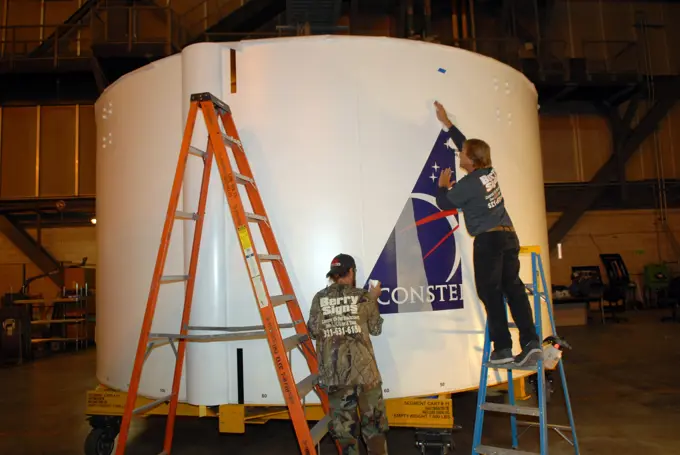
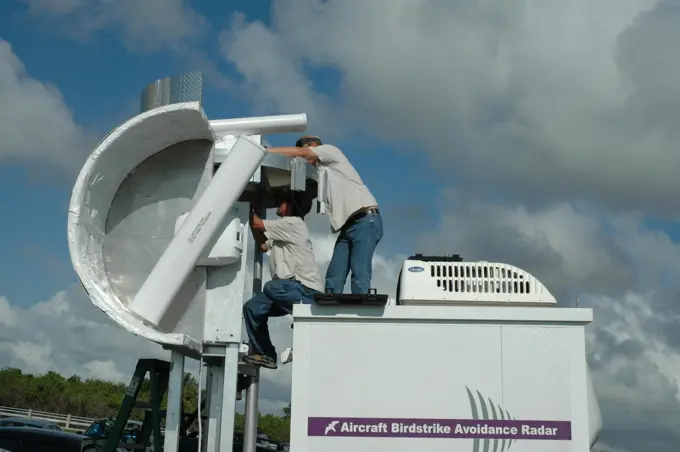
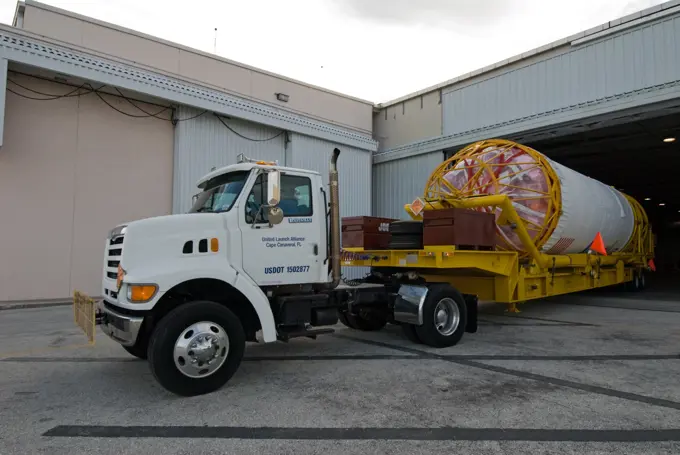
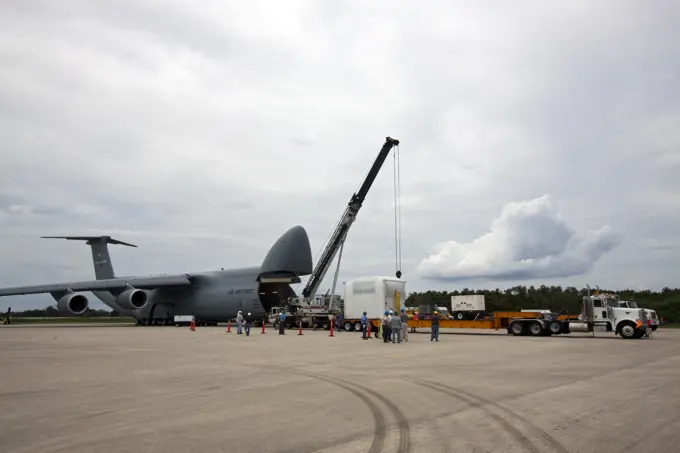
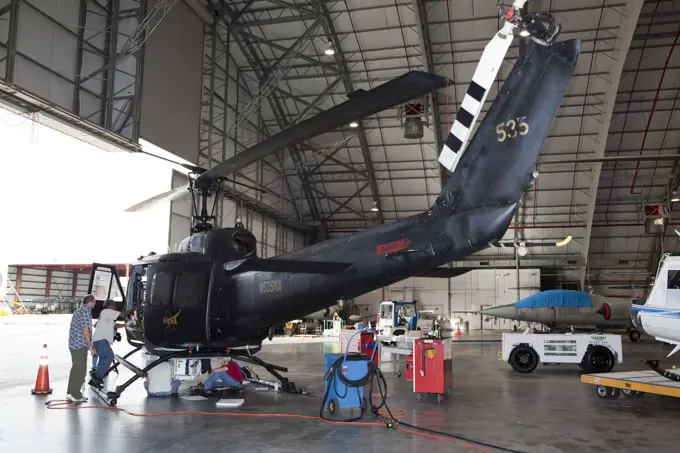
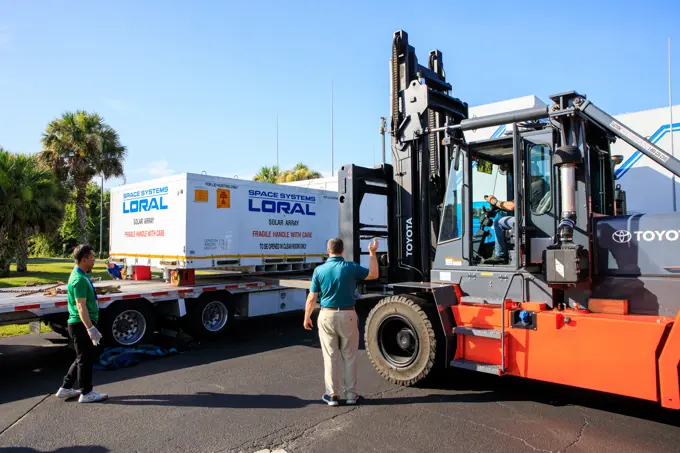
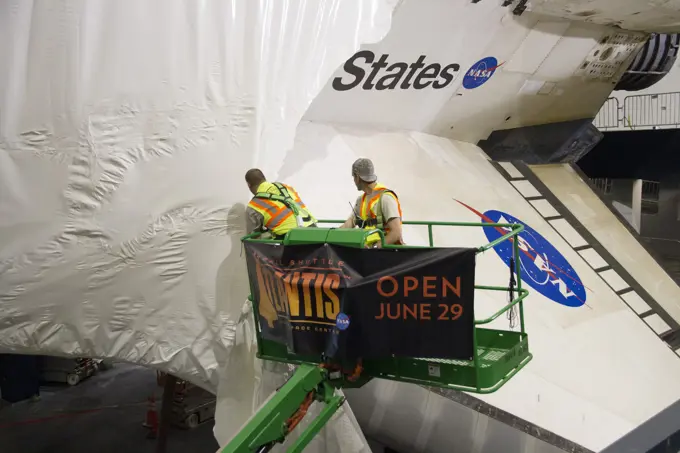
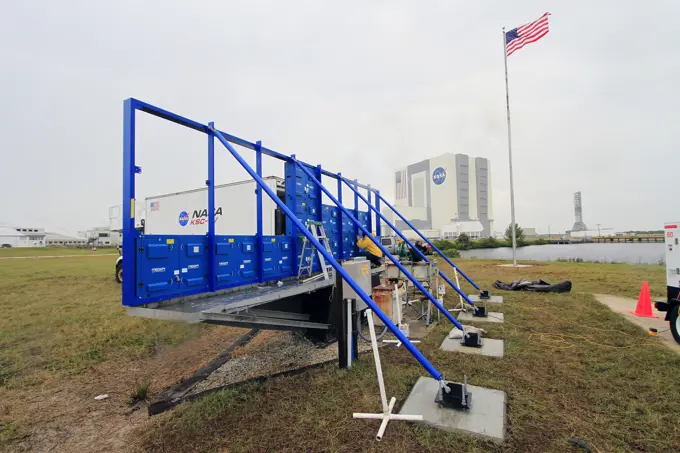
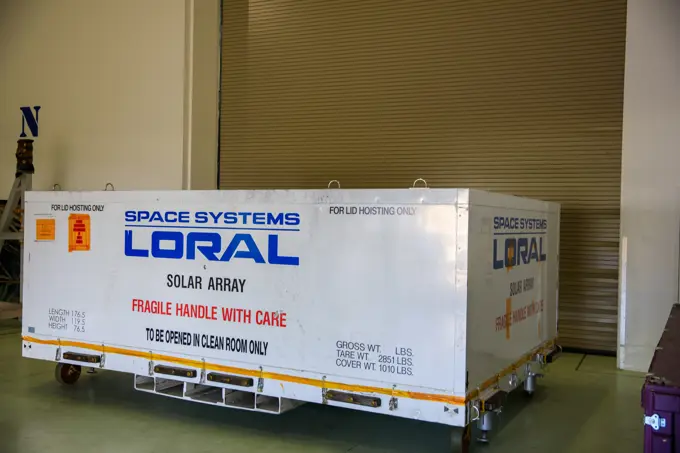
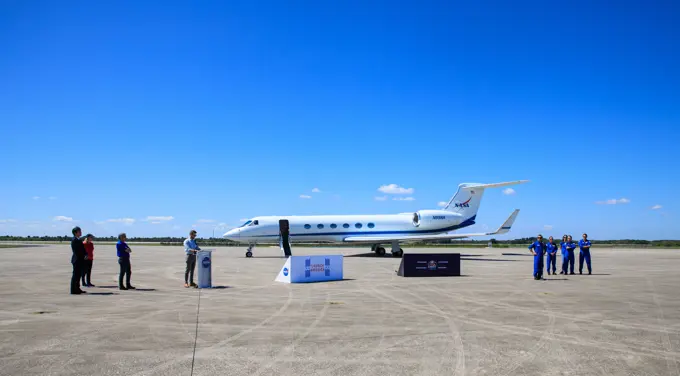
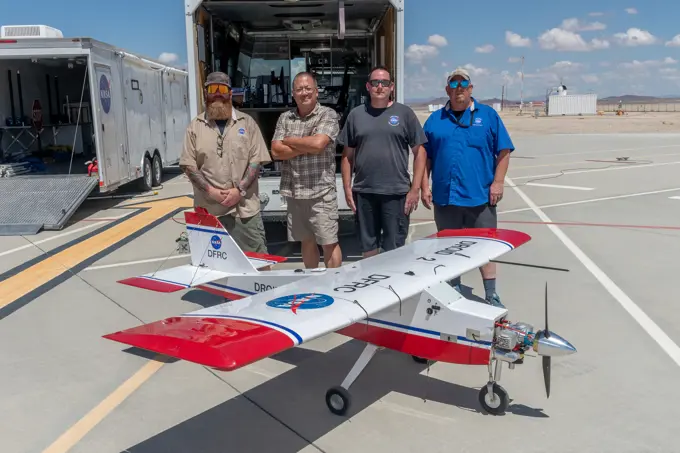
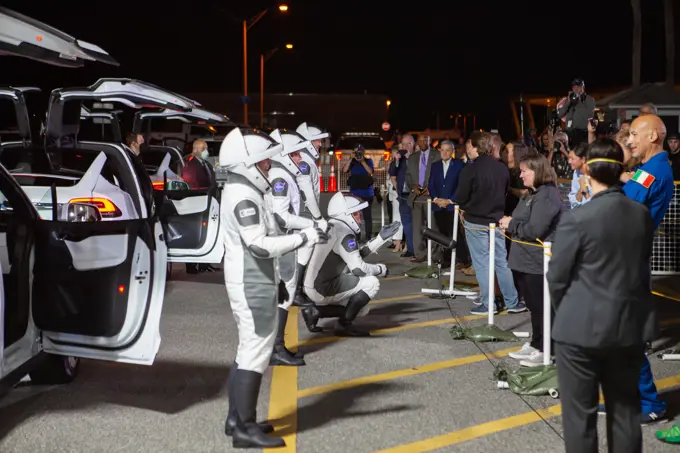
KENNEDY SPACE CENTER, FLA. -- Technicians prepare to install the replacement wrist joint for the Space Station Remote Manipulator System into Space Shuttle Endeavour's payload bay. The new wrist joint, called an Orbital Replacement Unit (ORU), will be installed next to the arm's Latching End Effector during the final of three planned spacewalks. Mission STS-111 is designated UF-2, the 14th assembly flight to the International Space Station. Endeavour's payload includes the Multi-Purpose Logistics Module Leonardo and Mobile Base System. The mission also will swap resident crews on the Station, carrying the Expedition 5 crew and returning to Earth Expedition 4. Liftoff of Endeavour is scheduled between 4 and 8 p.m. May 30, 2002Edwards, Calif. - ED-0144-01 - Plastic wrapping that protected the Sierra Nevada Corporation, or SNC, Dream Chaser flight test vehicle during its transport from Colorado is carefully removed by SNC employee Will Armijo following the craft's arrival at NASA's Dryden Flight Research Center in southern California. The prototype space access vehicle will undergo ground and approach-and-landing flight tests in the coming months as part of NASA's Commercial Crew Program, or CCP, development work. SNC is one of three companies working with CCP during the agency's Commercial Crew Integrated Capability, or CCiCap, initiative, which is intended to lead to the availability of commercial human spaceflight services for government and commercial customers.CAPE CANAVERAL, Fla. - Support equipment for NASA's Morpheus lander, a vertical test bed vehicle, is unloaded at a building at the Shuttle Landing Facility, or SLF, at the Kennedy Space Center in Florida. Morpheus is designed to demonstrate new green propellant propulsion systems and autonomous landing and an Autonomous Landing and Hazard Avoidance Technology, or ALHAT, system.Checkout of the prototype lander has been ongoing at NASAs Johnson Space Center in Houston in preparation for its first free flight. The SLF site will provide the lander with the kind of field necessary for realistic testing. Project Morpheus is one of 20 small projects comprising the Advanced Exploration Systems, or AES, program in NASAs Human Exploration and Operations Mission Directorate. AES projects pioneer new approaches for rapidly developing prototype systems, demonstrating key capabilities and validating operational concepts for future human missions beyond Earth orbit.In Hangar N at NASA's Kennedy Space Center, a heat shield for the Constellation crew exploration vehicle, or CEV, is being prepared for a demonstration. A developmental heat shield for the Orion spacecraft is being tested and evaluated at Kennedy. The shield was designed and assembled by the Boeing Company in Huntington Beach, Calif., for NASA's Constellation Program. The thermal protection system manufacturing demonstration unit is designed to protect astronauts from extreme heat during re-entry to Earth's atmosphere from low Earth orbit and lunar missions. The CEV will be used to dock and gain access to the International Space Station, travel to the moon in the 2018 timeframe and play a crucial role in exploring Mars.The Sentinel-6 Michael Freilich satellite, secured inside a shipping container, arrives at Vandenberg Air Force Base in California on Sept. 24, 2020, aboard an Antonov cargo aircraft. The mission is an international partnership and the first launch of a constellation of two satellites that will observe changes in Earths sea levels for at least the next decade. Launching atop a SpaceX Falcon 9 rocket, Sentinel-6 Michael Freilich is targeted to lift off from Vandenbergs Space Launch Complex 4 on Nov. 10, 2020. The Launch Services Program at Kennedy is responsible for launch management.At NASA's Kennedy Space Center in Florida, a shade is placed around the new countdown clock at the spaceport's Press Site. The modern, multimedia display is similar to the screens seen at sporting venues. The new screen is nearly 26 feet wide by 7 feet high, a foot taller than the original clock. The historic countdown clock was designed by Kennedy engineers and built by space center technicians before Apollo 12 in 1969. NASA has acquired the countdown clock from the agencys Artifact Working Group at the agency's Headquarters for display at the Kennedy Space Center Visitor Complex.At NASA's Building 836, the Spacecraft Labs Telemetry Station at Vandenberg Air Force Base in California, on Tuesday, April 17, 2018, a United Launch Alliance (ULA) Delta II booster is transported to Space Launch Complex-2 where it will launch NASA's Ice, Cloud and land Elevation Satellite-2, or ICESat-2, satellite. This will be the last flight for the venerable Delta II rocket. ICESat-2, which is being built and tested by Orbital ATK in Gilbert, Arizona, will carry a single instrument called the Advanced Topographic Laser Altimeter System, or ATLAS. The ATLAS instrument is being built and tested at NASAs Goddard Space Flight Center in Greenbelt Maryland. Once in orbit, the satellite is designed to measure the height of a changing Earth, one laser pulse at a time, 10,000 laser pulses a second. ICESat-2 will help scientists investigate why, and how much, Earths frozen and icy areas, called the cryosphere, are changing.The development of the electric space actuator represents an unusual case of space technology transfer wherein the product was commercialized before it was used for the intended space purpose. MOOG, which supplies the thrust vector control hydraulic actuators for the Space Shuttle and brake actuators for the Space Orbiter, initiated development of electric actuators for aerospace and industrial use in the early 1980s. NASA used the technology to develop an electric replacement for the Space Shuttle main engine TVC actuator. An electric actuator is used to take passengers on a realistic flight to Jupiter at the US Space and Rocket Center, Huntsville, Alabama.Electric actuators are used on a motion simulator to take passengers on a realistic flight at the US Space and Rocket Center, Huntsville, Alabama.  The development of the electric space actuator represents an unusual case of space technology transfer wherein the product was commercialized before it was used for the intended space purpose. MOOG, which supplies the thrust vector control hydraulic actuators for the Space Shuttle and brake actuators for the Space Orbiter, initiated development of elVANDENBERG AIR FORCE BASE, Calif. - On the ramp of Vandenberg Air Force Base in California, workers make final checks of the Pegasus XL rocket before departure for the Kwajalein Atoll, a part of the Marshall Islands in the Pacific Ocean.  Mated to NASAs Interstellar Boundary Explorer, or IBEX, spacecraft, the Pegasus is attached under the wing of the aircraft for launch.  Departing from Kwajalein, the Pegasus rocket will be dropped from under the wing of the L-1011 over the Pacific Ocean to carry the spacecraft approximately 130 miles above Earth and place it in orbit.  Then, the spacecrafts own engine will boost it to its final high-altitude orbit (about 200,000 miles high) — most of the way to the Moon. The IBEX satellite will make the first map of the boundary between the Solar System and interstellar space.  IBEX science will be led by the Southwest Research Institute of San Antonio, Texas.  IBEX is targeted for launch over the Pacific Oct. 19.VANDENBERG AIR FORCE BASE, Calif. -- Technicians prepare to offload the spacecraft airborne support equipment for the Orbital Sciences' L-1011 carrier aircraft. This equipment will maintain the in-flight monitoring and control of the NuSTAR spacecraft before the release of the Pegasus XL rocket.The Pegasus will launch NuSTAR into space where the high-energy x-ray telescope will conduct a census for black holes, map radioactive material in young supernovae remnants, and study the origins of cosmic rays and the extreme physics around collapsed stars.CAPE CANAVERAL, Fla. -- Workers unload a container holding the cruise stage, one of the first three elements for NASA's Mars Science Laboratory (MSL) that arrived at NASA Kennedy Space Center's Shuttle Landing Facility aboard an Air Force C-17 cargo plane. The cruise stage, back shell and heat shield, the first flight elements to arrive for the MSL mission, were taken to the Payload Hazardous Servicing Facility (PHSF) located in the KSC Industrial Area to begin processing. The Curiosity rover will arrive next month. A United Launch Alliance Atlas V-541 configuration will be used to loft MSL into space. Curiositys 10 science instruments are designed to search for evidence on whether Mars has had environments favorable to microbial life, including chemical ingredients for life.  The unique rover will use a laser to look inside rocks and release its gasses so that the rovers spectrometer can analyze and send the data back to Earth. MSL is scheduled to launch from Cape Canaveral Air Force CAPE CANAVERAL, Fla. - NASA's Morpheus lander, a vertical test bed vehicle, is being transported out from its checkout building for a short trip to a launch position at the Shuttle Landing Facility, or SLF, at the Kennedy Space Center in Florida. Morpheus is designed to demonstrate new green propellant propulsion systems and autonomous landing and an Autonomous Landing and Hazard Avoidance Technology, or ALHAT, system.Checkout of the prototype lander has been ongoing at NASAs Johnson Space Center in Houston in preparation for its first free flight. The SLF site will provide the lander with the kind of field necessary for realistic testing. Project Morpheus is one of 20 small projects comprising the Advanced Exploration Systems, or AES, program in NASAs Human Exploration and Operations Mission Directorate. AES projects pioneer new approaches for rapidly developing prototype systems, demonstrating key capabilities and validating operational concepts for future human missions beyond CAPE CANAVERAL, Fla. -- In the morning fog at Cape Canaveral Air Force Station's Space Launch Complex 41 in Florida, preparations are underway to erect the first stage of the Atlas V rocket that will carry the Tracking and Data Relay Satellite, TDRS-K, into orbit.Launch of the TDRS-K on the Atlas V rocket is planned for January 29, 2013. The TDRS-K spacecraft is part of the next-generation series in the Tracking and Data Relay Satellite System, a constellation of space-based communication satellites providing tracking, telemetry, command and high-bandwidth data return services.KENNEDY SPACE CENTER, FLA. -   Radar technicians  adjust two bird detection radars near Launch Pad 39B before the July 1 launch of Space Shuttle Discovery on mission STS-121.  When birds, especially vultures, are near the shuttle during a launch, impact on a critical area is possible and could cause catastrophic damage to the vehicle.  Already proven affective for aviation where threats posed by bird strikes have been a problem, the avian radar, known as Aircraft Birdstrike Avoidance Radar, provides horizontal and vertical scanning and can monitor either launch pad for movement of vultures around them.  If data relayed from the avian radar indicates large birds are dangerously close to the vehicle, controllers could hold the countdown.CAPE CANAVERAL, Fla. -  In the Vehicle Assembly Building high bay 4 at NASA's Kennedy Space Center in Florida, workers begin adhering the Constellation patch on one of the Ares I-X upper stage simulator segments. The upper stage simulator will be used in the test flight identified as Ares I-X in 2009.  Ares I-X is the test vehicle for the Ares I, which is part of the Constellation Program to return men to the moon and beyond.  Ares I is the essential core of a safe, reliable, cost-effective space transportation system that eventually will carry crewed missions back to the moon, on to Mars and out into the solar system. Ares I may also use its 25-ton payload capacity to deliver resources and supplies to the International Space Station, or to "park" payloads in orbit for retrieval by other spacecraft bound for the moon or other destinations.At NASA's Kennedy Space Center in Florida, assembly has begun on the first of 24 light emitting diode LED panels for installation in the new countdown clock at the spaceport's Press Site. The new modern, multimedia display will be similar to the screens seen at sporting venues. The new screen will be nearly 26 feet wide by 7 feet high, a foot taller than the original clock. The historic countdown clock was designed by Kennedy engineers and built by space center technicians before Apollo 12 in 1969. NASA has requested to acquire the countdown clock from the agencys Artifact Working Group at the agency's Headquarters for likely display at the Kennedy Space Center Visitor Complex.CAPE CANAVERAL, Fla. -- At NASAs Kennedy Space Center in Florida, the Project Morpheus prototype lander is prepared for its move from a support building to a launch platform at the north end of the Shuttle Landing Facility. Testing of the prototype lander was performed at NASAs Johnson Space Center in Houston in preparation for tethered and free flight testing at Kennedy.The landing facility will provide the lander with the kind of field necessary for realistic testing, complete with rocks, craters and hazards to avoid. Morpheus utilizes an autonomous landing and hazard avoidance technology, or ALHAT, payload that will allow it to navigate to clear landing sites amidst rocks, craters and other hazards during its descent. Project Morpheus is being managed under the Advanced Exploration Systems, or AES, Division in NASAs Human Exploration and Operations Mission Directorate. The efforts in AES pioneer new approaches for rapidly developing prototype systems, demonstrating key capabiliVANDENBERG AIR FORCE BASE, Calif. -  The cover of the environmentally controlled container is lifted off NASAs Interstellar Boundary Explorer, or IBEX, spacecraft  after its arrival at Hangar 1555 on Vandenberg Air Force Base in California. In the hangar, IBEX will be mated with the Pegasus XL rocket for launch. The IBEX satellite will make the first map of the boundary between the Solar System and interstellar space. IBEX is targeted for launch from the Kwajalein Atoll, a part of the Marshall Islands in the Pacific Ocean, on Oct.  19 aboard the Pegasus rocket dropped from under the wing of an L-1011 aircraft flying over the Pacific Ocean. The Pegasus will carry the spacecraft approximately 130 miles above Earth and place it in orbit.KENNEDY SPACE CENTER, FLA. -   Radar technicians  adjust two bird detection radars near Launch Pad 39B before the July 1 launch of Space Shuttle Discovery on mission STS-121. When birds, especially vultures, are near the shuttle during a launch, impact on a critical area is possible and could cause catastrophic damage to the vehicle.  Already proven affective for aviation where threats posed by bird strikes have been a problem, the avian radar, known as Aircraft Birdstrike Avoidance Radar, provides horizontal and vertical scanning and can monitor either launch pad for movement of vultures around them.  If data relayed from the avian radar indicates large birds are dangerously close to the vehicle, controllers could hold the countdown.KENNEDY SPACE CENTER, FLA. - At the Space Station Processing Facility, a trailer delivers the Cupola, an element scheduled to be installed on the International Space Station in early 2009. It was shipped from Alenia Spazio in Turin, Italy, for the European Space Agency.  A dome-shaped module with seven windows, the Cupola will give astronauts a panoramic view for observing many operations on the outside of the orbiting complex.  The view out of the Cupola windows will enhance an arm operator's situational awareness, supplementing television camera views and graphics.  It will provide external observation capabilities during spacewalks, docking operations and hardware surveys and for Earth and celestial studies. The Cupola is the final element of the Space Station core.CAPE CANAVERAL, Fla. - The Magnetospheric Multiscale spacecraft, enclosed in a protective shipping container, arrive at Building 2 of the Astrotech payload processing facility in Titusville, Florida, near Kennedy Space Center.MMS is a Solar Terrestrial Probes mission comprising four identically instrumented spacecraft that will use Earths magnetosphere as a laboratory to study the microphysics of three fundamental plasma processes: magnetic reconnection, energetic particle acceleration and turbulence.  Launch aboard a United Launch Alliance Atlas V rocket from Space Launch Complex 41 on Cape Canaveral Air Force Station is targeted for March 12, 2015.CAPE CANAVERAL, Fla. - At the Atlas Spaceflight Operations Center on Cape Canaveral Air Force Station in Florida, preparations are under way to move the Centaur upper stage for the Atlas V rocket scheduled to launch NASA's Solar Dynamics Observatory, or SDO, to Pad 41.SDO is the first space weather research network mission in NASA's Living With a Star Program. The spacecraft's long-term measurements will give solar scientists in-depth information about changes in the sun's magnetic field and insight into how they affect Earth. Liftoff on the United Launch Alliance Atlas V is scheduled for 10:53 a.m. EST on Feb. 3, 2010.Secured atop a transport vehicle, Orion moves along the route to the Multi-Payload Processing Facility (MPPF) on Jan. 16, 2021, after departing from the Neil Armstrong Operations and Checkout Building at NASAs Kennedy Space Center in Florida. In the MPPF, Orion will undergo processing with the Exploration Ground Systems team taking over ground processing ahead of the Artemis I launch.CAPE CANAVERAL, Fla. -- At NASA's Kennedy Space Center in Florida, workers begin to offload the Alpha Magnetic Spectrometer, or AMS, from an Air Force C-5M aircraft, which flew in from Europe. The tractor-trailer will transport the AMS from the Shuttle Landing Facility runway to the Space Station Processing Facility, where it will be processed for launch. The state-of-the-art particle physics detector is designed to operate as an external module on the International Space Station. It will use the unique environment of space to study the universe and its origin by searching for dark matter.  AMS will fly to the station aboard space shuttle Endeavour's STS-134 mission targeted to launch Feb. 26, 2011.The Exploration Mission-1 (EM-1) left-hand forward skirt for NASA's Space Launch System (SLS) solid rocket boosters is prepared for its move from Hangar AE at Cape Canaveral Air Force Station in Florida, to the Booster Fabrication Facility (BFF) at Kennedy Space Center. In the BFF, the forward skirt will be inspected and prepared for use on the left-hand solid rocket booster for EM-1. NASA's Orion spacecraft will fly atop the SLS rocket on its first uncrewed flight test.CAPE CANAVERAL, Fla. - Near the Shuttle Landing Facility at NASA's Kennedy Space Center in Florida, a space agency team installed and tested hazard avoidance instrumentation on a Huey helicopter. Led by the Johnson Space Center and supported by Jet Propulsion Laboratory and Langley Research Center, the Autonomous Landing Hazard Avoidance Technology, or ALHAT, laser system provides a planetary lander the ability to precisely land safely on a surface while detecting any dangerous obstacles such as rocks, holes and slopes. Just north of Kennedy's Shuttle Landing Facility runway, a rock- and crater-filled planetary scape has been built so engineers can test the ability to negotiate away from risks.At NASA's Kennedy Space Center in Florida, the historic countdown clock at the spaceport's Press Site is disassembled for removal. Kennedy has requested to acquire the countdown clock from the agencys Artifact Working Group at NASA Headquarters for likely display at the Kennedy Space Center Visitor Complex. A new modern multimedia display soon will be installed, similar to the screens seen at sporting venues, is in the works. The new screen will be nearly 26 feet wide by 7 feet high. The old timepiece was designed by Kennedy engineers and built by Kennedy technicians in 1969. Not including the triangular concrete and aluminum base, the famous landmark is nearly six feet high, 26 feet wide and 3 feet deep. The new display will be similar in size, with the screen being nearly 26 feet wide by seven feet high.Psyche Solar Array Arrival and Offload. The transport carrier containing the twin solar arrays for NASAs Psyche spacecraft is offloaded at the Astrotech Space Operations Facility near the agencys Kennedy Space Center in Florida on July 15, 2023. The solar arrays were shipped from  Maxar Technologies, in California. They are part of the solar electric propulsion system, provided by Maxar, that will power the spacecraft on its journey to explore a metal-rich asteroid. Psyche will launch atop a SpaceX Falcon Heavy rocket from Launch Complex 39A at Kennedy. Launch is targeted for Oct. 5, 2023. Riding with Psyche is a pioneering technology demonstration, NASAs Deep Space Optical Communications (DSOC) experiment.CAPE CANAVERAL, Fla. -- At the Kennedy Space Center Visitor Complex in Florida, construction crews remove 16,000 square feet of plastic shrink-wrap from the space shuttle Atlantis. The spacecraft was enclosed in the plastic shrink-wrap since November of last year to protect the artifact from dust and debris during construction of the 90,000-square-foot facility. Last November, the space shuttle Atlantis made its historic final journey to its new home, traveling 10 miles from the Kennedy Space Center's Vehicle Assembly Building to the spaceport's visitor complex. The new $100 million 'Space Shuttle Atlantis' facility will include interactive exhibits that tell the story of the 30-year Space Shuttle Program and highlights the future of space exploration. The 'Space Shuttle Atlantis' exhibit scheduled to open June 29, 2013.CAPE CANAVERAL, Fla. - At NASA's Kennedy Space Center in Florida, work continues to install 24 light emitting diode LED panels in the new countdown clock at the spaceport's Press Site. The modern, multimedia display is similar to the screens seen at sporting venues. The new screen will be nearly 26 feet wide by 7 feet high, a foot taller than the original clock.The historic countdown clock was designed by Kennedy engineers and built by space center technicians before Apollo 12 in 1969. NASA has requested to acquire the countdown clock from the agencys Artifact Working Group at the agency's Headquarters for likely display at the Kennedy Space Center Visitor Complex.CAPE CANAVERAL, Fla. - Near the Shuttle Landing Facility at NASA's Kennedy Space Center in Florida, a space agency team installed and tested hazard avoidance instrumentation on a Huey helicopter.Led by the Johnson Space Center and supported by Jet Propulsion Laboratory and Langley Research Center, the Autonomous Landing Hazard Avoidance Technology, or ALHAT, laser system provides a planetary lander the ability to precisely land safely on a surface while detecting any dangerous obstacles such as rocks, holes and slopes. Just north of Kennedy's Shuttle Landing Facility runway, a rock- and crater-filled planetary scape has been built so engineers can test the ability to negotiate away from risks.Psyche Solar Array Arrival and Offload. The transport carrier containing the twin solar arrays for NASAs Psyche spacecraft is secured inside the Astrotech Space Operations Facility near the agencys Kennedy Space Center in Florida on July 15, 2023. The solar arrays were shipped from Maxar Technologies, in San Jose, California. They are part of the solar electric propulsion system, provided by Maxar, that will power the spacecraft on its journey to explore a metal-rich asteroid. Psyche will launch atop a SpaceX Falcon Heavy rocket from Launch Complex 39A at Kennedy. Launch is targeted for Oct. 5, 2023. Riding with Psyche is a pioneering technology demonstration, NASAs Deep Space Optical Communications (DSOC) experiment.NASA Hosts Media Event for the agencys SpaceX Crew-5 Mission. JAXA (Japan Aerospace Exploration Agency) astronaut Koichi Wakata speaks to members of the news media during crew arrival for NASAs SpaceX Crew-5 mission at the Launch and Landing Facility at Kennedy Space Center in Florida on Oct. 1, 2022. The astronauts will launch aboard the Crew Dragon on a SpaceX Falcon 9 rocket on Oct. 5. Launch is targeted for noon EDT from Launch Complex 39A. Crew-5 is the fifth crew rotation mission with SpaceX to the station, and the sixth flight of Dragon with people as part of the agencys Commercial Crew Program.. Justin Hall, Derek Abramson, Justin Link, and Robert "Red" Jensen were key to a successful mission for the DROID 2 (Dryden Remotely Operated Integrated Drone 2) aircraft at NASA's Armstrong Flight Research Center in Edwards, California. The aircraft flew as part of the Advanced Exploration of Reliable Operation at Low Altitudes: Meteorology, Simulation, and Technology campaign. The focus was to study wind to provide data for safe takeoff and landing of future air taxis.Crew-4 astronauts Kjell Lindgren, Samantha Cristoforetti, Bob Hines, and Jessica Watkins wave to their families outside of the Neil Armstrong Operations and Checkout Building at NASAs Kennedy Space Center in Florida before getting into the customized Tesla Model X vehicles that will transport them to their spacecraft at Launch Complex 39A. SpaceXs Crew Dragon, powered by the companys Falcon 9 rocket, will carry the four-person crew to the International Space Station as part of NASAs Commercial Crew Program. Crew-4 is scheduled to launch today at 3:52 a.m. EDT, from Pad 39A at Kennedy.TITUSVILLE, Fla. - Visitors to the Tico Air Show near NASA's Kennedy Space Center in Florida take time to learn about the work the agency is pursuing and plans for future exploration. Visitors to the NASA booth found out about the Ground Systems Development and Operations Program, the Launch Services Program and the Commercial Crew Program, all based at Kennedy. They could also see models of spacecraft and rockets including the Space Launch System, or SLS.