Fine ArtVintageFootageSubscriptionBoardsFree ResearchPricing
  • Fine Art
  • Vintage
  • Footage
  • Subscription
  • Boards
  • Free Research
  • Pricing

Space Shuttle Payload Processing

Images of various modules and cargo related to the Space Shuttle program, emphasizing preparations and equipment at NASA's Kennedy Space Center.
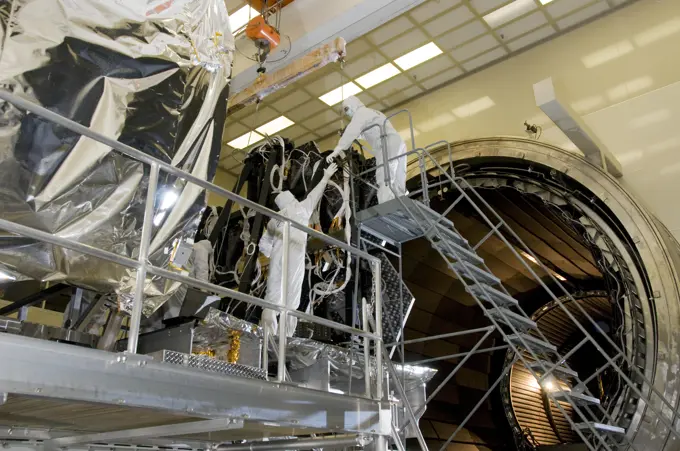
SIX OF THE EIGHTEEN JAMES WEBB SPACE TELESCOPE MIRROR SEGMENTS ARE BEING PREPPED TO MOVE INTO THE X-RAY AND CRYOGENIC FACILITY FOR TESTING.
352 assets in this story
6145-45245615
LANCAIR AIRFOIL THERMO ICE PROTECTION
6145-58964068
KENNEDY SPACE CENTER, FLA. -- In the Space Station Processing Facility, Multi-Purpose Logistics Module Leonardo has the attention of workers and some of the STS-102 crew. The MPLM, part of the payload on the STS-102 mission, is the first of three pressurized modules that will serve as the International Space Stations moving vans, carrying laboratory racks filled with equipment, experiments and supplies to and from the Space Station aboard the Space Shuttle. Leonardo is scheduled to be launched in early March. On that flight, Leonardo will be filled with equipment and supplies to outfit the U.S. laboratory module Destiny. The mission will also be carrying the Expedition Two crew to the Space Station, replacing the Expedition One crew who will return on Shuttle Discovery
6145-44733954
Apollo interium midcourse flight simulator Brent Creer, Chief of the Ames manned spacecraft simulation branch, developed the Apollo mid-course navigation and guidance simulator.
6145-58963454
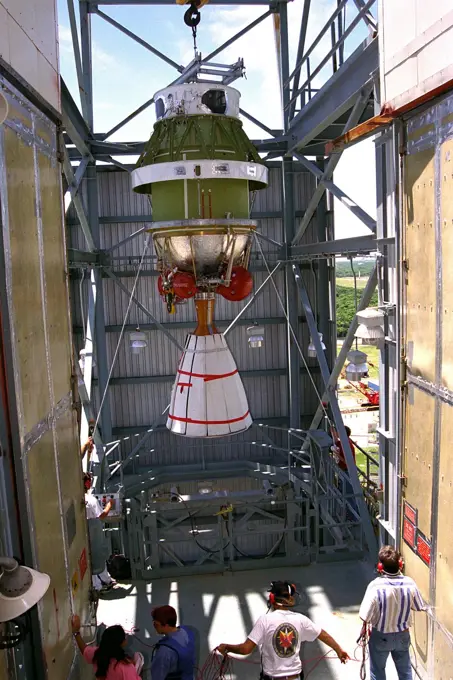
KENNEDY SPACE CENTER, FLA. - Inside the mobile service tower on Launch Pad 17-B, Cape Canaveral Air Force Station, Fla., a Boeing worker aids in lowering the replacement interstage adapter toward the Boeing Delta II below. The rocket is the launch vehicle for the Deep Impact spacecraft. Boeing workers will attach the adapter to the rockets center body section. Later the second stage, which was removed to allow access to the previous adapter, will be reattached. The first adapter was removed after it was found to be faulty during a review of launch vehicle hardware. Launch of Deep Impact is now scheduled no earlier than Jan. 12.
6145-44861252
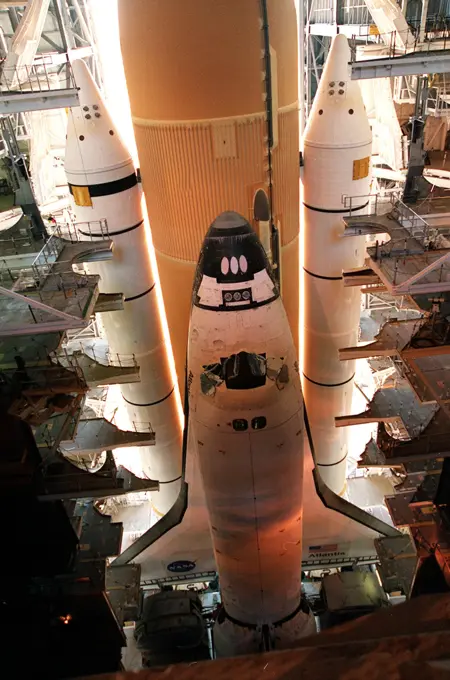
CAPE CANAVERAL, Fla. -- In the Vehicle Assembly Building at NASA's Kennedy Space Center in Florida, shuttle Atlantis is lowered toward the mobile launcher platform where it will be joined with its external fuel tank and solid rocket boosters.Commander Chris Ferguson, Pilot Doug Hurley and Mission Specialists Sandra Magnus and Rex Walheim are expected to launch in mid-July, taking with them the Raffaello multi-purpose logistics module packed with supplies, logistics and spare parts. The STS-135 mission also will fly a system to investigate the potential for robotically refueling existing spacecraft and return a failed ammonia pump module to help NASA better understand the failure mechanism and improve pump designs for future systems. STS-135 will be the 33rd flight of Atlantis, the 37th shuttle mission to the space station, and the 135th and final mission of NASA's Space Shuttle Program.
6145-58962121
KENNEDY SPACE CENTER, FLA. - In NASA Kennedy Space Centers Orbiter Processing Facility, bay 3, the Canadian-built orbiter boom sensor system robotic arm is removed from Discoverys payload bay. The boom, which was was used on Return to Flight mission STS-114 to provide more extensive inspection and photography of Discovery, will undergo inspection. The orbiter will be processed for the second Return to Flight mission, STS-121.
6145-44669741
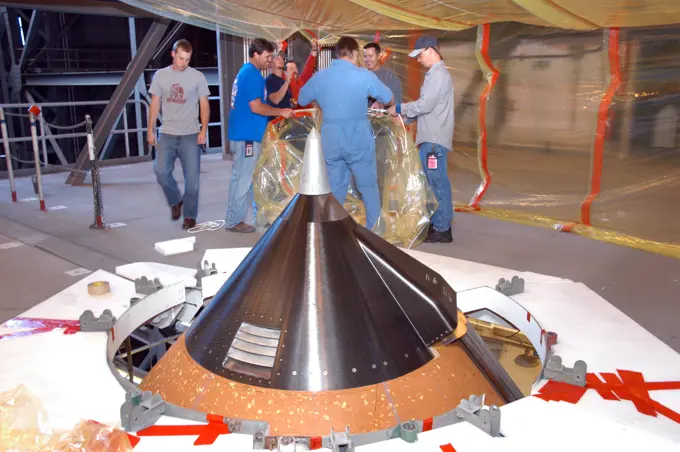
On an upper level of high bay 1 of the Vehicle Assembly Building, technicians prepare the area around the nose cone (foreground) of Atlantis' external tank that will undergo repair for hail damage. A severe thunderstorm with golf ball-sized hail caused visible divots in the giant tank's foam insulation and minor surface damage to about 26 heat shield tiles on the shuttle's left wing. Further evaluation of the tank is necessary to get an accurate accounting of foam damage and determine the type of repair required and the time needed for that work. A new target launch date has not been determined, but teams will focus on preparing Atlantis for liftoff in late April on mission STS-117.
6145-44871754
ISS028-E-015451 (10 July 2011) --- This is one of a series of images showing various parts of the space shuttle Atlantis in Earth orbit as photographed by one of three crew members -- half the station crew -- who were equipped with still cameras for this purpose on the International Space Station as the shuttle posed” for photos and visual surveys and performed a back-flip for the rendezvous pitch maneuver (RPM). Seen at the rear of the cargo bay is the Raffaello multi-purpose logistics module, packed with supplies and spare parts for the orbiting outpost. A  400 millimeter lens was used to capture this particular series of images.
6145-58968244
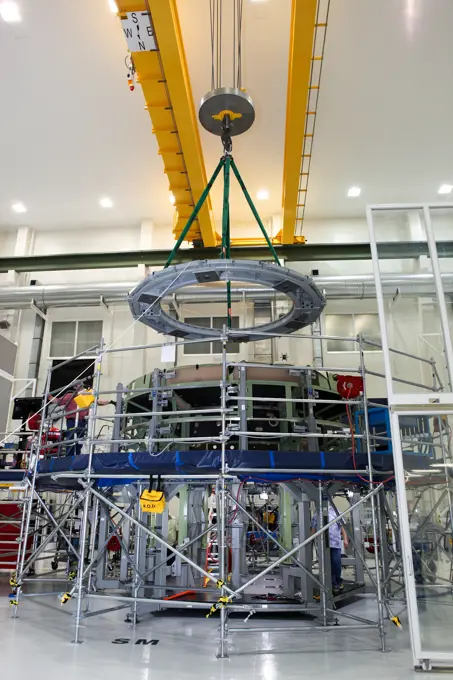
Technicians work on assembly of the Exploration Flight Test-1 (EFT-1) Orion service module mass simulator at the Operations and Checkout (O&C) Building at Kennedy Space Center on March 13, 2013. Part of Batch image transfer from Flickr.
6145-44887870
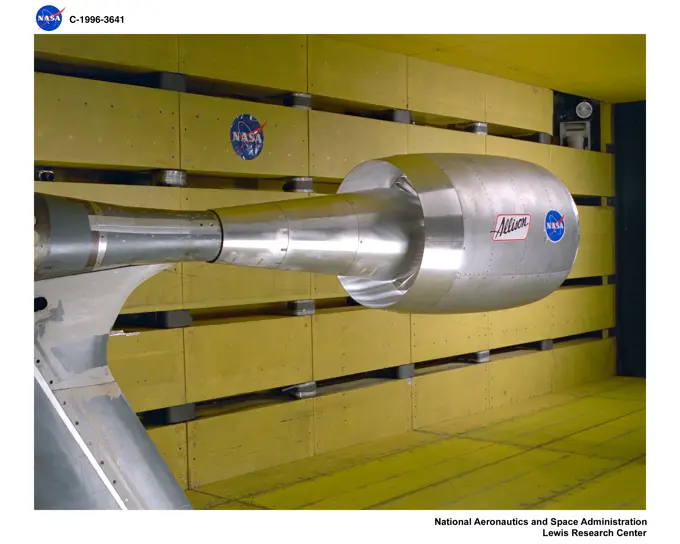
ALLISON DUCTED FAN IN 9X15 FOOT LOW SPEED WIND TUNNEL
6145-58964304
KENNEDY SPACE CENTER, FLA. -- Technicians in the Payload Changeout Room work to secure the U.S. Lab Destiny in the orbiters payload bay. The PCR is the enclosed, environmentally controlled portion of the rotating service structure that supports payload delivery at the launch pad and vertical installation in the orbiter payload bay. Destiny, a key element in the construction of the International Space Station, is 28 feet long and weighs 16 tons. This research and command-andcontrol center is the most sophisticated and versatile space laboratory ever built. It will ultimately house a total of 23 experiment racks for crew support and scientific research. STS-98 is the seventh construction flight to the ISS. Launch of STS-98 is scheduled for Jan. 19 at 2 11 a.m. EST
6145-55975210
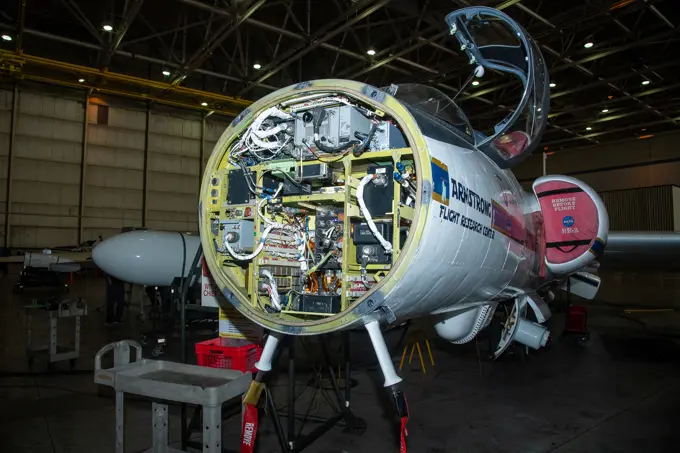
. NASA Armstrongs ER-2 aircraft is uploaded with instruments for its ALOFT mission.  The ER-2 will fly at high altitudes above the Floridian coastline to collect data about the energetic characteristics and behavior of lightning and thunderclouds.  Scientists from the University of Bergen, Norway will interpret that data from the ground and collaborate with NASA pilots to safely collect the most accurate data for this project about the power of lightning.
6145-45127992
Technicians with United Launch Alliance (ULA) attach crane lines to the Centaur upper stage of the ULA Atlas V Centaur stage at the Vertical Integration Facility at Space Launch Complex 41 at Cape Canaveral Air Force Station in Florida. The Centaur stage will be lifted and mated to the first stage booster. The rocket is being prepared for Orbital ATK's seventh commercial resupply mission, CRS-7, to the International Space Station. Orbital ATK's CYGNUS pressurized cargo module is scheduled to launch atop ULA's Atlas V rocket from Pad 41 on March 19, 2017. CYGNUS will deliver 7,600 pounds of supplies, equipment and scientific research materials to the space station.
6145-58965784
KENNEDY SPACE CENTER, FLA. -- The stacking of the launch vehicle for the Apollo Soyuz Test Project was completed today with the addition of the Command and Service Modules. The vehicle for the mid-July joint U.S._USSR space mission is scheduled to be moved to the launch pad on March 24.
6145-52086516
A view of a satellite installed in a fairing combined payload. Country: Unknown
6145-44795597
CAPE CANAVERAL, Fla. - In the Space Station Processing Facility at NASA's Kennedy Space Center in Florida, the installation of resupply stowage racks and platforms in the interior of Multi-Purpose Logistics Module Leonardo has been completed to support space shuttle Discovery's STS-131 mission to the International Space Station.  Cargo integration is the next step in Leonardo's processing.The cargo secured to the racks and platforms Leonardo delivers will be transferred to locations throughout the station. Three spacewalks during STS-131 will include work to attach a spare ammonia tank assembly to the station's exterior and to                       return a European experiment from outside the station's Columbus module. STS-131 will be the 33rd shuttle mission to the station. Launch is targeted for March 18, 2010.
6145-45159351
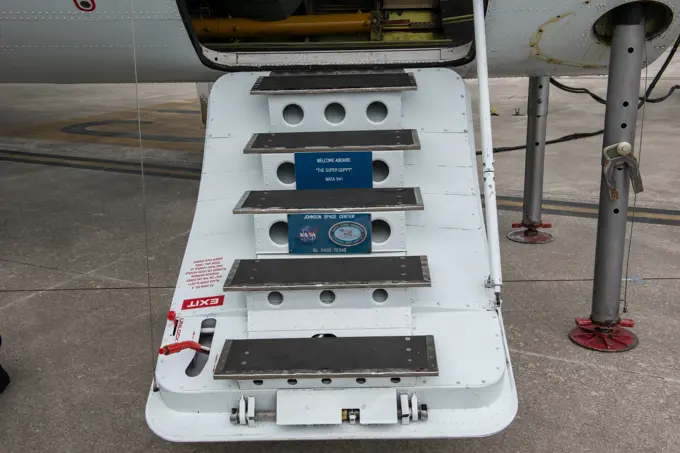
NASA's Super Guppy aircraft arrives to the U.S. Armys Redstone Airfield in Huntsville, Alabama, April 2, to pick up flight hardware for NASAs Space Launch System - its new, deep-space rocket that will enable astronauts to begin their journey to explore destinations far into the solar system. The Guppy will depart on Tuesday, April 3 to deliver the Orion stage adapter to NASAs Kennedy Space Center in Florida for flight preparations. On Exploration Mission-1, the first integrated flight of the SLS and the Orion spacecraft, the adapter will connect Orion to the rocket and carry 13 CubeSats as secondary payloads.
6145-44616854
KENNEDY SPACE CENTER, FLA.  -  In the Orbiter Processing Facility, workers check wiring being installed in Discoverys cargo bay that will support the addition of an Orbiter Boom Sensor System (OBSS) .  The OBSS is one of the new safety measures for Return to Flight, equipping the Shuttle with cameras and laser systems to inspect the Shuttles Thermal Protection System while in space.  Discovery is designated as the Return to Flight vehicle for mission STS-114, no earlier than March 2005
6145-45224781
The Solar Orbiter spacecraft is moved out of the cavernous interior of an Antonov An-124 cargo plane at NASA Kennedy Space Centers Launch and Landing Facility on Nov. 1, 2019. The spacecraft was delivered to the Florida spaceport from Munich, Germany, then transported to the Astrotech Space Operations facility in nearby Titusville. Solar Orbiter is a European Space Agency mission with strong NASA participation. The mission aims to study the Sun, its outer atmosphere and solar winds. The spacecraft will provide the first images of the Suns poles. NASAs Launch Services Program based at Kennedy is managing the launch. Liftoff is scheduled for Feb. 5, 2020, from Cape Canaveral Air Force Station aboard a United Launch Alliance Atlas V rocket.
6145-44620735
KENNEDY SPACE CENTER, FLA. - In the Orbiter Processing Facility, workers lower the nose cap toward the orbiter Atlantis for installation. The nose cap was removed from the vehicle in May and sent back to the vendor for thorough Non-Destructive Engineering evaluation and recoating.  Thermography was also performed to check for internal flaws.  This procedure uses high intensity light to heat areas that are immediately scanned with an infrared camera.  White Thermal Protection System blankets were reinstalled on the nose cap before installation.  Processing continues on Atlantis for its future mission to the International Space Station.
6145-44915520
View of Space Shuttle Main Engine
6145-58964736
KENNEDY SPACE CENTER, Fla. -- Daylight glows from behind Space Shuttle Atlantis as it begins rollout to Launch Pad 39A for the second time. An attempt to roll out on Jan. 2 incurred a failed computer processor on the crawler transporter and the Shuttle was returned to the Vehicle Assembly Building using a secondary computer processor on the vehicle. Atlantis will fly on mission STS-98, the seventh construction flight to the International Space Station, carrying the U.S. Laboratory, named Destiny. The lab will have five system racks already installed inside the module. After delivery of electronics in the lab, electrically powered attitude control for Control Moment Gyroscopes will be activated. Atlantis is scheduled for launch no earlier than Jan. 19, 2001, with a crew of five
6145-45278001
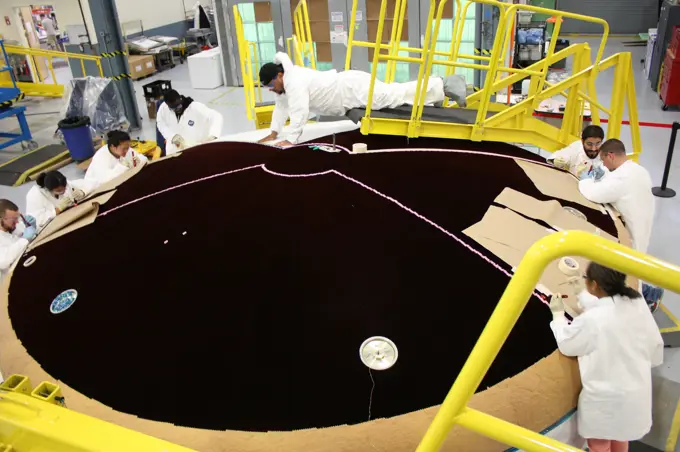
Inside the Neil Armstrong Operations and Checkout Building high bay at NASA's Kennedy Space Center in Florida, the AVOCAT block bonding is complete on the Artemis II heat shield on July 2, 2020. The heat shield is one of the most critical elements of Orion and will protect the capsule and astronauts during reentry through Earths atmosphere. Artemis II is the first crewed mission in a series of missions to the Moon and on to Mars. Artemis II will confirm all of the Orion spacecrafts systems operate as designed in the actual environment of deep space with astronauts aboard. As part of the Artemis Program, NASA will send the first woman and next man to the Moon by 2024.
6145-58968371
The Orion test capsule undergoes stationary recovery testing in Norfolk, VA on Aug. 13, 2013. NASA and the U.S Navy led the tests using the USS Arlington...The stationary recovery tests allow the teams to demonstrate and evaluate the recovery processes, the hardware and the test personnel in a controlled environment. ..During the test, the U.S Navy Dive Team checked the capsule for hazards while sailors from the USS Arlington approached the capsule in inflatable boats, and towed it back to the ships flooded well deck.  Part of Batch image transfer from Flickr.
6145-44859662
CAPE CANAVERAL, Fla. -- At NASA's Space Launch Complex 17B in Florida, workers secure the second stage of a United Launch Alliance Delta II launch vehicle to the first stage. The payload fairing then will be raised into the white room of the mobile service tower.The Delta II will carry NASA's Gravity Recovery and Interior Laboratory, or GRAIL, spacecraft into lunar orbit. The GRAIL mission is a part of NASA's Discovery Program. GRAIL will fly twin spacecraft in tandem orbits around the moon for several months to measure its gravity field. The mission also will answer longstanding questions about Earth's moon and provide scientists a better understanding of how Earth and other rocky planets in the solar system formed. GRAIL is scheduled to launch Sept. 8.
6145-44555052
The second stage of the Delta II rocket which will to be used to launch the Advanced Composition Explorer (ACE) spacecraft is erected at Launch Complex 17A at Cape Canaveral Air Station. Scheduled for launch on Aug. 25, ACE will study low-energy particles of solar origin and high-energy galactic particles. The ACE observatory will be placed into an orbit almost a million miles (1.5 million kilometers) away from the Earth, about 1/100 the distance from the Earth to the Sun
6145-44574867
The cockpit of the orbiter Atlantis is revealed with its new full-color, flat panel Multifunction Electronic Display Subsystem (MEDS), also called the "glass cockpit." The recently installed MEDS upgrade improves crew/orbiter interaction with easy-to-read, graphic portrayals of key flight indicators like attitude display and mach speed. The installation makes Atlantis the most modern orbiter in the fleet and equals the systems on current commercial jet airliners and military aircraft. Atlantis is scheduled to fly on mission STS-101 in early December
6145-45223540
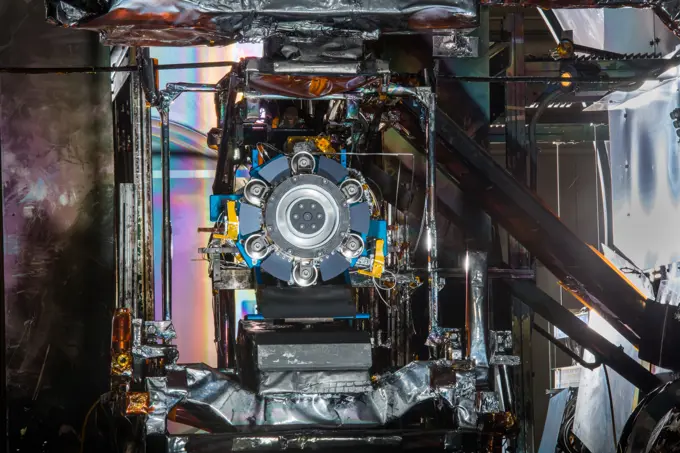
Advanced Electric Propulsion System, AEPS, Engineering Test Unit 2, ETU-2, Thruster Hardware
6145-44527356
KENNEDY SPACE CENTER, Fla. -- Workers in the payload changeout room on Launch Pad 39A keep watch as they move the Multi-Purpose Logistics Module Leonardo out of the payload canister. The MPLM is the primary payload on mission STS-105 to the International Space Station. The mission includes a crew changeover on the Space Station. Expedition Three will be traveling on Discovery to replace Expedition Two, who will return to Earth on board Discovery. Launch of STS-105 is scheduled for Aug. 9
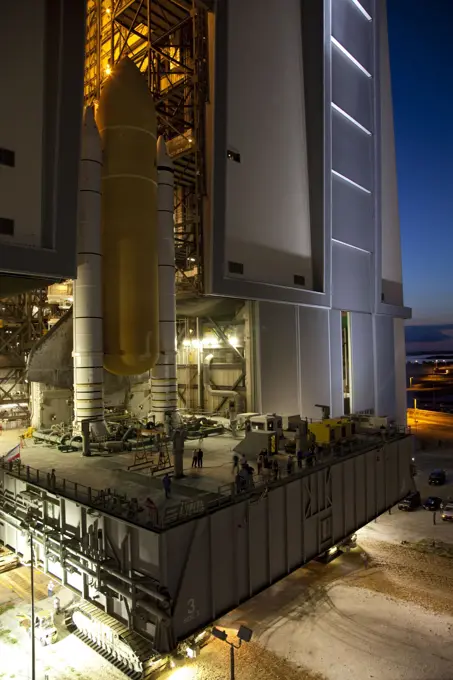
6145-45160832
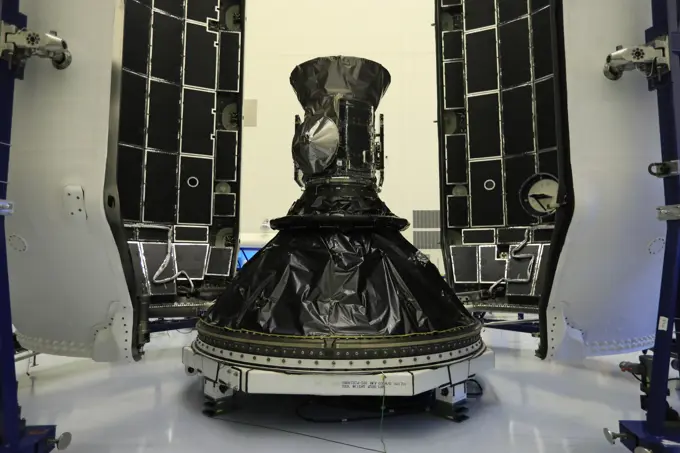
Inside the Payload Hazardous Servicing Facility at NASA's Kennedy Space Center in Florida, NASA's Transiting Exoplanet Survey Satellite (TESS) is being prepared for encapsulation in the SpaceX payload fairing. The satellite is scheduled to launch atop a SpaceX Falcon 9 rocket from Space Launch Complex 40 at Cape Canaveral Air Force Station on April 16. The satellite is the next step in NASA's search for planets outside our solar system, known as exoplanets. TESS is a NASA Astrophysics Explorer mission led and operated by MIT in Cambridge, Massachusetts, and managed by NASAs Goddard Space Flight Center in Greenbelt, Maryland. Dr. George Ricker of MITs Kavli Institute for Astrophysics and Space Research serves as principal investigator for the mission. Additional partners include Orbital ATK, NASAs Ames Research Center, the Harvard-Smithsonian Center for Astrophysics and the Space Telescope Science Institute. More than a dozen universities, research institutes and observatories worldw
6145-44978719
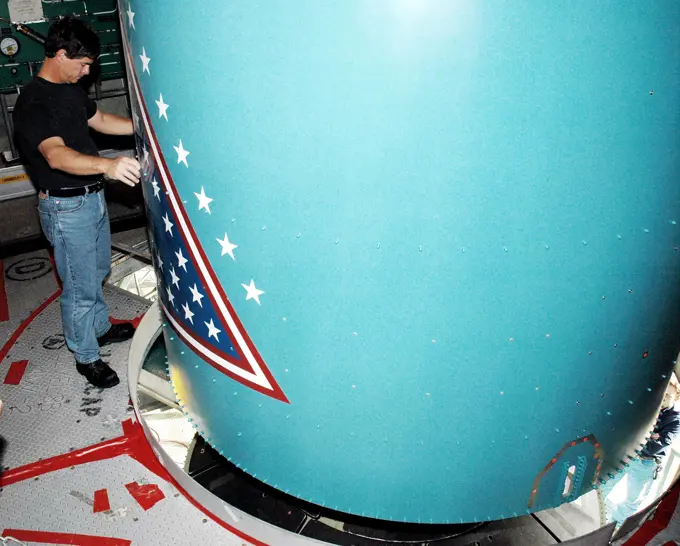
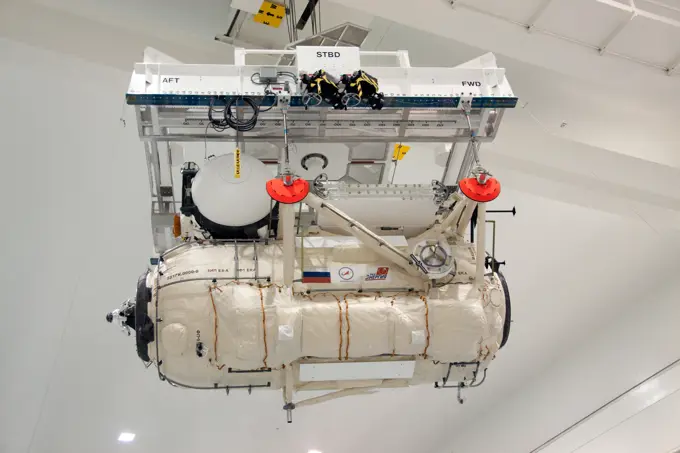
Workers make final preperations to a Soyuz TMA-11M spacecraft on Monday, Nov. 4, 2013, at the Baikonur Cosmodome in Baikonur, Kazakhstan. The rocket is adorned with the logo of the Sochi Olympic Organizing Committee and other related artwork to commemorate the launch of the Olympic torch with the crew for a four-day visit to the station. The torch will return to Earth with another trio of station residents on Nov. 11 and will be part of the torch relay that ends with the lighting of the flame at the Fisht Stadium in Sochi, Russia Feb. 7 to mark the opening of the 2014 Winter Olympics.
1570R-128408
A dishwasher with knives sticking dangerously point side up
6145-54465648
A view of a Mark 91 fire control system mounted on the lattice mast aboard the nuclear-powered aircraft carrier USS ABRAHAM LINCOLN (CVN 72). Base: Hampton Roads, Norfolk State: Virginia (VA) Country: United States Of America (USA)
6145-58968286
Technicians work on the Exploration Flight Test-1 (EFT-1) Orion heat shield at Textron in Wimington, MA on June 7, 2013. Part of Batch image transfer from Flickr.
6145-45140193
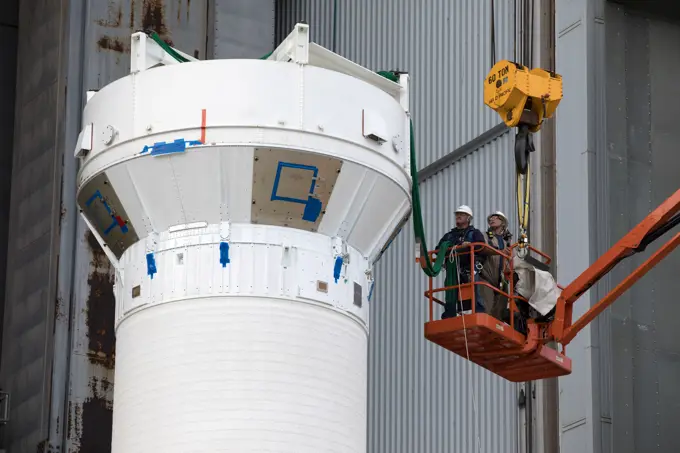
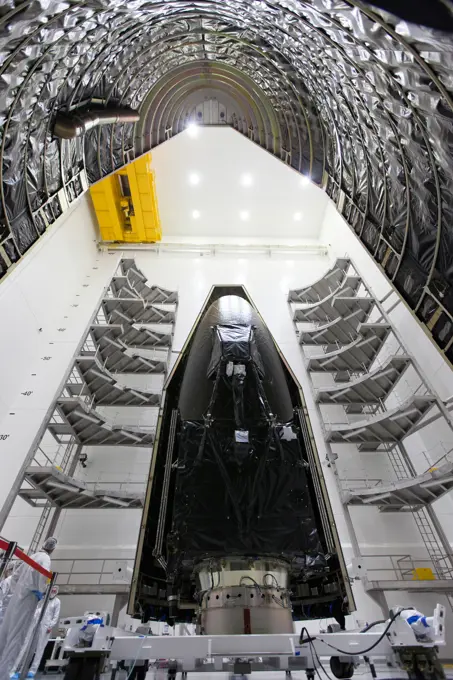
Inside the Astrotech facility in Titusville, Florida, the payload fairing for NASA's Tracking and Data Relay Satellite, TDRS-M, is positioned to encapsulate the spacecraft. TDRS-M is the latest spacecraft destined for the agency's constellation of communications satellites that allows nearly continuous contact with orbiting spacecraft ranging from the International Space Station and Hubble Space Telescope to the array of scientific observatories. Liftoff atop a United Launch Alliance Atlas V rocket is scheduled to take place from Space Launch Complex 41 at Cape Canaveral Air Force Station at 8:03 a.m. EDT Aug. 18, 2017.
4409-18480186
NASA-CENTRO ESPACIAL-DESPIECE MODULAR Y HORIZONTAL DE COHETES PARA SU EXHIBICION-TOBERAS. Location: JOHNSON SPACE CENTER. HOUSTON-TEXAS.
6145-58966331
CAPE CANAVERAL, Fla. -- Space shuttle Atlantis, attached to its external fuel tank and solid rocket boosters atop a mobile launcher platform, slowly inches out of the Vehicle Assembly Building for the final time. "Rollout," to Launch Pad 39A at NASA's Kennedy Space Center in Florida began at 8:42 p.m. EDT. It will take the crawler-transporter about six hours to carry the shuttle stack to its seaside launch pad.The milestone move, known as "rollout," paves the way for the launch of the STS-135 mission to the International Space Station, targeted for July 8. STS-135 will be the 33rd flight of Atlantis, the 37th shuttle mission to the space station, and the 135th and final mission of NASA's Space Shuttle Program.
6145-58970871
STS-132 MINI RESEARCH MODULE-1 INSTALL TO CANISTER
6145-45082602
SAN DIEGO, Calif. -- NASA's Orion spacecraft is secured with tether lines inside the flooded well deck of the USS Anchorage in the Pacific Ocean about 600 miles off the coast of San Diego, California. After lifting off at 7:05 a.m. EST atop a Delta IV Heavy rocket from Space Launch Complex 37 at Cape Canaveral Air Force Station in Florida, Orion completed a two-orbit, four-and-a-half hour mission to test systems critical to crew safety, including the launch abort system, the heat shield and the parachute system. NASA, the U.S. Navy and Lockheed Martin coordinated efforts to recover Orion after splashdown. The Ground Systems Development and Operations Program is leading the recovery efforts.
6145-44922296
CAPE CANAVERAL, Fla. -- In the morning fog at Cape Canaveral Air Force Station's Space Launch Complex 41 in Florida, operations are underway to erect the first stage of the Atlas V rocket that will carry the Tracking and Data Relay Satellite, TDRS-K, into orbit.Launch of the TDRS-K on the Atlas V rocket is planned for January 29, 2013. The TDRS-K spacecraft is part of the next-generation series in the Tracking and Data Relay Satellite System, a constellation of space-based communication satellites providing tracking, telemetry, command and high-bandwidth data return services.
6145-45251293
Ariane V Horizontal Separation System 3 (HSS3) Payload Fairing Separation Pre and Post Test Photo Documentation Inside Space Power Facility (SPF)
6145-58965269
KODIAK ISLAND, Alaska -- A technician performs final testing on Starshine 3 at the Naval Research Laboratory in Washington, D.C., to prepare for the launch of the Kodiak Star at Kodiak Island, Alaska. The first orbital launch to take place from Alaska's Kodiak Launch Complex, Kodiak Star is scheduled to lift off on a Lockheed Martin Athena I launch vehicle on Sept. 17 during a two-hour window that extends from 5 00 to 7 00 p.m. ADT. The payloads aboard include the Starshine 3, sponsored by NASA, and the PICOSat, PCSat and Sapphire, sponsored by the Department of Defense (DoD) Space Test Program.
6145-45221740
In this view looking up inside the Vehicle Assembly Building at NASAs Kennedy Space Center in Florida, a crane lowers the Space Launch System (SLS) Core Stage pathfinder into High Bay 3 on Oct. 16, 2019. The 212-foot-long core stage pathfinder arrived on NASA's Pegasus Barge at Kennedys Launch Complex 39 turn basin wharf on Sept. 27, 2019. The Pegasus Barge made its first delivery to Kennedy in support of the agency's Artemis missions. The pathfinder is being used by Exploration Ground Systems and its contractor, Jacobs, to practice offloading, moving and stacking maneuvers, using important ground support equipment to train employees and certify all the equipment works properly. The pathfinder will stay at Kennedy through at least the month of October before trekking back to NASA's Michoud Assembly Facility in Louisiana.
6145-45048980
VANDENBERG AIR FORCE BASE, Calif. - Both halves of the fairing for NASA's Orbiting Carbon Observatory-2 mission, or OCO-2, have arrived in the environmental enclosure, or clean room, at the top of the Delta II launcher at Space Launch Complex 2 on Vandenberg Air Force Base in California. The fairing will protect OCO-2 during launch aboard a United Launch Alliance Delta II rocket from Space Launch Complex 2 in July. The observatory will collect precise global measurements of carbon dioxide in the Earth's atmosphere and provide scientists with a better idea of the chemical compound's impacts on climate change. Scientists will analyze this data to improve our understanding of the natural processes and human activities that regulate the abundance and distribution of this important atmospheric gas.
6145-44779523
VANDENBERG AIR FORCE BASE, Calif. -- At Vandenberg Air Force Base's Astrotech processing facility in California, NASA's Wide-field Infrared Survey Explorer, or WISE, spacecraft is being moved to the flight conical adapter and test stand. The satellite will survey the entire sky at infrared wavelengths, creating a cosmic clearinghouse of hundreds of millions of objects, which will be catalogued, providing a vast storehouse of knowledge about the solar system, the Milky Way, and the universe. Launch is scheduled no earlier than Dec. 7.
6145-58963651
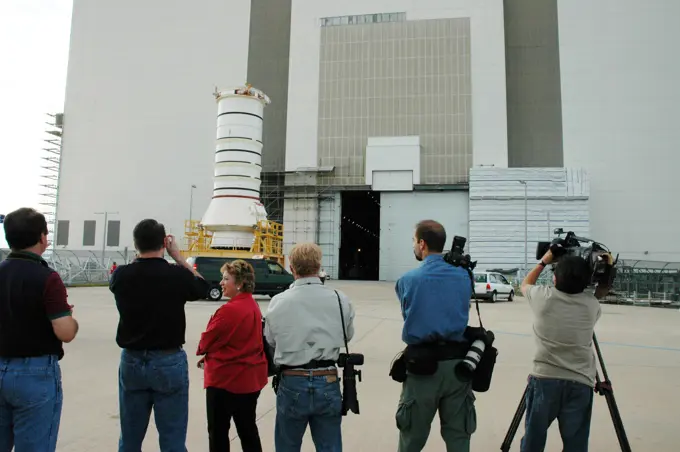
KENNEDY SPACE CENTER, FLA. - Photographers shoot the movement of the aft skirt and lower segment of the Solid Rocket Booster for the Return to Flight mission STS-114 as it nears the Vehicle Assembly Building. This is a significant milestone in Return to Flight preparations. Other segments will follow for stacking. Two SRBs support the liftoff of the Space Shuttle on a launch. The twin 149-foot tall, 12-foot diameter SRBs provide the main propulsion system during launch to place the 180,000-pound orbiters in the proper orbit around the Earth. They operate parallel with the Space Shuttle main engines for the first two minutes of flight and jettison away from the orbiter with help from the Booster Separation Motors, about 26.3 nautical miles above the Earths surface.
6145-44996890
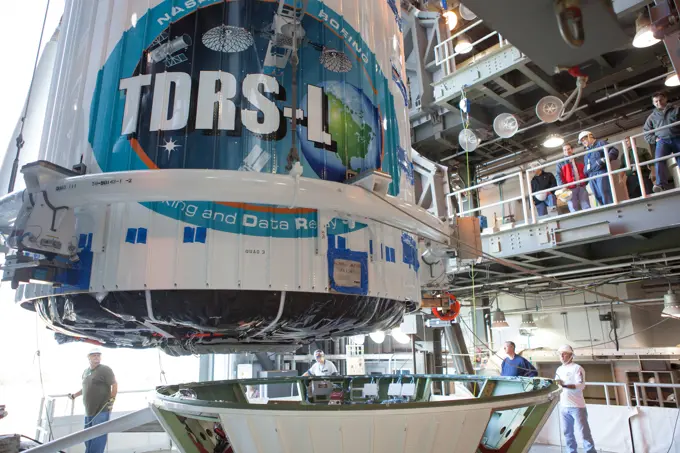
CAPE CANAVERAL, Fla. - At Cape Canaveral Air Force Station's Vertical Integration Facility at Launch Complex 41, NASA's Tracking and Data Relay Satellite, or TDRS-L, spacecraft is moved into position for mating atop a United Launch Alliance Atlas V rocket. The TDRS-L satellite will be a part of the second of three next-generation spacecraft designed to ensure vital operational continuity for the NASA Space Network. It is scheduled to launch from Cape Canaveral's Space Launch Complex 41 atop a United Launch Alliance Atlas V rocket on Jan. 23, 2014. The current Tracking and Data Relay Satellite system consists of eight in-orbit satellites distributed to provide near continuous information relay contact with orbiting spacecraft ranging from the International Space Station and Hubble Space Telescope to the array of scientific observatories.
1848-53982345
Wind energy, model of a plant, segment of a wind turbine mast, IdeenPark 2012, a technology and education summit conference for young people, Essen, Ruhr area, North Rhine-Westphalia, Germany, Europe
1525-25737110
TV studio for filming programs and news. TV studio
6188-60061102
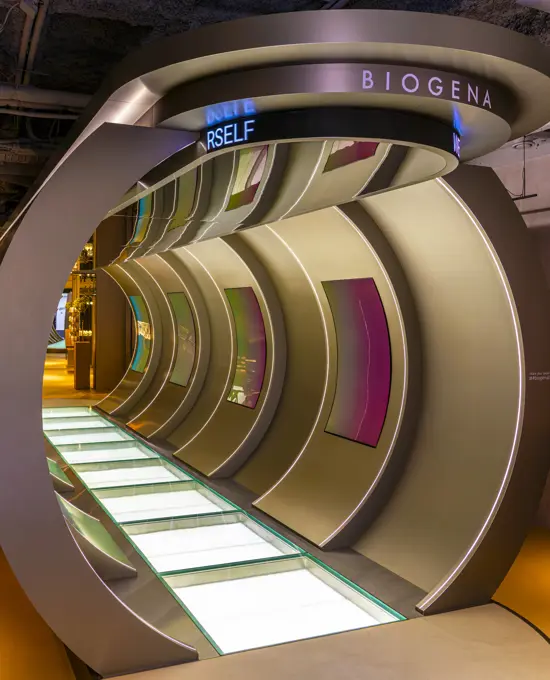
Futuristic Access to a Drugstore, Salzburg, Austria 1020924648
6145-58965821
KENNEDY SPACE CENTER, FLA. -- Technicians prepared for removal of Viking Lander 1's aeroshell cover in KSC's Spacecraft Assembly and Encapsulation Facility 2 (SAEF-2) today. The cover remains over the Lander throughout its 440,000,000-mile journey to Mars. After the Lander separates from the Orbiter, the aeroshell will help to decelerate the speed of descent and will serve as a heat shield. After the aeroshell separates, the Lander's parachute will deploy at about 4,000 feet altitude to further slow descent for a soft landing on the Red Planet. The Kennedy Space Center will launch the first Viking from Complex 41, Cape Canaveral, no earlier than Aug. 11. The second Viking will be launched no earlier than Aug. 21.
6145-58969586
On April 6, 2016, engineers at NASAs Langley Research Center in Hampton, Virginia, kicked off a series of nine drop tests of a representative Orion crew capsule with crash test dummies inside to understand what the spacecraft and astronauts may experience when landing in the Pacific Ocean after deep-space missions. The high-fidelity capsule, coupled with the heat shield from Orion's first flight in space, was hoisted approximately 16 feet above the water and vertically dropped into Langleys 20-foot-deep Hydro Impact Basin. The crash test dummies were instrumented to provide data and secured inside the capsule to help provide information engineers need to ensure astronauts will be protected from injury during splashdown. Each test in the series simulates different scenarios for Orions parachute-assisted landings, wind conditions, velocities and wave heights the spacecraft may experience when touching down in the ocean.
PREVIOUS
of 4
NEXT
2401 S. Ervay, Suite 206
Dallas, Texas 75215
United States
Browse
CategoriesGalleriesFree Research
For Creators
License Your ContentSuperStock For StudentsFrame of Mind BlogContributor PortalNew Image SpotlightLicense AI Imagery
Resources
About UsLicensingTerms & ConditionsAPI AccessPrivacyPricing
Contact
+1 866 236 0087help@superstock.com Contact form
©2026 SuperStock. All Rights Reserved. -B
This site is protected by reCAPTCHA and Google Privacy Policy and Terms of Service apply.