Fine ArtVintageFootageSubscriptionBoardsFree ResearchPricing
  • Fine Art
  • Vintage
  • Footage
  • Subscription
  • Boards
  • Free Research
  • Pricing

Space Shuttle Mission Insignias

A collection of mission patches showcasing various space shuttle missions, featuring shuttles, international cooperation, and symbolic elements related to NASA's history.
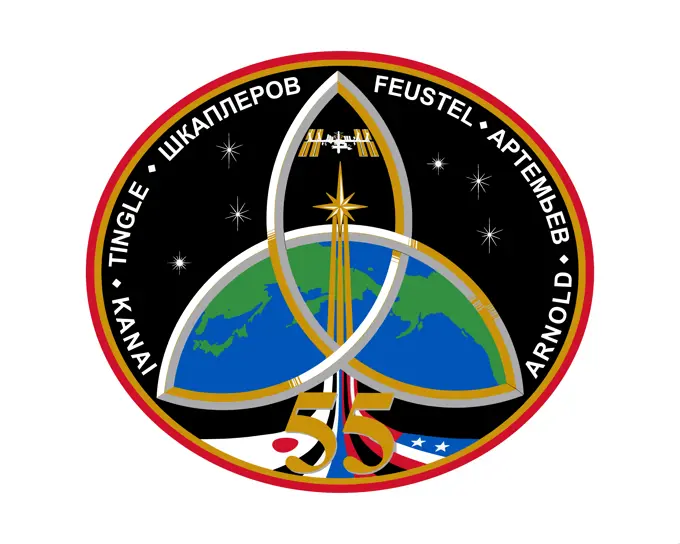
iss055-s-001 (Oct. 10, 2017) --- The official mission insignia of the Expedition 55 crew.
51 assets in this story
6145-58971786
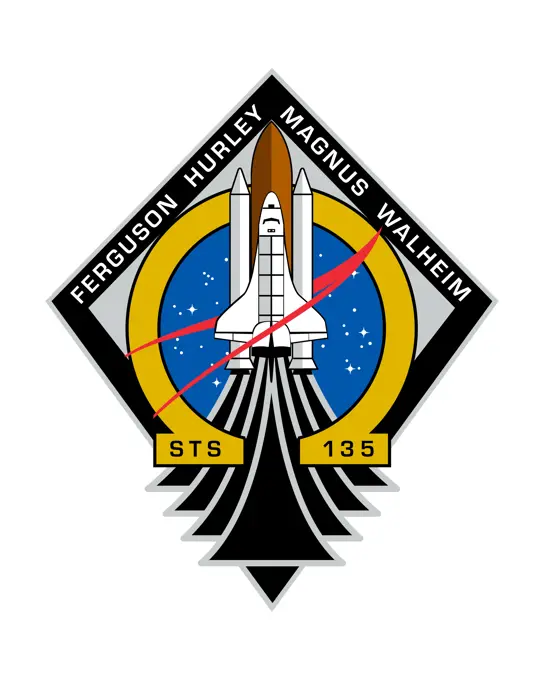
STS135-S-001 (27 Jan. 2011) --- The STS-135 patch represents the space shuttle Atlantis embarking on its mission to resupply the International Space Station. Atlantis is centered over elements of the NASA emblem depicting how the space shuttle has been at the heart of NASA for the last 30 years.  It also pays tribute to the entire NASA and contractor team that made possible all the incredible accomplishments of the space shuttle.  Omega, the last letter in the Greek alphabet, recognizes this mission as the last flight of the Space Shuttle Program. The NASA insignia design for space shuttle flights is reserved for use by the astronauts and for other official use as the NASA Administrator may authorize. Public availability has been approved only in the forms of illustrations by the various news media. When and if there is any change in this policy, which is not anticipated, the change will be publicly announced.
6145-44640119
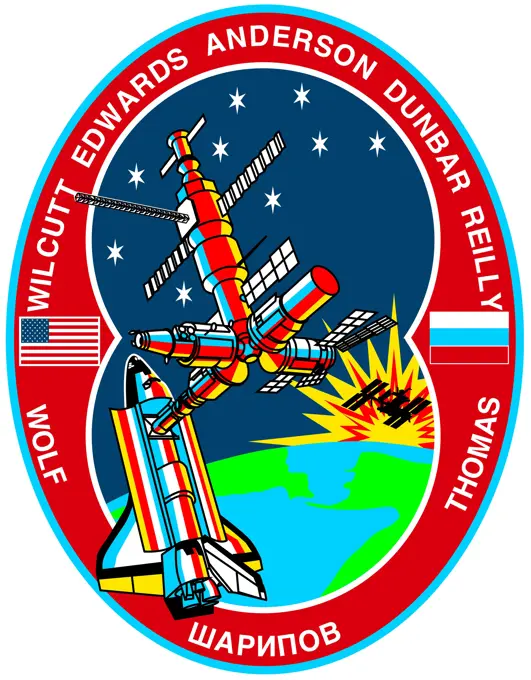
In the STS-89 crew insignia, the link between the United States and Russia is symbolically represented by the Space Shuttle Endeavour and Russia's Mir Space Station orbiting above the Bering Strait between Siberia and Alaska. The success of the joint United States-Russian missions is depicted by the Space Shuttle and Mir colored by the rising sun in the background. A shadowed representation of the International Space Station (ISS) rising with the sun represents the future program for which the Shuttle-Mir missions are prototypes. The inside rim of the insignia describes the outline of the number eight representing STS-89 as the eighth Shuttle/Mir docking mission. The nine stars represent the nine joint missions to be flown of the program and when combined with the number eight in the rim, reflect the mission number. The nine stars also symbolize the children of the crew members who will be the future beneficiaries of the joint development work of the space programs of the two countries
6145-45145417
iss055-s-001 (Oct. 10, 2017) --- The official mission insignia of the Expedition 55 crew.
6145-44635335
This mission patch for mission STS-80 depicts the Space Shuttle Columbia and the two research satellites its crew deployed into the blue field of space. The uppermost satellite is the Orbiting Retrievable Far and Extreme Ultraviolet Spectrograph-Shuttle Pallet Satellite (ORFEUS-SPAS), a telescope aimed at unraveling the life cycles of stars and understanding the gases that drift between them. The lower satellite is the Wake Shield Facility (WSF), flying for the third time. It will use the vacuum of space to create advanced semiconductors for the nation's electronics industry. ORFEUS and WSF are joined by the symbol of the Astronaut Corps, representing the human contribution to scientific progress in space. The two bright blue stars represent the mission's Extravehicular Activities (EVA), final rehearsals for techniques and tools to be used in assembly of the International Space Station (ISS). Surrounding Columbia is a constellation of 16 stars, one for each day of the mission, represen
6145-44539702
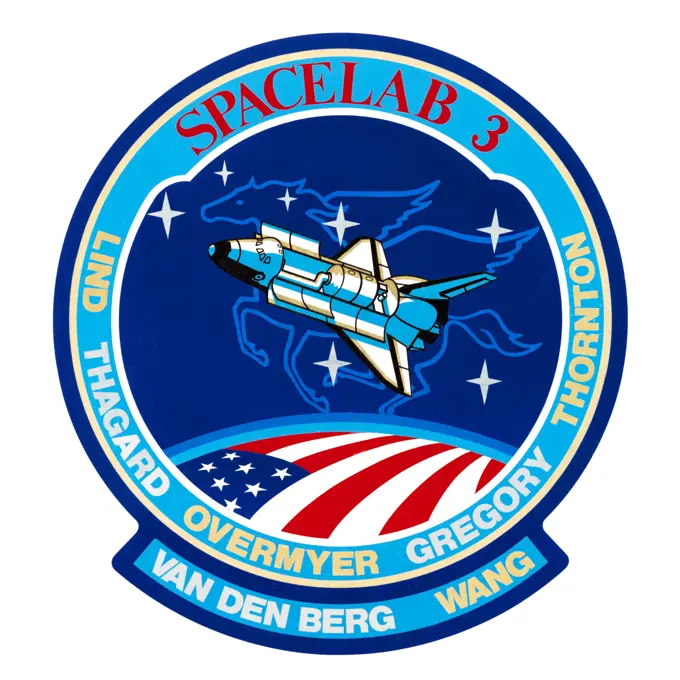
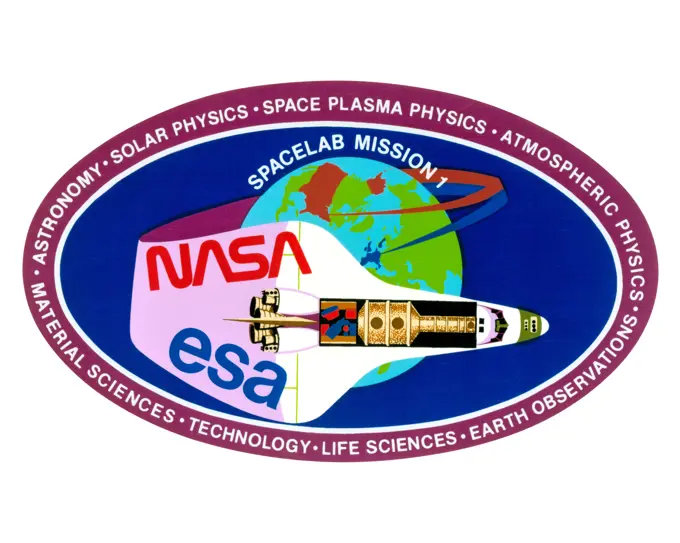
S84-44372 (December 1984) --- The space shuttle Discovery and its science module payload are featured in the insignia for the STS-51B/Spacelab 3 mission. The seven stars of the constellation Pegasus surround the orbiting spaceship above the flag draped Earth. Surnames of the seven crew members encircle the scene. Crew members are astronauts Robert F. Overmyer, Frederick D. Gregory, Don L. Lind, Norman E. Thagard and William E. Thornton; and payload specialists Lodewijk van den Berg and Taylor G. Wang. The artwork was done by Carol Ann Lind. The NASA insignia design for space shuttle flights is reserved for use by the astronauts and for other official use as the NASA Administrator may authorize. Public availability has been approved only in the forms of illustrations by the various news media. When and if there is any change in this policy, which is not anticipated, the change will be publicly announced.
6145-44818909
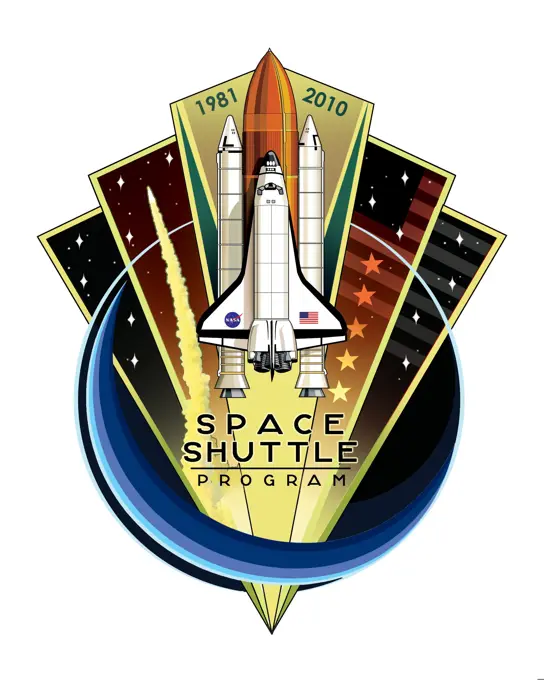
JOHNSON SPACE CENTER, Houston - JSC2010-E-079335 -- To celebrate the upcoming 30th anniversary and retirement of the Space Shuttle Program, the design of this patch aims to capture the visual essence and spirit of the program in an iconic and triumphant manner. As the Space Shuttle Program has been an innovative, iconic gem in the history of American spaceflight, the overall shape of the patch and its faceted panels are reminiscent of a diamond or other fine jewel. The shape of the patch fans out from a fine point at the bottom to a wide array across the top, to evoke the vastness of space and our aim to explore it, as the shuttle has done successfully for decades. The outlined blue circle represents the shuttle's exploration within low Earth orbit, but also creates a dynamic fluidity from the bottom right around to the top left to allude to the smoothness of the shuttle orbiting Earth. The diagonal lines cascading down into the top-right corner of the design form the American Flag as
6145-44752068
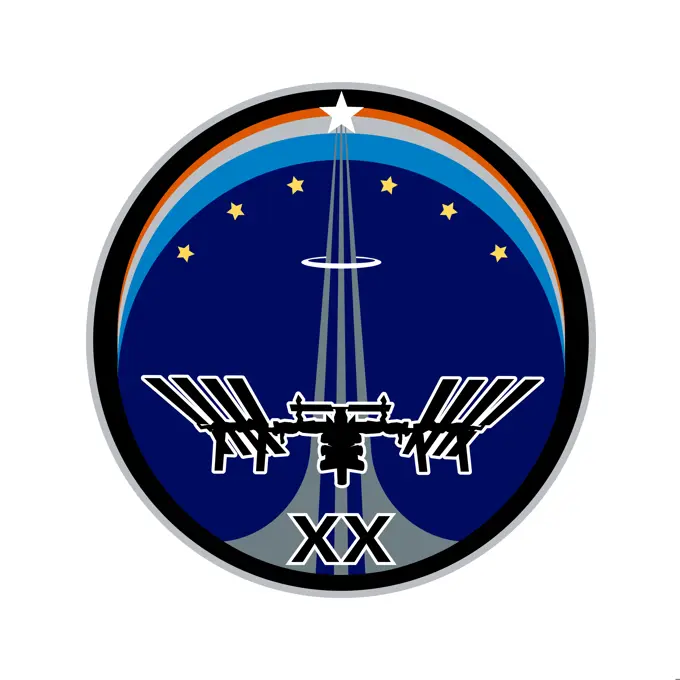
ISS020-S-001B (December 2008) --- The Expedition 20 patch symbolizes a new era in space exploration with the first six-person crew living and working onboard ISS and represents the significance of the ISS to the exploration goals of NASA and its international partners. The six gold stars signify the men and women of the crew. The astronaut symbol extends from the base of the patch to the star at the top to represent the international team, both on the ground and on orbit, that are working together to further our knowledge of living and working in space. The space station in the foreground represents where we are now and the important role it is playing towards meeting our exploration goals. The knowledge and expertise developed from these advancements will enable us to once again leave low earth orbit for the new challenges of establishing a permanent presence on the moon and then on to Mars. The blue, gray and red arcs represent our exploration goals as symbols of Earth, the moon and
6145-44637948
The 41-G mission insignia focuses on its seven crew members (first to exceed six), the U.S. Flag and the Unity symbol known as the astronaut pin. The pin design in center shows a trio of trajectories merging in infinite space, capped by a bright shining star and encircled by an elliptical wreath denoting orbital flight.
6145-44524209
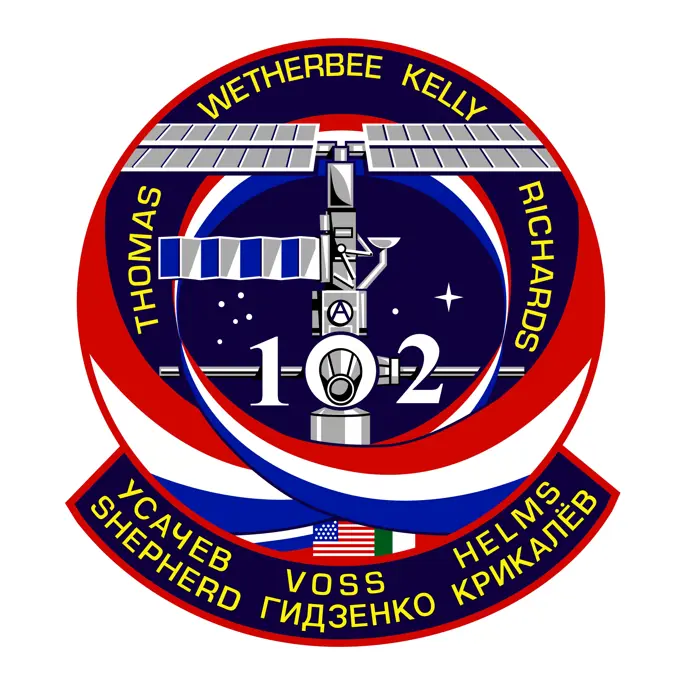
STS102-S-001 (January 2001) --- The central image on the STS-102 crew patch depicts the International Space Station (ISS) in the build configuration that it will have at the time of the arrival and docking of Discovery during the STS-102 mission, the first crew exchange flight to the space station. The station is shown along the direction of the flight as will be seen by the shuttle crew during their final approach and docking, the so-called V-bar approach. The names of the shuttle crew members are depicted in gold around the top of the patch, and surnames of the Expedition crew members being exchanged are shown in the lower banner. The three ribbons swirling up to and around the station signify the rotation of these ISS crew members. The number two is for the Expedition Two crew who fly up to the station, and the number one is for the Expedition One crew who then return down to Earth. In conjunction with the face of the Lab module of the station, these Expedition numbers create the sh
6145-44637945
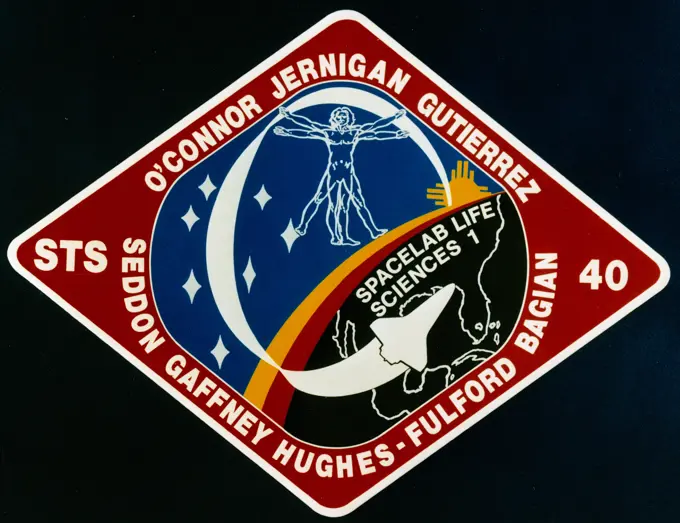
The STS-40 patch makes a contemporary statement focusing on human beings living and working in space. Against a background of the universe, seven silver stars, interspersed about the orbital path of Columbia, represent the seven crew members. The orbiter's flight path forms a double-helix, designed to represent the DNA molecule common to all living creatures. In the words of a crew spokesman, ...(the helix) affirms the ceaseless expansion of human life and American involvement in space while simultaneously emphasizing the medical and biological studies to which this flight is dedicated. Above Columbia, the phrase Spacelab Life Sciences 1 defines both the Shuttle mission and its payload. Leonardo Da Vinci's Vitruvian man, silhouetted against the blue darkness of the heavens, is in the upper center portion of the patch. With one foot on Earth and arms extended to touch Shuttle's orbit, the crew feels, he serves as a powerful embodiment of the extension of human inquiry from the boundarie
6145-45241296
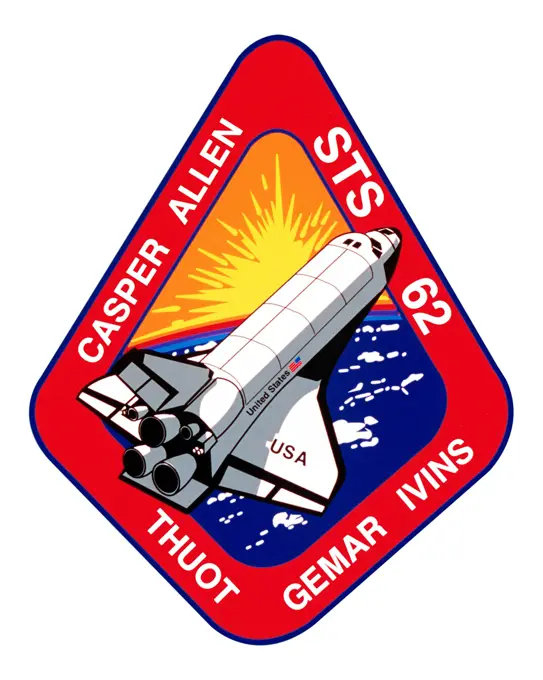
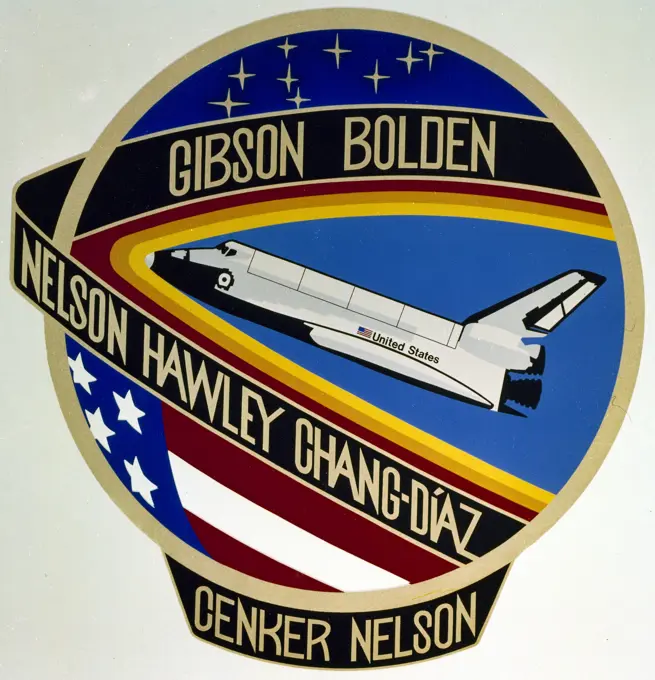
STS062-S-001 (October 1993) --- The crew patch depicts the world's first reusable spacecraft on its sixteenth flight. The space shuttle Columbia is in its entry-interface attitude as it prepares to return to Earth. The primary mission objectives of STS-62 include the United States Microgravity Payload (USMP-2) and the NASA Office of Aeronautics and Space Technology (OAST-2) payloads. These payloads represent a multifaceted array of space science and engineering experiments. The varied hues of the rainbow on the horizon connote the varied, but complementary, nature of all the payloads united on this mission. The upward-pointing vector shape of the patch is symbolic of America's reach for excellence in its in its unswerving pursuit to explore the frontiers of space. The brilliant sunrise just beyond Columbia suggests the promise that research in space holds for the hopes and dreams of future generations. The STS-62 insignia was designed by Mark Pestana. The NASA insignia design for space
6145-44640026
The STS-86 flight was the seventh shuttle-Mir docking mission, symbolized by seven stars. The international crew includes astronauts from the United States, Russia, and France. The flags of these nations are incorporated in the rays of the astronaut logo. The rays of light streaking across the sky depict the orbital tracks of the two spacecraft as they prepare to dock. During the flight, an American astronaut and a Russian cosmonaut will perform an extravehicular activity (EVA). The mercator projection of Earth illustrates the global cooperative nature of the flight.
6145-44476902
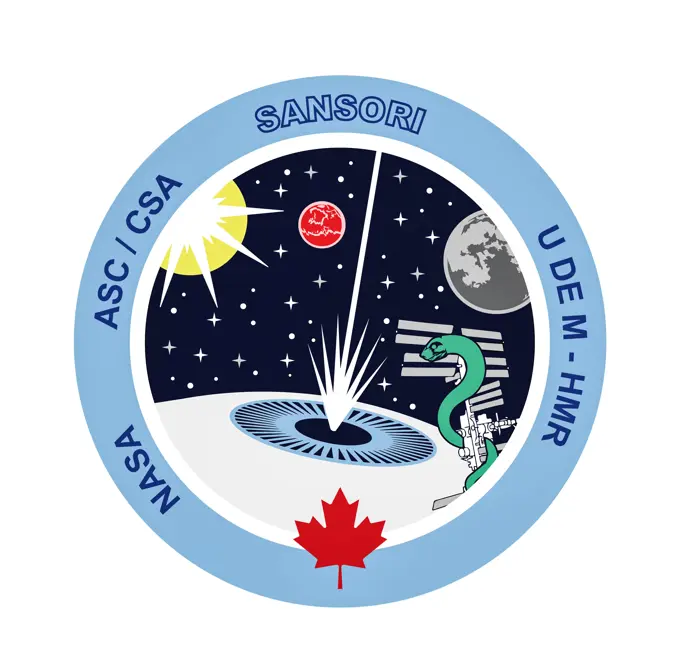
The SANSORI Mission Patch. Space Flight-Associated Neuro-Ocular Syndrome Ocular Rigidity Investigation (SANSORI) investigates whether stiffness of the eye, called ocular rigidity, contributes to development of Space Flight-Associated Neuro-Ocular Syndrome (SANS).
6145-44720657
S82-31408 (May 1983) --- The Spacelab 2 emblem is a symbolic representation of the scientific objectives of the mission. The emblem is in the shape of a triangular shield with convexly curved edges. Across the top of a black out border are the words SPACELAB 2 . Within the black border is a sky blue border carryhing the words ASTRONOMY , ON TOP PHYSICS , on the left; and BIOLOGY , on the right. Within the blue border is a schematic view of the sun, the earth, and the orbiter with Spacelab 2. The sun appears in the upper right background as a white disc surrounded by six concentric rings ranging grom bright yellow near the disc through yellow-red to a dark red out ring. A sector of the earth with blue ocean and a black portion of North America is in the upper left corner. The black and white Orbiter is seen from directly overhead in the foreground, the right side illuminated by the sun, the left side in shadow. Although the payload bay doors are not open, the Spacelab 2 payload is seen
6145-45245137
STS064-S-001 (July 1994) --- The patch depicts the space shuttle Discovery in a payload-bay-to-Earth attitude with its primary payload, Lidar In-Space Technology Experiment (LITE-1) operating in support of Mission to Planet Earth. LITE-1 is a lidar (light detection and ranging) system that uses a three-wavelength laser, symbolized by the three gold rays emanating from the star in the payload bay that form part of the astronaut symbol. The major objective of this first flight of LITE-1 is to validate its design and operating characteristics by gathering data about the Earth's troposphere and stratosphere, represented by the clouds and dual-colored Earth limb. A secondary payload on STS-64 is the free-flier SPARTAN-201 satellite shown on the Remote Manipulator System (RMS) arm post-retrieval. The objective of SPARTAN-201 is to investigate the physics of the solar wind and complement data being obtained from the ULYSSES satellite launched on STS-41. The RMS will also operate another secon
6145-58971207
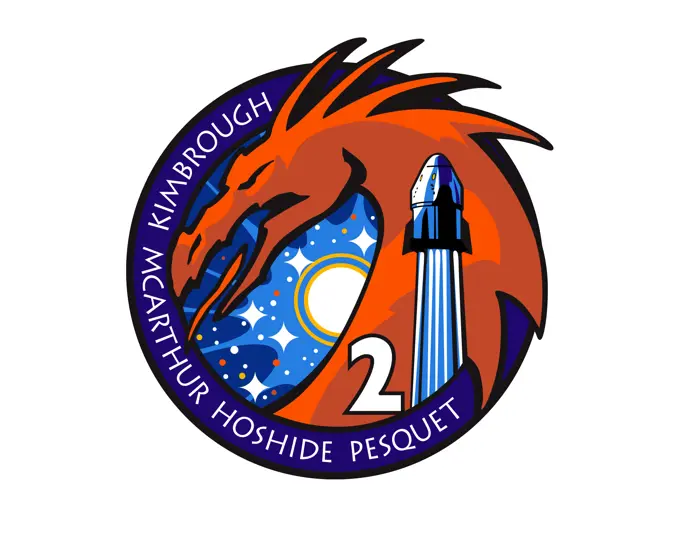
jsc2020e051470 (Dec. 3, 2020) --- The determined expression of the Dragon reflects the strength of the team and their contribution to the exploration of space. The five large stars represent the five partner space agencies coopering the International Space Station program.
6145-45245358
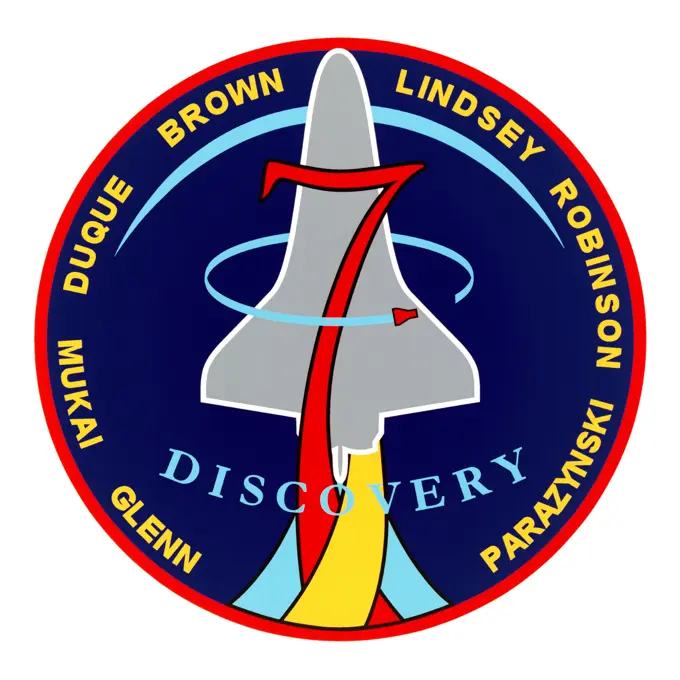
STS095-S-001 (June 1998) --- The STS-95 patch, designed by the crew, is intended to reflect the scientific, engineering, and historic elements of the mission. The space shuttle Discovery is shown rising over the sunlit Earth limb, representing the global benefits of the mission science and the solar science objectives of the Spartan Satellite. The bold number "7" signifies the seven members of Discovery's crew and also represents a historical link to the original seven Mercury astronauts. The STS-95 crew member John Glenn's first orbital flight is represnted by the Friendship 7 capsule. The rocket plumes symbolize the three major fields of science represented by the mission payloads:  microgravity material science, medical research for humans on Earth and in space, and astronomy.The NASA insignia design for space shuttle flights is reserved for use by the astronauts and for other official use as the NASA Administrator may authorize. Public availability has been approved only in the f
6145-45243578
STS086-S-001 (May 1997) --- This is the crew patch for STS-86, the seventh Shuttle-Mir docking mission, symbolized by seven stars. The international crew includes astronauts from the United States, Russia and France. The flags of these nations are incorporated in the rays of the astronaut logo. The rays of light streaking across the sky depict the orbital tracks of the two spacecraft as they prepare to dock. During the flight, an American astronaut and a Russian cosmonaut will perform a extravehicular activity (EVA). The mercator projection of Earth illustrates the global cooperative nature of the flight.The NASA insignia design for space shuttle flights is reserved for use by the astronauts and for other official use as the NASA Administrator may authorize. Public availability has been approved only in the forms of illustrations by the various news media. When and if there is any change in this policy, which is not anticipated, the change will be publicly announced.
6145-44547409
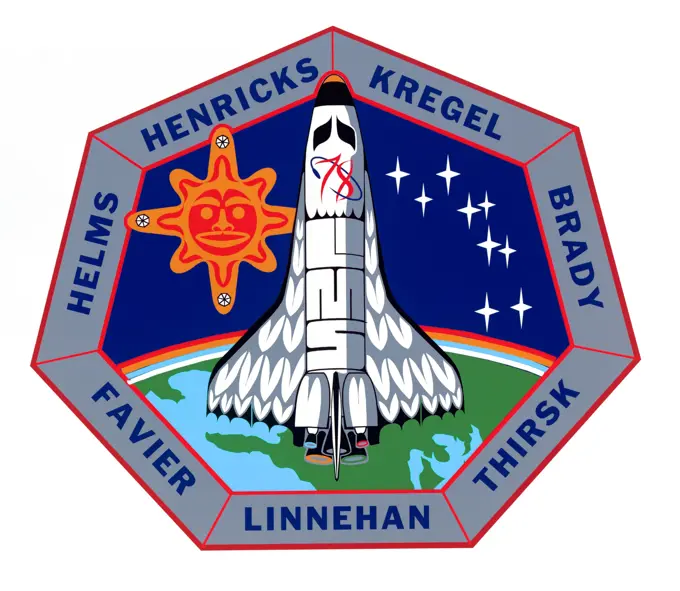
STS078-S-001 (March 1998) --- The STS-78 mission links the past with the present through a crew patch influenced by Pacific Northwest Native American art. Central to the design is the space shuttle Columbia, whose shape evokes the image of the eagle, an icon of power and prestige and the national symbol of the United States. The eagles feathers, representing both peace and friendship, symbolize the spirit of international unity on STS-78. An orbit surrounding the mission number recalls the traditional NASA emblem. The Life Sciences and Microgravity Spacelab (LMS) is housed in Columbias payload bay and is depicted in a manner reminiscent of totem art. The pulsating sun, a symbol of life, displays three crystals representing STS-78s three high-temperature microgravity materials processing facilities. The constellation Delphinus recalls the dolphin, friend of sea explorers. Each star represents one member of STS-78s international crew including the alternate payload specialists Pedro
6145-44957020
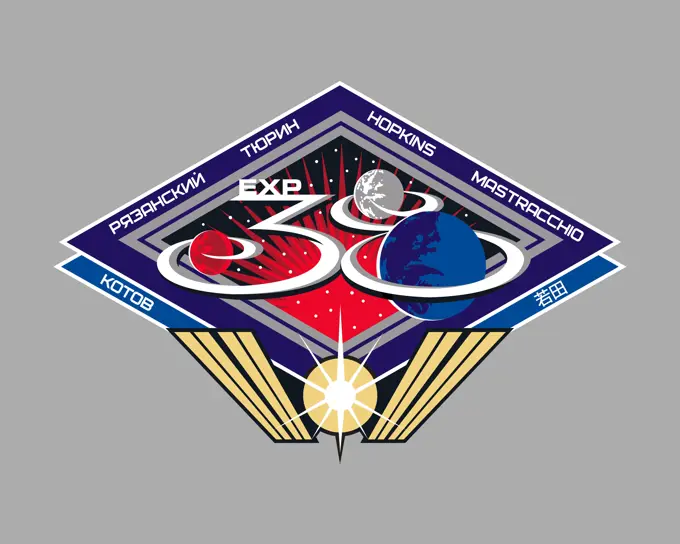
ISS038-S-001 (April 2013)  ---  As the International Space Station (ISS) has become a stepping stone to future space exploration, the Expedition 38 mission patch design paints a visual roadmap of exploration beyond low Earth orbit, most prominently represented by the designs flowing Expedition 38 mission numbers that wrap around  Earth, the moon and Mars. Just as the sun is a guiding light in the galaxy, the ISS illuminates the bottom of the design as it is a shining beacon of the advancement of science, knowledge, and technology carried out aboard the Space Station. To visually capture the idea of the ISS being a foundation for infinite discovery, the space stations iconic solar arrays span upwards, providing the number 38 and its exploration roadmap a symbolic pedestal to rest on. Finally, the overall use of red, white, and blue in the design acknowledges the flags of the countries of origin for Expedition 38s crew  the United States, Russia, and Japan. The NASA insignia design f
6145-45240513
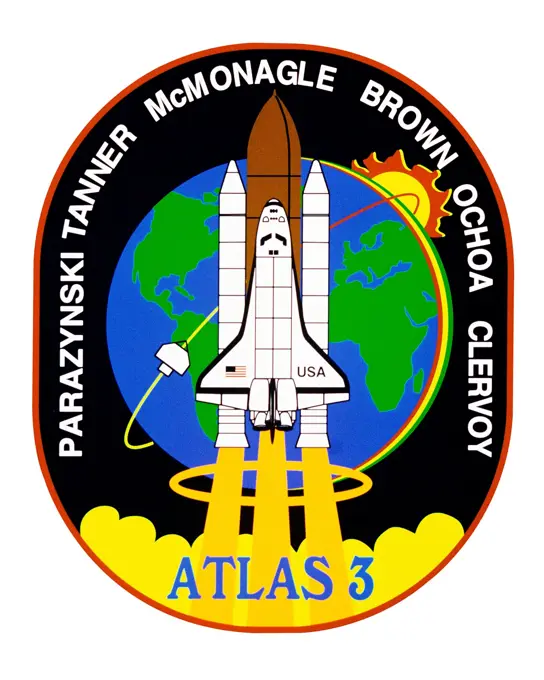
STS066-S-001 (October 1994) --- Designed by the crew members, the STS-66 insignia depicts the space shuttle Atlantis launching into Earth orbit to study global environmental change. The payload for the Atmospheric Laboratory for Applications and Science (ATLAS-3) and complementary experiments are part of a continuing study of the atmosphere and the sun's influence on it. The space shuttle is trailed by gold plumes representing the astronaut symbol and is superimposed over Earth, much of which is visible from the flight's high inclination orbit. Sensitive instruments aboard the ATLAS pallet in the shuttle payload bay and on the free-flying Cryogenic Infrared Spectrometers and Telescopes for the Atmospheric-Shuttle Pallet Satellite (CHRISTA-SPAS) will gaze down on Earth and toward the sun, illustrated by the stylized sunrise and visible spectrum. The NASA insignia design for space shuttle flights is reserved for use by the astronauts and for other official use as the NASA Administrator m
1848-66584911
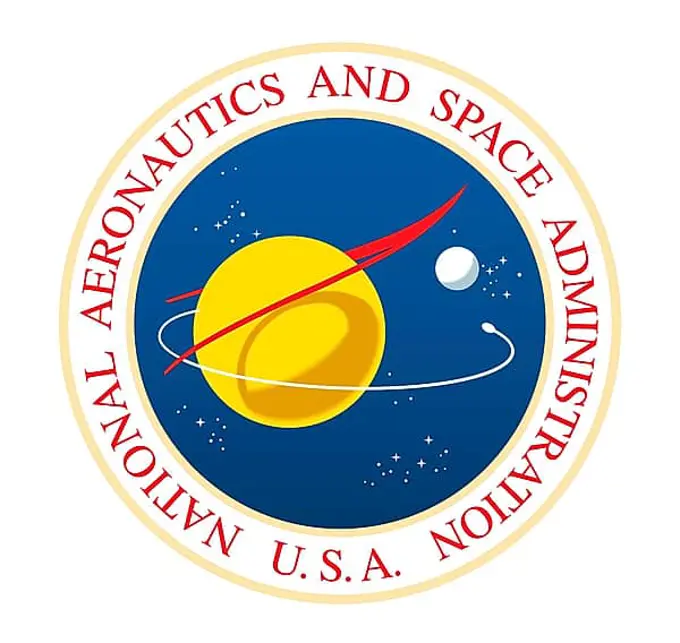
NASA symbol, Organization, Logo
6145-44639883
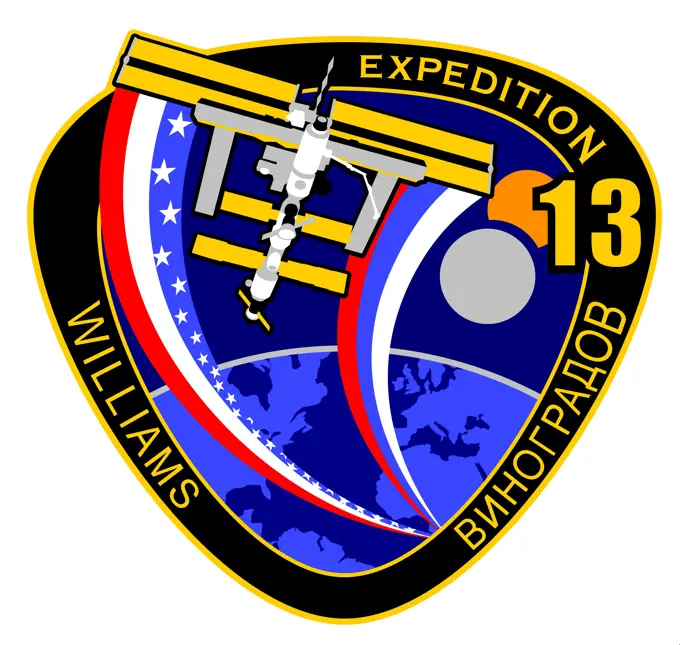
ISS013-S-001 (January 2006) --- This patch commemorates the thirteenth expeditionary mission to the International Space Station (ISS) which continues the permanent human presence in space. The ISS is depicted in its configuration at the start of the six-month expedition with trailing elements from the country flags representing both of the crew members--cosmonaut Pavel V. Vinogradov and astronaut Jeffrey N. Williams. The crew members made the following statement about their patch: "The dynamic trajectory of the space station against the background of the Earth, Mars, and the Moon symbolizes the vision for human space exploration beyond Earth orbit and the critical role that the ISS plays in the fulfillment of that vision."The NASA insignia design for shuttle flights and station increments is reserved for use by the astronauts and for other official use as the NASA Administrator may authorize. Public availability has been approved only in the forms of illustrations by the various news
6145-52136576
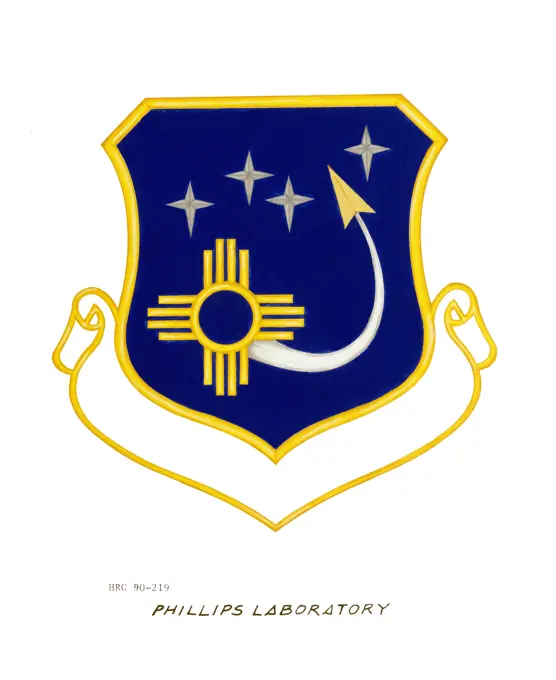
Approved insignia for: Phillips Laboratory. Country: Unknown
6145-44752845
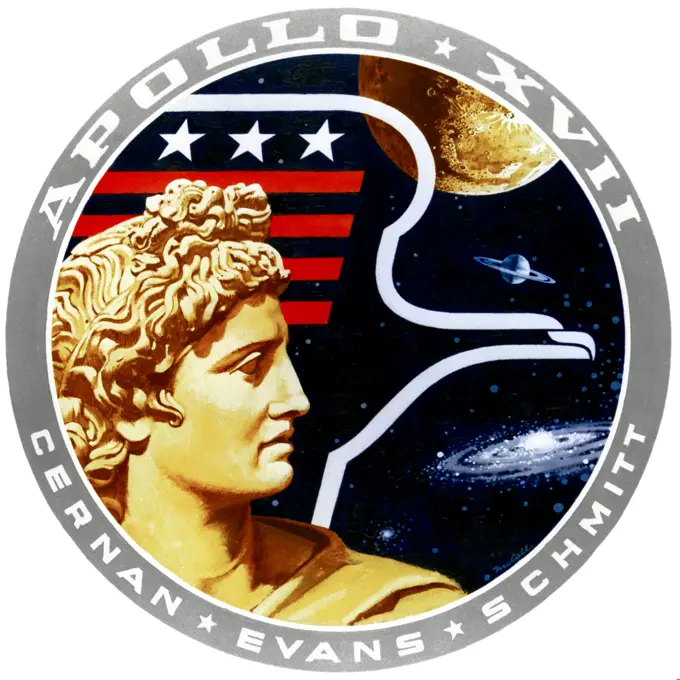
S72-49079 (8 Sept. 1972) --- This is the official emblem of the Apollo 17 lunar landing mission which will be flown by astronauts Eugene A. Cernan, Ronald E. Evans and Harrison H. Schmitt. The insignia is dominated by the image of Apollo, the Greek sun god. Suspended in space behind the head of Apollo is an American eagle of contemporary design, the red bars of the eagle's wing represent the bars in the United States flag; the three white stars symbolize the three astronaut crewmen. The background is deep blue space and within it are the moon, the planet Saturn and a spiral galaxy or nebula. The moon is partially overlaid by the eagle's wing suggesting that this is a celestial body that man has visited and in that sense conquered. The thrust of the eagle and the gaze of Apollo to the right and toward Saturn and the galaxy is meant to imply that man's goals in space will someday include the planets and perhaps the stars. The colors of the emblem are red, white and blue, the colors of ou
6145-58965810
KENNEDY SPACE CENTER, FLA. - This is the official insignia for the first Space Shuttle orbital flight test (STS-1). Crew of the OV-102 Columbia on STS-1 will be astronauts John W. Young, commander, and Robert L. Crippen, pilot. The artwork was done by artist Robert McCall. The STS-1 mission, known as a shuttle systems test flight, will seek to demonstrate safe launch into orbit and safe return of the orbiter and crew and verify the combined performance of the entire shuttle vehicle -- orbiter, solid rocket boosters and external tank. STS-1 will be launched from Pad A at the Kennedy Space Center's Launch Complex 39 no earlier than March 1981.
6145-45251800
ISS010-S-001 (May 2004) --- The Expedition 10 patch uses simple symbolism to describe the mission. The large Roman numeral "X," formed by the American and Russian flags, symbolizes the joint nature of this mission, as well as the fact that this flight is the 10th mission to stay on the International Space Station (ISS). The current configuration of the ISS is next to the name of the ISS Commander, while the Soyuz vehicle is placed next to the name of the Soyuz Commander. The single star and the black background signify this is a space mission. The NASA insignia design for shuttle flights and station increments is reserved for use by the astronauts and for other official use as the NASA Administrator may authorize. Public availability has been approved only in the forms of illustrations by the various news media. When and if there is any change in this policy, which is not anticipated, the change will be publicly announced.
6145-44638158
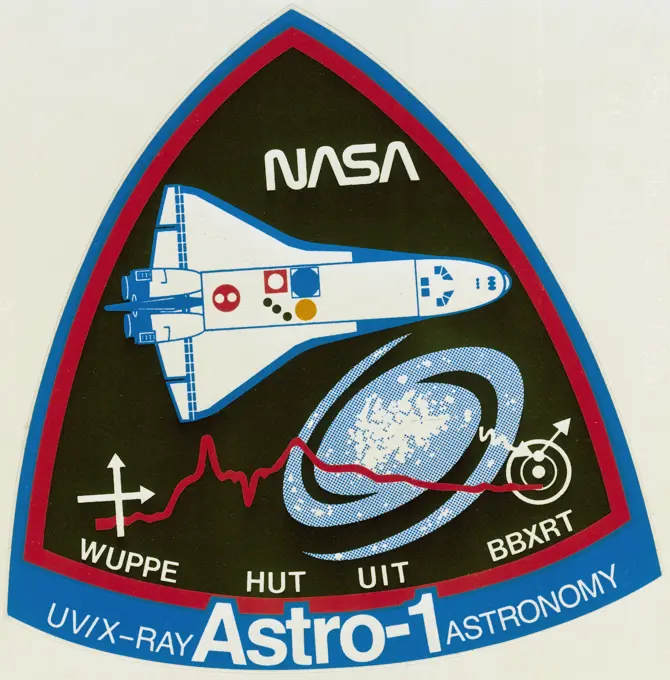
The primary payload for Space Shuttle Mission STS-35, launched December 2, 1990, was the ASTRO-1 Observatory. Designed for round the clock observation of the celestial sphere in ultraviolet and X-ray astronomy, ASTRO-1 featured a collection of four telescopes the Hopkins Ultraviolet Telescope (HUT); the Wisconsin Ultraviolet Photo- Polarimeter Experiment (WUPPE); the Ultraviolet Imaging Telescope (UIT); and the Broad Band X-ray Telescope (BBXRT). Ultraviolet telescopes mounted on Spacelab elements in cargo bay were to be operated in shifts by flight crew. Loss of both data display units (used for pointing telescopes and operating experiments) during mission impacted crew-aiming procedures and forced ground teams at Marshall Space Flight Center to aim ultraviolet telescopes with fine-tuning by flight crew. BBXRT, also mounted in cargo bay, was directed from outset by ground-based operators at Goddard Space Flight Center. This is the logo or emblem that was designed to represent the ASTR
6145-44497495
STS044-S-001 (July 1991) --- Designed by the participating crew members, the STS-44 patch shows the space shuttle Atlantis shortly after liftoff as it rolls to ascend into orbit. The orbital path illustrated by the red, white and blue of the stylized American flag represents the American contribution and strength derived from this mission. The black background of space, indicative of the mysteries of the universe, is illuminated by six large stars, which depict the American crew of six and the hopes that travel with them. The smaller stars represent the myriad of unheralded Americans who work in support of this mission. Within the shuttle's payload bay is a Defense Support Program (DSP) Satellite which will help insure peace. The stars of the flag symbolize our leadership in an exciting quest of space and the boundless dreams for mankind's future.  In the words of a crew spokesman, "the stars of the flag symbolize our leadership in an exciting quest of space and the boundless dreams fo
6145-45246448
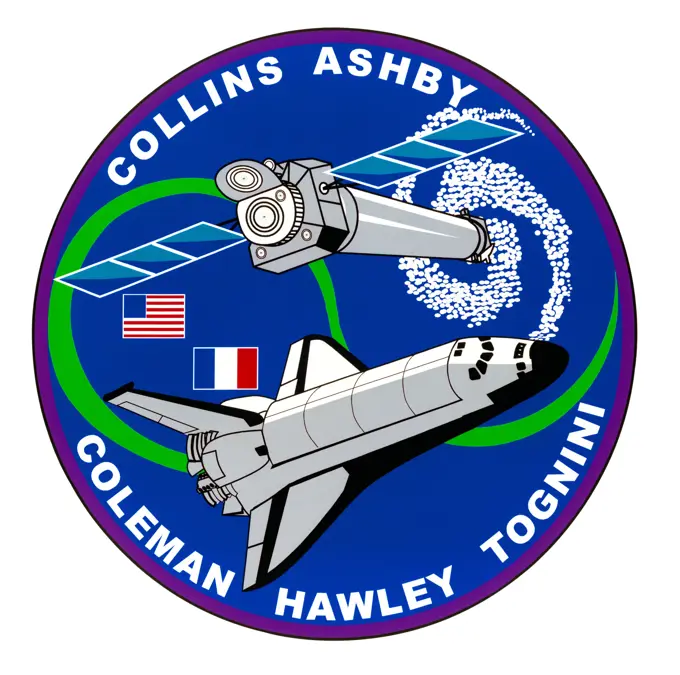
STS093-S-001 (September 1998) --- This is the STS-93 mission insignia designed by the crew members. Space shuttle Columbia will carry the Advanced X-ray Astrophysics Facility (AXAF) into low Earth orbit initiating its planned five-year astronomy mission. AXAF is the third of NASA's great observatories, following the Hubble Space Telescope (HST) and the Compton Gamma Ray Observatory (GRO). AXAF will provide scientists and order-of magnitude improvement over current capabilities at X-ray wavelengths. In the words of the crew, "Observations of X-ray emissions from energetic galaxies and clusters, as well as black holes, promise to greatly expand current understanding of the origin and evolution of our universe." The patch depicts AXAF separating from the space shuttle Columbia after a successful deployment. A spiral galaxy is shown in the background as a possible target for AXAF observations. The two flags represent the international crew, consisting of astronauts from both the United Sta
6145-45149376
. NASA_60TH_FULLCOLOR_BLKGRD_300DPI
6145-44612261
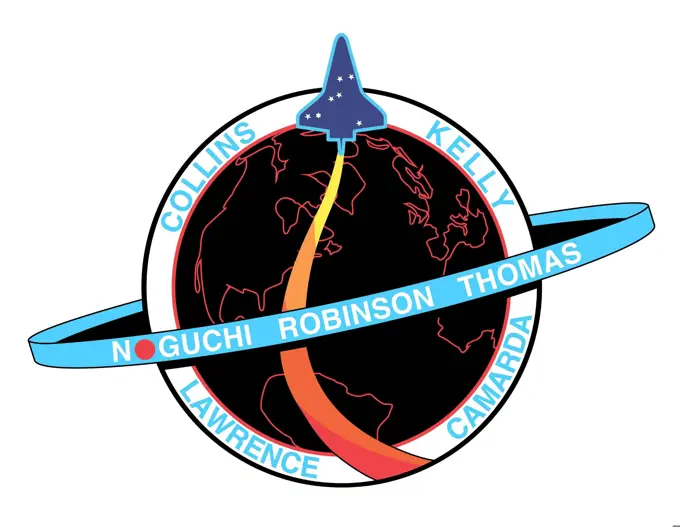
JOHNSON SPACE CENTER, Houston -  The STS-114 patch design signifies the return of the Space Shuttle to flight and honors the memory of the STS-107 Columbia crew. The blue Shuttle rising above Earths horizon includes the Columbia constellation of seven stars, echoing the STS-107 patch and commemorating the seven members of that mission. The crew of STS-114 will carry the memory of their friends on Columbia and the legacy of their mission back into Earth orbit. The dominant design element of the STS-114 patch is the planet Earth, which represents the unity and dedication of the many people whose efforts allows the Shuttle to safely return to flight. Against the background of the Earth at night, the blue orbit represents the International Space Station (ISS), with the EVA crewmembers named on the orbit. The red sun on the orbit signifies the contributions of the Japanese Space Agency to the mission and to the ISS program. The multi-colored Shuttle plume represents the broad spectrum of c
6145-54495926
Air Force Organizational Emblem: Air Force Research Laboratory, Air Force Material Command Exact Date Shot Unknown. Base: Maxwell Air Force Base State: Alabama (AL) Country: United States Of America (USA)
6145-44637966
This is the insignia designed by the STS-61B crewmembers to represent their November 1985 mission aboard the Space Shuttle Atlantis, depicted here in earth orbit, making only its second space flight. The design is surrounded by the sumames of the seven crewmembers.
6145-44541501
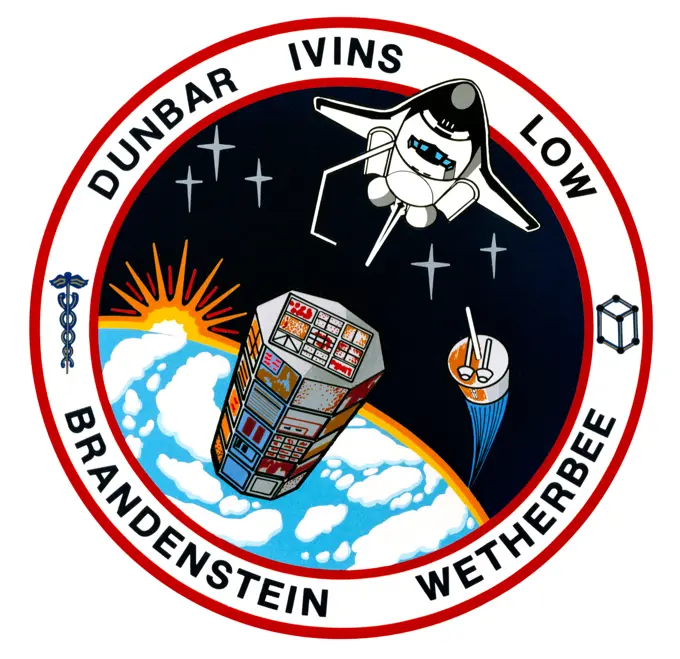
S89-44076 (November 1989) --- The STS-32 patch, designed by the five crew members for the scheduled December 1989 space mission, depicts the space shuttle orbiter rendezvousing with the Long Duration Exposure Facility (LDEF) satellite from above. The Syncom satellite is successfully deployed and on its way to geosynchronous orbit.  Five stars have been arranged so that three are one side of the orbiter and two on the other to form the number 32. The seven major rays of the sun are in remembrance of the crew members for STS51-L. In preparation for the first Extended Duration Orbiter (EDO) missions, STS-32 will conduct a number of medical and middeck scientific experiments. The caduceus on the left represents the medical experiments, and the crystalline structure on the right represents the materials science. The crew is comprised of astronauts Daniel C. Brandenstein, James D. Wetherbee, Bonnie J. Dunbar, Marsha S. Ivins and G. David Low. The NASA insignia design for space shuttle flig
6145-44566978
STS79-S-001 (April 1996) --- STS-79 is the fourth in a series of NASA docking missions to the Russian Mir Space Station, leading up to the construction and operation of the International Space Station (ISS). As the first flight of the Spacehab Double Module, STS-79 encompasses research, test and evaluation of ISS, as well as logistics resupply for the Mir Space Station. STS-79 is also the first NASA-Mir American crew member exchange mission, with John E. Blaha (NASA-Mir-3) replacing Shannon W. Lucid (NASA-Mir-2) aboard the Mir Space Station. The lettering of their names either up or down denotes transport up to the Mir Space Station or return to Earth on STS-79. The patch is in the shape of the space shuttles airlock hatch, symbolizing the gateway to international cooperation in space. The patch illustrates the historic cooperation between the United States and Russia in space. With the flags of Russia and the United States as a backdrop, the handshake of Extravehicular Mobility Unit
6145-44749651
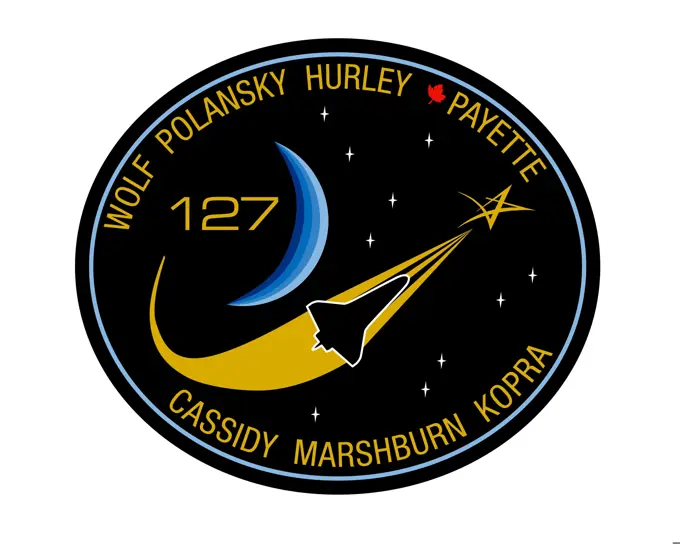
JOHNSON SPACE CENTER, Houston - STS127-S-001 (JSC) -- Space shuttle mission STS-127 is the 32nd construction flight of the International Space Station, or ISS, and the final of a series of three flights dedicated to the assembly of the Japanese "Kibo" laboratory complex.  In addition to delivering, installing and servicing an external scientific platform that will be attached to the end of the Japanese module, STS-127 will bring up a new ISS crew member and return another one to Earth, replace vital components of the ISS electrical production system, and transfer various pieces of hardware to ISS.  Five spacewalks and the operation of four different robotic arms will be required to accomplish these tasks over 10 days.  A crew spokesperson had the following words for the patch: "Bathed in sunlight, the blue Earth is represented without boundaries to remind us that we all share this world.  In the center, the golden flight path of the space shuttle turns into the three distinctive rays o
6145-44499036
STS042-S-001 (October 1991) --- Designed by the crew members, the International Microgravity Lab-1 (IML-1) insignia depicts the orbiter with the Spacelab Module aboard. The spacecraft is oriented in a quiescent, tail-to-Earth, gravity-gradient attitude to best support the various microgravity payloads and experiments. The international composition of the crew is depicted by symbols representing both the Canadian Space Agency (CSA) and the European Space Agency (ESA). The number 42 is represented by six white stars -- four on one side of the orbiter and two on the other. The single gold star above Earth's horizon honors the memory of astronaut Manley L. (Sonny) Carter, who was killed earlier this year in a commuter plane crash. A crew spokesperson stated that Carter "...was our crew mate, colleague and friend."  Blue letters set against white give the surnames of the five astronauts and two payload specialists for the flight.The NASA insignia design for space shuttle flights is reserv
6145-45241293
STS039-S-001 (October 1990) --- The arrowhead shape of the STS-39 crew patch represents a skyward aim to learn more about our planet's atmosphere and space environment in support of the Department of Defense. Our national symbol is represented by the star constellation Aguila (the eagle) as its brightest star, Altair, lifts a protective canopy above Earth. The space shuttle encircles the spectrum which represents x-ray, ultraviolet, visible and infrared electromagnetic radiation to be measured by a variety of scientific instruments. Experiments will be operated within the payload bay and aboard a free-flying satellite which will be deployed and retrieved during the mission. The patch was designed by the STS-39 crew.The NASA insignia design for space shuttle flights is reserved for use by the astronauts and for other official use as the NASA Administrator may authorize. Public availability has been approved only in the form of illustrations by the various news media. When and if there
6145-44665764
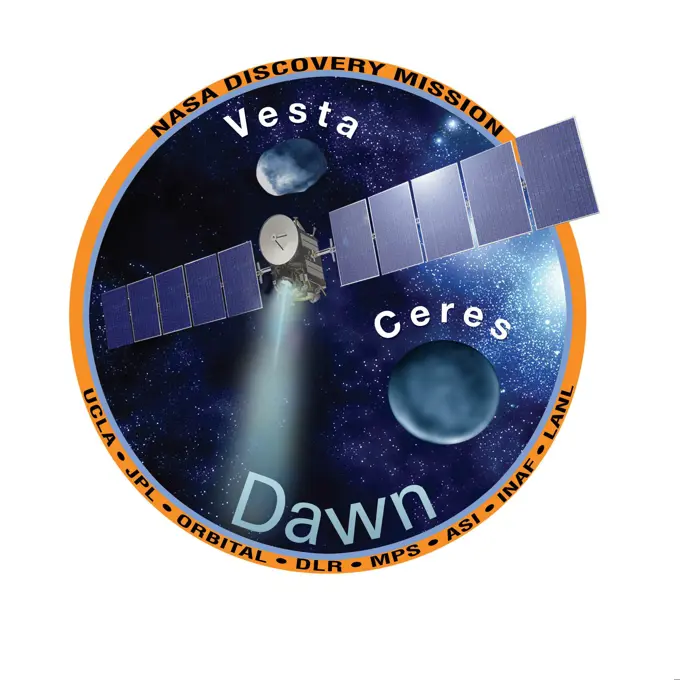
NASA's Dawn mission patch, part of the Dawn Mission Art series.
6145-44541059
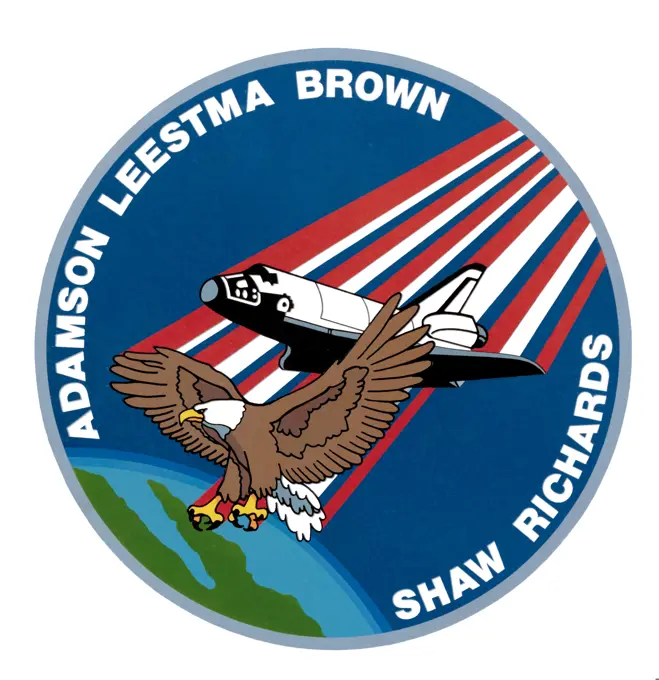
S88-40309 (7 Nov. 1988) --- The STS-28 insignia was designed by the astronaut crew, who said it portrays the pride the American people have in their manned spaceflight program. It depicts America (the eagle) guiding the space program (the space shuttle) safely home from an orbital mission. The view looks south on Baja California and the west coast of the United States as the space travelers re-enter the atmosphere. The hypersonic contrails created by the eagle and shuttle represent the American flag. The crew called the simple boldness of the design symbolic of America's unfaltering commitment to leadership in the exploration and development of space. Crew members for STS-28 are astronauts Brewster H. Shaw Jr.,commander; Richard N. Richards, pilot; and David C. Leestma, Mark N. Brown and James C.  Adamson, mission specialists. The NASA insignia design for space shuttle flights is reserved for use by the astronauts and for other official use as the NASA Administrator may authorize. Pu
6145-44719340
S73-23952 (May 1973) --- This is the official emblem for the National Aeronautics and Space Administration's
6145-44635327
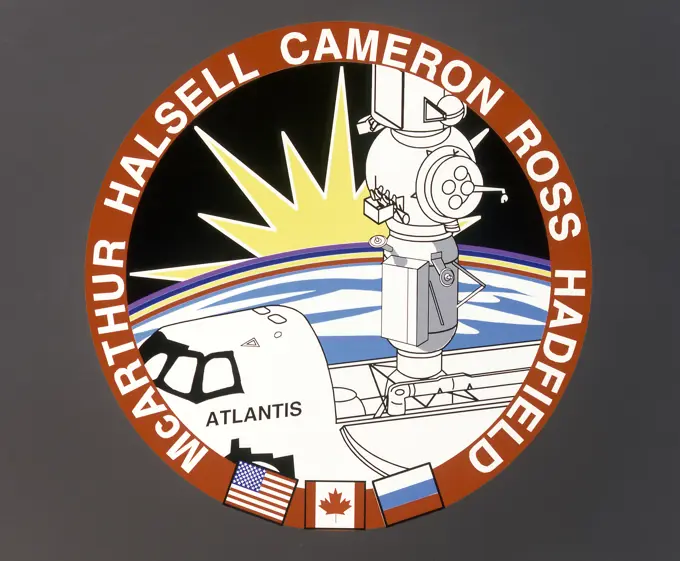
The STS-74 crew patch depicts the orbiter Atlantis docked to the Russian Space Station Mir. The central focus is on the Russian-built docking module, drawn with shading to accentuate its pivotal importance to both STS-74 and the NASA-Mir Program. The rainbow across the horizon represents the Earth's atmosphere, the thin membrane protecting all nations, while the three flags across the bottom show those nations participating in STS-74 Russia, Canada, and the United States. The sunrise is symbolic of the dawn of a new era in NASA space flight , that of International Space Station construction.
6145-44638127
Columbia, which opened the era of the Space Transportation System with four orbital flight tests, is featured in re-entry in the emblem designed by the STS-61C crew representing the seven team members who manned the vehicle for its seventh STS mission. Gold lettering against black background honors the astronaut crewmembers on the delta pattern surrounding colorful re-entry shock waves, and the payload specialists are honored similarly below the sphere
6145-51897122
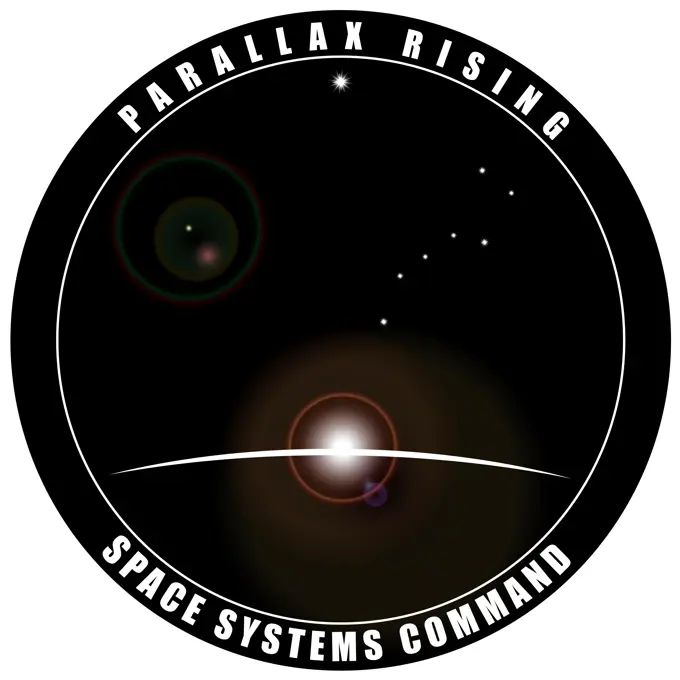
Space Systems Command conducted its first joint operations training at Cape Canaveral Space Force Station, Fla. in a newly defined training series called Parallax Rising. This exercise series places an emphasis on exploring and identifying potential policies and procedures to synchronize efforts between the command and its partners ability to deliver warfighting capabilities on-orbit. (U.S. Space Force graphic by Master Sergeant Travis Ferguson)
6145-44548700
STS074-S-001 (July 1995) --- Designed by crew members, this STS-74 crew patch depicts the space shuttle Atlantis docked to Russia's Mir Space Station. The central focus is on the Russian-built Docking Module (DM), drawn with shading to accentuate its pivotal importance to both mission STS-74 and the NASA - Mir Program. The rainbow across the horizon represents Earth's atmosphere, the thin membrane protecting all nations, while the three flags across the bottom show those nations participating in STS-74 - Russia, Canada and the United States. The sunrise is symbolic of the dawn of a new era in NASA space flight - that of space station construction.The NASA insignia design for space shuttle flights is reserved for use by the astronauts and for other official use as the NASA Administrator may authorize. Public availability has been approved only in the forms of illustrations by the various news media. When and if there is any change in this policy, which is not anticipated, the change w
6145-45245136
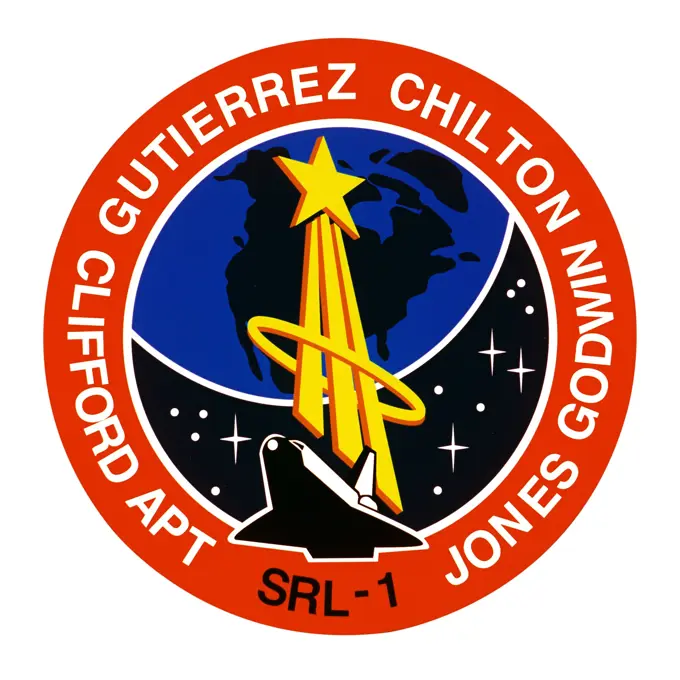
STS059-S-001 (November 1993) --- Designed by the crew members, the STS-59 insignia is dominated by Earth, reflecting the focus of the first Space Radar Laboratory (SRL-1) mission upon our planet's surface and atmosphere. The golden symbol of the astronaut corps emblem sweeps over Earth's surface from the space shuttle Endeavour, representing the operation of the SIR-C/Synthetic Aperture Radar (X-SAR) and the Measurement of Air Pollution from Space (MAPS) sensors. The astronaut emblem also signals the importance of the human element in space exploration and in the study of our planet. Using the unique vantage point of space, Endeavour and its crew -- along with scientists from around the world -- will study Earth and its environment. The starfield visible below Earth represents the many talents and skills of the international (SRL-1) team in working to make this Mission to Planet Earth (MTPE) a scientific and operational success. The NASA insignia design for space shuttle flights is res
6145-44604104
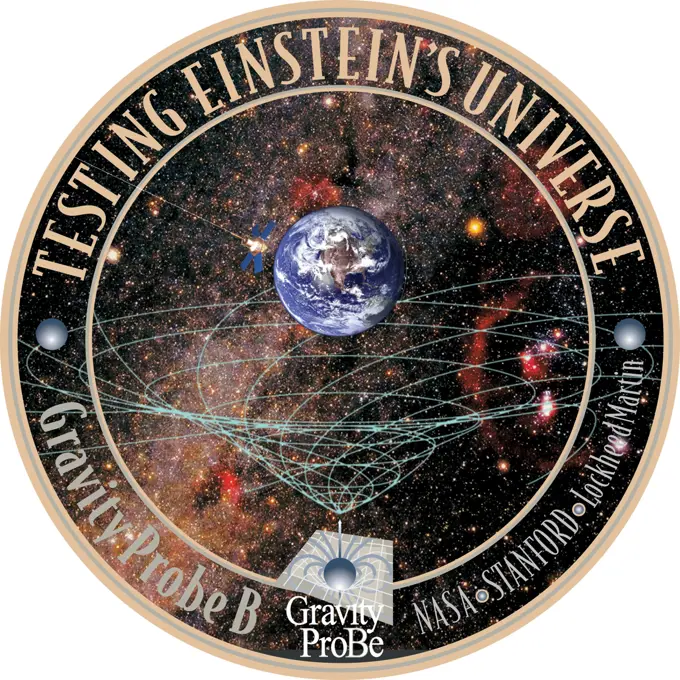
KENNEDY SPACE CENTER, FLA.  - This seal illustrates the mission of the Gravity Probe B spacecraft and the organizations who developed the experiment: Stanford University, NASAs Marshall Space Flight Center and Lockheed Martin.  The Gravity Probe B mission will test the theory of curved spacetime and "frame-dragging," depicted graphically in the lower half, that was developed by Einstein and other scientists.   Above the graphic is a drawing of GP-B circling the Earth.
6145-45043362
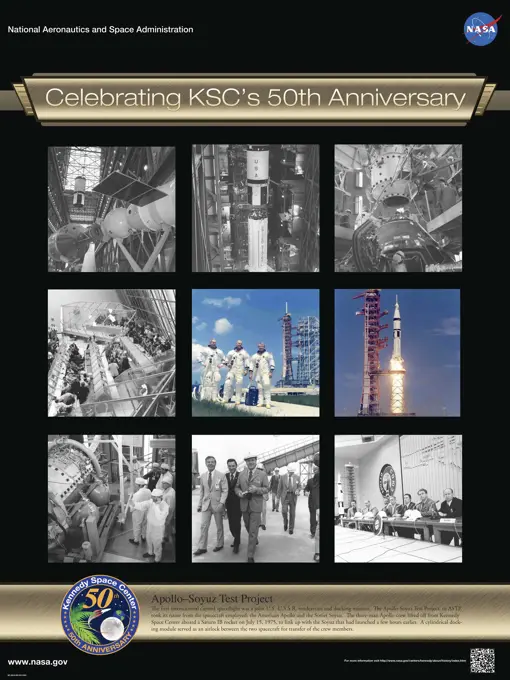
Apollo-Soyuz Test Project:The first international crewed spaceflight was a joint U.S.-U.S.S.R. rendezvous and docking mission.  The Apollo-Soyuz Test Project, or ASTP, took its name from the spacecraft employed: the American Apollo and the Soviet Soyuz.  The three-man Apollo crew lifted off from Kennedy Space Center aboard a Saturn IB rocket on July 15, 1975, to link up with the Soyuz that had launched a few hours earlier.  A cylindrical docking module served as an airlock between the two spacecraft for transfer of the crew members. Poster designed by Kennedy Space Center Graphics Department/Greg Lee.
6145-50597132
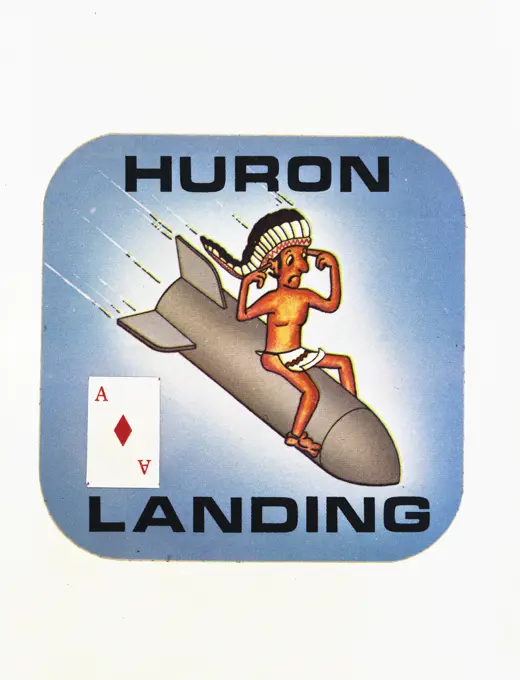
A810561 U12N HL/DB LOGO DAINS (PROJECT ENGINEER) SEP 22 81 IN LOGO FILE EG&G/NTS PHOTO LAB Publication Date: 9/22/1981  ARTWORKS; EDGERTON, GERMESHAUSEN & GRIER; EG&G; HL/DB LOGO; HURON LANDING; HURON LANDING TEST; LOGOS; MISSILES; NATIVE AMERICANS; NEVADA; NEVADA TEST SITE; NTS; NUCLEAR ENERGY TECHNOLOGY; NUCLEAR TESTING; NUCLEAR TESTS; TEST SITES; UGT; UNDERGROUND TESTING  historical images. 1972 - 2012. Department of Energy. National Nuclear Security Administration. Photographs Related to Nuclear Weapons Testing at the Nevada Test Site.
6145-52162432
DN-SC-90-01972. Country: Unknown
PREVIOUS
of 1
NEXT
2401 S. Ervay, Suite 206
Dallas, Texas 75215
United States
Browse
CategoriesFree ResearchGalleries
For Creators
License Your ContentSuperStock For StudentsFrame of Mind BlogContributor PortalNew Image SpotlightLicense AI Imagery
Resources
About UsLicensingTerms & ConditionsAPI AccessPrivacyPricing
Contact
+1 866 236 0087help@superstock.com Contact form
©2026 SuperStock. All Rights Reserved. -B
This site is protected by reCAPTCHA and Google Privacy Policy and Terms of Service apply.