Fine ArtVintageFootageSubscriptionBoardsFree ResearchPricing
  • Fine Art
  • Vintage
  • Footage
  • Subscription
  • Boards
  • Free Research
  • Pricing

Parachute Testing

Visuals of parachutes deploying from spacecraft models in bright blue skies. The scenes illustrate high-altitude tests, emphasizing the engineering behind aerospace safety.

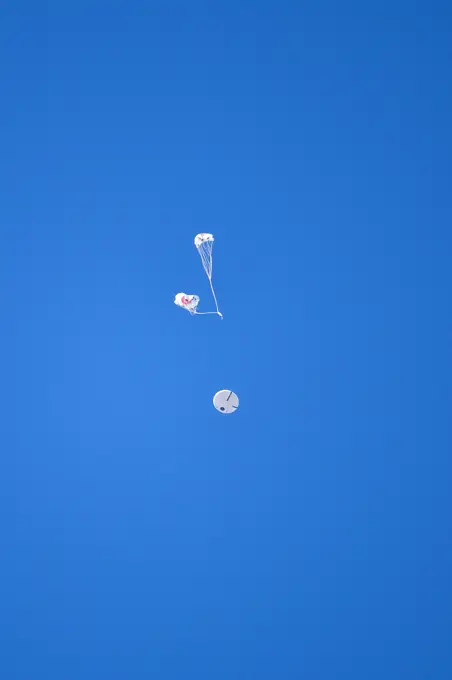
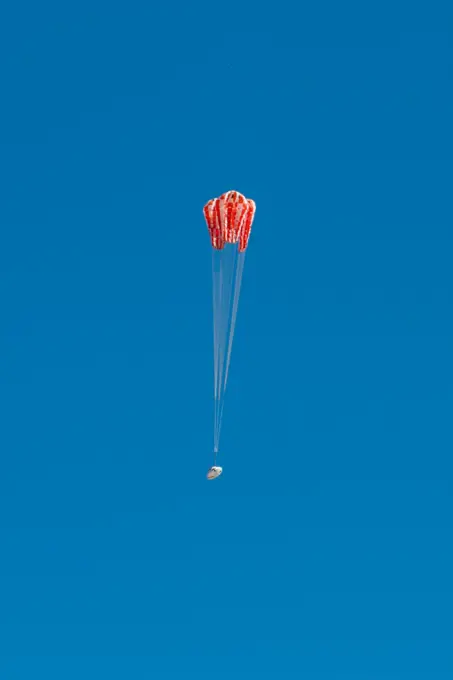
An Orion parachute development test takes place at U.S. Army Yuma Proving Ground in Yuma, Arizona, on April 17, 2012.  Part of Batch image transfer from Flickr.
An Orion parachute development test takes place at U.S. Army Yuma Proving Ground in Yuma, Arizona, on April 17, 2012. Part of Batch image transfer from Flickr.
65 assets in this story
6145-58967921
An Orion parachute development test takes place at U.S. Army Yuma Proving Ground in Yuma, Arizona, on April 17, 2012.  Part of Batch image transfer from Flickr.
6145-58968925
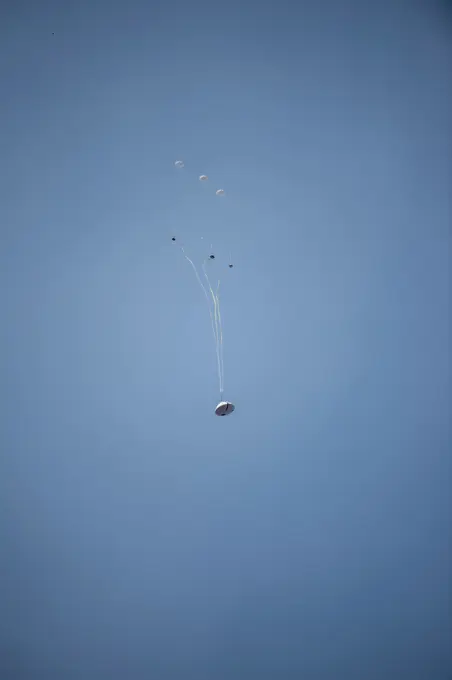
Orion's parachutes deploy as it returns to Earth after Exploration Flight Test-1 (EFT-1) on Dec. 5, 2014. Part of Batch image transfer from Flickr.
6145-58969815
Orions three main orange and white parachutes help a representative model of the spacecraft descend through sky above Arizona, where NASA engineers tested the parachute system on Sept. 13, 2017 at the U.S. Army Proving Ground in Yuma. NASA is qualifying Orions parachutes for missions with astronauts.. .During this test, engineers replicated a situation in which Orion must abort off the Space Launch System rocket and bypasses part of its normal parachute deployment sequence that typically helps the spacecraft slow down during its descent to Earth after deep space missions. The capsule was dropped out of a C-17 aircraft at more than 4.7 miles in altitude and allowed to free fall for 20 seconds, longer than ever before, to produce high aerodynamic pressure before only its pilot and main parachutes were deployed, testing whether they could perform as expected under extreme loads. Orions full parachute system includes 11 total parachutes -- three forward bay cover parachutes and two drogue
6145-58969812
Orions three main orange and white parachutes help a representative model of the spacecraft descend through sky above Arizona, where NASA engineers tested the parachute system on Sept. 13, 2017 at the U.S. Army Proving Ground in Yuma. NASA is qualifying Orions parachutes for missions with astronauts.. .During this test, engineers replicated a situation in which Orion must abort off the Space Launch System rocket and bypasses part of its normal parachute deployment sequence that typically helps the spacecraft slow down during its descent to Earth after deep space missions. The capsule was dropped out of a C-17 aircraft at more than 4.7 miles in altitude and allowed to free fall for 20 seconds, longer than ever before, to produce high aerodynamic pressure before only its pilot and main parachutes were deployed, testing whether they could perform as expected under extreme loads. Orions full parachute system includes 11 total parachutes -- three forward bay cover parachutes and two drogue
6145-58969807
Orions three main orange and white parachutes help a representative model of the spacecraft descend through sky above Arizona, where NASA engineers tested the parachute system on Sept. 13, 2017 at the U.S. Army Proving Ground in Yuma. NASA is qualifying Orions parachutes for missions with astronauts.. .During this test, engineers replicated a situation in which Orion must abort off the Space Launch System rocket and bypasses part of its normal parachute deployment sequence that typically helps the spacecraft slow down during its descent to Earth after deep space missions. The capsule was dropped out of a C-17 aircraft at more than 4.7 miles in altitude and allowed to free fall for 20 seconds, longer than ever before, to produce high aerodynamic pressure before only its pilot and main parachutes were deployed, testing whether they could perform as expected under extreme loads. Orions full parachute system includes 11 total parachutes -- three forward bay cover parachutes and two drogue
6145-54684470
Orion Splashdown. At 12:40 p.m. EST, Dec. 11, 2022, NASAs Orion spacecraft for the Artemis I mission splashed down in the Pacific Ocean after a 25.5 day mission to the Moon. Orion will be recovered by NASAs Landing and Recovery team, U.S. Navy and Department of Defense partners aboard the USS Portland ship.
6145-44689372
Under the goals of the Vision for Space Exploration, Ares I is a chief component of the cost-effective space transportation infrastructure being developed by NASA's Constellation Program. This transportation system will safely and reliably carry human explorers back to the moon, and then onward to Mars and other destinations in the solar system. The Ares I effort includes multiple project element teams at NASA centers and contract organizations around the nation, and is managed by the Exploration Launch Projects Office at NASA's Marshall Space Flight Center (MFSC). ATK Launch Systems near Brigham City, Utah, is the prime contractor for the first stage booster. ATK's subcontractor, United Space Alliance of Houston, is designing, developing and testing the parachutes at its facilities at NASA's Kennedy Space Center in Florida. NASA's Johnson Space Center in Houston hosts the Constellation Program and Orion Crew Capsule Project Office and provides test instrumentation and support personne
6145-45293170
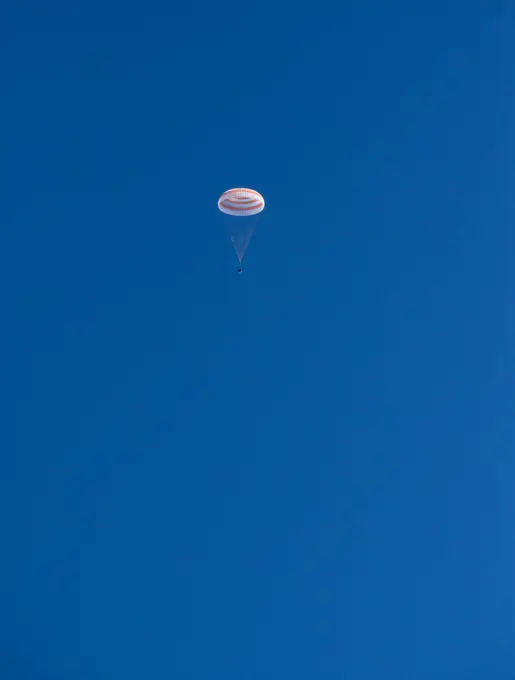
The Soyuz MS-17 spacecraft is seen as it lands in a remote area near the town of Zhezkazgan, Kazakhstan with Expedition 64 crew members Kate Rubins of NASA, Sergey Ryzhikov and Sergey Kud-Sverchkov of Roscosmos, Saturday, April 17, 2021. Rubins, Ryzhikov and Kud-Sverchkov returned after 185 days in space having served as Expedition 63-64 crew members onboard the International Space Station.
6145-45154837
Boeing conducted the first in a series of reliability tests of its CST-100 Starliner flight drogue and main parachute system by releasing a long, dart-shaped test vehicle from a C-17 aircraft over Yuma, Arizona.  Two more tests are planned using the dart module, as well as three similar reliability tests using a high fidelity capsule simulator designed to simulate the CST-100 Starliner capsules exact shape and mass. In both the dart and capsule simulator tests, the test spacecraft are released at various altitudes to test the parachute system at different deployment speeds, aerodynamic loads, and or weight demands. Data collected from each test is fed into computer models to more accurately predict parachute performance and to verify consistency from test to test.
6145-45167669
The Soyuz MS-07 spacecraft is seen as it lands with Expedition 55 crew members Anton Shkaplerov of Roscosmos, Scott Tingle of NASA, and Norishige Kanai of the Japan Aerospace Exploration Agency (JAXA) near the town of Zhezkazgan, Kazakhstan on Sunday, June 3, 2018. Shkaplerov, Tingle, and Kanai are returning after 168 days in space where they served as members of the Expedition 54 and 55 crews onboard the International Space Station.
6145-44973136
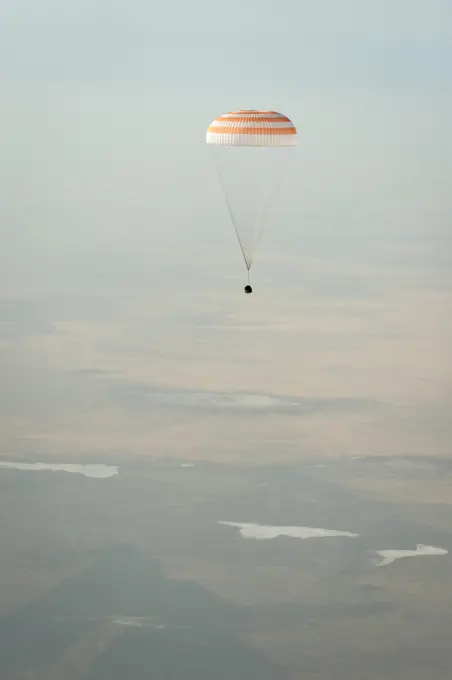
The Soyuz TMA-08M spacecraft with Expedition 36 Commander Pavel Vinogradov of the Russian Federal Space Agency (Roscosmos), Flight Engineer Alexander Misurkin of Roscosmos and Flight Engineer Chris Cassidy of NASA aboard, is seen as it lands in a remote area near the town of Zhezkazgan, Kazakhstan, on Wednesday, Sept. 11, 2013. Vinogradov, Misurkin and Cassidy returned to Earth after five and a half months on the International Space Station.
6145-54684464
Orion Splashdown. At 12:40 p.m. EST, Dec. 11, 2022, NASAs Orion spacecraft for the Artemis I mission splashed down in the Pacific Ocean after a 25.5 day mission to the Moon. Orion will be recovered by NASAs Landing and Recovery team, U.S. Navy and Department of Defense partners aboard the USS Portland.
6145-45010712
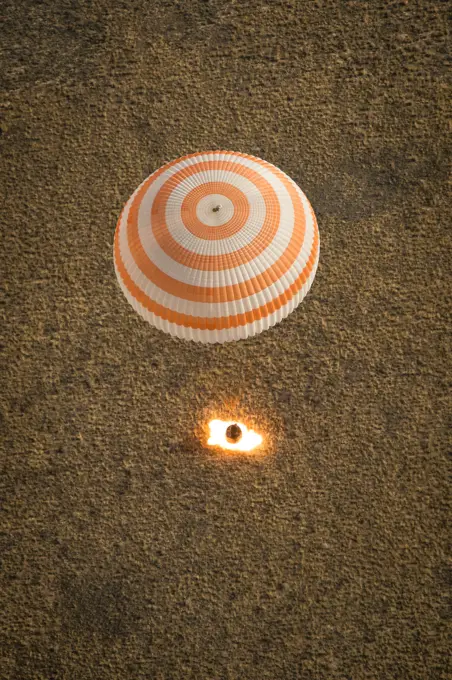
The Soyuz TMA-21 spacecraft is seen as it lands with Expedition 28 Commander Andrey Borisenko, and Flight Engineers Ron Garan, and Alexander Samokutyaev in a remote area outside of the town of Zhezkazgan, Kazakhstan, on Friday, Sept. 16, 2011. NASA Astronaut Garan, Russian Cosmonauts Borisenko and Samokutyaev are returning from more than five months onboard the International Space Station where they served as members of the Expedition 27 and 28 crews.
6145-44531783
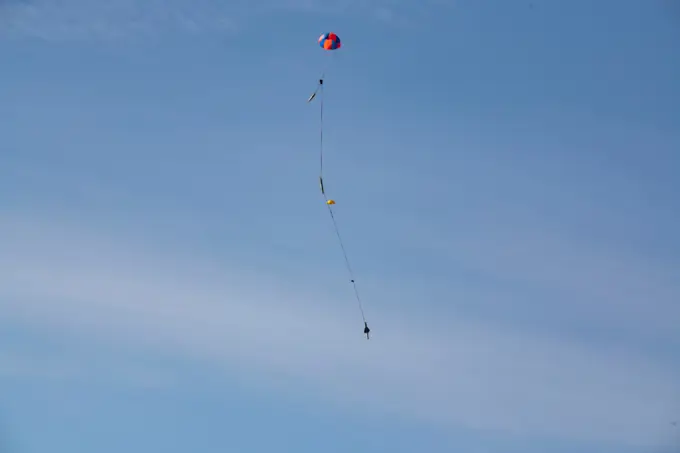
A weather balloon takes flight from the Cape Canaveral Air Force Station weather station. The balloon is equipped with a radiosonde, an instrument that transmits measurements on atmospheric pressure, humidity, temperature and winds as it ascends. The data will be used to determine if conditions are acceptable for the launch of NASA's THEMIS mission. THEMIS, an acronym for Time History of Events and Macroscale Interactions during Substorms, consists of five identical probes that will track violent, colorful eruptions near the North Pole. This will be the largest number of scientific satellites NASA has ever launched into orbit aboard a single rocket. The THEMIS mission aims to unravel the mystery behind auroral substorms, an avalanche of magnetic energy powered by the solar wind that intensifies the northern and southern lights. The mission will investigate what causes auroras in the Earths atmosphere to dramatically change from slowly shimmering waves of light to wildly shifting strea
6145-58968923
Orion's parachutes deploy as it returns to Earth after Exploration Flight Test-1 (EFT-1) on Dec. 5, 2014.  Part of Batch image transfer from Flickr.
6145-58969726
A successful Orion parachute test takes place at U.S. Army Yuma Proving ground in Arizona on March 8, 2017. This is the second test in a series of eight that will certify Orion's parachutes for human space flight.
6145-58969871
NASA successfully tested the Orion spacecrafts parachute system on March 16, 2018 at the U.S. Army Proving Ground in Yuma, Arizona. It was the first time engineers intentionally failed one of the systems three Forward Bay Cover parachutes. The Forward Bay Cover protects the upper part of Orion throughout its mission, but must be jettisoned during landing so the rest of Orions parachutes can deploy. Engineers are nearing completion of the series of tests to qualify the parachute system for flights with crew.
6145-45153625
SpaceX performed its fourteenth overall parachute test supporting Crew Dragon development. This most recent exercise was the first of several planned parachute system qualification tests ahead of the spacecrafts first crewed flight and resulted in the successful touchdown of Crew Dragons parachute system. During this test, a C-130 aircraft transported the parachute test vehicle, designed to achieve the maximum speeds that Crew Dragon could experience on re-entry, over the Mojave Desert in Southern California and dropped the vehicle from an altitude of 25,000 feet. The test demonstrated an off-nominal situation, deploying only one of the two drogue chutes and intentionally skipping a reefing stage on one of the four main parachutes, proving a safe landing in such a contingency scenario.
6145-45206267
The Soyuz MS-11 spacecraft is seen as it lands in a remote area near the town of Zhezkazgan, Kazakhstan with Expedition 59 crew members Anne McClain of NASA, David Saint-Jacques of the Canadian Space Agency, and Oleg Kononenko of Roscosmos, Tuesday, June 25, 2019 Kazakh time (June 24 Eastern time). McClain, Saint-Jacques, and Kononenko are returning after 204 days in space where they served as members of the Expedition 58 and 59 crews onboard the International Space Station.
6145-45180033
The Soyuz MS-08 spacecraft is seen as it lands with Expedition 56 Commander Drew Feustel and Flight Engineer Ricky Arnold of NASA, along with Flight Engineer and Soyuz Commander Oleg Artemyev of Roscosmos near the town of Zhezkazgan, Kazakhstan on Thursday, Oct. 4, 2018. Feustel, Arnold, and Artemyev are returning after 197 days in space where they served as members of the Expedition 55 and 56 crews onboard the International Space Station.
6145-58969733
A successful Orion parachute test takes place at U.S. Army Yuma Proving ground in Arizona on March 8, 2017. This is the second test in a series of eight that will certify Orion's parachutes for human space flight.
6145-45155584
The Soyuz MS-06 spacecraft is seen as it lands with Expedition 54 crew members Joe Acaba and Mark Vande Hei of NASA and cosmonaut Alexander Misurkin near the town of Zhezkazgan, Kazakhstan on Wednesday, Feb. 28, 2018 (February 27 Eastern time.) Acaba, Vande Hei, and Misurkin are returning after 168 days in space where they served as members of the Expedition 53 and 54 crews onboard the International Space Station.
6145-58967920
An Orion parachute development test takes place at U.S. Army Yuma Proving Ground in Yuma, Arizona, on April 17, 2012.  Part of Batch image transfer from Flickr.
6145-44787047
A Russian Search and Rescue force helicopter flies around the Soyuz TMA-14 spacecraft as it lands with Expedition 20 Commander Gennady Padalka, Flight Engineer Michael Barratt, and spaceflight participant Guy Laliberté near the town of Arkalyk, Kazakhstan on Sunday, Oct. 11, 2009. Padalka and Barratt are returning from six months onboard the International Space Station, along with Laliberté who arrived at the station on Oct. 2 with Expedition 21 Flight Engineers Jeff Williams and Maxim Suraev aboard the Soyuz TMA-16 spacecraft.
6145-44997951
CAPE CANAVERAL, Fla. - The Project Morpheus prototype lander ascends after launching on its third free flight test at the north end of the Shuttle Landing Facility at NASAs Kennedy Space Center in Florida. The 57-second test began at 1:15 p.m. EST with the Morpheus lander launching from the ground over a flame trench and ascending about 187 feet, nearly doubling the target ascent velocity from the last test in December 2013. The lander flew forward, covering about 154 feet in 20 seconds before descending and landing within 11 inches of its target on a dedicated pad inside the autonomous landing and hazard avoidance technology, or ALHAT, hazard field. Project Morpheus tests NASAs ALHAT and an engine that runs on liquid oxygen and methane, or green propellants, into a fully-operational lander that could deliver cargo to other planetary surfaces. The landing facility provides the lander with the kind of field necessary for realistic testing, complete with rocks, craters and hazards to a
6145-45180029
The Soyuz MS-08 spacecraft is seen as it lands with Expedition 56 Commander Drew Feustel and Flight Engineer Ricky Arnold of NASA, along with Flight Engineer and Soyuz Commander Oleg Artemyev of Roscosmos near the town of Zhezkazgan, Kazakhstan on Thursday, Oct. 4, 2018. Feustel, Arnold, and Artemyev are returning after 197 days in space where they served as members of the Expedition 55 and 56 crews onboard the International Space Station.
6145-45274321
The Soyuz MS-15 spacecraft is seen as it lands in a remote area near the town of Zhezkazgan, Kazakhstan with Expedition 62 crew members Jessica Meir and Drew Morgan of NASA, and Oleg Skripochka of Roscosmos, Friday, April 17, 2020. Meir and Skripochka returned after 205 days in space, and Morgan after 272 days in space. All three served as Expedition 60-61-62 crew members onboard the International Space Station.
6145-58969753
A drop test at U.S. Army Yuma Proving Ground in Yuma, Arizona qualifying Orion's parachute system for human spaceflight takes place on June 14, 2017. Part of Batch images transfer from Flickr.
6145-58969805
Orions three main orange and white parachutes help a representative model of the spacecraft descend through sky above Arizona, where NASA engineers tested the parachute system on Sept. 13, 2017 at the U.S. Army Proving Ground in Yuma. NASA is qualifying Orions parachutes for missions with astronauts.. .During this test, engineers replicated a situation in which Orion must abort off the Space Launch System rocket and bypasses part of its normal parachute deployment sequence that typically helps the spacecraft slow down during its descent to Earth after deep space missions. The capsule was dropped out of a C-17 aircraft at more than 4.7 miles in altitude and allowed to free fall for 20 seconds, longer than ever before, to produce high aerodynamic pressure before only its pilot and main parachutes were deployed, testing whether they could perform as expected under extreme loads. Orions full parachute system includes 11 total parachutes -- three forward bay cover parachutes and two drogue
6145-58968931
Orion's parachutes deploy as it returns to Earth after Exploration Flight Test-1 (EFT-1) on Dec. 5, 2014.  Part of Batch image transfer from Flickr.
6145-44919447
The Soyuz rocket with Expedition 34/35 crew members Russian Cosmonaut and Soyuz Commander Roman Romanenko, NASA astronaut and Flight Engineer Tom Marshburn, and Canadian Space Agency (CSA) Flight Engineer Chris Hadfield onboard the TMA-07M spacecraft launches to the International Space Station on Wednesday, Dec. 19, 2012, in Baikonur, Kazakhstan. Romanenko, Marshburn and Hadfield will be on a five-month mission aboard the International Space Station.
6145-44578618
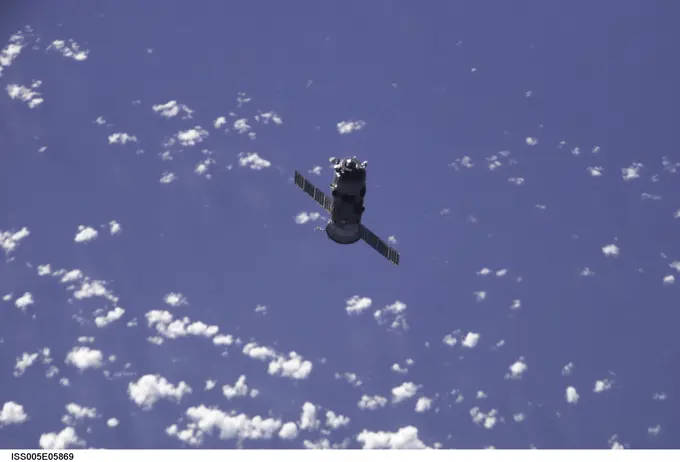
ISS005-E-05869 (25 June 2002) --- Backdropped by the blue and white Earth, an unpiloted Progress 7 supply vehicle departs from the Zvezda Service Module’s docking port on the International Space Station (ISS) carrying its load of trash and unneeded equipment to be deorbited and burned up in the atmosphere. The undocking clears the way for the arrival of a new Progress 8, filled with fresh supplies, which is planned to dock to the station at 1:25 a.m. (CDT) on June 29, 2002.
6145-44531282
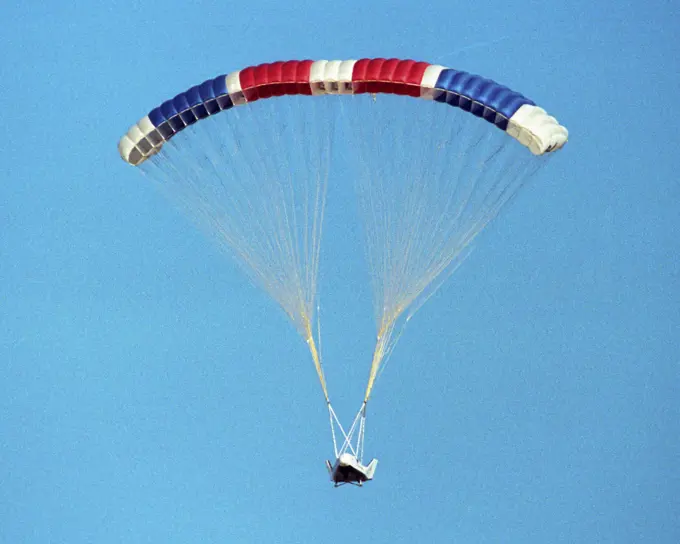
The X-38 prototype of the Crew Return Vehicle for the International Space Station is suspended under its giant 7,500-square-foot parafoil during its eighth free flight on Thursday, Dec. 13, 2001. A portion of the descent was flown by remote control by a NASA astronaut from a ground vehicle configured like the CRV's interior before the X-38 made an autonomous landing on Rogers Dry Lake.
6145-45185207
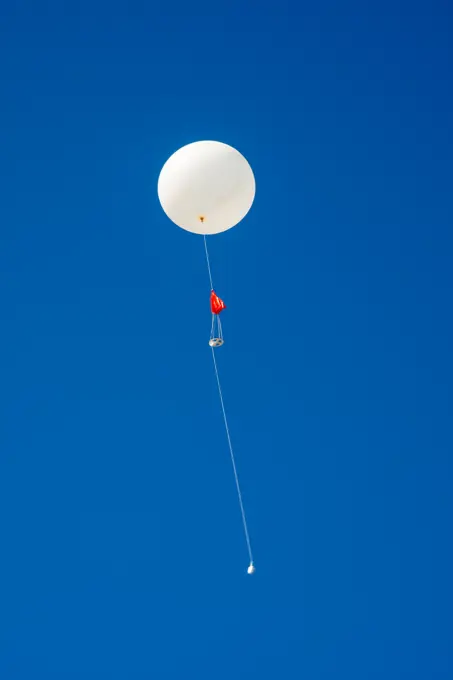
In order to make sure weather conditions are acceptable at multiple altitudes, NASA meteorologists on the ground conduct constant monitoring operations, and launch weather balloons to get accurate data for aircraft and pilot.
6145-45110685
A NASA F/A-18 demonstrates different volumes of sonic booms for attendees of a NASA Social at the NASA Armstrong Flight Research Center in California.
6145-45003367
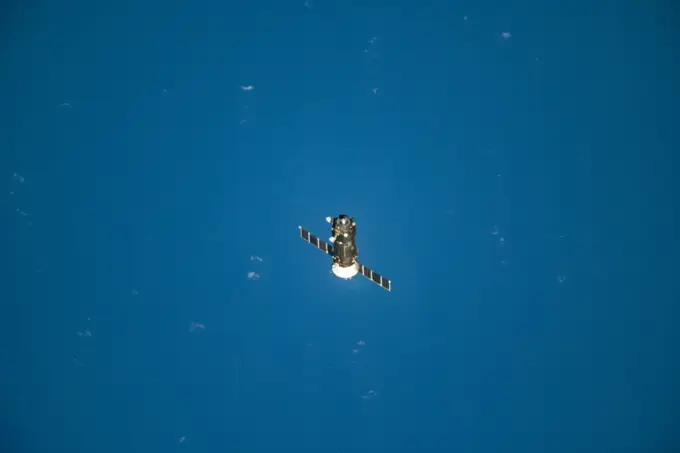
ISS038-E-042675 (5 Feb. 2014) --- An unpiloted ISS Progress resupply vehicle approaches the International Space Station, carrying 2.8 tons of food, fuel and supplies for the Expedition 38 crew members. The Progress 54 spacecraft launched from the Baikonur Cosmodrome in Kazakhstan at 11:23 a.m. (10:23 p.m. Baikonur time) and completed its four-orbit trek at 5:22 p.m. (EST) when it docked automatically to the station's Pirs docking compartment.
6176-66915097
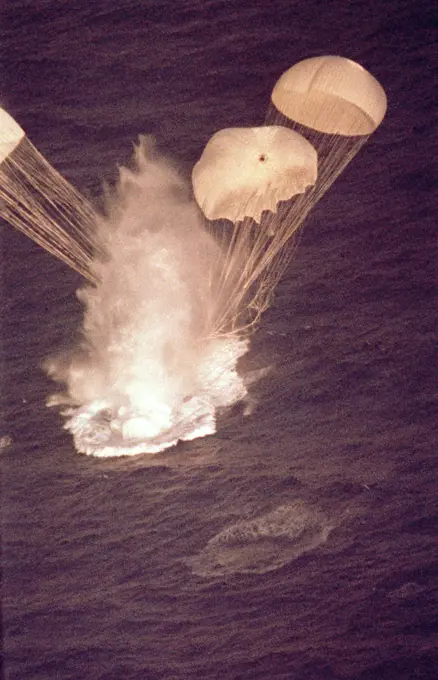
The Apollo 14 Command Module (CM), with astronauts Alan B. Shepard Jr., commander; Stuart A. Roosa, command module pilot; and Edgar D. Mitchell, lunar module pilot, aboard, approaches touchdown in the South Pacific Ocean to successfully end a 10-day lunar landing mission. The splashdown occurred at 3:04:39 p.m. (CST), Feb. 9, 1971, approximately 765 nautical miles south of American Samoa. The three crew men were flown by helicopter to the USS New Orleans prime recovery ship.
6145-58968933
Orion splashes down in the Pacific Ocean after Exploration Flight Test-1 (EFT-1) on Dec. 5, 2014.  Part of Batch image transfer from Flickr.
6145-44474181
Boeings CST-100 Starliner spacecraft lands at White Sands Missile Ranges Space Harbor, Wednesday, May 25, 2022, in New Mexico. Boeings Orbital Flight Test-2 (OFT-2) is Starliners second uncrewed flight test to the International Space Station as part of NASA's Commercial Crew Program. OFT-2 serves as an end-to-end test of the system's capabilities.
6145-44573132
The X-38, a research vehicle built to help develop technology for an emergency Crew Return Vehicle (CRV), flares for its lakebed landing at the end of a March 1999 test flight at the Dryden Flight Research Center, Edwards, California.
6145-44474184
Boeings CST-100 Starliner spacecraft opens its main parachutes as it lands at White Sands Missile Ranges Space Harbor, Wednesday, May 25, 2022, in New Mexico. Boeings Orbital Flight Test-2 (OFT-2) is Starliners second uncrewed flight test to the International Space Station as part of NASA's Commercial Crew Program. OFT-2 serves as an end-to-end test of the system's capabilities.
6145-58968188
Orion teams perform an Orion Capsule Parachute Assembly System (CPAS) drop test using the Parachute Test Vehicle (PTV) at the U.S. Army Yuma Proving Ground in Yuma, Arizona on Dec. 20, 2012. Part of Batch image transfer from Flickr.
6145-45180034
The Soyuz MS-08 spacecraft is seen as it lands with Expedition 56 Commander Drew Feustel and Flight Engineer Ricky Arnold of NASA, along with Flight Engineer and Soyuz Commander Oleg Artemyev of Roscosmos near the town of Zhezkazgan, Kazakhstan on Thursday, Oct. 4, 2018. Feustel, Arnold, and Artemyev are returning after 197 days in space where they served as members of the Expedition 55 and 56 crews onboard the International Space Station.
7175-70561323
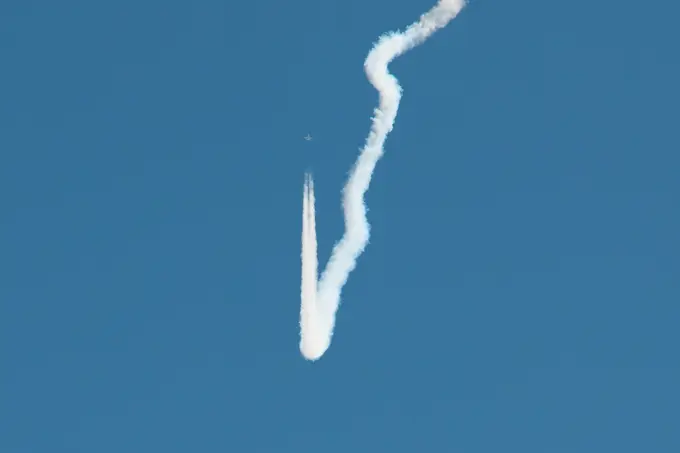
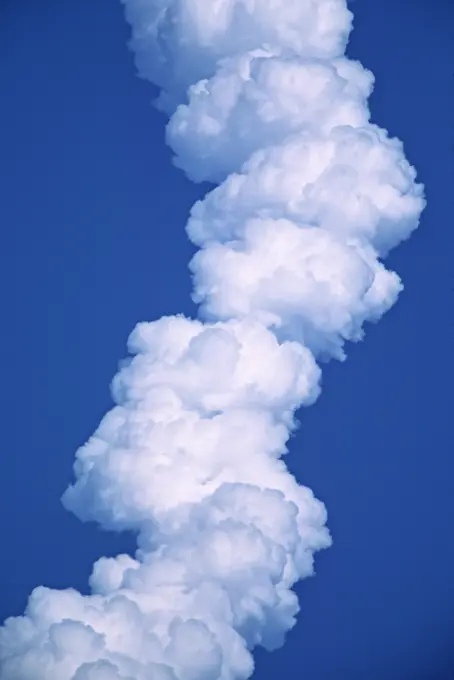
North America, USA, Florida, Cape Canaveral.  Smoke trail from a rocket at Cape Canaveral
6145-55187196
OSIRIS-REx Sample Return Training. Recovery teams participate in helicopter training in preparation for the retrieval of the sample return capsule from NASA's OSIRIS-REx mission, Wednesday, July 19, 2023, at the Department of Defense's Utah Test and Training Range. The sample was collected from the asteroid Bennu in October 2020 by NASAs OSIRIS-REx spacecraft and will return to Earth on September 24th, landing under parachute at the Utah Test and Training Range.
6145-58969879
NASA successfully tested the Orion spacecrafts parachute system on March 16, 2018 at the U.S. Army Proving Ground in Yuma, Arizona. It was the first time engineers intentionally failed one of the systems three Forward Bay Cover parachutes. The Forward Bay Cover protects the upper part of Orion throughout its mission, but must be jettisoned during landing so the rest of Orions parachutes can deploy. Engineers are nearing completion of the series of tests to qualify the parachute system for flights with crew.
6145-44912111
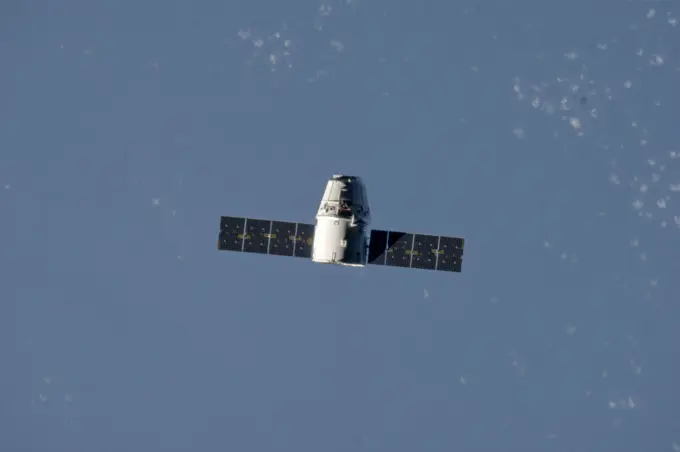
ISS033-E-011355 (10 Oct. 2012) --- The SpaceX Dragon commercial cargo craft makes its relative approach to the International Space Station prior to grapple by the stations Canadarm2 robotic arm, controlled by Expedition 33 crew members.
6145-45206243
iss059e122556 (June 24, 2019) --- The Soyuz MS-11 crew craft separates from the International Space Station after its undocking and begins its descent to Earth. Expedition 59 crewmembers Oleg Kononenko of Roscosmos, Anne McClain of NASA and David Saint-Jacques of the Canadian Space Agency would parachute to a landing in Kazakhstan aboard the Soyuz after 204 days in space.
6145-45263284
This illustration shows a simulated view of NASA's InSight lander descending towards the surface of Mars on its parachute.
6145-45279514
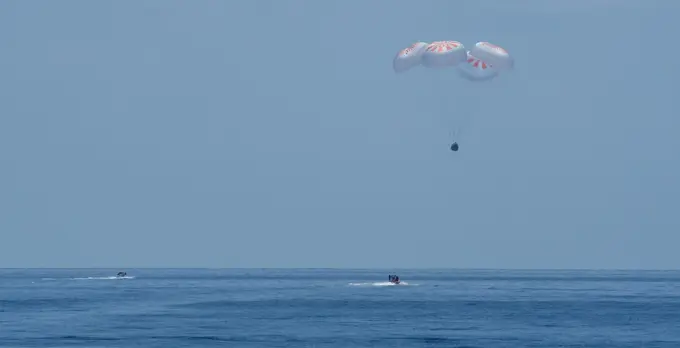
The SpaceX Crew Dragon Endeavour spacecraft is seen as it lands with NASA astronauts Robert Behnken and Douglas Hurley onboard in the Gulf of Mexico off the coast of Pensacola, Florida, Sunday, Aug. 2, 2020. The Demo-2 test flight for NASA's Commercial Crew Program was the first to deliver astronauts to the International Space Station and return them safely to Earth onboard a commercially built and operated spacecraft. Behnken and Hurley returned after spending 64 days in space.
1815R-53673
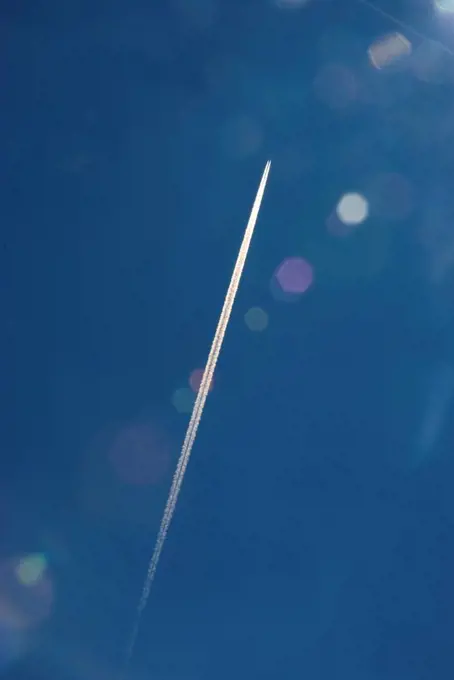
Condensation trails in sky
6145-45115762
View taken by the Expedition 49 crew of track of first of four pairs of Planet Lab DoveSats over the Earth. This deployment titled Flock 2” is a fleet of nanosatellites designed, built and operated by Planet Labs Inc., and will enable imagery of the changing planet to be taken on a frequent basis, with humanitarian and environmental applications ranging from monitoring deforestation and the ice caps to disaster relief and improving agriculture yields in developing nations. Image used as part of Twitter message - We launched two satellites from @Space_Station today - like skydivers soaring towards the earth." #AstroKate.
6145-45197305
High School and College students from around the U.S. came together at Bragg Farms in Toney, Alabama for the 2019 Student Launch Initiative. The students launched their rockets to their own predetermined altitude with various payloads including remote rovers and unmanned aerial vehicles.
6145-44688046
Expedition 16 Commander Peggy Whitson, Flight Engineer and Soyuz Commander Yuri Malenchenko and Malaysian Spaceflight Participant Sheikh Muszaphar Shukor blasted off from the Baikonur Cosmodrome in Kazakhstan at sunset Oct. 10, 2007 in their Soyuz TMA-11 spacecraft bound for a docking to the International Space Station on Oct. 12. Whitson and Malenchenko will spend six months on the station, while Shukor will return to Earth Oct. 21 with two of the Expedition 15 crewmembers currently on the complex.
4186-70019170
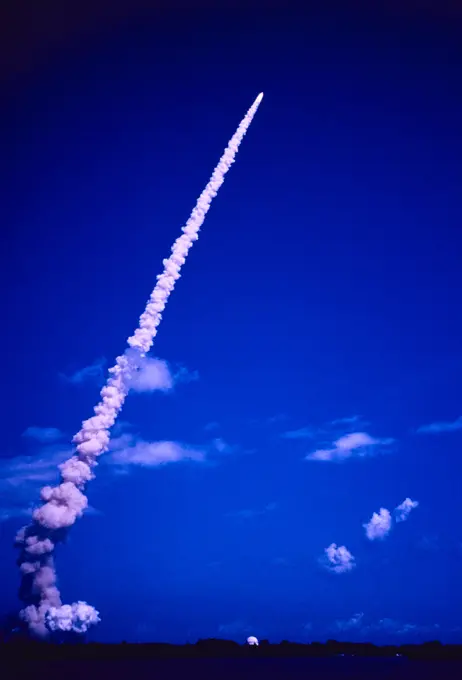
Vintage Photograph. SPACE SHUTTLE COLUMBIA LIFTOFF FLORIDA. Rocket launch against a deep blue sky with dramatic vapor trail.
6145-44491008
NASAs SpaceX Crew-4 Splashdown. The SpaceX Crew Dragon Freedom spacecraft is seen as it lands with NASA astronauts Kjell Lindgren, Robert Hines, Jessica Watkins, and ESA (European Space Agency) astronaut Samantha Cristoforetti aboard in the Atlantic Ocean off the coast of Jacksonville, Florida, Friday, Oct. 14, 2022. Lindgren, Hines, Watkins, and Cristoforetti are returning after 170 days in space as part of Expeditions 67 and 68 aboard the International Space Station.
6145-58971167
The first-stage booster of a SpaceX Falcon 9 rocket flies down toward a landing at Vandenberg Air Force Base in California during the launch of the Sentinel-6 Michael Freilich mission. The Falcon 9 carrying the satellite lifted off from Vandenbergs Space Launch Complex 4 on Nov. 21, 2020, at 9:17 a.m. PST (12:17 p.m. EST). The Sentinel-6/Jason-CS (Continuity of Service) mission consists of the Sentinel-6 Michael Freilich satellite, which will be followed by its twin, the Sentinel-6B satellite, in 2025. The Sentinel-6/Jason-CS mission is part of Copernicus, the European Unions Earth observation program, managed by the European Commission. Continuing the legacy of the Jason series missions, Sentinel-6/Jason-CS will extend the records of sea level into their fourth decade, collecting accurate measurements of sea surface height for more than 90% of the worlds oceans, and providing crucial information for operational oceanography, marine meteorology, and climate studies. NASAs Launch Servic
6145-44529945
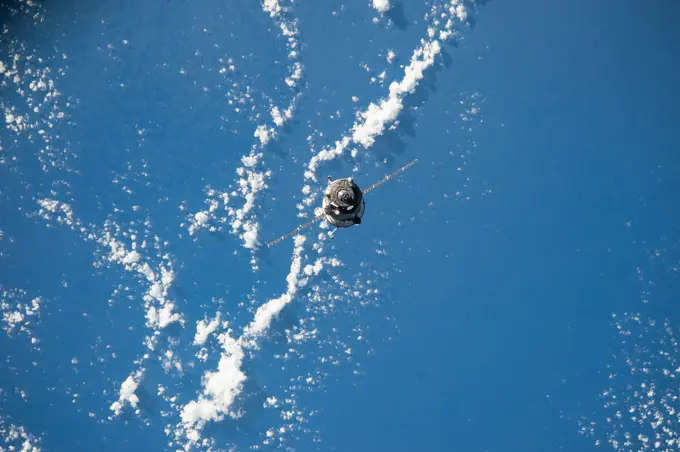
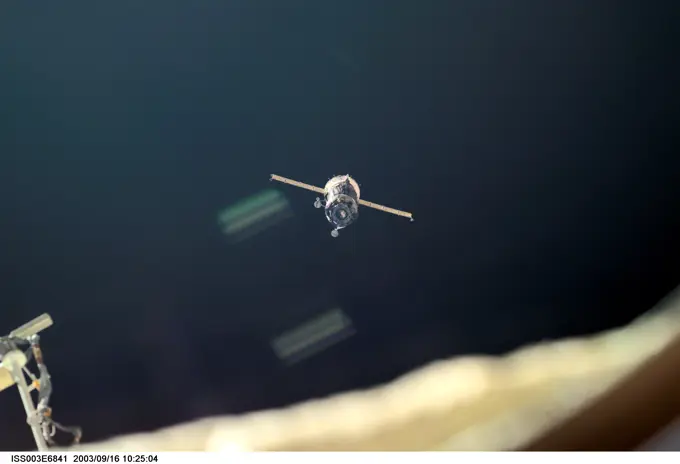
ISS003-E-6841 (23 October 2001) --- A Soyuz spacecraft approaches the International Space Station (ISS) carrying the Soyuz taxi crew, Commander Victor Afanasyev, Flight Engineer Konstantin Kozeev and French Flight Engineer Claudie Haignere for an eight-day stay on the station. Afanasyev and Kozeev represent Rosaviakosmos, and Haignere represents ESA, carrying out a flight program for CNES, the French Space Agency, under a commercial contract with the Russian Aviation and Space Agency. This image was taken with a digital still camera.
6145-45242862
he left solid rocket booster (SRB) for the STS-5 mission is shown in this photograph at the moment of splashdown after its separation from the external tank. This view was photographed from a Cast Glance aircraft. After impact to the ocean, it was retrieved and refurbished for reuse. The Shuttle's SRB's and solid rocket motors (SRM's) are the largest ever built and the first designed for refurbishment and reuse. Standing nearly 150-feet high, the twin boosters provide the majority of thrust for the first two minutes of flight, about 5.8 million pounds. That is equivalent to 44 million horsepower, or the combined power of 400,000 subcompact cars.
6145-44973139
The Soyuz TMA-08M spacecraft with Expedition 36 Commander Pavel Vinogradov of the Russian Federal Space Agency (Roscosmos), Flight Engineer Alexander Misurkin of Roscosmos and Flight Engineer Chris Cassidy of NASA aboard, is seen as it lands in a remote area near the town of Zhezkazgan, Kazakhstan, on Wednesday, Sept. 11, 2013. Vinogradov, Misurkin and Cassidy returned to Earth after five and a half months on the International Space Station.
6145-58969751
A drop test at U.S. Army Yuma Proving Ground in Yuma, Arizona qualifying Orion's parachute system for human spaceflight takes place on June 14, 2017. Part of Batch images transfer from Flickr.
6145-44651639
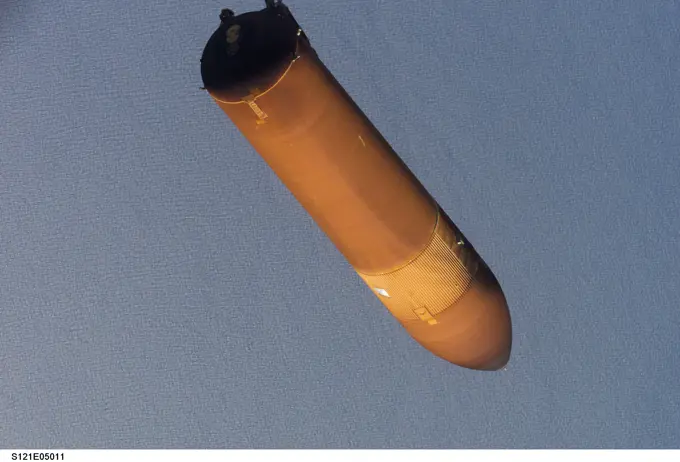
STS121-E-05011 (4 July 2006)-- This picture of the STS-121 external tankwas taken with a digital still camera by an astronaut only seconds after separation from the Space Shuttle Discovery on launch day.  Engineers, managers and flight controllers have carefully studied this image and other frames from this series as well as a number of pictures showing the falling ET as photographed from umbilical well cameras.
6145-44491009
NASAs SpaceX Crew-4 Splashdown. The SpaceX Crew Dragon Freedom spacecraft is seen as it lands with NASA astronauts Kjell Lindgren, Robert Hines, Jessica Watkins, and ESA (European Space Agency) astronaut Samantha Cristoforetti aboard in the Atlantic Ocean off the coast of Jacksonville, Florida, Friday, Oct. 14, 2022. Lindgren, Hines, Watkins, and Cristoforetti are returning after 170 days in space as part of Expeditions 67 and 68 aboard the International Space Station.
6145-44972847
S74-17742 (8 Feb. 1974) --- The Skylab 4 Command Module bobs in an apex-down configuration (stable two) in the calm water of the Pacific Ocean 176 miles southwest of San Diego, California, following a successful splashdown and 84-day mission in Earth orbit.
4389-845
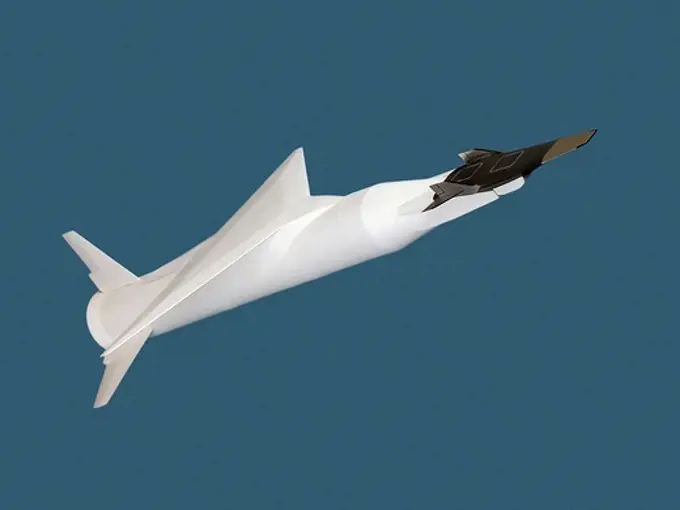
Model of X-43A 'Hyper-X' and Pegasus Launch Vehicle
PREVIOUS
of 1
NEXT
2401 S. Ervay, Suite 206
Dallas, Texas 75215
United States
Browse
CategoriesGalleriesFree Research
For Creators
License Your ContentSuperStock For StudentsFrame of Mind BlogContributor PortalNew Image SpotlightLicense AI Imagery
Resources
About UsLicensingTerms & ConditionsAPI AccessPrivacyPricing
Contact
+1 866 236 0087help@superstock.com Contact form
©2026 SuperStock. All Rights Reserved. -A
This site is protected by reCAPTCHA and Google Privacy Policy and Terms of Service apply.