International Space Station Views

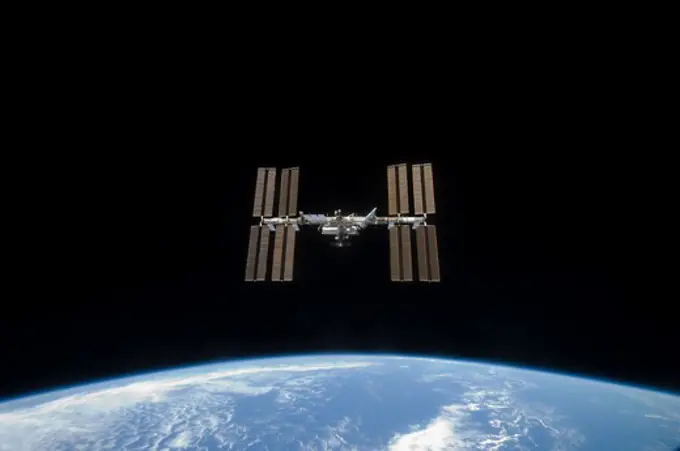
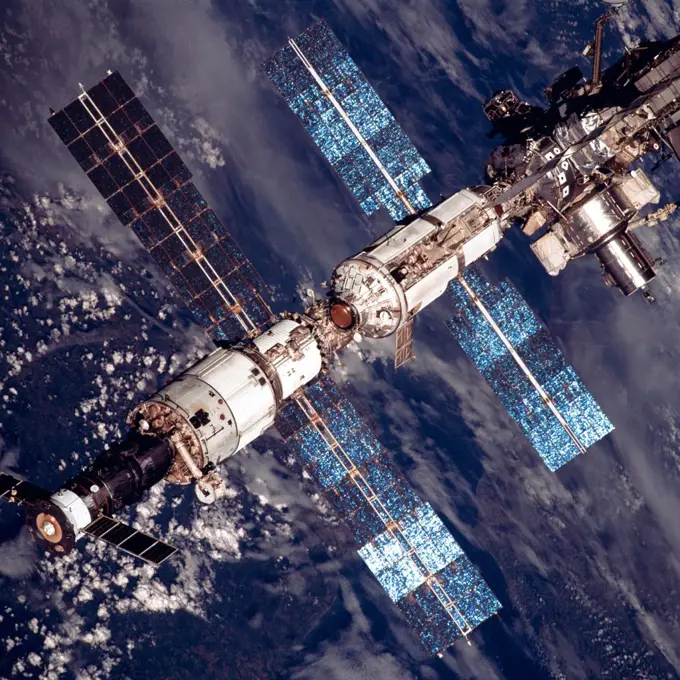
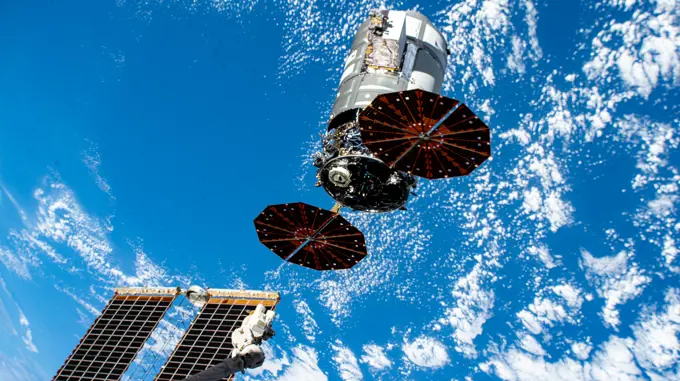
Images capturing the International Space Station from different angles in space, highlighting its structure against the backdrop of Earth and space.

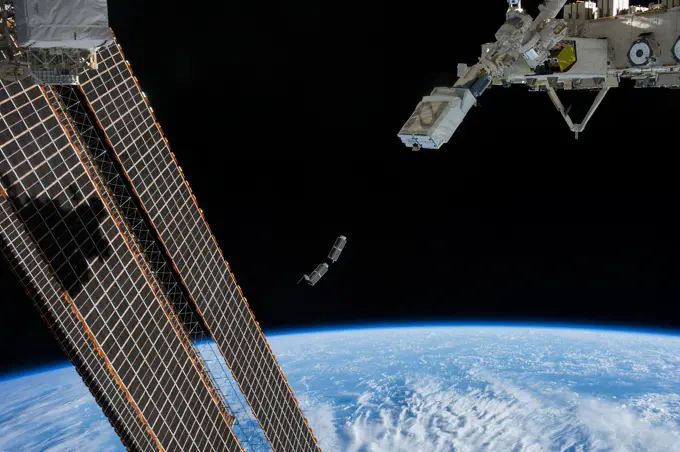
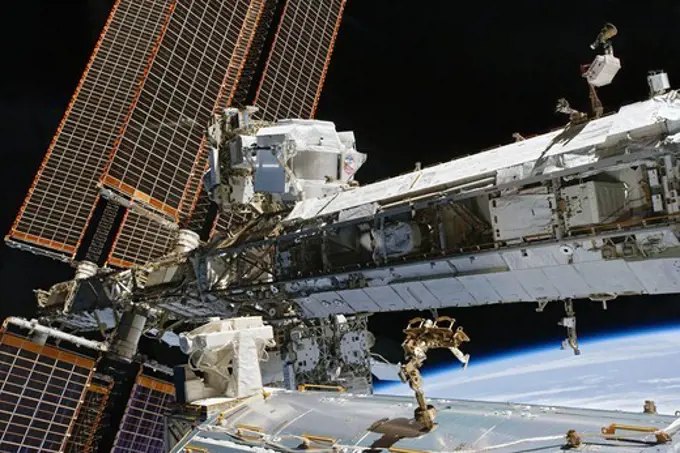
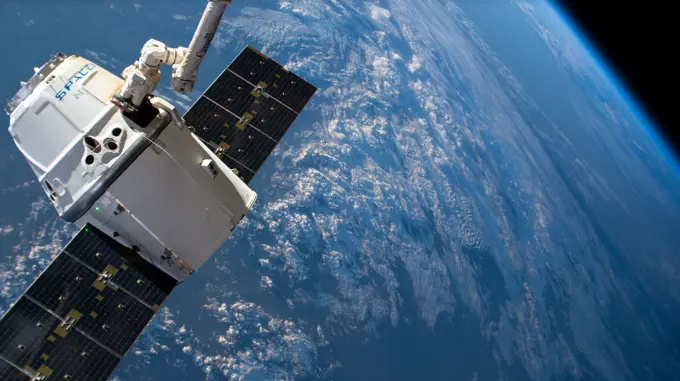
At right, the Canadarm2 robotic arm maneuvers the Earth Surface Mineral Dust Source Investigation, or EMIT, after retrieving it from the trunk of the SpaceX Dragon cargo craft. EMIT was installed on ExPRESS Logistics Carrier-1 (top center) on the port side of the International Space Station's truss structure. The station's main solar arrays are also seen extending from the port truss segment. EMIT is a mineral dust source observation experiment that explores the Earths mineral dust cycle.
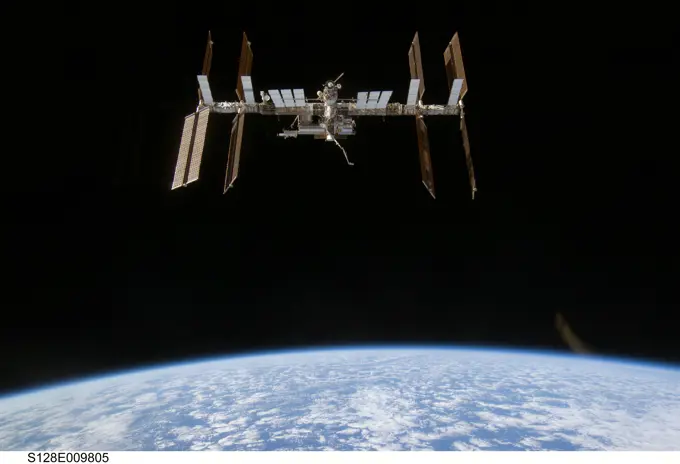
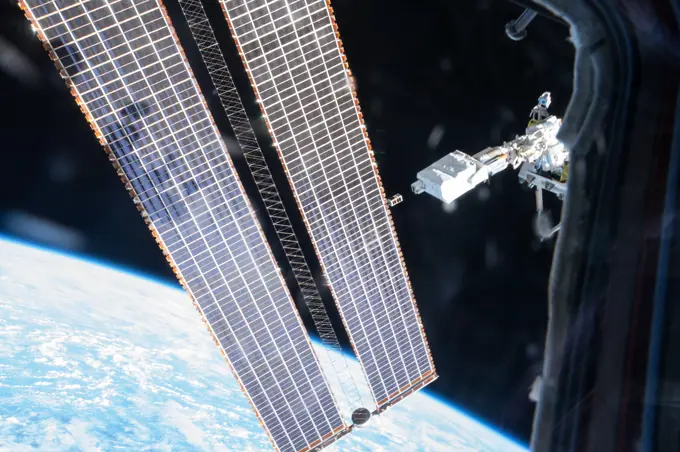
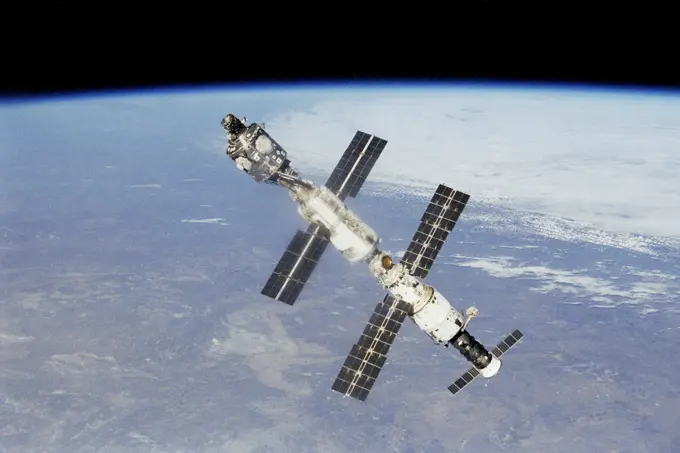
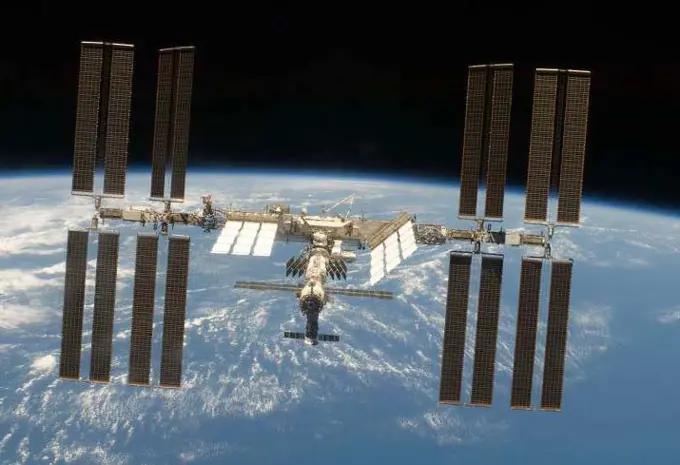
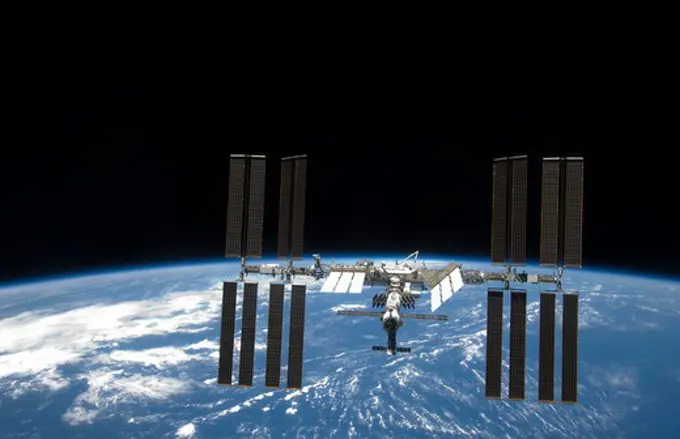
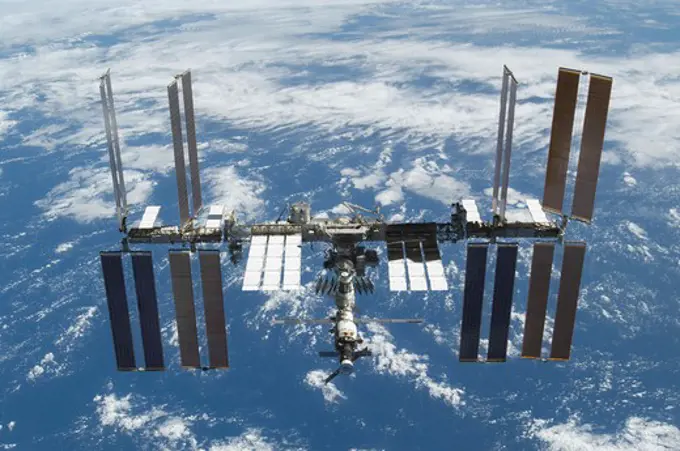
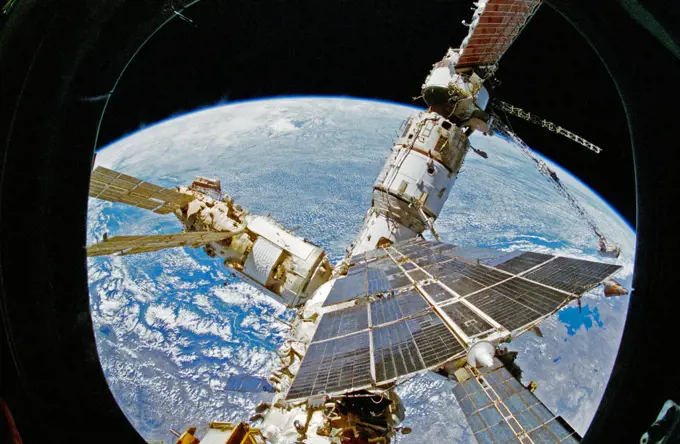
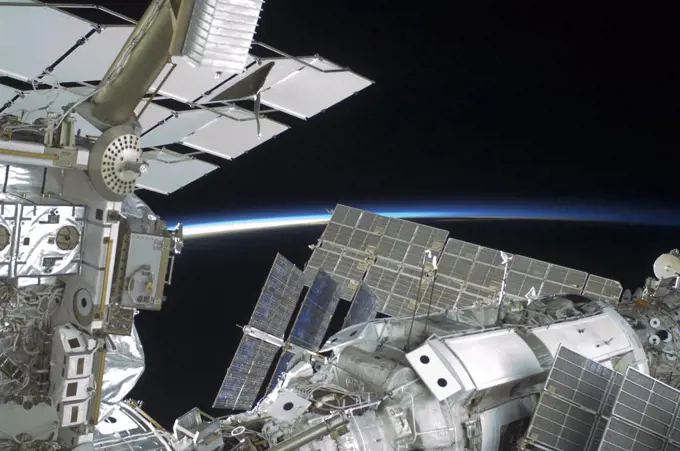
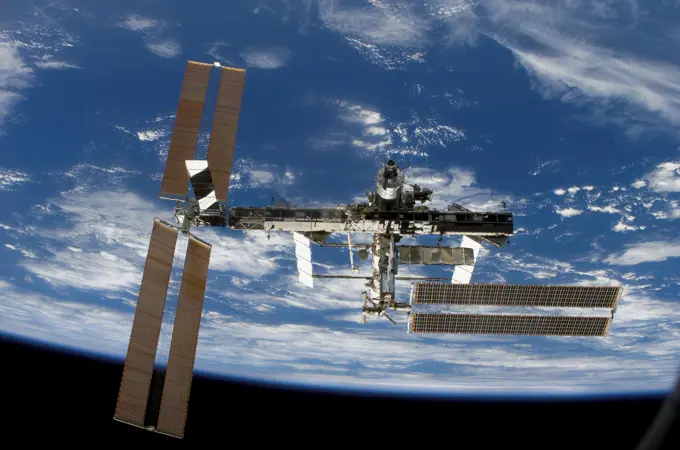
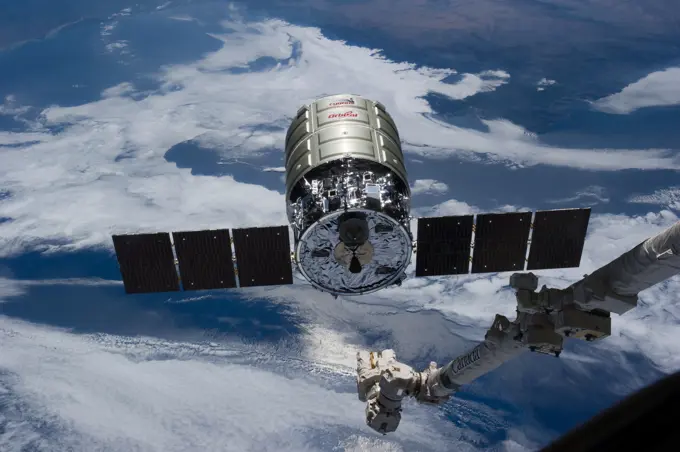
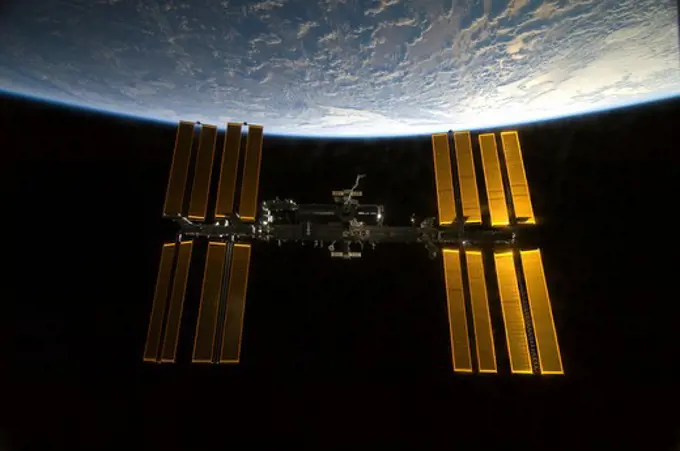
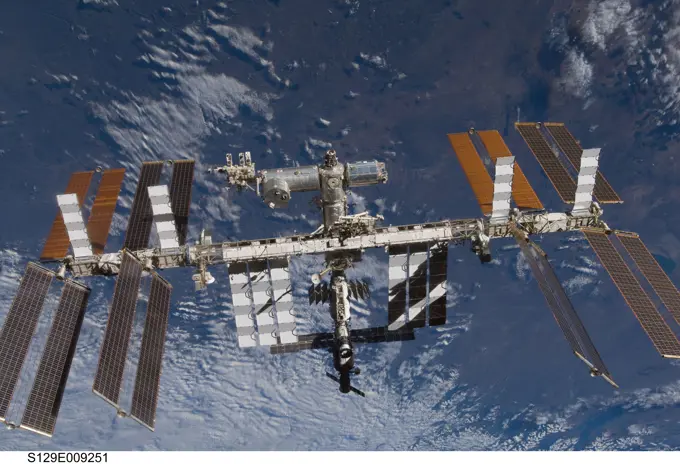
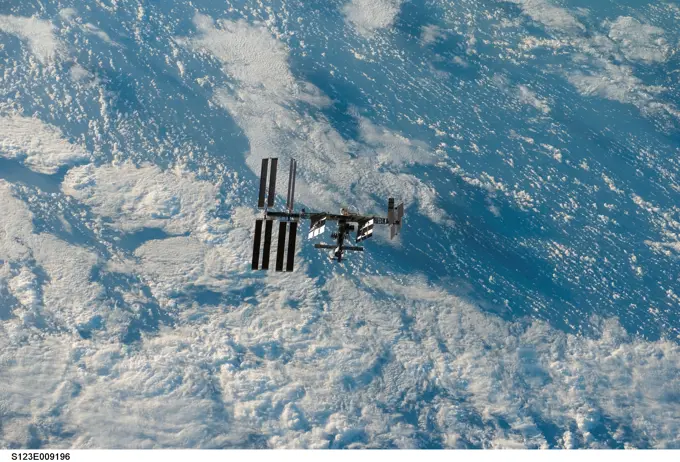
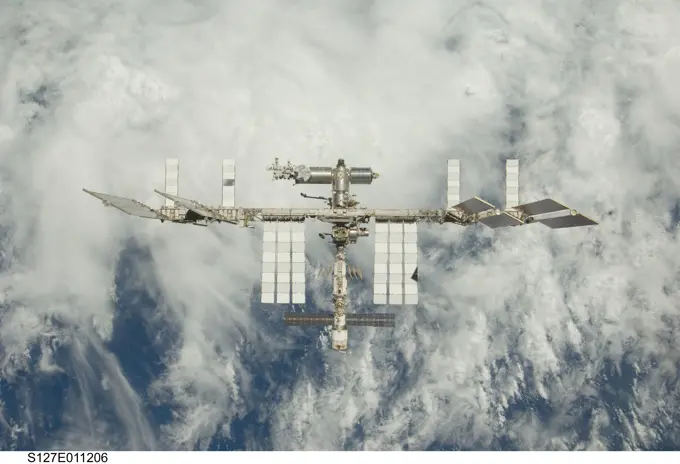
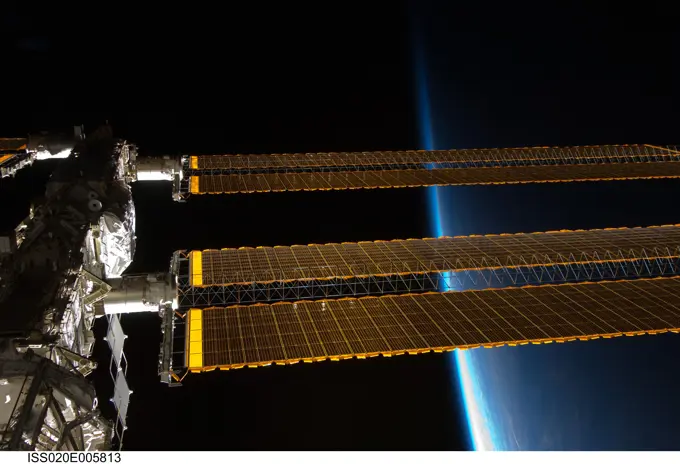
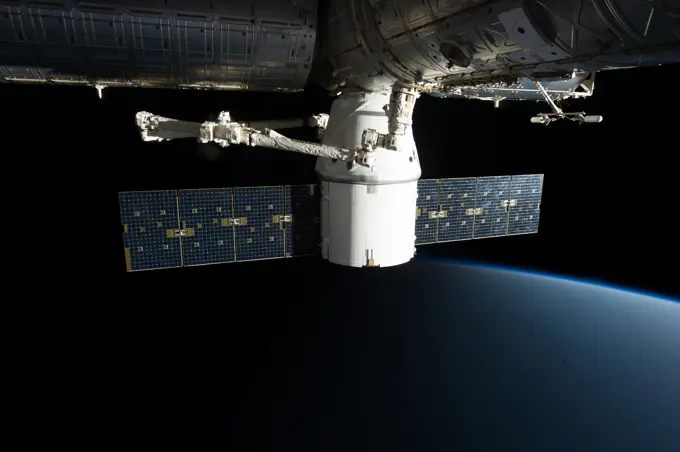
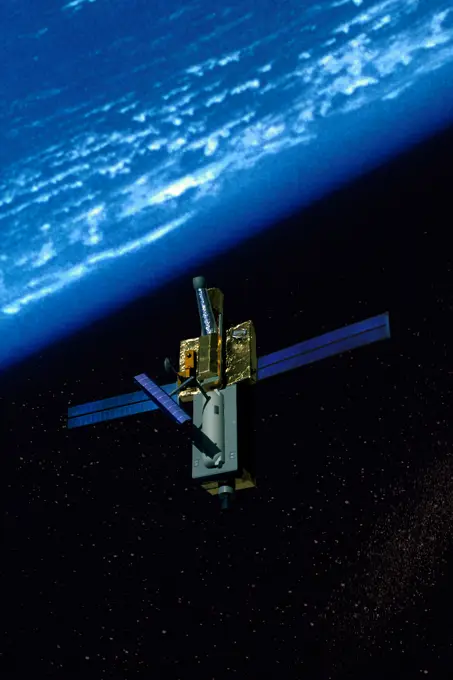
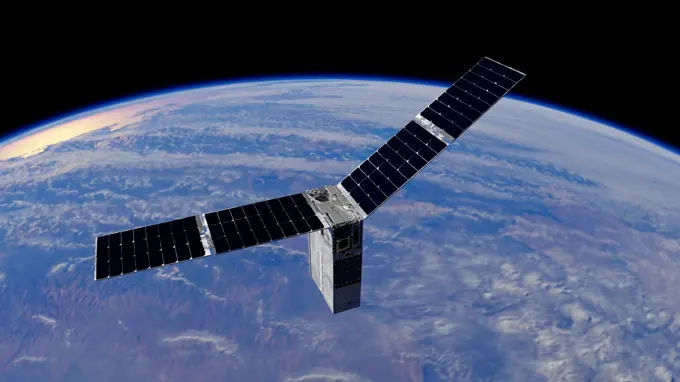
Back dropped by the blackness of space and Earth's horizon is the International Space Station (ISS) as seen from Space Shuttle Discovery as the two spacecraft begin their relative separation. The latest configuration of the ISS includes the Italian-built U.S. Node 2, named Harmony, and the P6 truss segment installed over 11 days of cooperative work onboard the shuttle and station by the STS-120 and Expedition 16 crews. Undocking of the two spacecraft occurred at 4 32 a.m. (CST) on Nov. 5, 2007.ISS038-E-056389 (25 Feb. 2014) --- A set of NanoRacks CubeSats is photographed by an Expedition 38 crew member after the deployment by the NanoRacks Launcher attached to the end of the Japanese robotic arm. The CubeSats program contains a variety of experiments such as Earth observations and advanced electronics testing. International Space Station solar array panels are at left. Earth's horizon and the blackness of space provide the backdrop for the scene.At right, the Canadarm2 robotic arm maneuvers the Earth Surface Mineral Dust Source Investigation, or EMIT, after retrieving it from the trunk of the SpaceX Dragon cargo craft. EMIT was installed on ExPRESS Logistics Carrier-1 (top center) on the port side of the International Space Station's truss structure. The station's main solar arrays are also seen extending from the port truss segment. EMIT is a mineral dust source observation experiment that explores the Earths mineral dust cycle.S128-E-009805 (8 Sept. 2009) --- Backdropped by Earths horizon and the blackness of space, the International Space Station is seen from Space Shuttle Discovery as the two spacecraft begin their relative separation. Earlier the STS-128 and Expedition 20 crew concluded nine days of cooperative work onboard the shuttle and station. Undocking of the two spacecraft occurred at 2:26 p.m. (CDT) on Sept. 8, 2009.S129-E-009323 (25 Nov.2009) --- This is one of a series of images featuring the International Space Station photographed soon after the space shuttle Atlantis and the station began their post-undocking relative separation. Undocking of the two spacecraft occurred at 3:53 a.m. (CST) on Nov. 25, 2009. Some scenes in the series show parts of the Mediterranean Sea and Africa and Spain in the background.iss050e017076 (12/19/2016) --- A view after Japanese Experiment Module Remote Manipulator System (JEMRMS) Small Satellite Deployment called Space Tethered Autonomous Robotic satellite (STARS-C).STS106-375-018 (8-20 September 2000) --- The International Space Station as photographed against land mass and clouds on Earth during a fly-around by the Space Shuttle Atlantis.S130-E-012125 (19 Feb. 2010) --- Backdropped by a blue and white part of Earth, the International Space Station is featured in this image photographed by an STS-130 crew member on space shuttle Endeavour after the station and shuttle began their post-undocking relative separation. Undocking of the two spacecraft occurred at 7:54 p.m. (EST) on Feb. 19, 2010.S133-E-010426 (7 March 2011) --- The International Space Station is featured in this image photographed by an STS-133 crew member on space shuttle Discovery after the station and shuttle began their post-undocking relative separation. Undocking of the two spacecraft occurred at 7 a.m. (EST) on March 7, 2011. Discovery spent eight days, 16 hours, and 46 minutes attached to the orbiting laboratory.View of the International Space StationISS008-E-22399 (28 February 2004) --- This view, taken during Expedition 8 extravehicular activity (EVA), shows the Strela Cargo Boom at left; and the functional cargo block (FGB) or Zarya; Pressurized Mating Adapter (PMA-3); Destiny laboratory and Canadarm2, or Space Station Remote Manipulator System (SSRMS), at right, backdropped against Earth’s horizon and the blackness of space.iss052e056245 (Aug. 21, 2017) --- As millions of people across the United States experienced a total eclipse as the umbra, or moons shadow passed over them, only six people witnessed the umbra from space. Viewing the eclipse from orbit were NASAs Randy Bresnik, Jack Fischer and Peggy Whitson, ESA (European Space Agencys) Paolo Nespoli, and Roscosmos Commander Fyodor Yurchikhin and Sergey Ryazanskiy. The space station crossed the path of the eclipse three times as it orbited above the continental United States at an altitude of 250 miles.November 5, 2007 - Backdropped by the blackness of space and Earth's horizon, the International Space Station is seen from Space Shuttle Discovery as the two spacecraft begin their relative separation. Earlier the STS-120 and Expedition 16 crews concluded 11 days of cooperative work onboard the shuttle and station. Undocking of the two spacecraft occurred at 4:32 a.m. (CST) on November 5, 2007.iss056e201235 (Oct. 4, 2018) --- The International Space Station photographed by Expedition 56 crew members from a Soyuz spacecraft after undocking. NASA astronauts Andrew Feustel and Ricky Arnold and Roscosmos cosmonaut Oleg Artemyev executed a fly around of the orbiting laboratory to take pictures of the station before returning home after spending 197 days in space. The station will celebrate the 20th anniversary of the launch of the first element Zarya in November 2018.S130-E-012136 (19 Feb. 2010) --- Backdropped by a blue and white part of Earth, the International Space Station is featured in this image photographed by an STS-130 crew member on space shuttle Endeavour after the station and shuttle began their post-undocking relative separation. Undocking of the two spacecraft occurred at 7:54 p.m. (EST) on Feb. 19, 2010.iss059e025207 (April 17, 2019) --- The International Space Station crosses the terminator, the line that separates night and day on Earth, as it orbits 254 miles above the Gulf of Guinea on Africa's mid-western coast. Portions of the orbital complex can be seen including a pair of high-pressure gas tanks, solar arrays and the Soyuz MS-12 crew ship docked to the Rassvet module.The International Space Station backdropped by Earth's horizonAlpha Magnetic Spectrometer-2ISS022-E-062767 (11 Feb. 2010) --- In the grasp of the stations Canadarm2, the Tranquility module is transferred from its stowage position in space shuttle Endeavours (STS-130) payload bay to position it on the port side of the Unity node of the International Space Station. Tranquility was locked in place with 16 remotely-controlled bolts. Earths horizon and the blackness of space provide the backdrop for the scene.View of Soyuz Spacecraft and Progress Spacecrafts. Photo was taken during Expedition 34.April 8, 2006 - Backdropped by a blanket of clouds, the Soyuz TMA-7 spacecraft departs from the International Space Station. ISS040-E-094422 (15 Aug. 2014) --- The International Space Stations Canadarm2 unberths the Orbital Sciences' Cygnus commercial cargo craft after a month visiting the orbital outpost. European Space Agency astronaut Alexander Gerst and NASA astronaut Reid Wiseman, both Expedition 40 flight engineers, were at the controls of the robotics workstation in the Cupola removing Cygnus from the Harmony node then safely releasing at 6:40 a.m. (EDT) Aug. 15, 2014. A cloud-covered part of Earth and the blackness of space provide the backdrop for the scene.iss054e000136 (Dec. 14, 2017) --- The Soyuz MS-05 spacecraft that brought home Expedition 53 crew members Randy Bresnik of NASA, Sergey Ryazanskiy of Roscosmos and Paolo Nespoli of the European Space Agency, is pictured moments before undocking from the Rassvet module.S117-E-08003 (19 June 2007) --- Backdropped by the blackness of space and Earth's horizon, the International Space Station moves away from the Space Shuttle Atlantis. Earlier the STS-117 and Expedition 15 crews concluded about eight days of cooperative work onboard the shuttle and station. Undocking of the two spacecraft occurred at 9:42 a.m. (CDT) on June 19, 2007. Astronaut Lee Archambault, STS-117 pilot, was at the controls for the departure and fly-around, which gave Atlantis' crew a look at the station's new expanded configuration.ISS040-E-123166 (2 Sept. 2014) --- Various solar array panels, the Rassvet Mini-Research Module 1 (MRM1) (right) and the Tranquility node with the Cupola (center) are featured in this image photographed by an Expedition 40 crew member aboard the International Space Station. Earths horizon and the blackness of space provide the backdrop for the scene.The International Space Station backdropped by Earth's horizonSTS110-E-6058 (17 April 2002) --- This is one a series of digital still images of the International Space Station (ISS) recorded by the STS-110 crew members on board the Space Shuttle Atlantis following the undocking of the two spacecraft some 247 statute miles above the North Atlantic. Atlantis pulled away from the complex at 1:31 p.m. (CDT).    After more than a week of joint operations between the shuttle and station crews, astronaut  Stephen N. Frick, pilot,  backed Atlantis away to a distance of about 400 feet in front of the station, where he began a 1 1/4 lap flyaround of the ISS, newly equipped with the 27,000 pound S0 (S-zero) truss, visible in this series of images.  S0 is the first segment of a truss structure which will ultimately  expand the station to the length of a football field.S130-E-012100 (19 Feb. 2010) --- Backdropped by a blue and white part of Earth, the International Space Station is featured in this image photographed by an STS-130 crew member on space shuttle Endeavour after the station and shuttle began their post-undocking relative separation. Undocking of the two spacecraft occurred at 7:54 p.m. (EST) on Feb. 19, 2010.S122-E-011112 (18 Feb. 2008) --- Backdropped by Earth's horizon and the blackness of space, the International Space Station is seen from Space Shuttle Atlantis as the two spacecraft begin their relative separation. Earlier the STS-122 and Expedition 16 crews concluded almost nine days of cooperative work onboard the shuttle and station. Undocking of the two spacecraft occurred at 3:24 a.m. (CST) on Feb. 18, 2008.The International Space Station backdropped by Earth's horizonSTS091-707-090 (2-12 June 1998) --- Russia's Mir space station is captured on film as it floats above the blue and white planet Earth during Shuttle-Mir final fly-around.ISS040-E-123162 (2 Sept. 2014) --- A portion of the Russian segment of the International Space Station is featured in this image photographed by an Expedition 40 crew member onboard the station. A blue and white part of Earth and the blackness of space provide the backdrop for the scene.ISS036-E-047951 (7 Sept. 2013) --- Backdropped by a blue and white part of Earth and the blackness of space, International Space Station solar array panels are featured in this image photographed by an Expedition 36 crew member aboard the station.Earth Observations taken by Expedition 34 crewmember.International Space Station in orbit above the Earth.iss054e042055 (Feb. 11, 2018) --- Russia's Soyuz MS-07 crew ship (foreground) and Progress 68 cargo craft are seen docked to the Earth-facing ports of the International Space Station's Russian segment. The Soyuz is docked to the Rassvet module and the Progress is attached to the Pirs docking compartment. The space station was orbiting 253 miles above the northern United States when this photograph was taken by an Expedition 54 crew member.(15-24 May 1997) --- As photographed from the Space Shuttle Atlantis, this 70mm scene provides a view of several of the components of Russia's Mir Space Station while the two spacecraft were docked.  Forming the backdrop is an Andean winter scene.  Lake Titicaca is clearly visible beneath the solar array panel at far right.. S130-E-012142 (19 Feb. 2010) --- Backdropped by Earths horizon and the blackness of space, the International Space Station is featured in this image photographed by an STS-130 crew member on space shuttle Endeavour after the station and shuttle began their post-undocking relative separation. Undocking of the two spacecraft occurred at 7:54 p.m. (EST) on Feb. 19, 2010.iss063e017103 (May 25, 2020) --- The H-II Transfer Vehicle-9 (HTV-9) from JAXA (Japan Aerospace Exploration Agency) is pictured moments before the Canadarm2 robotic arm (right) captured the resupply ship. Expedition 63 Commander Chris Cassidy was at the robotics controls ready to command the Canadarm2 to reach out and grapple the HTV-9 that was carrying over four tons of food, supplies and experiments to replenish the International Space Station crew.iss056e094392 (July 10, 2018) --- The Northrop Grumman (formerly Orbital ATK) Cygnus resupply ship and its UltraFlex solar arrays figure prominently in this photograph of several International Space Station components with Earth in the background. At left are a set of basketball court-sized solar arrays. In the foreground is the Cupola and a portion of the Tranquility module. At right is the Soyuz MS-09 spacecraft docked to the Rassvet module.ISS034-E-0605712 (3 March 2013) --- This is one of a series of photos taken by the Expedition 34 crew members aboard the International Space Station during the March 3 approach, capture and docking of the SpaceX Dragon. Thus the spacecraft begins its scheduled three-week-long stay at the orbiting space station.S100-E-5958 (29 April 2001) --- Backdropped against the blue and white Earth and sporting a readily visible new addition in the form of the Canadarm2 or space station robotic arm, the International Space Station (ISS) was photographed following separation from the Space Shuttle Endeavour.  With six astronauts and a Rosaviakosmos cosmonaut aboard the shuttle, the spacecraft performed a fly-around survey of the station, which was inhabited by two astronauts and a Russian cosmonaut. The image was recorded with a digital still camera.JSC2006-E-25645 (October 2006) --- Computer-generated scene showing a high-angle wide view (starboard-forward) of the International Space Station, after assembly work is completed.ISS041-E-046450 (29 Sept. 2014) --- An Expedition 41 crew member aboard the International Space Station photographed this view of the SpaceX Dragon cargo ship docked to the nadir port of the Harmony node as the station's Canadarm2 and the Special Purpose Dexterous Manipulator prepare to remove external cargo from Dragon.Earth Observation taken during a day pass by the Expedition 40 crew aboard the International Space Station (ISS).S88-E-5060 (12-08-98) --- Astronaut James H. Newman is seen near the Unity module during late phases of the first of three scheduled spacewalks on STS-88. At the end of the extravehicular activity (EVA), astronauts Newman and Jerry L. Ross, both mission specialists, were  successful in mating 40 cables and connectors running 76 feet from the Zarya control module to Unity, with the 35-ton complex towering over Endeavour's cargo bay. The spacewalk last 7 hours and 21 minutes. This photo was taken with an electronic still camera (ESC) at 03:50:28 GMT, Dec. 8.S134-E-010137 (29 May 2011) --- The International Space Station is featured in this image photographed by an STS-134 crew member on the space shuttle Endeavour after the station and shuttle began their post-undocking relative separation. Undocking of the two spacecraft occurred at 11:55 p.m. (EDT) on May 29, 2011. Endeavour spent 11 days, 17 hours and 41 minutes attached to the orbiting laboratory.The International Space station in orbit over the earthS131-E-011050 (17 April 2010) --- Backdropped by Earths horizon and the blackness of space, the International Space Station is featured in this image photographed by an STS-131 crew member on space shuttle Discovery after the station and shuttle began their post-undocking relative separation. Undocking of the two spacecraft occurred at 7:52 a.m. (CDT) on April 17, 2010.This image of the International Space Station (ISS) was photographed by one of the crewmembers of the STS-112 mission following separation from the Space Shuttle Orbiter Atlantis as the orbiter pulled away from the ISS. The newly added S1 truss is visible in the center frame. The primary payloads of this mission, International Space Station Assembly Mission 9A, were the Integrated Truss Assembly S-1 (S-One), the Starboard Side Thermal Radiator Truss,and the Crew Equipment Translation Aid (CETA) cart to the ISS. The S1 truss provides structural support for the orbiting research facility's radiator panels, which use ammonia to cool the Station's complex power system. The S1 truss was attached to the S0 (S Zero) truss, which was launched on April 8, 2002 aboard the STS-110, and flows 637 pounds of anhydrous ammonia through three heat rejection radiators. The truss is 45-feet long, 15-feet wide, 10-feet tall, and weighs approximately 32,000 pounds. The CETA cart was attached to the Mobil Tiss056e201225 (Oct. 4, 2018) --- The International Space Station photographed by Expedition 56 crew members from a Soyuz spacecraft after undocking. NASA astronauts Andrew Feustel and Ricky Arnold and Roscosmos cosmonaut Oleg Artemyev executed a fly around of the orbiting laboratory to take pictures of the station before returning home after spending 197 days in space. The station will celebrate the 20th anniversary of the launch of the first element Zarya in November 2018.September 3, 2009 - A portion of the International Space Station is featured in this image photographed by a space walking astronaut during the STS-128 mission. The blackness of space and the thin line of Earth's atmosphere provide the backdrop for the scene.Spacecrafts in space, Space Shuttle Atlantis, Soyuz Spacecraft, STS-115 Mission, September 17, 2006S116-E-07106 (19 Dec. 2006) --- Backdropped by the blackness of space and Earth's horizon, the International Space Station moves away from Space Shuttle Discovery. Earlier the STS-116 and Expedition 14 crews concluded eight days of cooperative work onboard the shuttle and station. Undocking of the two spacecraft occurred at 4:10 p.m. (CST) on Dec. 19, 2006. Astronaut William A. (Bill) Oefelein, STS-116 pilot, was at the controls for the fly-around, which gave Discovery's crew a look at its handiwork, a new P5 spacer truss segment and a fully retracted P6 solar array wing. During their stay on orbital outpost, the combined crew installed the newest piece of the station's backbone and completely rewired the power grid over the course of four spacewalks.S130-E-012062 (19 Feb. 2010) --- Backdropped by rugged Earth terrain, the International Space Station is featured in this image photographed by an STS-130 crew member on space shuttle Endeavour after the station and shuttle began their post-undocking relative separation. Undocking of the two spacecraft occurred at 7:54 p.m. (EST) on Feb. 19, 2010.ISS013-E-10265 (17 April 2006) --- Backdropped by Earth’s horizon and the blackness of space, the Canadarm2 is featured in this image photographed by an Expedition 13 crewmember on the International Space Station. A portion of a station solar array is also visible.ISS017-E-011315 (15 July 2008) --- Russian Federal Space Agency cosmonaut Sergei Volkov, Expedition 17 commander, participates in a session of extravehicular activity (EVA) as construction and maintenance continue on the International Space Station. During the five-hour, 54-minute spacewalk, Volkov and cosmonaut Oleg Kononenko (out of frame), flight engineer, continued to outfit the station's exterior, including the installation of a docking target on the Zvezda Service Module.ISS041-E-067002 (7 Oct. 2014) --- NASA astronaut Reid Wiseman, Expedition 41 flight engineer, participates in a session of extravehicular activity (EVA) as work continues on the International Space Station. During the six-hour, 13-minute spacewalk, Wiseman and European Space Agency astronaut Alexander Gerst (out of frame), flight engineer, worked outside the space station's Quest airlock relocating a failed cooling pump to external stowage and installing gear that provides back up power to external robotics equipment.ISS038-E-015406 (12 Dec. 2013) --- The Canadarm2 and its end effector are featured in this image photographed by an Expedition 38 crew member from a window in the Cupola of the International Space Station. A blue and white part of Earth provides the backdrop for the scene.S124-E-005522 (2 June 2008) --- The International Space Station is featured in this image photographed by an STS-124 crewmember as Space Shuttle Discovery approaches the station during rendezvous and docking activities on flight day three. Docking occurred at 2:03 p.m. (EDT) on June 2, 2008.Space shuttle docked at the International Space Station.ISS040-E-007073 (3 June 2014) --- Some 228 nautical miles above the home planet, one of the Expedition 40 crew members aboard the International Space Station photographed this view of a sun-kissed solar array wing and a photovoltaic radiator (top) on the orbital outpost on June 3, 2014.The sun's glint beams off the Coral Sea northeast of Australia as the International Space Station orbited 264 miles above. Pictured in the right foreground, are a pair of the station's main solar arrays and a radiator.S130-E-006558 (9 Feb. 2010) --- Backdropped by Earths horizon and the blackness of space, the International Space Station is featured in this image photographed by an STS-130 crew member as space shuttle Endeavour and the station approach each other during rendezvous and docking activities. Docking occurred at 11:06 p.m. (CST) on Feb. 9, 2010, delivering the Tranquility node and its Cupola.ISS040-E-069162 (16 July 2014) --- Operated by an Expedition 40 crew member inside the stations Cupola, the Canadarm2 moves toward the Orbital Sciences Cygnus cargo craft as it approaches the International Space Station. The two spacecraft converged at 6:36 a.m. (EDT) on July 16, 2014. A blue and white part of Earth provides the backdrop for the scene.. GMT126_12_50_Frank Rubio_1039_Dragon RelocateS119-E-008577 (25 March 2009) --- Backdropped by a blue and white Earth, the International Space Station is seen from Space Shuttle Discovery as the two spacecraft begin their relative separation. Earlier the STS-119 and Expedition 18 crews concluded 9 days, 20 hours and 10 minutes of cooperative work onboard the shuttle and station. Undocking of the two spacecraft occurred at 2:53 p.m. (CDT) on March 25, 2009.ISS040-E-015756 (19 June 2014) --- Russian cosmonauts Alexander Skvortsov (red stripes) and Oleg Artemyev, both Expedition 40 flight engineers, participate in a session of extravehicular activity (EVA) as work continues on the International Space Station. During the seven-hour, 23-minute spacewalk Skvortsov and Artemyev completed installation and experiment tasks outside the station's Russian segment. The Progress 55 spacecraft, currently docked to the Pirs Docking Compartment, is at left.iss059e088875 (June 3, 2019) --- The SpaceX Dragon cargo craft on its 17th contracted mission to resupply mission to the International Space Station is pictured moments before being released from the Canadarm2 robotic arm. The orbiting lab was flying 261 miles above central Asia.International Space Station  backdropped against Earth's horizon.S129-E-009251 (25 Nov. 2009) ---  The International Space Station is featured in this image photographed by an STS-129 crew member on Atlantis soon after the station and shuttle began their post-undocking relative separation. Undocking of the two spacecraft occurred at 3:53 a.m. (CST) on Nov. 25, 2009.ISS041-E-035039 (25 Sept. 2014) --- The Soyuz TMA-14M spacecraft approaches the International Space Station, carrying Expedition 41 Soyuz Commander Alexander Samokutyaev, NASA Flight Engineer Barry Wilmore and Russian Flight Engineer Elena Serova. The Soyuz safely ferried the trio to the stations Poisk Mini-Research Module 2 (MRM2) despite a port solar array that wouldnt deploy until after its docking on Sept. 25, 2014.S123-E-009196 (24 March 2008) --- Backdropped by a blue and white part of Earth, the International Space Station is seen from Space Shuttle Endeavour as the two spacecraft begin their relative separation. Earlier the STS-123 and Expedition 16 crews concluded 12 days of cooperative work onboard the shuttle and station. Undocking of the two spacecraft occurred at 7:25 p.m. (CDT) on March 24, 2008.S133-E-010413 (7 March 2011) --- The International Space Station is featured in this image photographed by an STS-133 crew member on space shuttle Discovery after the station and shuttle began their post-undocking relative separation. Undocking of the two spacecraft occurred at 7 a.m. (EST) on March 7, 2011. Discovery spent eight days, 16 hours, and 46 minutes attached to the orbiting laboratory.S127-E-011206 (28 July 2009) --- Backdropped by a blue and white Earth, the International Space Station is seen from Space Shuttle Endeavour as the two spacecraft begin their relative separation. Earlier the STS-127 and Expedition 20 crews concluded 11 days of cooperative work onboard the shuttle and station. Undocking of the two spacecraft occurred at 12:26 p.m. (CDT) on July 28, 2009.iss064e0063416(Nov. 21, 2020) --- Earth's limb, or horizon, is pictured from the International Space Station as it orbited above the Pacific Ocean off the coast of Chile. Framing the top of the photograph, is a portion of Japan's Kibo laboratory module with its Exposed Facility that houses external experiments to understand the effects of space radiation and extreme temperatures on a variety of materials.ISS020-E-005813 (31 May 2009) --- Backdropped by Earth's horizon and the blackness of space, a portion of the International Space Station is featured in this image photographed by an Expedition 20 crew member aboard the station.ISS027-E-036801 (23 May 2011) --- This image of the International Space Station and the docked space shuttle Endeavour, flying at an altitude of approximately 220 miles, was taken by Expedition 27 crew member Paolo Nespoli from the Soyuz TMA-20 following its undocking on May 23, 2011 (USA time). The pictures taken by Nespoli are the first taken of a shuttle docked to the International Space Station from the perspective of a Russian Soyuz spacecraft. Onboard the Soyuz were Russian cosmonaut and Expedition 27 commander Dmitry Kondratyev; Nespoli, a European Space Agency astronaut; and NASA astronaut Cady Coleman. Coleman and Nespoli were both flight engineers. The three landed in Kazakhstan later that day, completing 159 days in space.This image of the International Space Station in orbit was taken from the Space Shuttle Endeavour prior to docking. Most of the Station's components are clearly visible in this photograph. They are the Node 1 or Unity Module docked with the Functional Cargo Block or Zarya (top) that is linked to the Zvezda Service Module. The Soyuz spacecraft is at the bottom.iss070e007599 (Oct. 20, 2023) --- The Canadarm2 robotic arm extends from the International Space Station as it orbited 261 miles above Turkey. Below, the Sinai Peninsula, the Red Sea, and the Nile River Delta are pictured leading toward the Mediterranean Sea at bottom.ISS038-E-028044 (12 Jan. 2014) --- The Canadarm2 moves toward the Orbital Sciences Corp. Cygnus commercial cargo craft as it approaches the International Space Station on Jan. 12, 2014. A colorful part of Earth provides the backdrop for the scene.ISS031-E-071547 (25 May 2012) --- The SpaceX Dragon commercial cargo craft is berthed to the Earth-facing side of the International Space Stations Harmony node. Expedition 31 Flight Engineers Don Pettit and Andre Kuipers grappled Dragon at 9:56 a.m. (EDT) with the Canadarm2 robotic arm and used it to berth Dragon to the at 12:02 p.m. May 25, 2012. Dragon became the first commercially developed space vehicle to be launched to the station to join Russian, European and Japanese resupply craft that service the complex while restoring a U.S. capability to deliver cargo to the orbital laboratory. Dragon is scheduled to spend about a week docked with the station before returning to Earth on May 31 for retrieval.ISS026-E-029249 (24 Feb. 2011) --- Backdropped by the blackness of space and Earths horizon, the European Space Agency's "Johannes Kepler" Automated Transfer Vehicle-2 (ATV-2) docks to the aft end of the International Space Station's Zvezda Service Module. Docking of the two spacecraft occurred at 10:59 a.m. (EST) on Feb. 24, 2011. A crescent moon is visible at center right.STS035-604-058  (2-10 Dec 1990) --- The various components of the Astro-1 payload are seen backdropped against the blue and white Earth in this scene photographed through Columbia's aft flight deck windows.  Parts of the Hopkins Ultraviolet Telescope (HUT), Ultraviolet Imaging Telescope (UIT) and the Wisconsin Ultraviolet Photopolarimetry Experiment (WUPPE) are visible on the Spacelab pallet in the foreground.  The Broad Band X-ray Telescope (BBXRT) is behind this pallet and is not visible in this scene.  The smaller cylinder in the foreground is the "Igloo," which is a pressurized container housing the Command and Data Management System, which interfaces with the in-cabin controllers to control the Instrument Pointing System (IPS) and the telescopes.  The photograph was made with a handheld Rolleiflex camera aimed through Columbia's aft flight deck windows.ISS034-E-060657 (3 March 2013) --- This is one of a series of photos taken by the Expedition 34 crew members aboard the International Space Station during the March 3 approach, capture and docking of the SpaceX Dragon. Thus the spacecraft begins its scheduled three-week-long stay at the orbiting space station.ISS020-E-005815 (31 May 2009) --- Backdropped by the thin line of Earth's atmosphere and the blackness of space, a portion of the International Space Station is featured in this image photographed by an Expedition 20 crew member aboard the station.MILITARY RECONNAISSANCE SATELLITE CONCEPT SATELLITES SPY SPYING ORBIT ORBITING EARTHInternational Space Station in 2001. Overhead close-up view of the expanded International Space Station. At lower left a Russian Soyuz capsule is docked.The Soyuz MS-19 crew ship and the Prichal docking module attached to the Nauka multipurpose laboratory module are pictured as the International Space Station orbited into an orbital sunset 260 miles above the Kuril Islands in between the Sea of Okhotsk and the Pacific Ocean.iss052e004998 (June 19, 2017) --- The aurora and the starry night are pictured above Earths atmosphere in this photograph taken from the space stations cupola June 19, 2017.iss070e044150 (Dec. 22, 2023) --- Northrop Grumman's Cygnus space freighter is pictured moments after being released from the Canadarm2 robotic arm. The orbital complex was soaring 259 miles above the Atlantic Ocean near the Canary Islands at the time of this photograph.One of Starlings CubeSats in orbit around the Earth (illustration). NASAs Starling six-month mission will use a team of four CubeSats in low-Earth orbit to test technologies that let spacecraft operate in a synchronized manner without resources from the ground. The technologies will advance capabilities in swarm maneuver planning and execution, communications networking, relative navigation, and autonomous coordination between spacecraft.   NASA/Conceptual Image Lab/Ross WalterS117-E-07315 (13 June 2007) --- Astronauts Patrick Forrester and Steven Swanson (out of frame), both STS-117 mission specialists, participate in the mission's second planned session of extravehicular activity (EVA), as construction resumes on the International Space Station. Among other tasks, Forrester and Swanson removed all of the launch locks holding the 10-foot-wide solar alpha rotary joint in place and began the solar array retraction.S116-E-07153 (19 Dec. 2006) --- Backdropped by the blackness of space and Earth's horizon, the International Space Station moves away from Space Shuttle Discovery. Earlier the STS-116 and Expedition 14 crews concluded eight days of cooperative work onboard the shuttle and station. Undocking of the two spacecraft occurred at 4:10 p.m. (CST) on Dec. 19, 2006. Astronaut William A. (Bill) Oefelein, STS-116 pilot, was at the controls for the fly-around, which gave Discovery's crew a look at its handiwork, a new P5 spacer truss segment and a fully retracted P6 solar array wing. During their stay on orbital outpost, the combined crew installed the newest piece of the station's backbone and completely rewired the power grid over the course of four spacewalks.JSC2006-E-25647 (October 2006) --- Computer-generated scene showing a high-angle wide view (starboard-aft) of the International Space Station, after assembly work is completed.International Space Station in outer space over the planet Earth. Elements of this image furnished by NASA.. International Space Station in outer space over the planet EarthInternational Space Station in outer space over the planet Earth International Space Station in outer space over the planet Earth. Elements of this image furnished by NASA. Copyright: xZoonar.com/StanislavxRishnyakx 14601051GMT003_20_42_Terry Virts_atmosphere colors high beta_131JSC2003-E-64500 (December 2003) - Post 10A aft view of the International Space Station with Shuttle docked to Node 2.International Space Station over the planet earth. Elements of this image furnished by NASA.