Heraldic and Emblematic Prints

Prints featuring coats of arms, allegorical figures, and heraldic symbols, showcasing intricate designs and meanings.
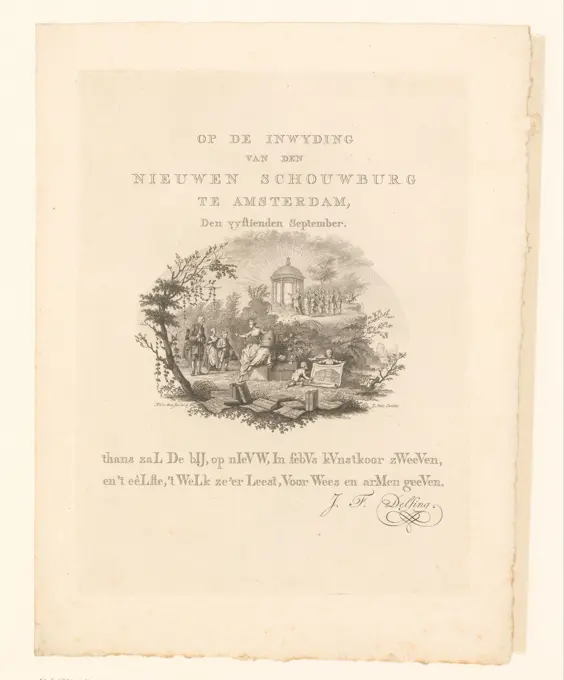
Time verses on the initiation of the Nieuwe Amsterdamse Schouwburg, 1774, 1774 - 1775 print Leaf with an oval allegorical performance and a two -way time -verse on the initiation of the new Amsterdam Schouwburg on the Leidseplein, September 15, 1774. This Stadsschouwburg was built to replace the theater on Keizersgracht and burned down in 1890. In the middle, the personification of the Amsterdam Schouwburg welcomes, with a new Bijenkorf, a man and two children on her lap. She is sitting on a block that says' J.E. De Witte ', Jacob Eduard de Witte, the architect of the Schouwburg. To the right of her two putti that unrolls an image of the new building. In the foreground books and writings with theater works. In the departure Apollo, the Muzen and Pegasus on the Parnassus.  paper etching / engraving Apollo and the Muses, Apollo Musagetes. bee-hive. Pegasus, the winged horse. theatre (building) Schouwburg Leidseplein (1774-1890)
Time verses on the initiation of the Nieuwe Amsterdamse Schouwburg, 1774, 1774 - 1775 print Leaf with an oval allegorical performance and a two -way time -verse on the initiation of the new Amsterdam Schouwburg on the Leidseplein, September 15, 1774. This Stadsschouwburg was built to replace the theater on Keizersgracht and burned down in 1890. In the middle, the personification of the Amsterdam Schouwburg welcomes, with a new Bijenkorf, a man and two children on her lap. She is sitting on a block that says' J.E. De Witte ', Jacob Eduard de Witte, the architect of the Schouwburg. To the right of her two putti that unrolls an image of the new building. In the foreground books and writings with theater works. In the departure Apollo, the Muzen and Pegasus on the Parnassus. paper etching / engraving Apollo and the Muses, Apollo Musagetes. bee-hive. Pegasus, the winged horse. theatre (building) Schouwburg Leidseplein (1774-1890)