Asian Religious Sculptures

A collection of wooden sculptures depicting various deities and figures from Japanese and Korean Buddhism, showcasing intricate designs, vibrant colors, and cultural significance.
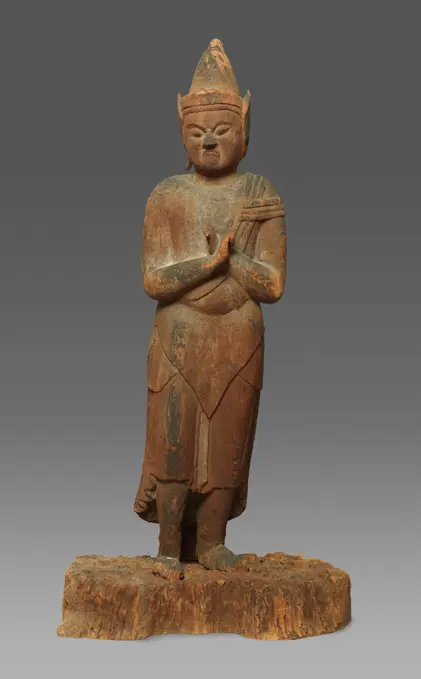
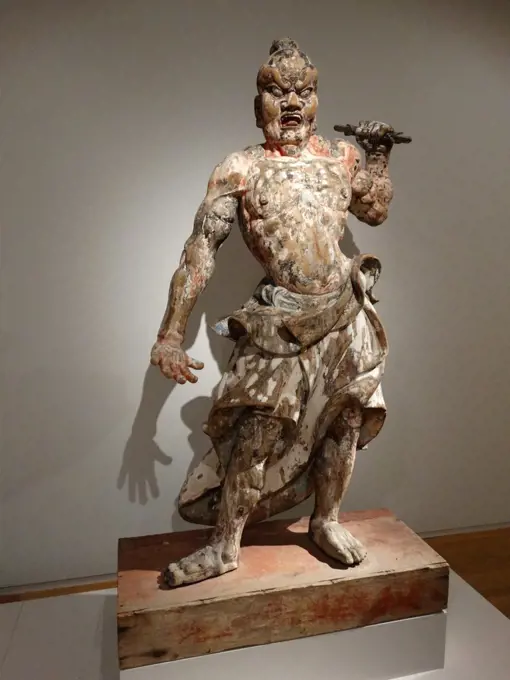
Zaō Gongen, Manifestation of Mount Kinpu, 12th century, Unknown Japanese, 48 3/4 × 12 3/4 × 8 7/8 in. (123.83 × 32.39 × 22.54 cm), Wood with polychrome, Japan, 12th century, This unhappy-looking fellow with large pointed ears and sporting a conical cap is Zaō Gongen. He is a guardian deity of the Shugendō ascetic practice, who is said to live in the Yoshino Mountains in the rugged interior of the Kii Peninsula south of the ancient capital of Nara. A rare example of a religious figure of purely Japanese origin, Zaō Gongen is believed to have originally appeared to En no Gyōja (634'-701'), the founder of Shugendō, atop Yoshinos Mount Kinpu. Mount Kinpu itself was believed to have been formed from the merging of three Buddhist deities (the historical Buddha Shaka, the Buddha of the Future Miroku, and the bodhisattva Kannon). The figure of Zaō Gongen itself is believed to be a manifestation of the spirit of Mount Kinpu.

Assets in this Story

4443-28729099
Zaō Gongen, Manifestation of Mount Kinpu, 12th century, Unknown Japanese, 48 3/4 × 12 3/4 × 8 7/8 in. (123.83 × 32.39 × 22.54 cm), Wood with polychrome, Japan, 12th century, This unhappy-looking fellow with large pointed ears and sporting a conical cap is Zaō Gongen. He is a guardian deity of the Shugendō ascetic practice, who is said to live in the Yoshino Mountains in the rugged interior of the Kii Peninsula south of the ancient capital of Nara. A rare example of a religious figure of purely Japanese origin, Zaō Gongen is believed to have originally appeared to En no Gyōja (634'-701'), the founder of Shugendō, atop Yoshinos Mount Kinpu. Mount Kinpu itself was believed to have been formed from the merging of three Buddhist deities (the historical Buddha Shaka, the Buddha of the Future Miroku, and the bodhisattva Kannon). The figure of Zaō Gongen itself is believed to be a manifestation of the spirit of Mount Kinpu.
6145-29711212
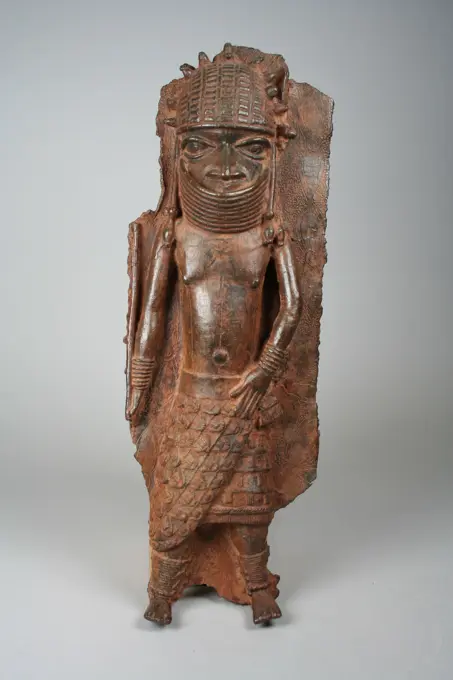
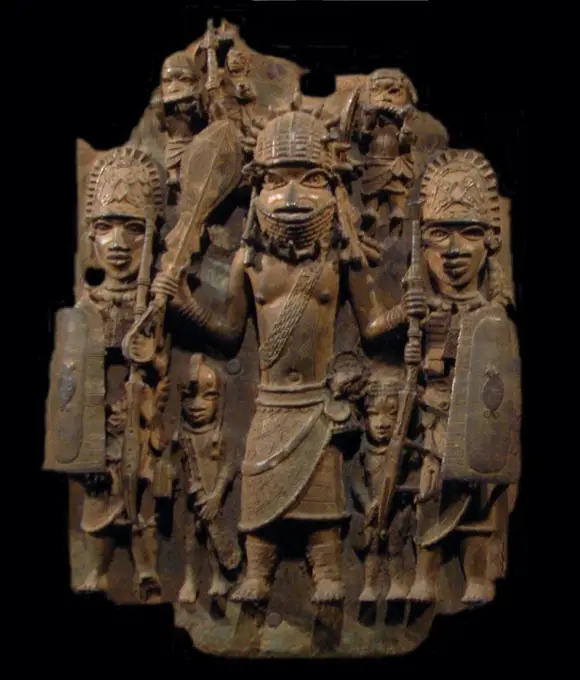
Plaque Fragment: Warrior Chief 16th-17th century Edo peoples At its origins, the centralized city-state of Benin was founded by Edo-speaking peoples. The accounts by official court historians and descriptions provided by visitors evoke a vibrant cultural center continually redefined by its leadership through shifting internal and external power dynamics. According to oral tradition, circa 1300, Edo chiefs are reputed to have reached out to the leader of neighboring Ife, Oranmiyan, to establish a new divinely sanctioned royal dynasty. Since then, the investiture of Benins rulers to the title of obas has conferred upon them at once a role of chief priest officiating in important religious ceremonies and presiding over an elaborate structure of palace officials. During the fifteenth century reign of Oba Ewuare, Benins armies were formed and the fortification of its capital with a massive wall undertaken. In parallel, delegations of Portuguese traders assiduously sought to secure exclusi
6145-30170987
Dragon King 1001-1150 Japan. The Dragon King, originally an Indian Hindu god, was gradually incorporated into the Buddhist pantheon. Veneration of this deity, who rules the seas, spread with Buddhism from India to China and, via Korea, to Japan; there the Dragon King was transformed into a Shinto god.This figure and that of the monk Hyeja originally belonged to a group of 12 Shinto deities (kami) believed to have come from the Izumo district on the north coast of the island of Honshu. At least 10 of these sculptures are in American and Canadian collections. The group is believed to represent Shotoku Taishi, his family, and his advisors.. Wood with traces of pigment .
6145-59100794
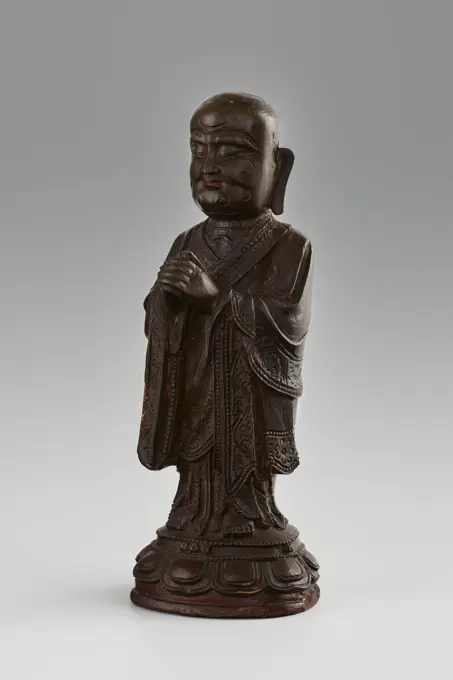
Monk;  19th/20th century (1891-00-00-1910-00-00);
1899-18859240
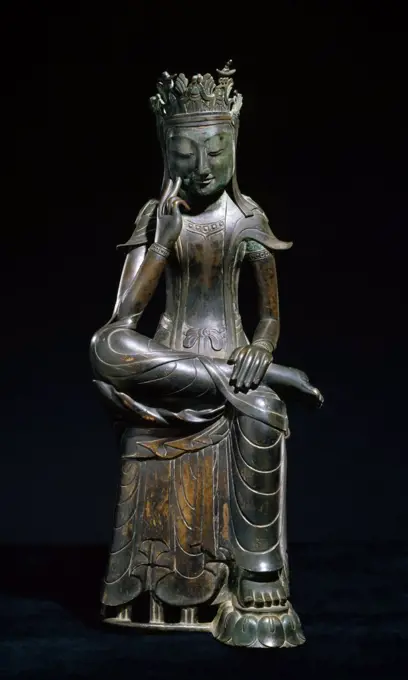
Buddhism was transmitted to Korea via China in the late 4th century CE. Little evidence of religious art exists in Korea before the introduction of Buddhism. Subsequent to its introduction, the religion inspired the production of devotional art as well as the beginnings of sophisticated temple architecture. Images of the Buddha were probably first imported by monks sent from China and the Buddhist sculpture of Korea is indebted to prototypes developed in India, Central Asia, and China. From these influences, a distinctive Korean style formed. Korean Buddhas typically exhibit Korean facial characteristics, were made with native casting and carving techniques, and employed only some of the motifs that were developed earlier in Buddhist art.
6145-58824850
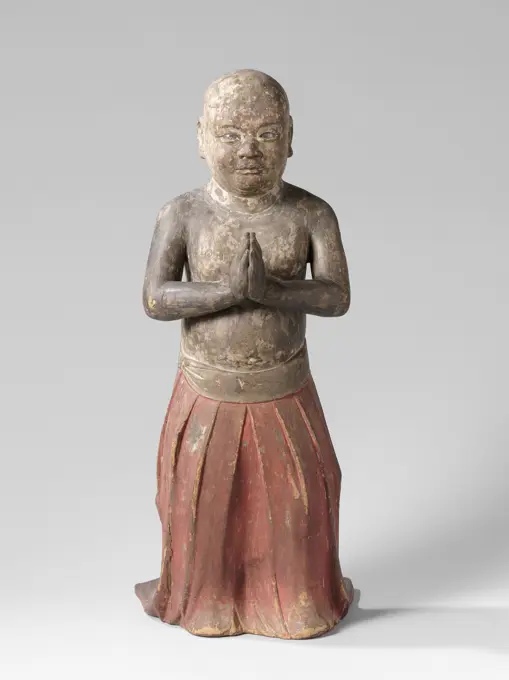
Shotoku Taishi, Anonymous, C. 1200 -C. 1350 Image of Shotoku Taishi as a child is standing attitude. He put his hands against each other in worship. The lower body is dressed in a red, loose rug with folds. Japan wood (plant material) Image of Shotoku Taishi as a child is standing attitude. He put his hands against each other in worship. The lower body is dressed in a red, loose rug with folds. Japan wood (plant material)
6145-29207812
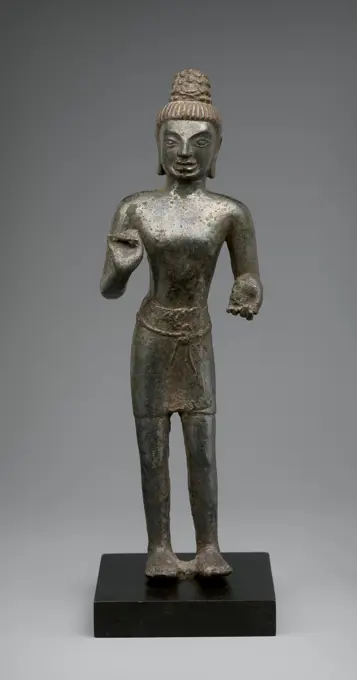
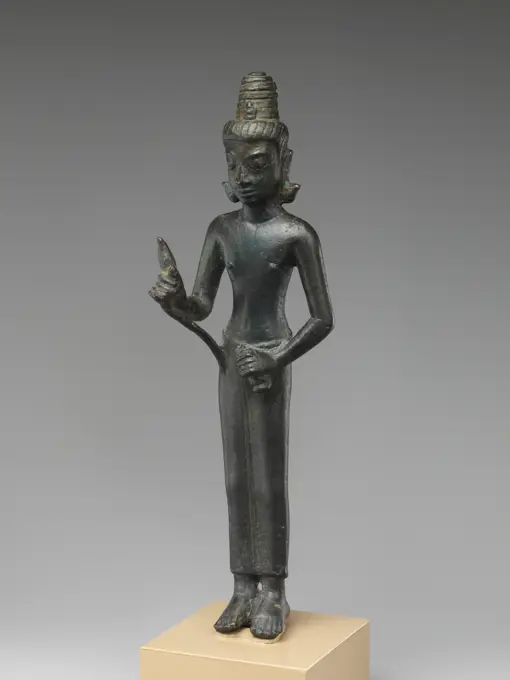
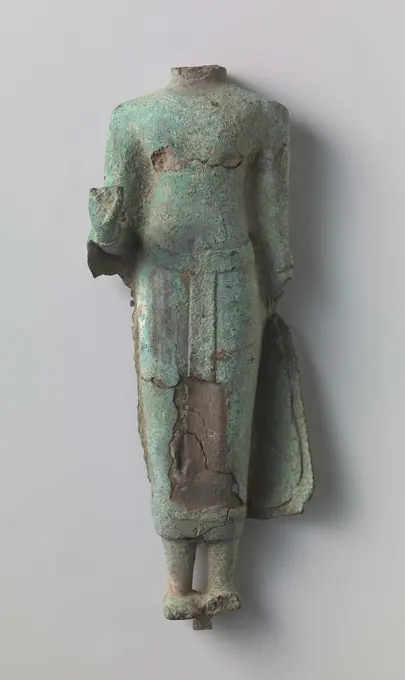
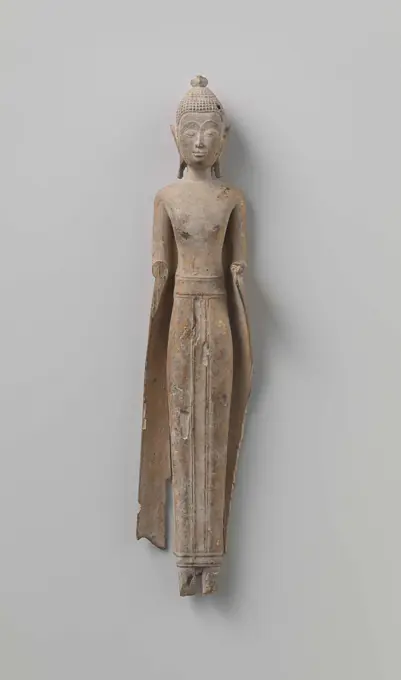
Standing Avalokiteshvara, the Bodhisattva of Infinite Compassion ca. 8th century Thailand (Buriram Province, Prakhon Chai). Standing Avalokiteshvara, the Bodhisattva of Infinite Compassion. Thailand (Buriram Province, Prakhon Chai). ca. 8th century. Bronze. Sculpture
4443-19542737
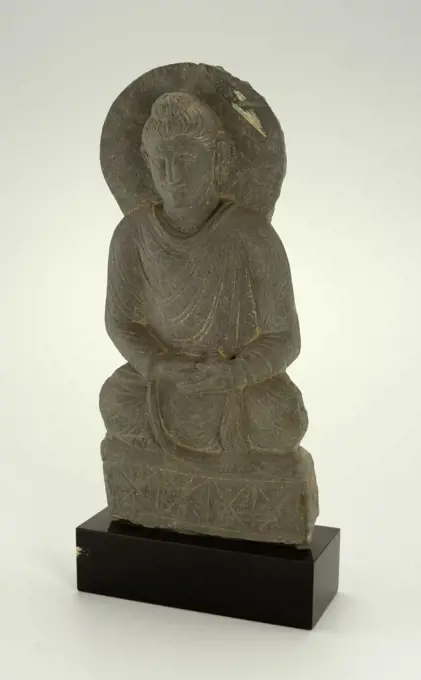
Buddah, Carved schist, Shallow slab of grey schist carved to represent a robed Buddah with halo behind his head, seated cross-legged on rectangular support with hands in lap. Reverse is roughly finished with horizontal gouge lines. Small round hole in center back., Gandbara, India, 2nd-3rd century, Decorative Arts, Figure, Figure
6145-29719103
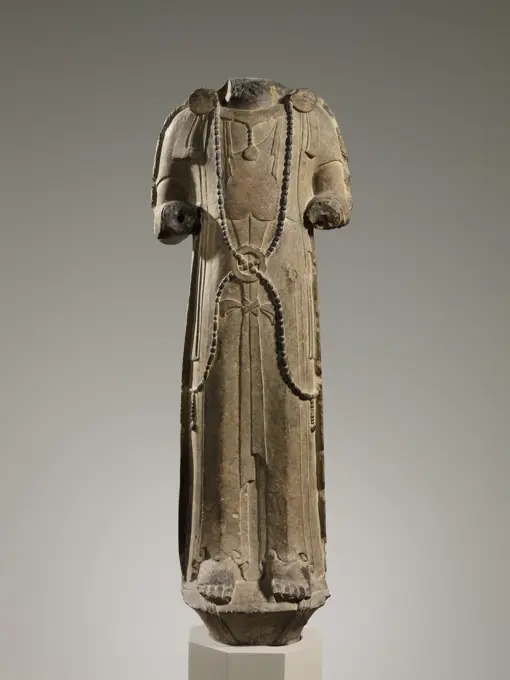
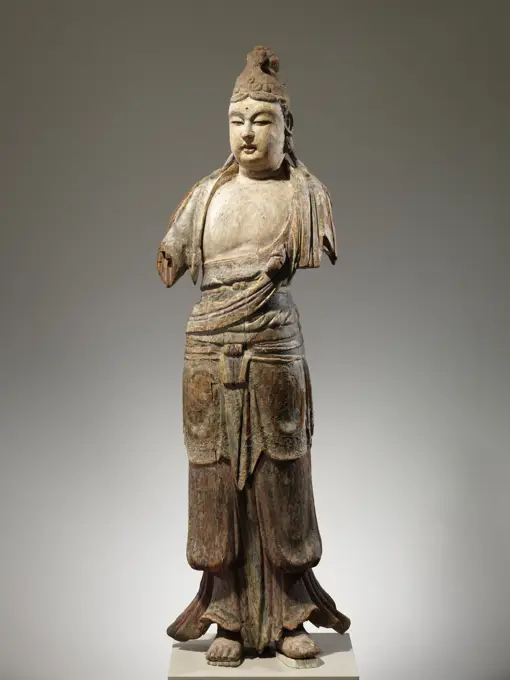
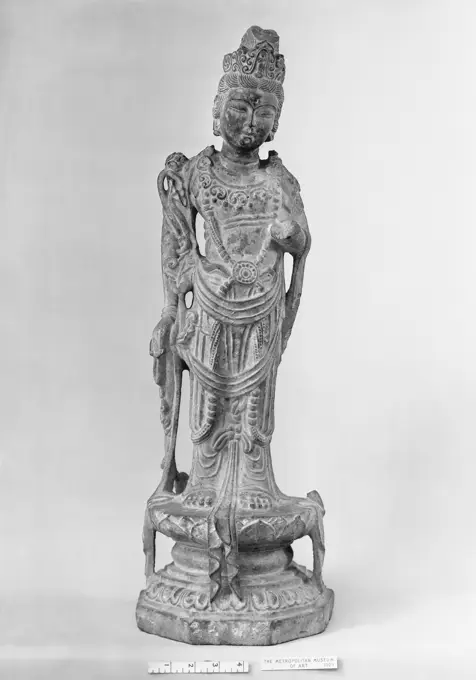
Standing bodhisattva mid- to late 6th century China. Standing bodhisattva. China. mid- to late 6th century. Limestone with traces of pigment. Northern Qi dynasty (550-577). Sculpture
6145-29714948
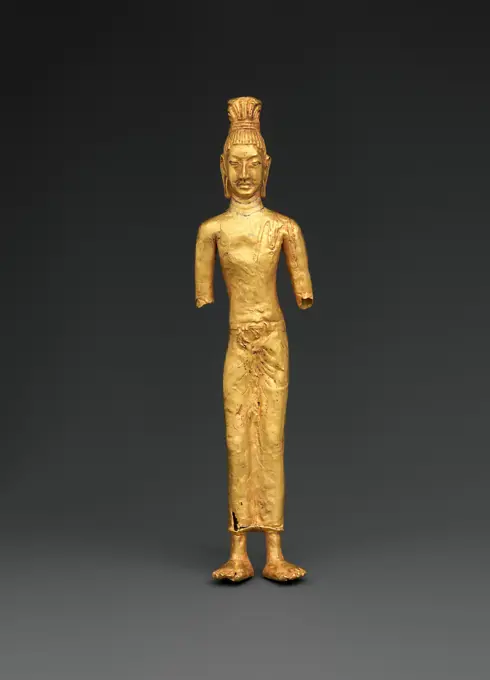
Standing Avalokiteshvara, the Bodhisattva of Infinite Compassion 8th-9th century probably Thailand or Cambodia This rare gold repoussé representation of Avalokiteshvara was fabricated from many pieces of fitted, worked gold. Both the high hairstyle (jatamukuta) and the deerskin over the figure's left shoulder are consistent with representations of Avalokiteshvara, a bodhisattva who offered compassion and protection to devotees. The thin, elongated body and the understated clothing are consistent with Si Thep production.. Standing Avalokiteshvara, the Bodhisattva of Infinite Compassion. probably Thailand or Cambodia. 8th-9th century. Gold. Metalwork
6145-29747245
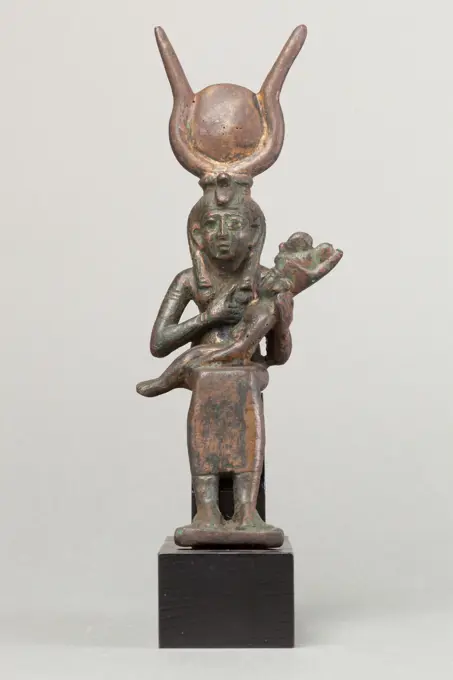
Isis and Horus 664-30 B.C. Late Period-Ptolemaic Period Isis name is first attested in the fifth dynasty in the Pyramid texts. She was the wife of Osiris and the mother of Horus, and thus was symbolically mother to the pharaoh. In the Late Period, the popularity of this important goddess dramatically increased. She is nearly always depicted in anthropomorphic form, standing or seated on a throne. This statuette shows the goddess in her most beloved pose, nursing her son Horus (known also as the lactans pose). Other goddesses sometimes nurse Horus or other child gods, but Isis is preeminent among them in this role. She wears the horned crown that by the Late Period she had adopted from the goddess Hathor, as well as the vulture headdress that emphasized the role of goddesses as royal mothers; the markings of the headdress are particularly clear on the back of the head. Armlets and bracelets complete her adornment.Horus is large in proportion to Isis, and somewhat more prominent than in
4409-17380924
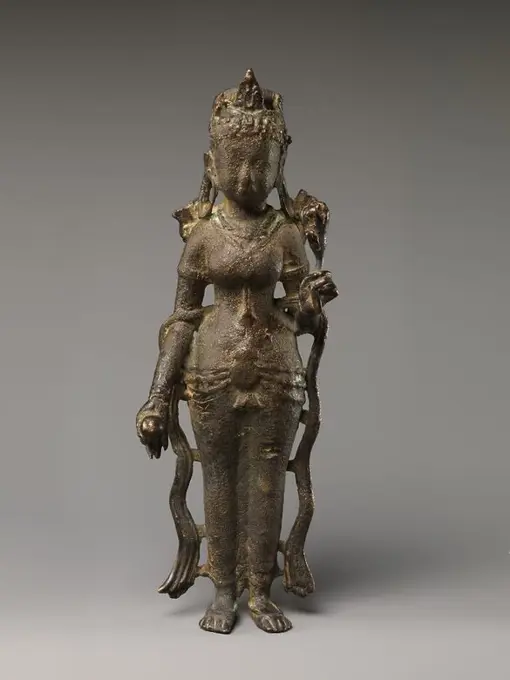
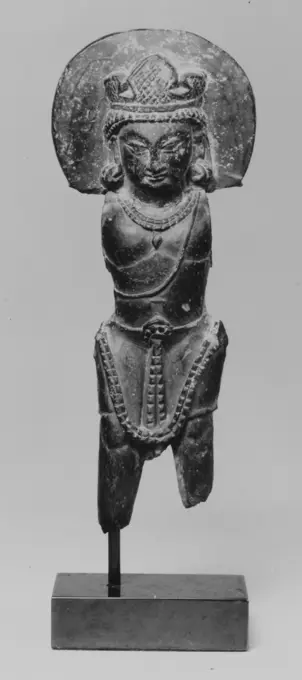
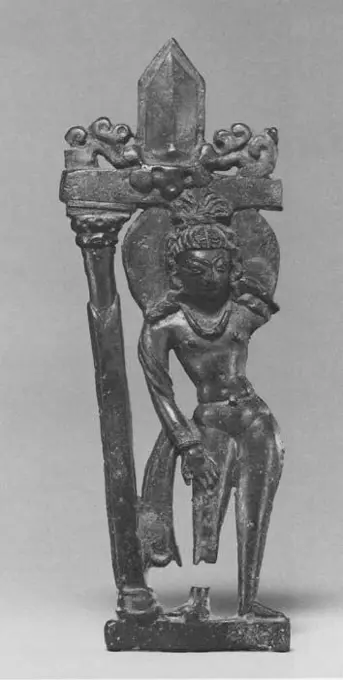
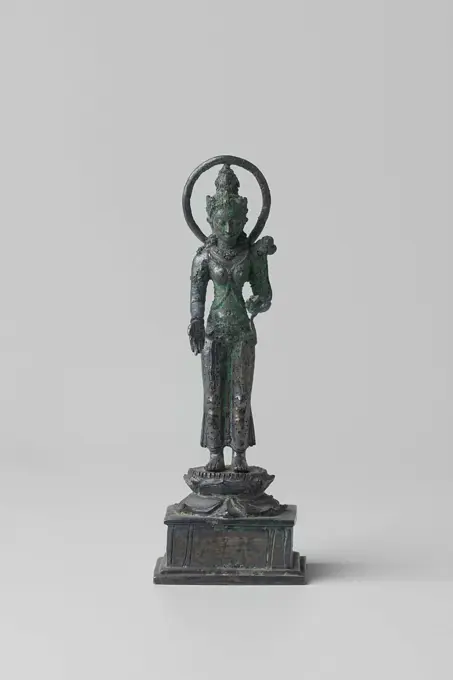
Tara. Culture: North India (possibly Uttar Pradesh). Dimensions: H. 12 in. (30.5 cm). Date: ca. 7th century.This elegant, full-bodied figure of a Buddhist saviouress holding a long-stemmed lotus suggests affiliations with Avalokiteshvara, the bodhisattva of compassion. The highly modeled jeweled girdle and flowing sashes hanging free of the body point to a seventh-century date, placing her among the earliest representations of Tara known from North India. The closest analogy is a bejeweled Gaja Lakshmi depicted on a copper seal with Brahmi script datable to the sixth or seventh century, excavated near Haridwar, in Uttar Pradesh. Museum: Metropolitan Museum of Art, New York, USA.
6145-58826096
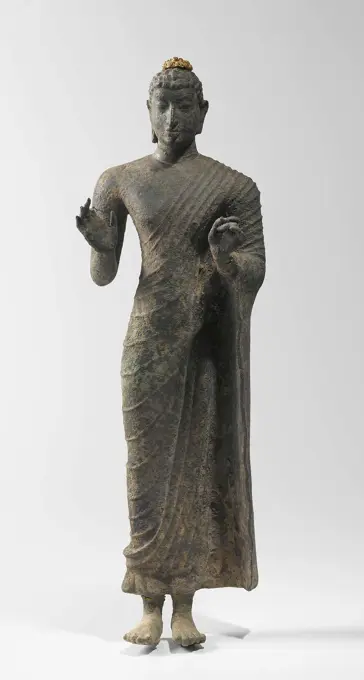
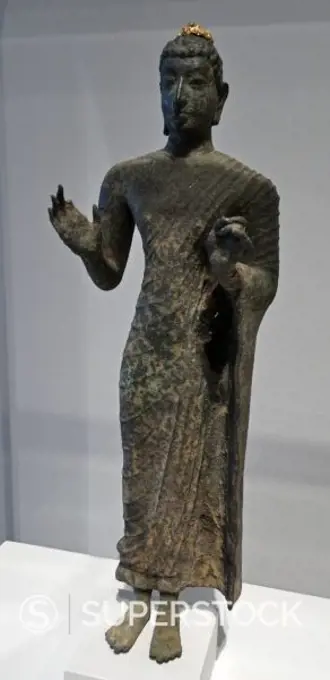
Standing Buddha, c. 700 - c. 800 Buddha, right foot has been made, right hand in Abhaya-Mudra, the left in Witarka-Mudra. The image is made of bronze for a cement-like core. East Java bronze (metal). gold (metal) Buddha, right foot has been made, right hand in Abhaya-Mudra, the left in Witarka-Mudra. The image is made of bronze for a cement-like core. East Java bronze (metal). gold (metal)
4409-17501762
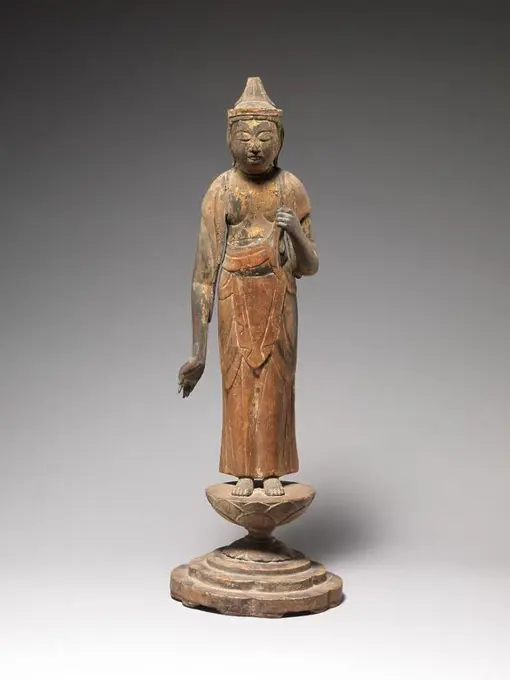
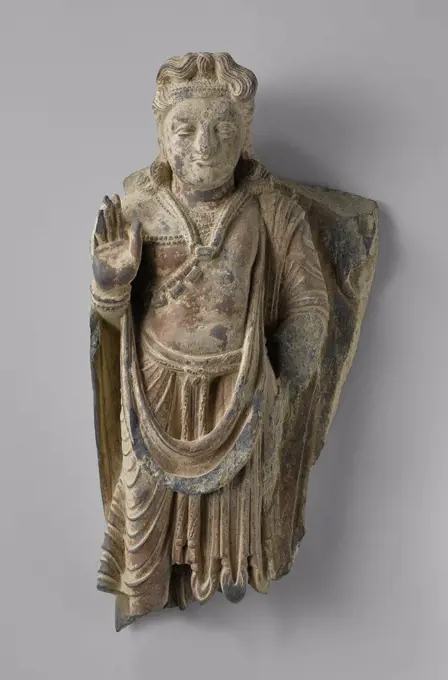
Sho Kannon. Culture: Japan. Dimensions: H. 17 3/4 in. (45.1 cm); W. 6 in. (15.2 cm); D. 5 3/4 in. (14.6 cm). Date: 12th century.The frontal pose and flattened drapery are evocative of Sho Kannon's status as the principal incarnation of Avalokiteshvara, the bodhisattva of compassion. Produced during the late Heian period in Japan, when wood was a strongly favored medium for devotional figures, this work would have been part of a sculptural ensemble. The figure's raised fist once probably held a lotus flower, now lost. Traces of pigment on the body and garment suggest that the surface would have been entirely painted. Museum: Metropolitan Museum of Art, New York, USA.
6145-59121339
Buddhas Akjamuni;  XVIII-XIX century (1701-00-00-1900-00-00);Buddha, Krakow, so -called REPWINDING ACTION - collection, Zaleski, Władysław - collection, figurines, Buddhist and Indian art, purchase (provenance)
4443-28741504
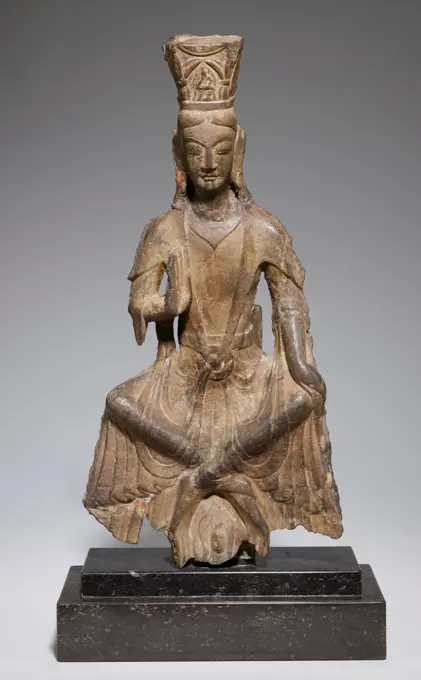
Maitreya (The Buddha of the Future), early 6th century BCE, 17 5/8 in. (44.77 cm), Grey limestone, China, 6th century BCE, This image of Maitreya, the Buddha of the Future, is typical of the Northern Wei style (386-534) as it developed at the Longmen cave complex during the fifth and sixth centuries. Located outside the Wei capital of Luoyang in Honan province, sculptural activities at Longmen lasted from approximately 500 to 750. This image from Pinyang Cave displays a non-Chinese seated posture with legs crossed at the ankles. The torso is slender and elongated and the thin garment has been depicted in a schematic fashion with folds, scarves and hemlines organized into a flat, pattern-like arrangement typical of the Northern Wei style.
6145-30114625
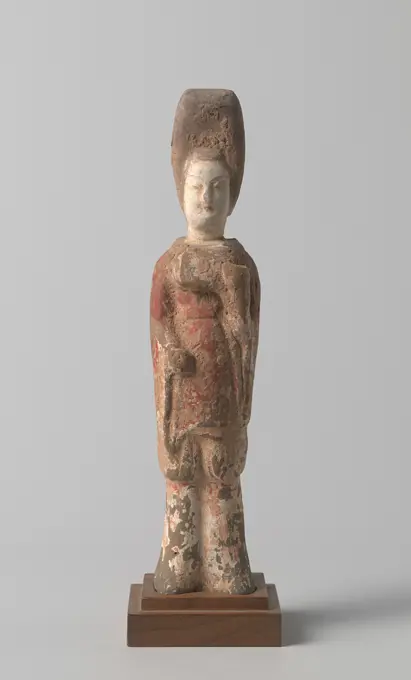
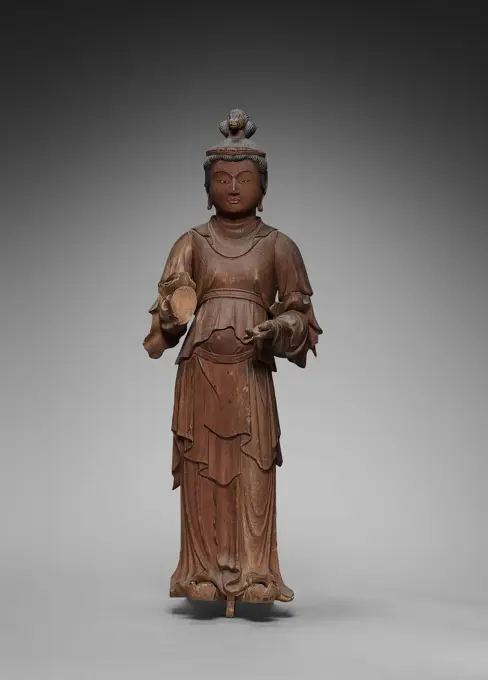
Funeral figure in the shape of a lady with an instrument.Graffigure of pottery in the shape of a standing lady, painted in red, white and black. The figure is dressed in a red robe with V-neck and wide sleeves and has a highly worked up hairstyle. She holds a tool instrument.
6145-58825420
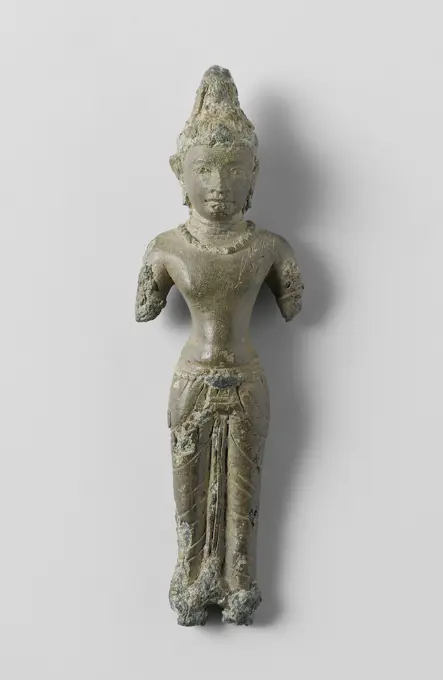
Avalokiteeshvara, Anonymous, 600 - 800 Figure of Bodhisattva Avalokitesvara, Diadem and headdress with possibly a Buddha figure. Evospor, necklace and jewelry around upper arms. Sumatra bronze (metal) Figure of Bodhisattva Avalokitesvara, Diadem and headdress with possibly a Buddha figure. Evospor, necklace and jewelry around upper arms. Sumatra bronze (metal)
4409-17423242
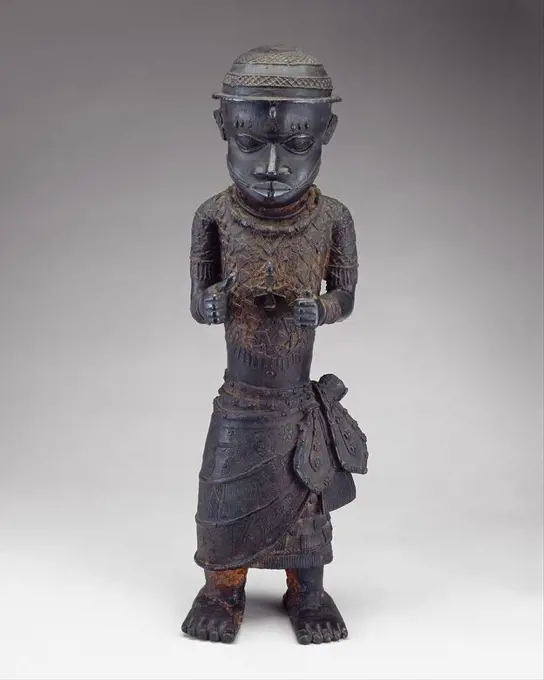
Male Figure: Court Official. Culture: Edo peoples. Dimensions: H. 25 3/4 x W. 7 x D. 5 7/8 in. (65.4 x 17.8 x 14.9 cm). Date: 16th-17th century.Scholars have suggested that this figure was placed upon a commemorative altar dedicated to a king, or "oba," of Benin. The figure is depicted wearing a distinctive cross pendant. His wrap skirt is adorned with profile heads of Portuguese traders, a frontal African head, and other common Benin motifs such as river leaves, mudfish, and interlace patterns.Three different identities have been proposed for this figure. The official may be a messenger from a ruler referred to as the "Ogane," who today is identified as the leader, or "oni," of Ife. The present Benin dynasty claims descent from the Yoruba kingdom of Ife. According to a sixteenth-century Portuguese text, each new "oba," or king, of Benin had to be confirmed by the "Ogane," whose messenger presented the "oba" with a brass hat, staff, and cross necklace. Another interpretation suggests t
1746-19664558
Buddha paré. 14th century, dorure lacquer sculpture in teak from Myanmar
6145-29202627
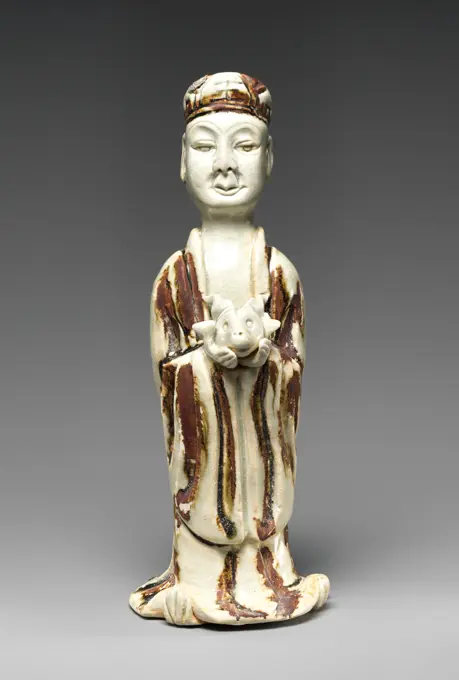
Daoist Priest with Zodiac Animal, Ram China. Daoist Priest with Zodiac Animal, Ram. China. Stoneware. Song dynasty (960-1279). Tomb Pottery
6145-46392764
Funeral Figure of A Standing Person. Graffigure of pottery in the shape of a standing person. Remnants of a painting in red, white and black. The hairstyle has been worked up to a point; The left arm hangs along the body, the right arm at the height of the waist.
6145-46650235
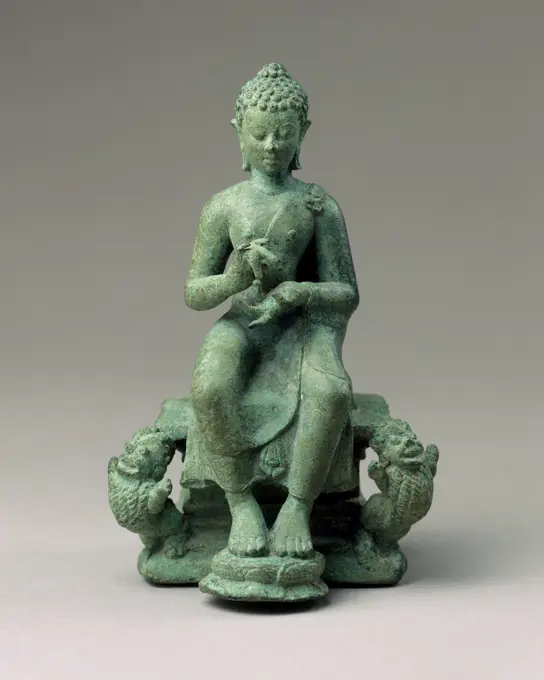
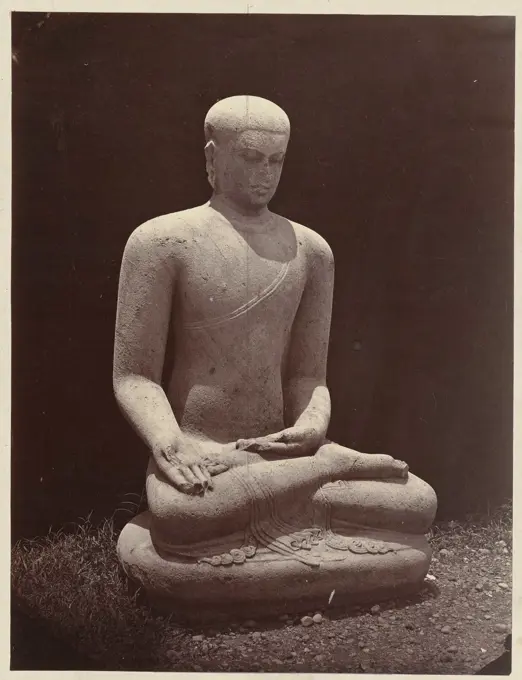
. Although this figure was found on Java, it was probably made elsewhere and exported to Indonesia. The drapery folds of the monks robe are characteristic of Buddha figures from India or Sri Lanka. The (ushnisha), or pro-tuberance on the head, a standard feature in representations of the Buddha, is a later addition in gold.
6145-29167160
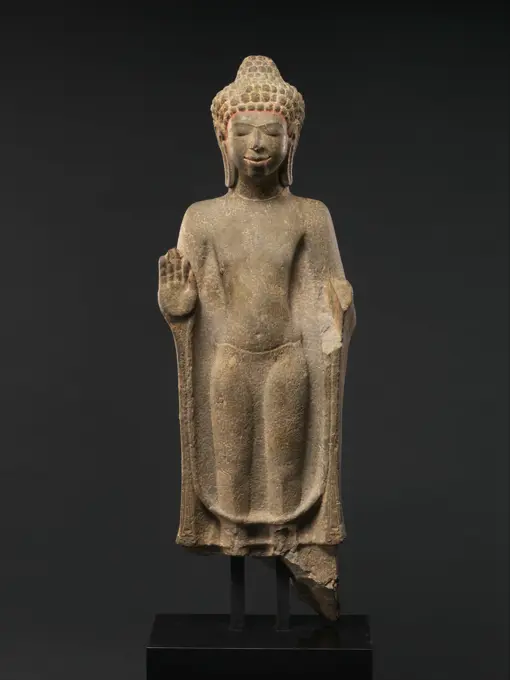
Standing Buddha 7th-8th century Thailand Considerable innovations in religious iconography were developed during the Mon-Dvaravati period. For example, many Buddhas hold both of their hands in a gesture of exposition or teaching (vitarkamudra) that in India is confined to the right hand. Images from the related site of Prakhon Chai also exhibit this double hand gesture, but otherwise it is unknown in the Buddhist world. Another iconographic innovation was to place a standing Buddha and flanking attendants on the back of Garuda, a semi-divine winged creaturethat usually appears as the vehicle (vahana) of Vishnu.. Standing Buddha 38165
6145-29066248
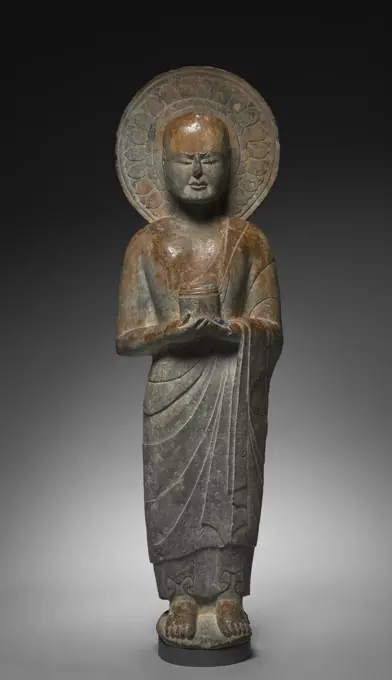
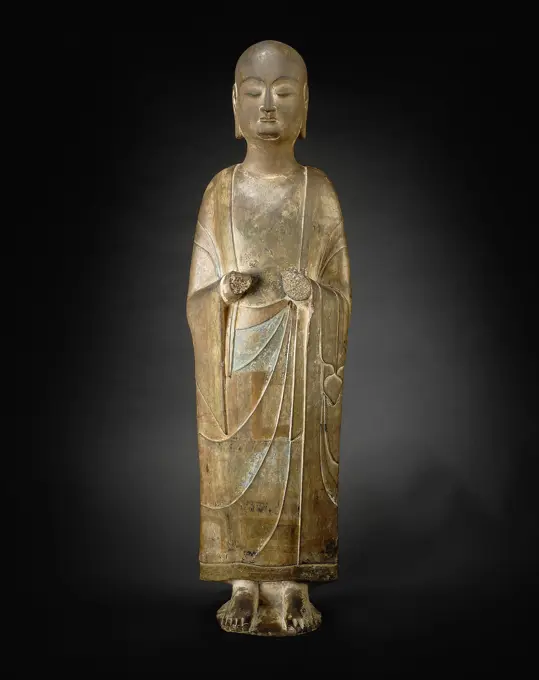
Standing Disciple Mahakasyapa Holding a Cylindrical Reliquary, c. 550. China, Hebei province, Southern Xiangtangshan caves, Northern Qi dynasty (550-577). Limestone with traces of pigment; overall: 116 x 33 x 25 cm (45 11/16 x 13 x 9 13/16 in.).
6145-29142117
Bodhisattva 11th-12th century China. Bodhisattva 36085
6145-29791140
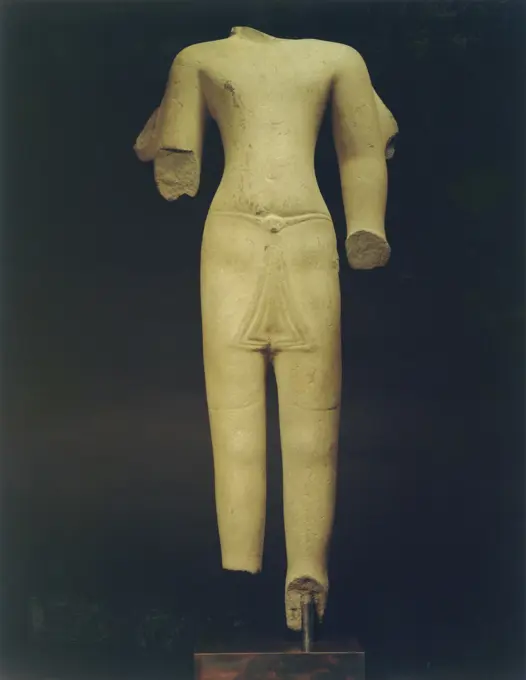
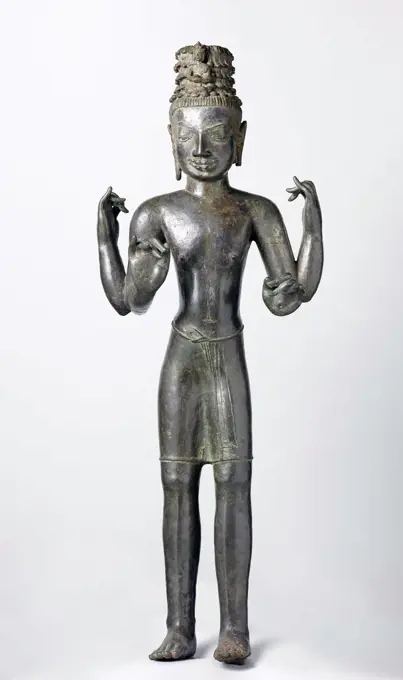
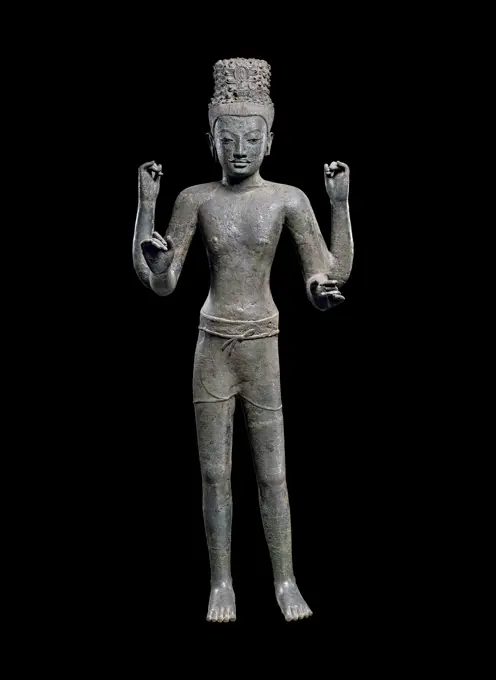
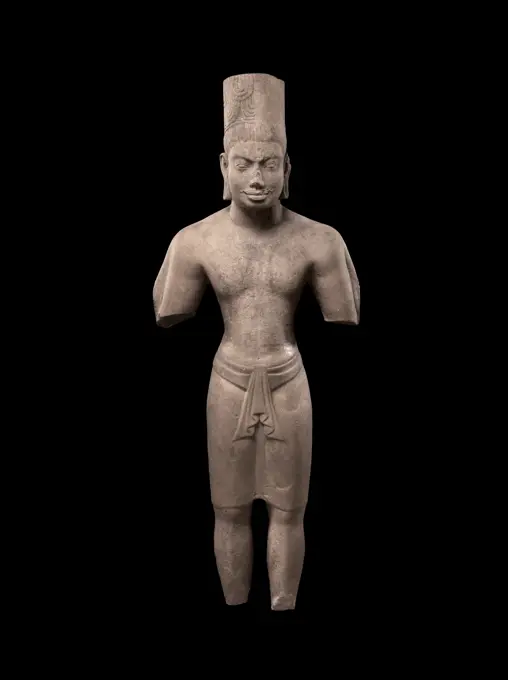
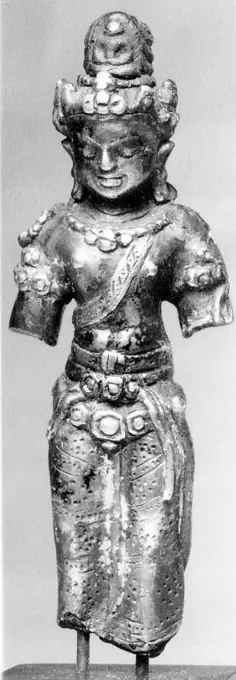
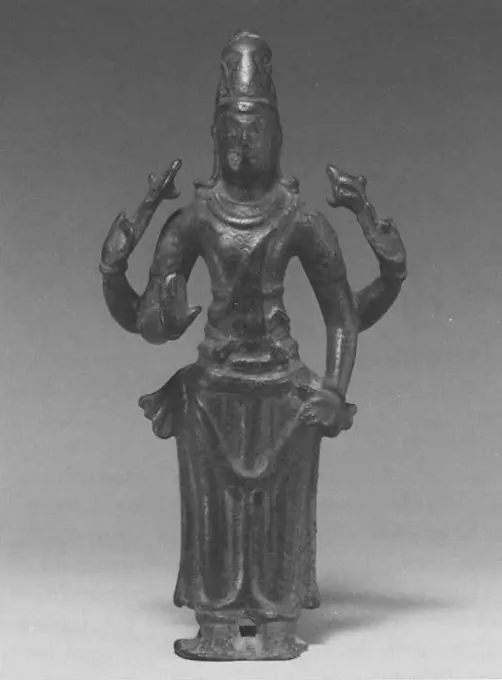
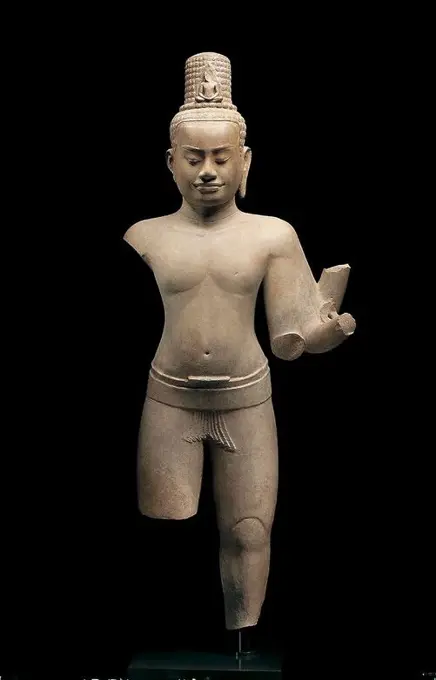
Standing Four-Armed Male Deity 6th century Cambodia. Standing Four-Armed Male Deity 38161
6145-29119766
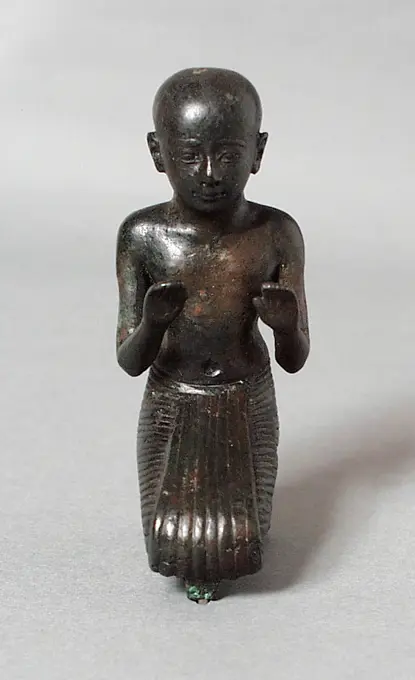
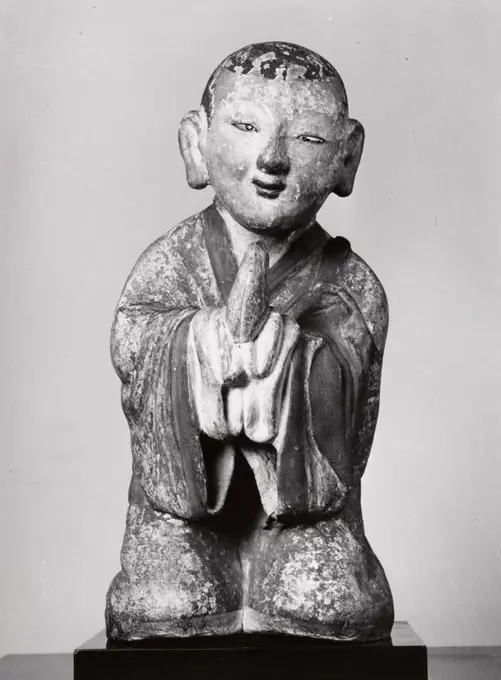
Kneeling Priest Figurine in Worshipping Pose
6145-29813196
Idiophone: Iyoba Striking Gong 18th-19th century Edo peoples Hand-held clappers commemorate an important event in Benin history, the victory of Oba Esigie over the Igala kingdom in the early sixteenth century. On the way to battle, Esigie and his army met the "bird of prophecy," which predicted disaster for Benin. Rather than submit to this fate, Esigie ordered the bird killed and went on to defeat his enemy. Ivory clappers depict the king and the queen mother; the latter is said to have used her vast spiritual powers to help her son prevail. Such instruments are played by chiefs at an annual palace festival celebrating Esigie's triumph.. Idiophone: Iyoba Striking Gong 316558
6145-59102535
Parvati as Annapurna;  20th century (1901-00-00-1940-00-00);
6145-29157204
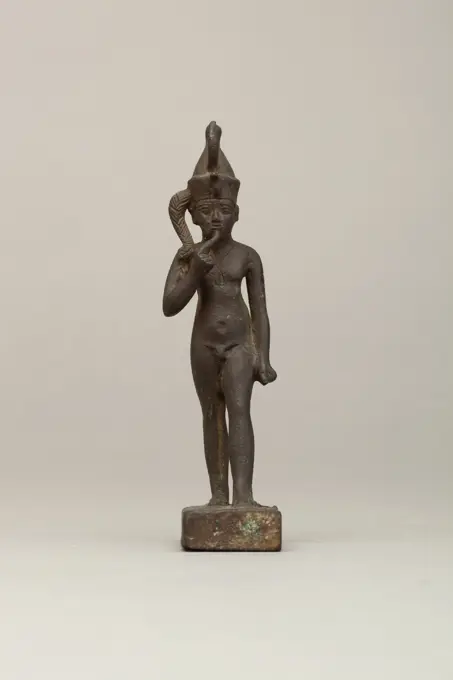
Harpokrates in double crown 664-30 B.C. Late Period-Ptolemaic Period The figure represents a child god in a striding/standing position, wearing the double crown, which alludes to his royal status. The child god is distinguished from adult gods by a range of iconographic clues: his nudity, the finger raised to the mouth (a child-like gesture), and the sidelock on the right side of his head. He wears an amulet on his chest, another attribute common to child gods but not adult gods.Child gods grew in popularity and cult from the Third Intermediate Period onwards, rivaling even the most powerful and ancient gods, especially as temple offerings. Without an inscription, it can be very difficult to securely distinguish and identify particular child gods, but here the double crown identifies the god as Harpokrates (Horus the Child), who was the son of Osiris and Isis. This royal crown symbolizes the union of Lower and Upper Egypt, and highlights Horus role as the legitimate ruler of the entir
6145-29163977
Standing Bodhisattva Maitreya , the Buddha of the Future 7th-8th century Thailand (near the Korat plateau). Standing Bodhisattva Maitreya , the Buddha of the Future 39093
6145-58829000
Avalokiteshvara, anonymous, c. 750 - c. 900 Standing image with four arms of Avalokitesvara. Prakhon Chai whole: bronze (metal) casting Standing image with four arms of Avalokitesvara. Prakhon Chai whole: bronze (metal) casting
1848-55026591
Yakshi, figurine, folk, 7th century A. D collected at Muttom near Boluvampatti, Coimbatore, Tamil Nadu, South India, India, Asia
4443-20293442
The bodhisattva Maitreya, Anonymous, 200 - 399
6145-30114886
Fragment van een Boeddha-beeld.Bust of a Buddha; The head has been broken down as well as the left hand and the fingers of the right hand.
6145-29764686
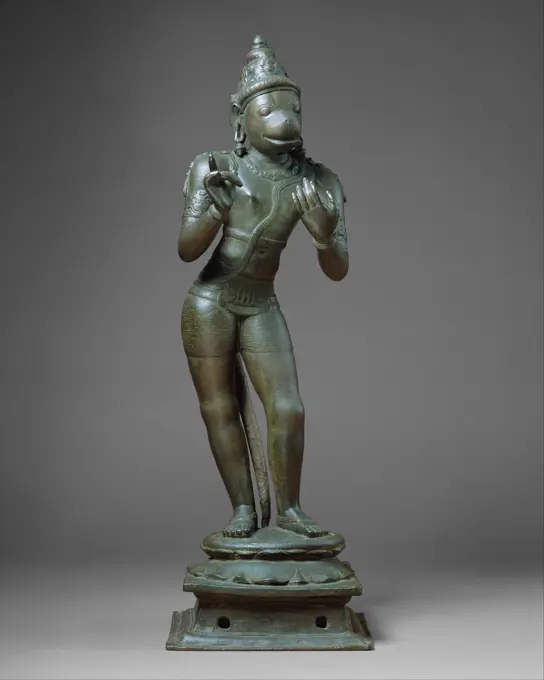
Hanuman Conversing 11th century India (Tamil Nadu) One of the most appealing Hindu deities, Hanumans bravery, courage, and loyalty throughout the Ramayana epic are renowned. Here, he gestures obeisance to Rama with his raised left hand while engaging in animated discussion with his Lord. This sculpture was part of an ensemble with Rama, Sita, and Lakshmana at its center. It was included among an assemblage of processional icons kept by Vaishnava temples in South India for festival use. Typical of Chola-period representations, Hanuman has assumed anthropomorphic form, with only his face and tail confirming his monkey identity. Among the finest bronze images of Hanuman to have survived from the Chola kingdom of south India, this work embodies his noble, virtuous character with great sensitivity.. Hanuman Conversing 38945
6145-29151050
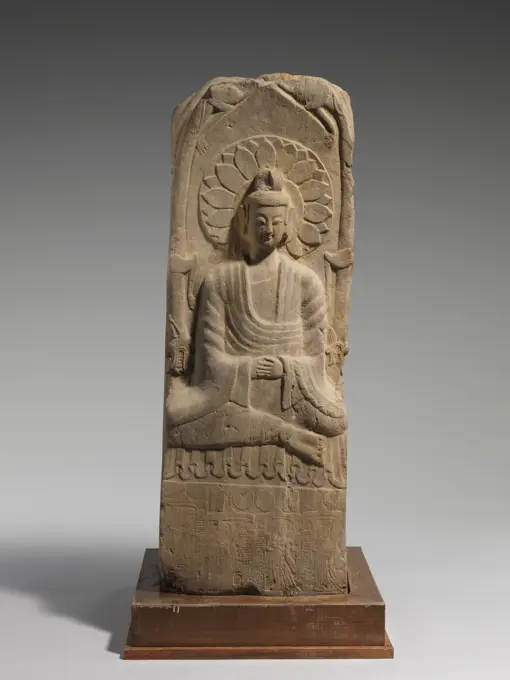
Stele with Buddha Maitreya dated 533 China. Stele with Buddha Maitreya 40523
6145-29749548
Standing Vishnu 9th century India (Tamil Nadu). Standing Vishnu 39335
6145-29786655
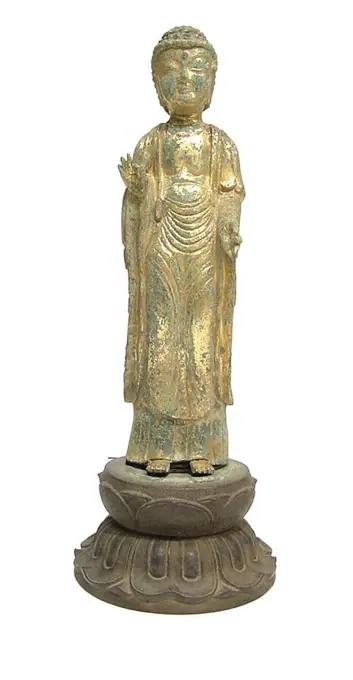
Standing Buddha 8th-9th century Korea. Standing Buddha 72394
6145-29748213
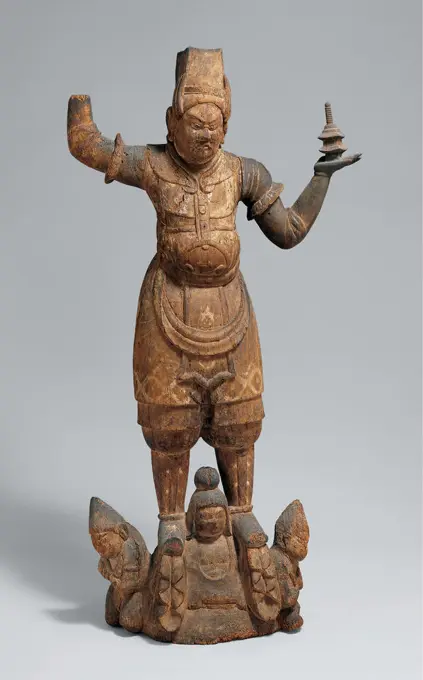
Tobatsu Bishamonten late 10th-early 11th century Japan Tobatsu Bishamonten is one of the manifestations of Bishamonten, the Guardian King of the North, who is usually included in a group of Four Guardian Kings (Shitennō), protectors of the four directions. However, in the manifestation of Tobatsu Bishamonten (as captured by this sculpture), the deity is always shown independently and typically stands on a mount supported by the female earth deity, Jiten, and two dwarf demons, Niranba and Biranba. Wearing an angry expression and dressed in the armor of a Chinese warrior, he holds in his left hand a miniature stupa, which symbolizes the Buddhas teachings and relics; his right hand most likely held a weapon to subjugate evil and suppress the enemies of Buddhism.. Tobatsu Bishamonten 53162
6145-29781749
Torso of Vishnu ca. 6th century India (Jammu & Kashmir, ancient kingdom of Kashmir). Torso of Vishnu 38377
1746-21108918
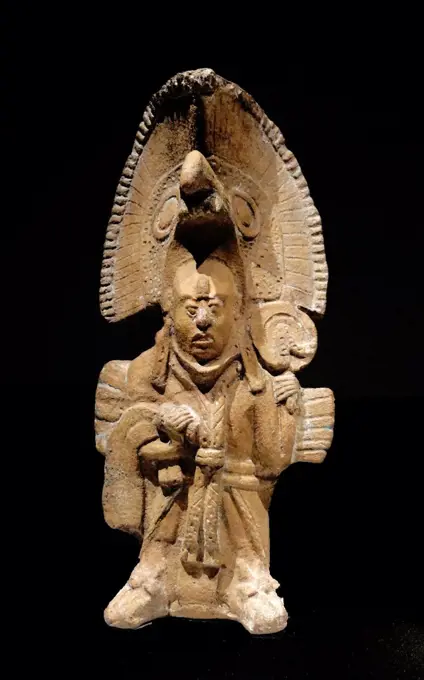
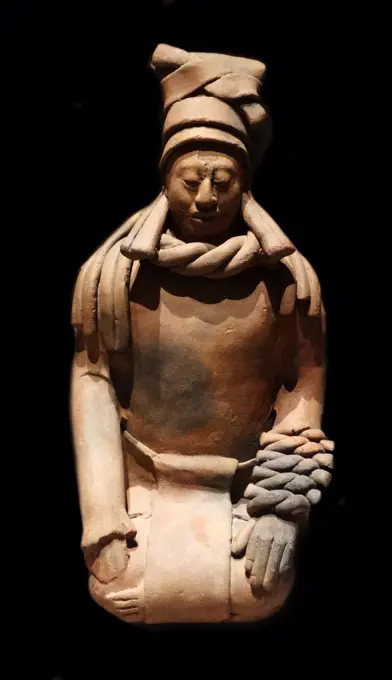
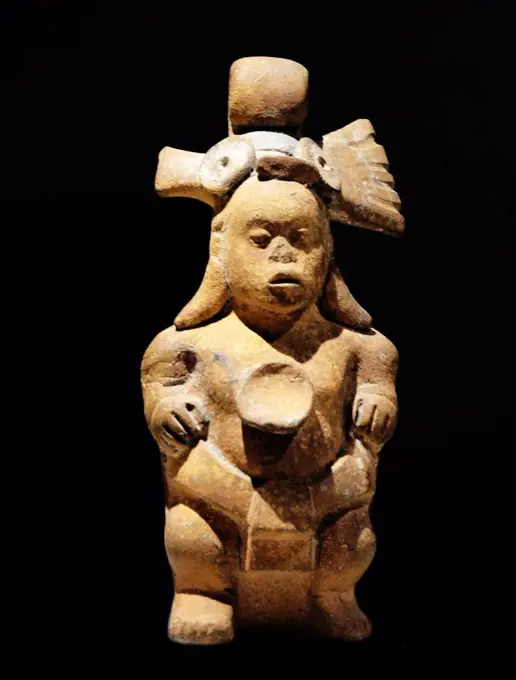
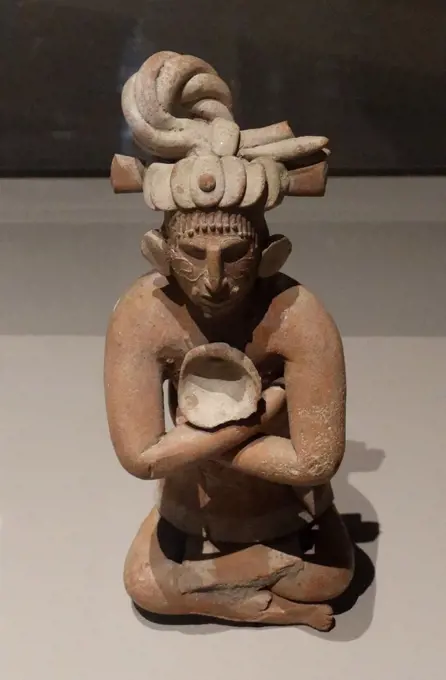
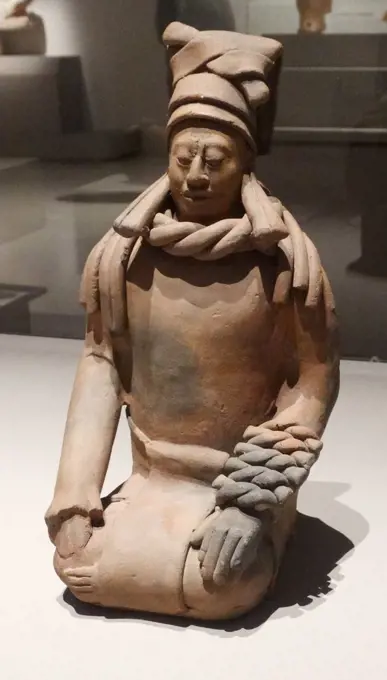
Mayan ceramic figurine of a Lord, 600-900 AD Mexican
1848-55979375
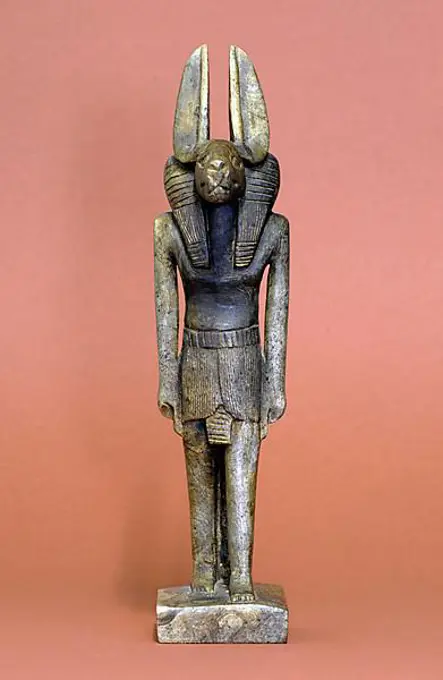
Antique statue of anubis, Egyptian god of embalmment
4409-17399720
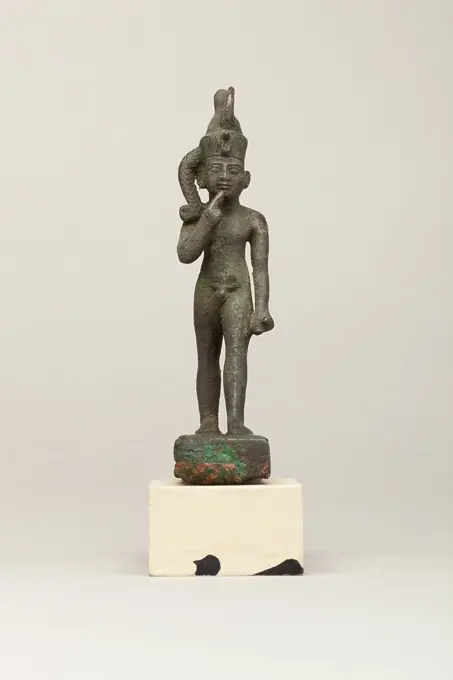
Harpokrates in double crown. Dimensions: H. 12.4 cm (4 7/8 in.); W. 3.6 cm (1 7/16 in.); D. 6.3 cm (2 1/2 in.). Date: 664-30 B.C..The figure represents a child god in a striding/standing position, wearing the double crown, which alludes to his royal status. The child god is distinguished from adult gods by a range of iconographic clues: his nudity, the finger raised to the mouth (a child-like gesture), and the sidelock on the right side of his head. The faint incised outline of a string is visible at his neck, intended for the suspension of an amulet, an attribute common to child gods but not adult gods.Child gods grew in popularity and cult from the Third Intermediate Period onwards, rivaling even the most powerful and ancient gods, especially as temple offerings. Without an inscription, it can be very difficult to securely distinguish and identify particular child gods, but here the double crown identifies the god as Harpokrates (Horus the Child), who was the son of Osiris and Isis.
6145-59098002
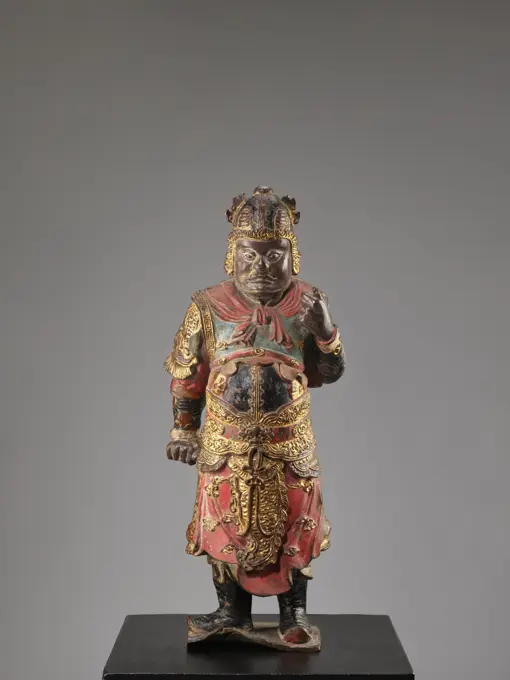
Lokapala - a guard;  19th century () (1800-00-00-1900-00-00);
6145-29071111
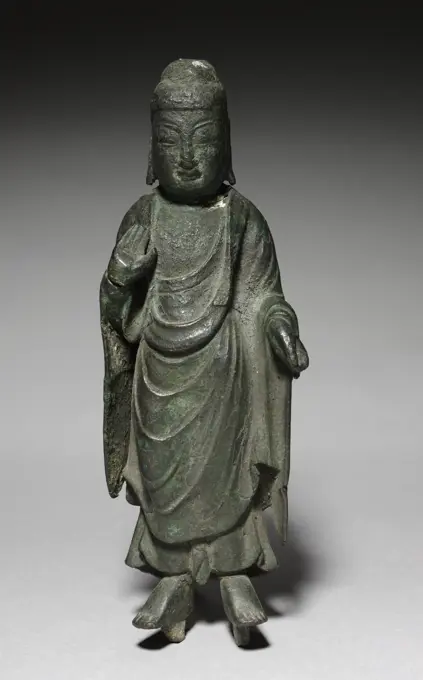
Standing Buddha, 676-935. Korea, Unified Silla period (676-935). Bronze; overall: 18.5 cm (7 5/16 in.).
6145-29149114
Bodhisattva Avalokiteshvara (Guanyin) China. Bodhisattva Avalokiteshvara (Guanyin). China. Limestone. style of the Tang dynasty (618-907). Sculpture
6188-68092938
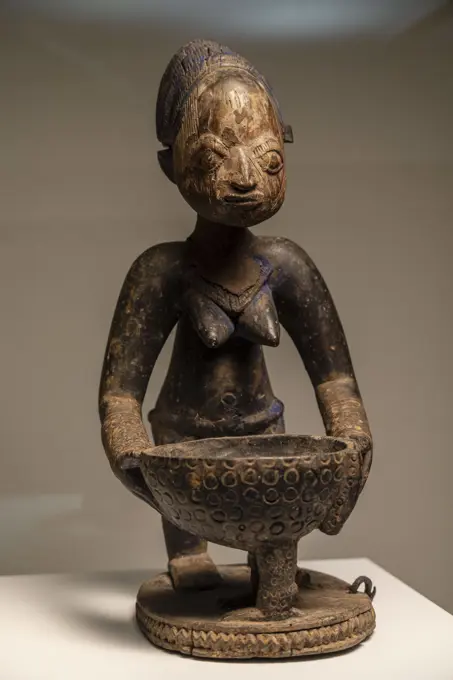
Ritualfigur für Ifa-Wahrsagezeremonien Ritual figure for Ifa divination ceremonies, Ioruba, Nigeria, 20th century, carved wood, pigment and metal application, MEB, Barcelona, Catalonia, Spain LicenseRF Copyright: xZoonar.com/Tolox 23171187
6145-29202632
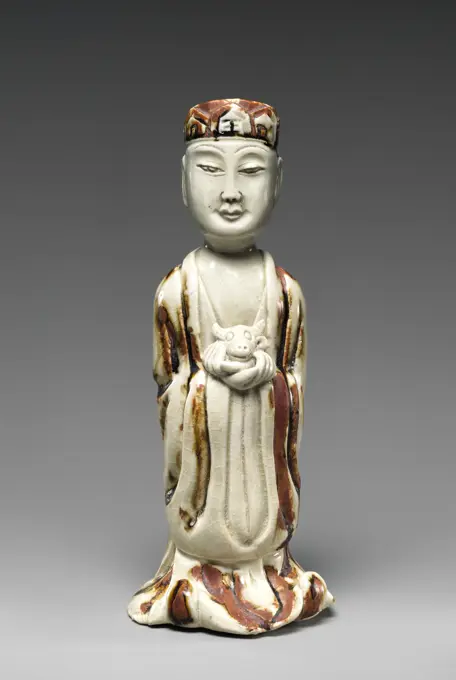
Zodiac Figure of an Ox China From the Tang dynasty onward, zodiac animals were routinely given human attributes. Here, the figure is envisioned as a Daoist deity holding the head of an ox. The large Chinese character wang (king) on the front of his hat signifies his heavenly identity.. Zodiac Figure of an Ox. China. Glazed stoneware. Yuan dynasty (1271-1368). Tomb Pottery
6145-29789575
Kneeling Priest 18th century Korea. Kneeling Priest 57386
6145-30153539
Monk 589 CE-618 CE China. Expressing serene dignity, these youthful monks stand erect, their eyes downcast and hands firmly joined in reverent prayer. Their long earlobes allude to earrings that were worn by the Buddha as a young Indian prince and to his rejection of material wealth. Characteristic of Sui dynasty sculpture, the monksí sharply defined facial features and the folds of their robes enhance the figuresí flat, understated modeling. Each of their robes was originally painted with rectangles of different colors, signifying the patchwork mantle worn by the Buddha and by pious monks who emulated his humble values. Only shadowy traces of these pigments are now evident.. Limestone with traces of polychromy .
6145-58826137
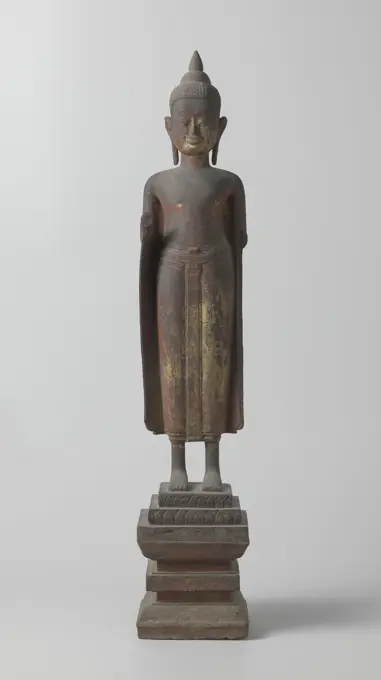
Buddha on pedestal, anonymous, 1400 - 1600 Buddha standing on a pedestal; Hands and a part of the arms are missing. Cambodia wood (plant material). gilding (material) gilding Buddha standing on a pedestal; Hands and a part of the arms are missing. Cambodia wood (plant material). gilding (material) gilding
6145-43631458
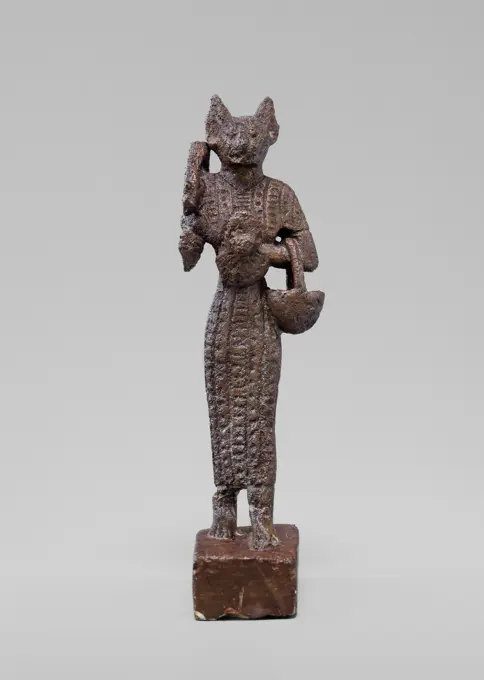
Figurka bogini Bastet. unknown, author
6145-29709331
Seated Bodhisattva late 10th-early 11th century Indonesia (Java, Ngandjuk). Seated Bodhisattva 39152
6145-29732089
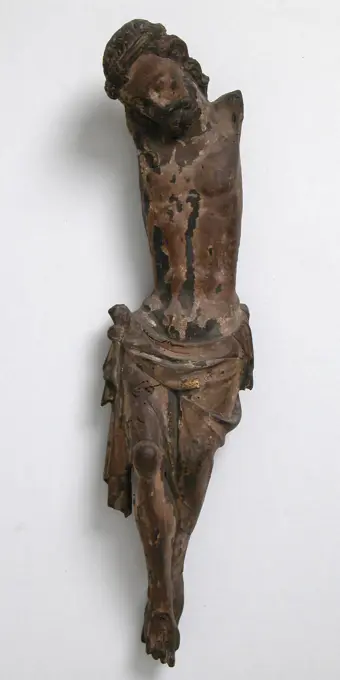
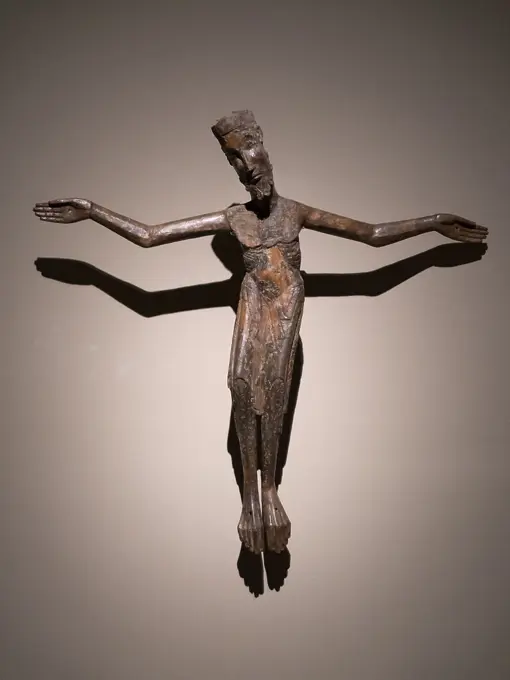
Crucified Christ 14th century Spanish. Crucified Christ 465989
6145-29850044
Robert WR Taylor, Indian Woman, c 1940 Indian Woman
6145-29715559
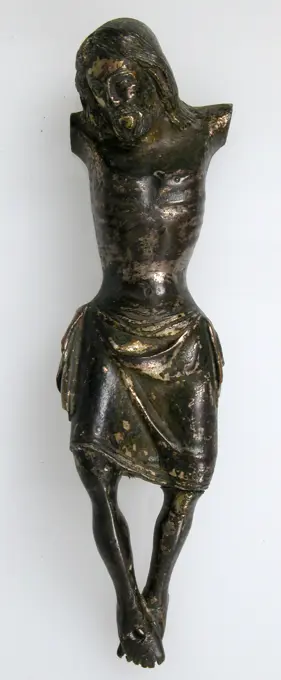
Christ 14th-15th century French. Christ 466559
6176-67037791
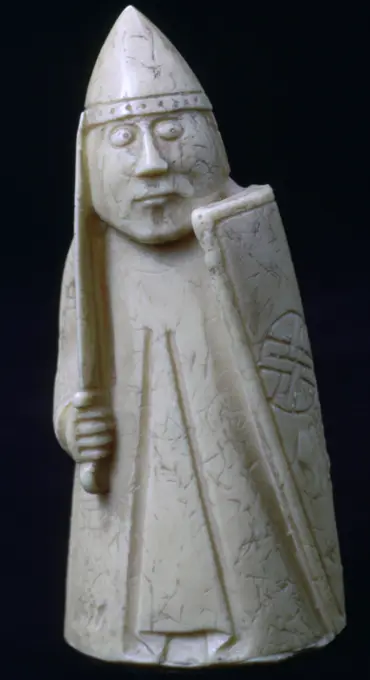
A Knight - The Lewis Chessmen, (Norwegian), c1150-c1200. Artist: Unknown
1899-18859227
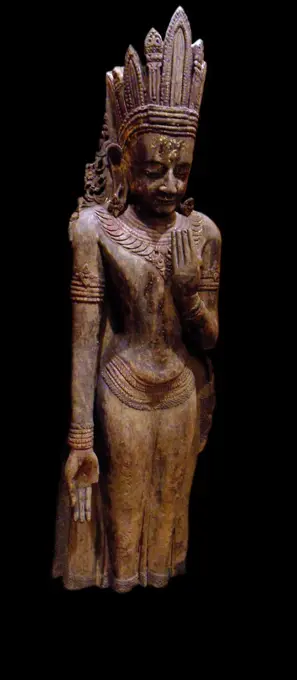
Prakhon Chai  is a district (Amphoe) in the southern part of Buriram Province, northeastern Thailand. In 1964, artwork depicting Buddhist figures, including Avalokitesvara, was discovered in Prakhon Chai. Originating from the Pre-Angkor period, these figures reflect traditional Indian styles, as passed down through the Cambodian tradition of the Chenla Kingdom. Avalokiteśvara ('Lord who looks down') is a bodhisattva who embodies the compassion of all Buddhas. Portrayed in different cultures as either male or female, Avalokiteśvara is one of the more widely revered bodhisattvas in mainstream Mahayana Buddhism, as well as unofficially in Theravada Buddhism.
6145-29168366
Bodhisattva Avalokiteshvara second quarter of the 8th century Northeastern Thailand The savior Avalokiteshvara, identified by the seated image of the Buddha Amitabha in his headdress, embodies infinite Buddhist compassion. The cult of ascetic bodhisattvasobserve his simple attirewas particularly powerful in Southeast Asia during the seventh and eighth centuries. This bronze image has a high tin content which would have given it the appearance of silver when newly cast. It was undoubtedly the product of elite royal patronage, yet the region where it was discovered, in northeastern Thailand, remains an historical enigma. It may be linked to a polity referred to as Canasa, with a capital named Canasapura, somewhere in the Khorat Plateau of northeast Thailand. But associating this object with that kingdom is speculative at best. Essentially the polity responsible for this extraordinary high quality and high value object remains unknown. Listen to experts illuminate this artwork's story L
6145-43630970
Figurka boga Mahesa. unknown, author
6145-29187642
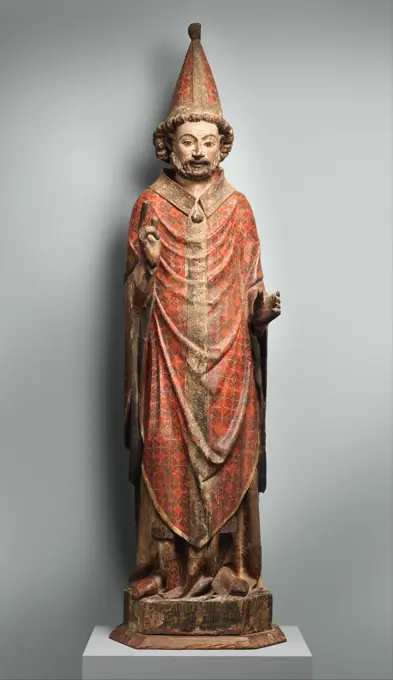
Saint Peter as the First Pope before 1348 Catalan Indentified by his papal tiara, the apostle Peter wears an ornately decorated ecclesiastical vestment (chasuble). The keys signifying his role as guardian of the gates to Heaven, which were given to him by Christ, are missing. The inscription indicates that the sculpture was commissioned by Bernat Pere, chaplain at the cathedral, who died in 1348.. Saint Peter as the First Pope. Catalan. before 1348. Pine partially covered with canvas, gesso, and paint. Made in present-day Spain. Sculpture-Wood
6145-30114135
Staande Boeddha.Standing Buddha; Hands, part of the arms, the feet and part of the rug are missing.
6145-29721981
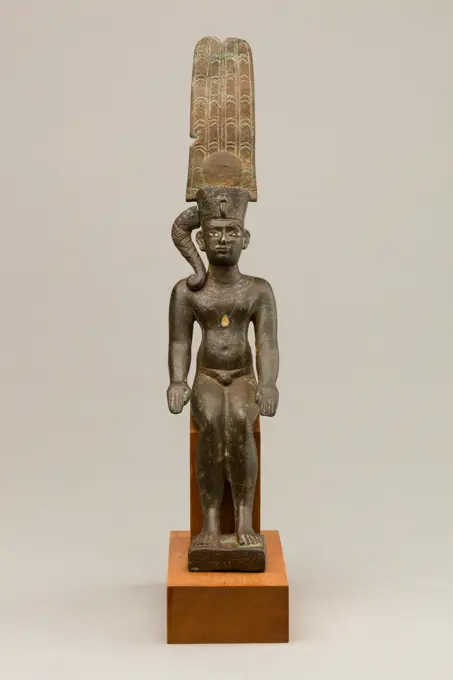
Child god with the Amonian crown named Horus of Mednit (Aphroditopolis) 664-30 B.C. Late Period-Ptolemaic Period The figure represents a child god in a seated/reclining position, wearing the double feather crown, which associates him with the god Amun. The child god is usually distinguished from adult gods by a range of iconographic clues: his nudity, the finger raised to the mouth (a child-like gesture), and a sidelock on the right side of his head. The right arm is at his side, like the left arm, but the sidelock and his nudity suffice for identification as a child god. An amulet hangs beneath the broad collar on the chest, and the amulet is another attribute common to child gods but not adult gods. The figure also has a slightly rounded, chubby belly, showcasing his ability to bring about prosperity and abundance.Child gods grew in popularity and cult from the Third Intermediate Period onwards, rivaling even the most powerful and ancient gods, especially as temple offerings. The imp
6145-29063796
Horse-Headed Kannon (Batō Kannon), 14th century. Japan, Kamakura period (1185-1333). Wood; overall: 110.6 cm (43 9/16 in.); base: 28 cm (11 in.); figure: 82.6 cm (32 1/2 in.). Bato Kannon is the "Horse-Headed" Avalokitesvara, or Bodhisattva of Compassion, who presides over the realm of animals in the Buddhist Six Realms of Existence.
6145-29823575
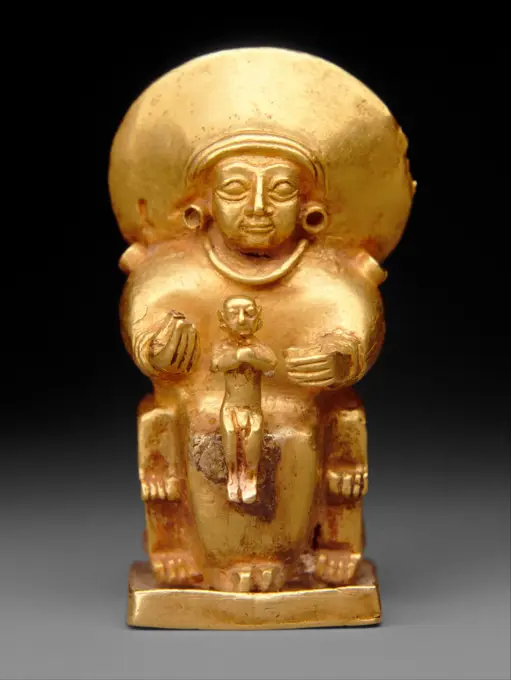
Seated goddess with a child ca. 14th-13th century B.C. Hittite This tiny pendant was probably intended to be worn round the neck as an amulet. Small gold figures with loops survive from Iran, Mesopotamia, the Levant, and Egypt, attesting to the widespread use of such objects. Similar objects from Hittite culture suggest that these small figures were portable representations of Hittite gods. The figure shown here, cast in gold using the lost-wax process, is of a seated goddess in a long gown, with large oval eyes and a thin mouth with creases at the sides. She is wearing simple, looped earrings and a necklace. Her disk-like headdress probably represents the sun, which would lead to the conclusion that this may be the sun goddess, Arinna, a major Hittite divinity. A loop for suspension protrudes from the back of the headdress. On her lap the goddess holds a naked child, cast separately of solid gold and then attached. The chair on which they are seated is backless and has lion paws.. Sea
1788-17085
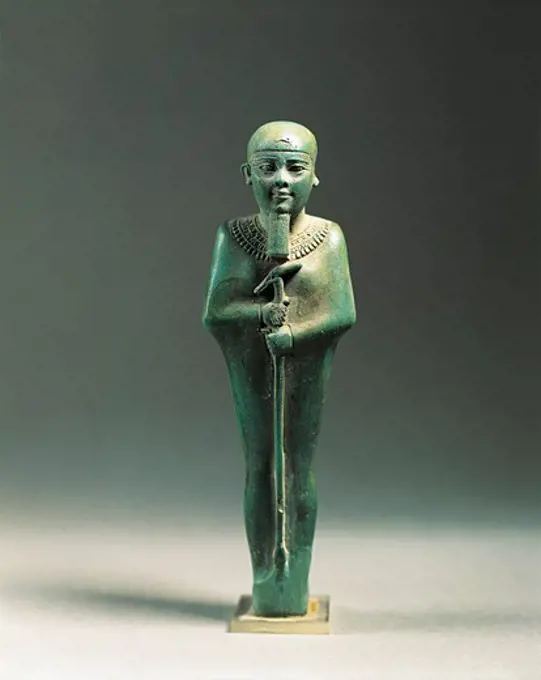
Statue of god Ptah, Egyptian civilization
1746-21109116
Mayan ceramic figurine of a kneeling female shaman or priestess. From Simojovel; Chiapas, Mexico 600-900 AD
1746-19675246
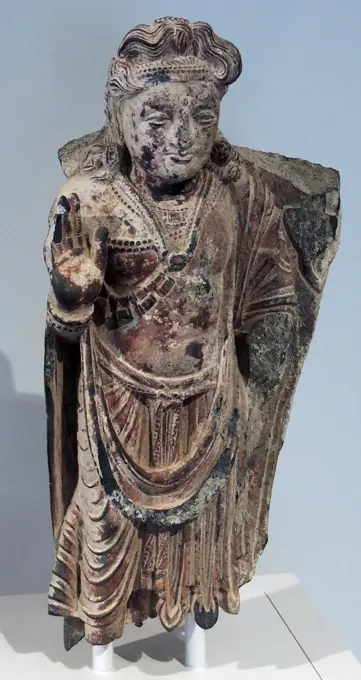
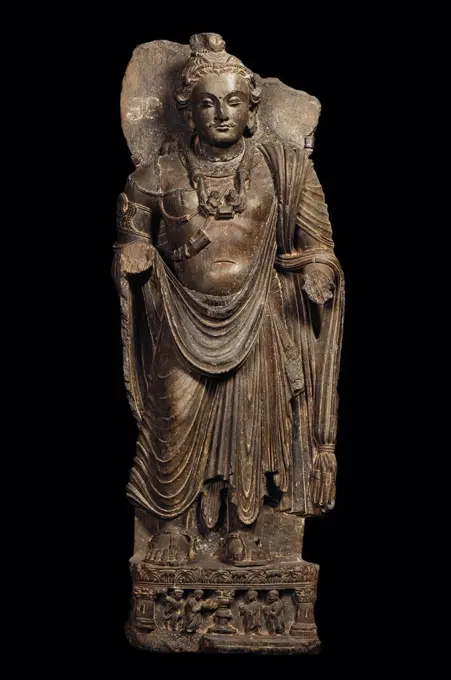
The bodhisattva Maitreya, Pakistan, Gandhara, 3rd century painted and gilded slate. Maitreya, the Buddha of the future, is making the abhaya mudra, or fear not gesture. His webbed fingers are a sign of his divine nature. This figure shows that Buddhist art in Gandhara, which was in contact via trade routes with religions around the Mediterranean Sea, was influenced by Greco-Roman sculpture. The drapery folds of the Maitreyas lower garment, for instance, recall Roman figures, while his hairstyle is based on representations of the Greek god Apollo.
6188-64528824
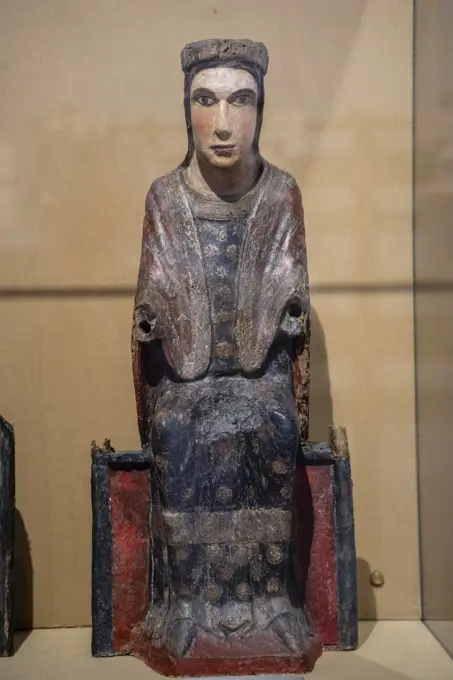
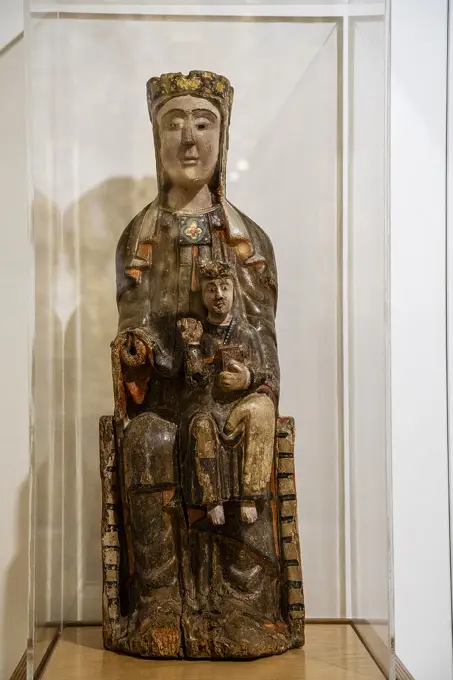
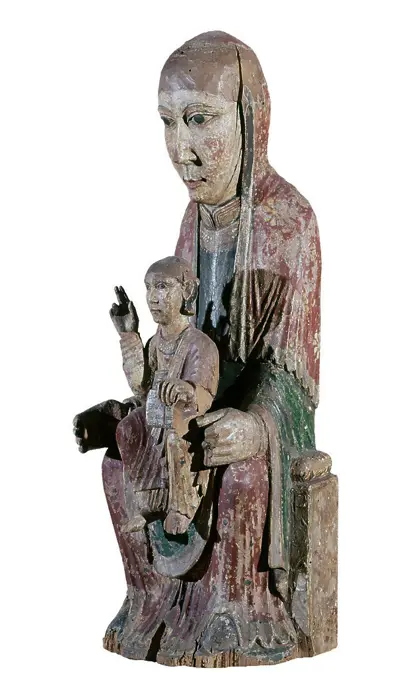
jungfrau maria in polychromem holz virgin mary in polychrome wood, 12th century, Catalan work, Girona art museum, Girona, Catalonia, Spain Copyright: xZoonar.com/TOLOxBALAGUERx 22282889
6145-29758269
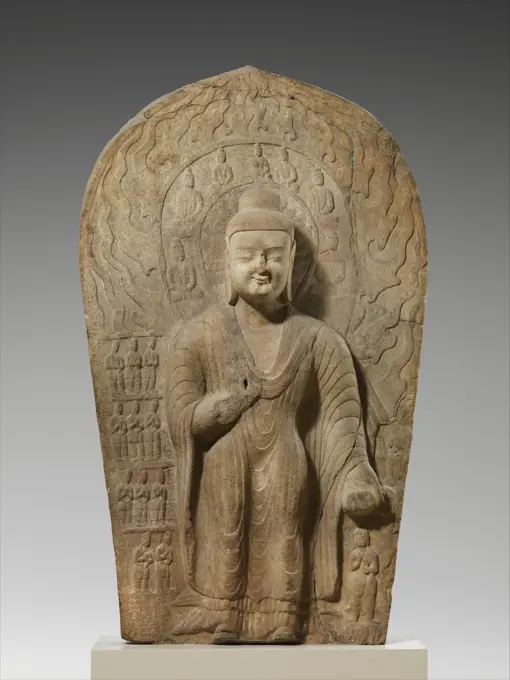
Buddha Dipankara (Dingguang) dated 495 (19 () year of Taihe reign) China The inscription on the back of this stele identifies the Buddha depicted on the front as Dipankara, who was thought to have lived before the historical Buddha Shakyamuni. He is shown here attended by a group of small figures wearing the clothing of the Xianbei, the non-Han Chinese peoples who ruled the Northern Wei dynasty. The smaller standing figure to the Buddha’s right may represent a youth named Sumedha, who was destined to become the historical Buddha in another lifetime. The imagery of this large sculpture is therefore intended to illustrate the promise or possibility of enlightenment in a future life. In Buddhism, the achievement of this advanced spiritual state is the goal of all practitioners. The bodhisattva with crossed ankles on the back of the stele recalls similar figures in the collection from the Yungang cave temple complex. Listen to experts illuminate this artwork's story Listen Play or pause #
4266-21641593
Standing Bodhisattva Maitreya, The Oriental Applied Arts
6145-29158047
Standing bodhisattva China. Standing bodhisattva. China. Gilt bronze, wood. Sui dynasty (581-618) (). Sculpture
6145-45525069
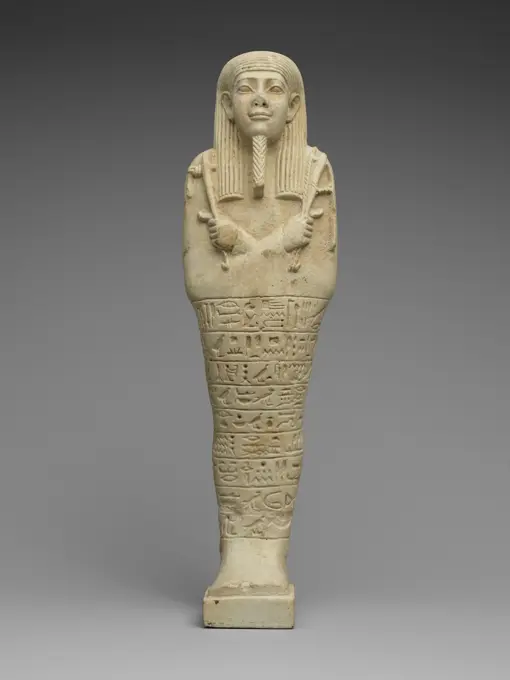
Ushabti
6145-29763592
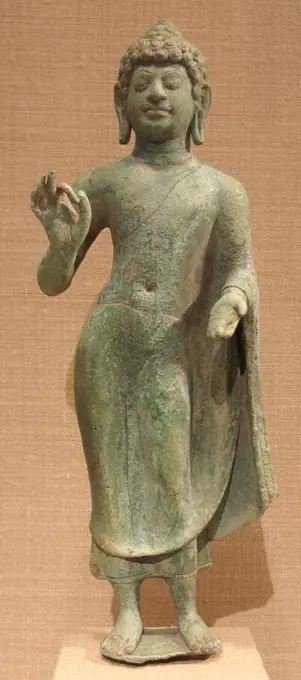
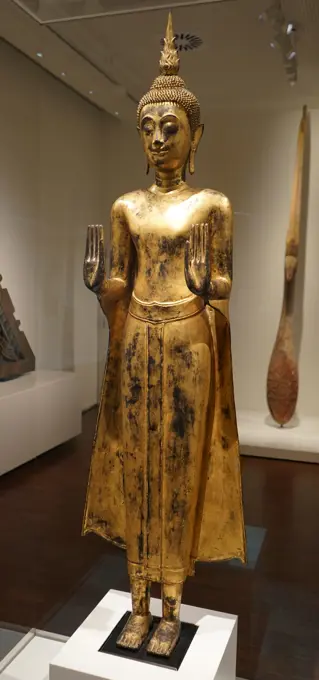
Standing Buddha 8th century Thailand. Standing Buddha. Thailand. 8th century. Bronze. Mon-Dvaravati period. Sculpture
6145-29829652
Fragment of a Bust of Buddha 8th century India (Jammu & Kashmir, ancient kingdom of Kashmir). Fragment of a Bust of Buddha 38402
6145-45928135
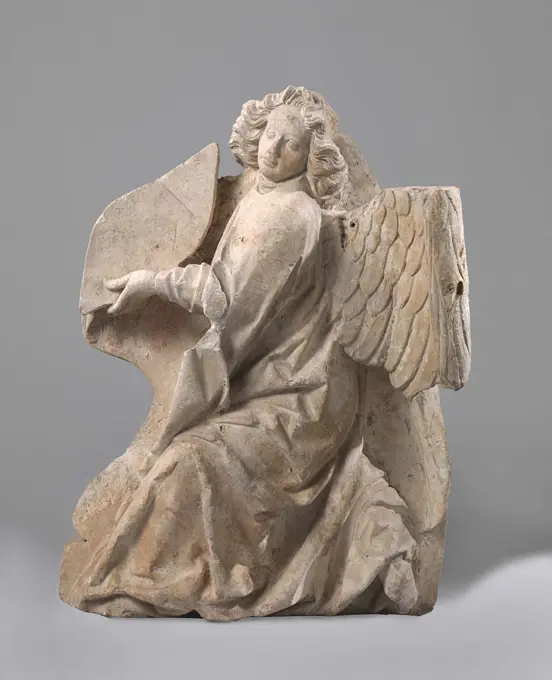
Kneeling angel (shield bearer).
6145-29706497
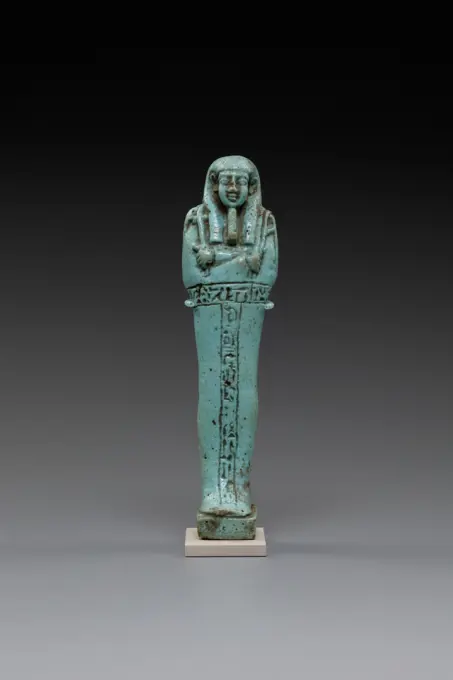
Shabti of Nesbanebdjed ca. 380-342 B.C Late Period This shabti comes from a tomb discovered in 1902 at the site of the ancient city of Mendes (Tell el-Ruba), the capital of Egypt for a short time during the Late Period. One of the two chambers of the tomb was almost completely empty, with only a few fragments of gold leaf left behind. In the second chamber were over 360 complete shabtis, plus a number of fragments. Most were inscribed, like this one, for the priest Nesbanebdjed. Of these shabtis, 322 had the type of T-shaped inscription seen here (see also 10.130.1044a). About 100 of Nesbanebdjeds shabtis remained in Egypt; many more can be found in museum and private collections around the world.Nesbanebdjeds priestly titles associate him with the cult of the ram-god Banebdjed, who was part of the Mendesian triad with the goddess Hatmehyt and the child god Harpocrates.. Shabti of Nesbanebdjed. ca. 380-342 B.C. Faience, green glazed. Late Period. From Egypt. Dynasty 30
6145-29162383
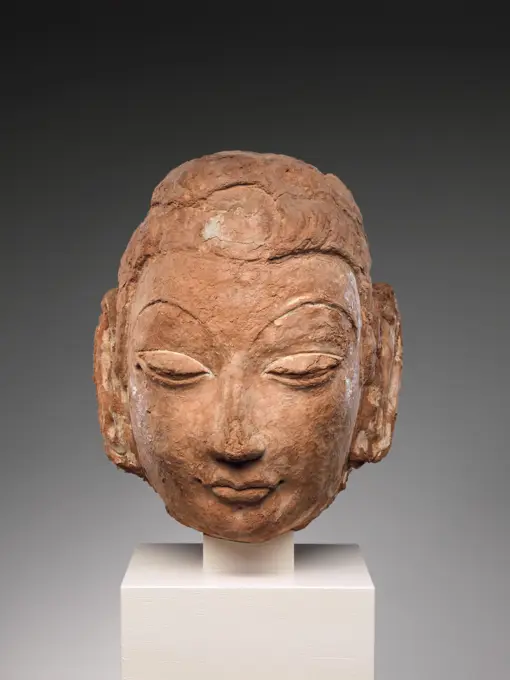
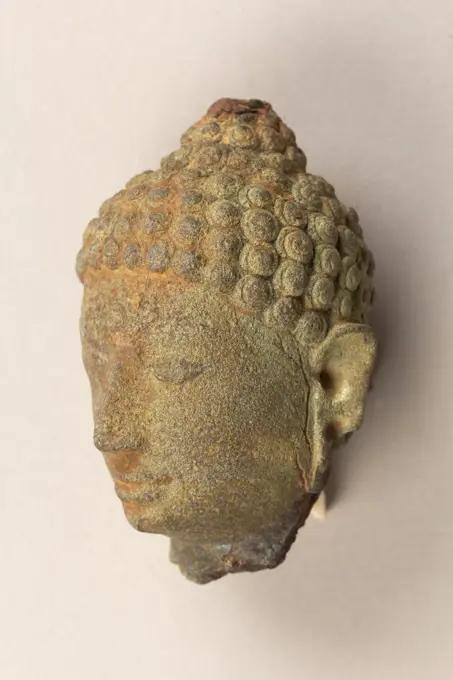
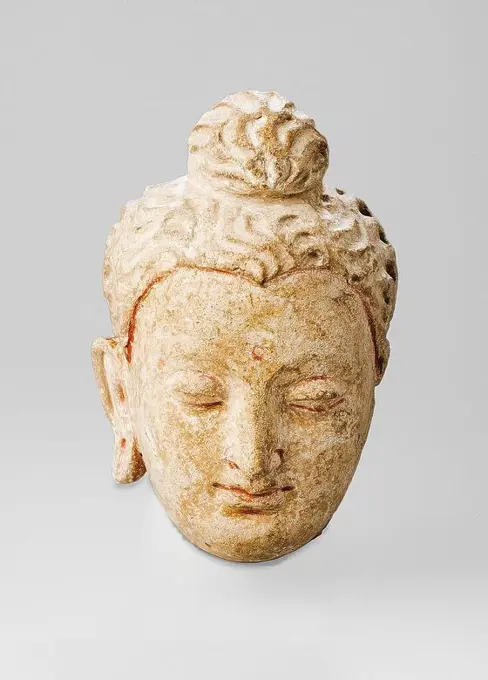
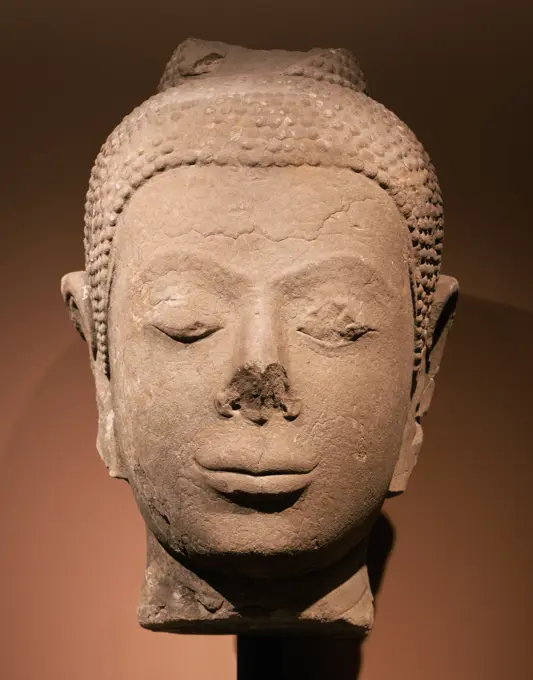
Head of Buddha 6th-7th century China (Xinjiang Autonomous Region) This unfired head is related to fifth- to seventh-century clay sculpture from Afghanistan, especially in the treatment of the eyebrows and in the hairstyle of three rows of curls. The site of Rawak comprises a cruciform stupa (relic mound) based on architecture established in Afghanistan and Gandhara; the enclosing wall of this sacred precinct was embellished with hundreds of clay Buddhas and bodhisattvas such as this one.. Head of Buddha 39904
6145-29764687
The Transcendent Buddha Vairochana () Seated in Western Fashion 9th century Indonesia (Java). The Transcendent Buddha Vairochana () Seated in Western Fashion 39021
6145-29750567
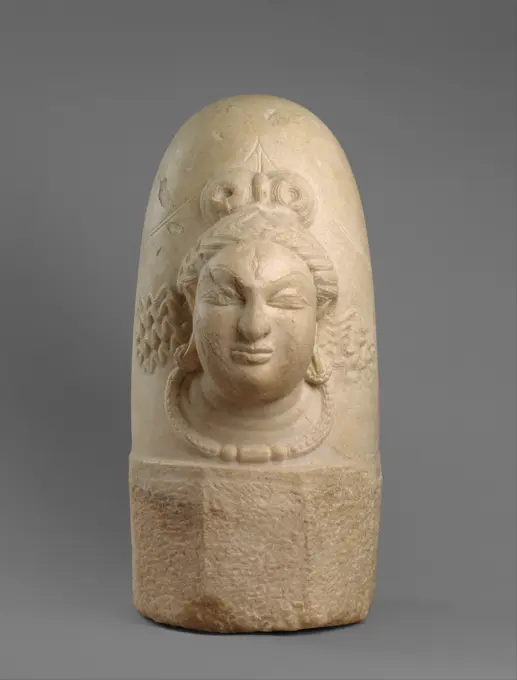
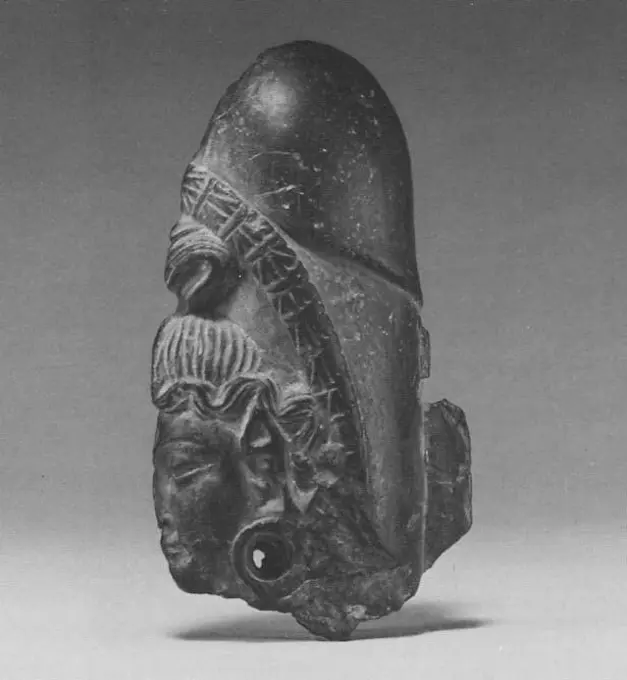
Linga with Face of Shiva (Ekamukhalinga) 9th century Afghanistan The linga, the aniconic pillar symbol emblematic of the Hindu god Shiva, symbolizes his essential generative powers. Here, the form is phallic, addorsed with Shivas face in a style reflecting iconographic innovations of the region as well as inherited design conventions from fifth-and sixth-century Gupta north India. The Shahi kingdom flourished in eastern Afghanistan only from the seventh to the ninth century, yet it produced a highly distinctive corpus of Hindu religious imagery. Typically sculpted in white marble, these works reflect links east, most notably to Kashmir for Shaiva imagery, and west, as seen in the flying locks of hair inspired by Sasanian royal imagery.. Linga with Face of Shiva (Ekamukhalinga) 38246
6145-46650017
. Topeng mask, role: figure from the monkey army, light blue face color, eyebrows and her black. Ornamented sections between the hair plated.
6145-43652499
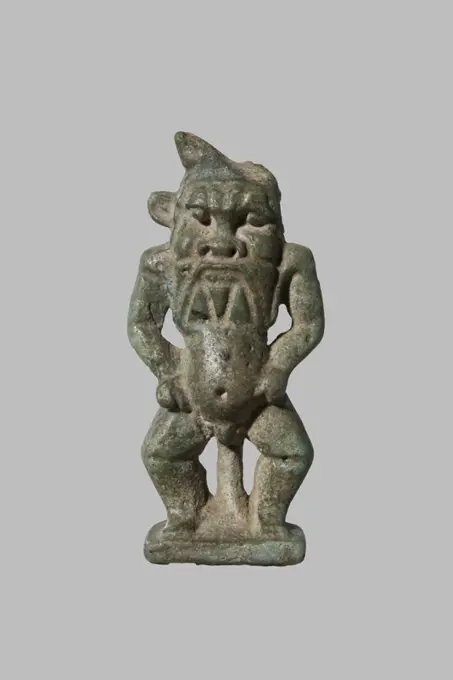
Amulet - Bes. unknown, author
6145-29129201
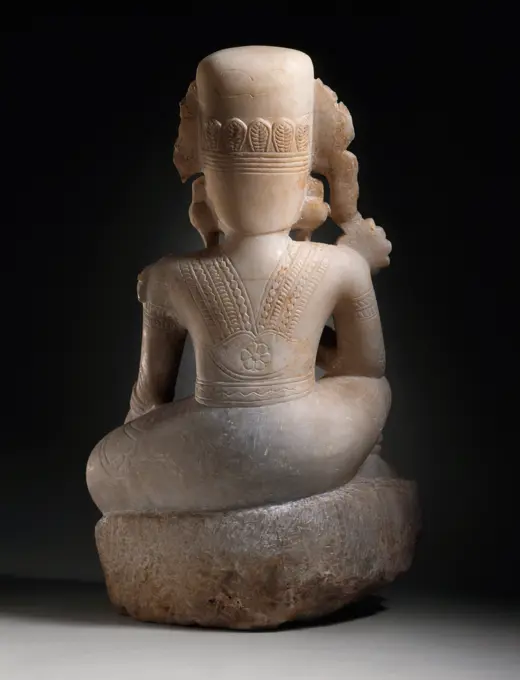
The Bodhisattva Lokanatha. Burma (Myanmar), Mandalay, circa 18th century. Sculpture. White marble
6145-29147786
Buddha 19th century China. Buddha. China. 19th century. Nephrite. Qing dynasty (1644-1911). Jade
6145-29143924
Bodhisattva Manjushri (Wenshu) 12th-14th century China. Bodhisattva Manjushri (Wenshu) 39636
1746-30020320
Statue of Isis a major goddess in ancient Egyptian religion whose worship spread throughout the Greco-Roman world. Isis was first mentioned in the Old Kingdom (c.2686 - c.2181 BCE) as one of the main characters of the Osiris myth, in which she resurrects her slain brother and husband, the divine king Osiris, and produces and protects his heir, Horus. She was believed to help the dead enter the afterlife
6176-67038709
Inuit carving of a human figure, 19th century. Artist: Unknown
6145-58825097
Jizo Bosatsu, Anonymous, C. 1200 -C. 1250 Standing Jizo that are missing hands and feet. Jizo Bosatsu. Japan wood (plant material). dye Standing Jizo that are missing hands and feet. Jizo Bosatsu. Japan wood (plant material). dye
6145-30194128
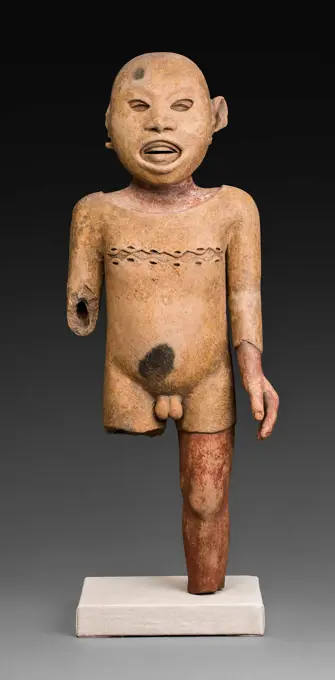
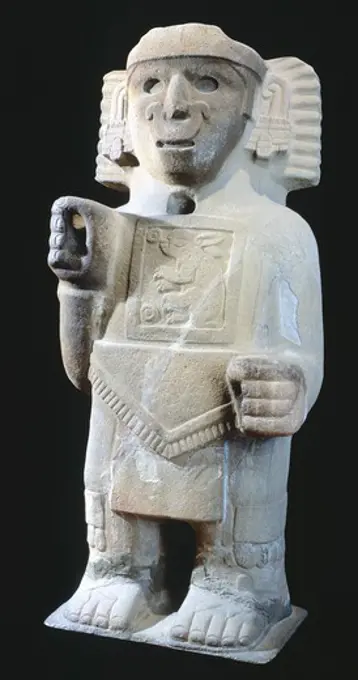
Ritual Impersonator of the Deity Xipe Totec 1450-1500 Veracruz. As a god of the late dry season and early rainy season (MayñJune), Xipe Totec (ìThe Flayed Oneî) expresses regeneration. By the time of Spanish contact in 1519, the cult of this deity was widespread throughout Mesoamerica. This figure depicts a young male wearing the skin of a sacrificed victim, a primary symbolic aspect of rituals conducted during agricultural fertility ceremonies dedicated to this deity. The lines across the chest represent stitched seams where the skin was fastened. Like living seed within a dried husk, the deity impersonator embodies the relationship between death and the renewal of life.. Ceramic and pigment . Aztec (Mexica)
6145-29828918
Head of Vishnu Wearing Three-Lobed Crown ca. 5th century India (Jammu and Kashmir). Head of Vishnu Wearing Three-Lobed Crown 38407
6145-29117174
Probably Shakyamuni (Shijiamouni), the Historical Buddha. China, Tang dynasty, about 700-800 A.D.. Sculpture. Carved marble with traces of paint and gilding
6145-29742991
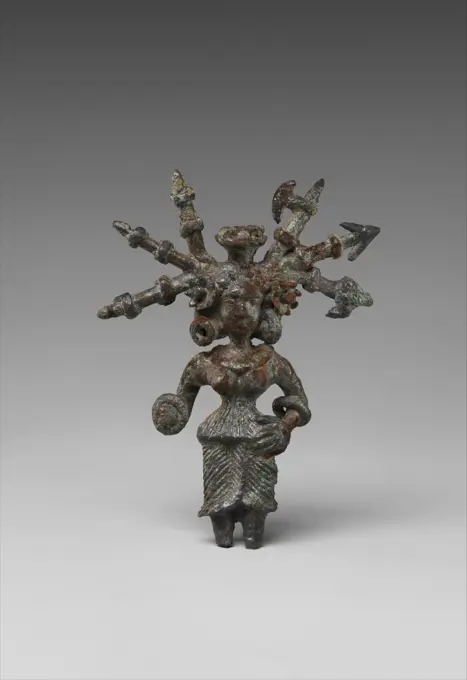
Goddess with Weapons in Her Hair 2nd century B.C. North India (possibly Kausambi, Uttar Pradesh) This miniature figure is among the earliest known representations in metal of a goddess with weapons radiating from her hair. The style suggests she was made in the Ganges basin region of northern Indiaprobably at the ancient Magadha capital of Pataliputra (Patna)and attests to this region being instrumental in the development of this iconography. About the early fifth century, the fully elaborated form of the goddess Durga appears, first in a rock-cut depiction at Udayagiri, displaying the same weapons. While the precise identity of our figure is unknown, she is clearly part of an emerging protector goddess tradition.. Goddess with Weapons in Her Hair 38924
1788-41643
God of pulque, artifact originating from da Castillo de Teayo (Mexico). Pre-Colombian Huasteca Civilization, 10th Century.
6145-29809993
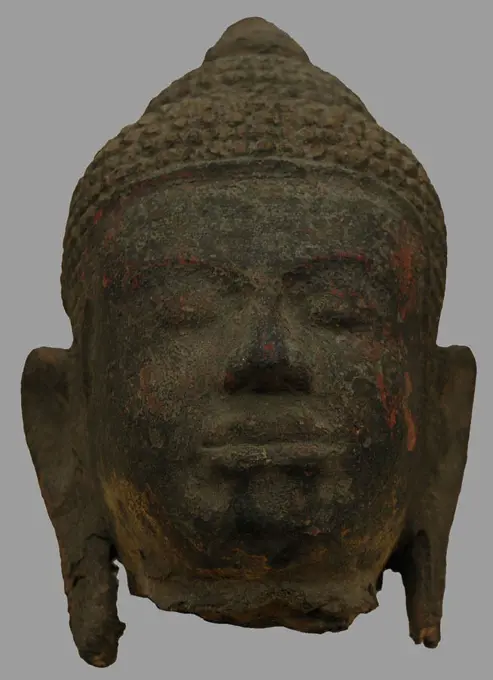
Head of Buddha ca. 12-14th century () Cambodia. Head of Buddha 38888
6145-46237853
Parvati. Parvati (standing). with Vadamudra and lotus stalk; Equipped with a Nimbus.
6145-29241137
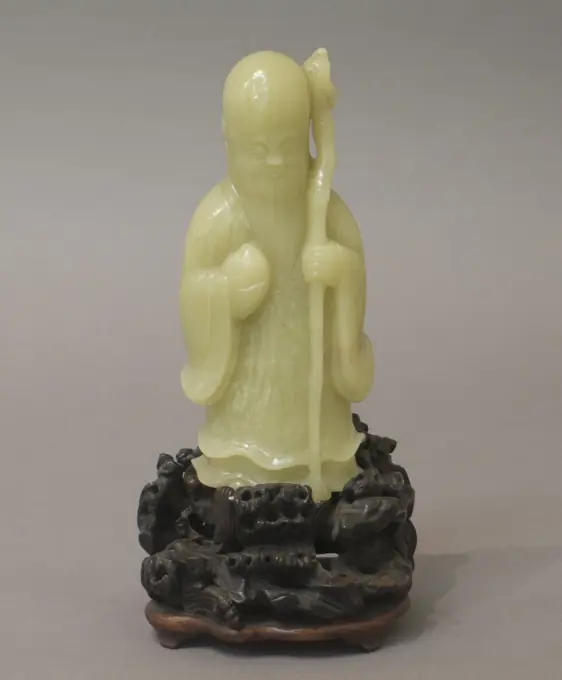
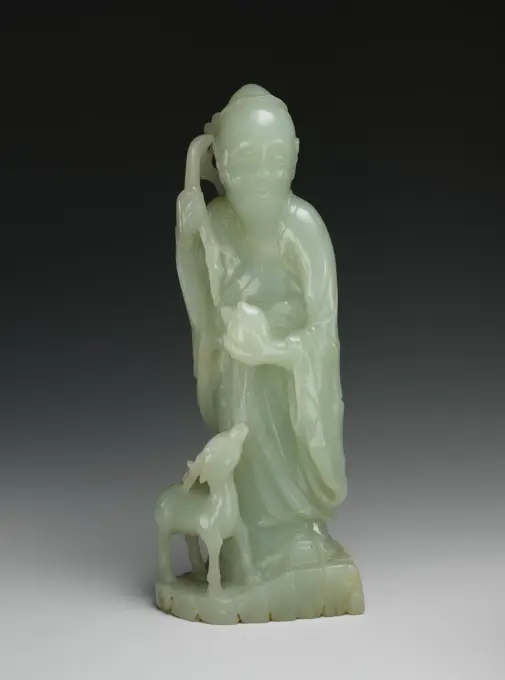
God of Longevity (Shoulao) and a deer 18th-19th century China. God of Longevity (Shoulao) and a deer. China. 18th-19th century. Jade (nephrite). Qing dynasty (1644-1911). Jade
4409-17352063
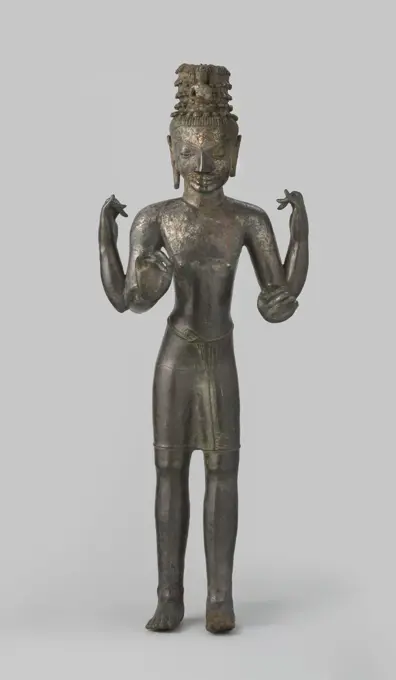
Standing Eight-Armed Avalokiteshvara, the Bodhisattva of Infinite Compassion. Culture: Cambodia or Thailand. Dimensions: H. 77 1/2 in. (196.9 cm); W. 33 1/4 (84.5 cm); D. 20 in. (50.8 cm). Date: late 12th century.The facial features of this sculpture are thought to reflect the appearance of the ruler Jayavarman VII, who commissioned the Bayon temple complex. Museum: Metropolitan Museum of Art, New York, USA.
6145-29164654
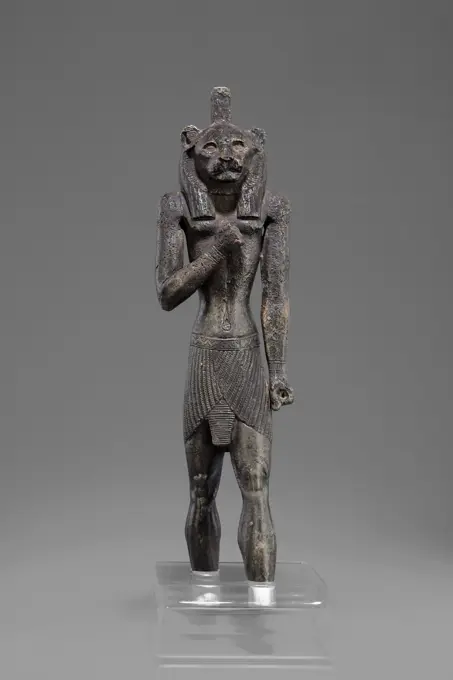
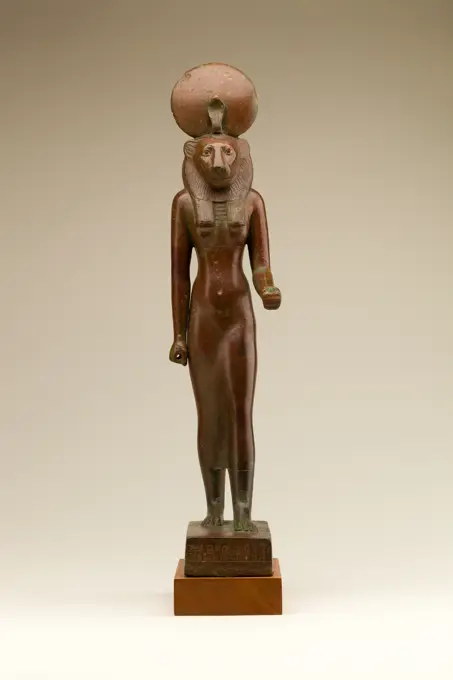
Statuette of Wadjet in the name of Akanosh son of Pediamenopet ca. 1070-664 B.C. or later Third Intermediate Period-Kushite Period or later Statuary and equipment in bronze and precious metals have long associations with temple cult and ritual. While the king traditionally made such gifts in his role as mediator between the gods and mankind, by the Third Intermediate Period much of the divine statuary in temples originated from nonroyal gifts, and great numbers of divine statuettes were inscribed with prayers for their donors eternal life. Evidence from a slightly later period indicates that such consecration of temple items for the benefit of a given individual was associated with their having provided some form of economic support for the temple or temple personnel. Lioness headed Wadjet is inscribed with the name of a donor Akanosh, a Libyan name, although the statue may date later than the Third Intermediate Period.. Statuette of Wadjet in the name of Akanosh son of Pediamenopet
6145-29708029
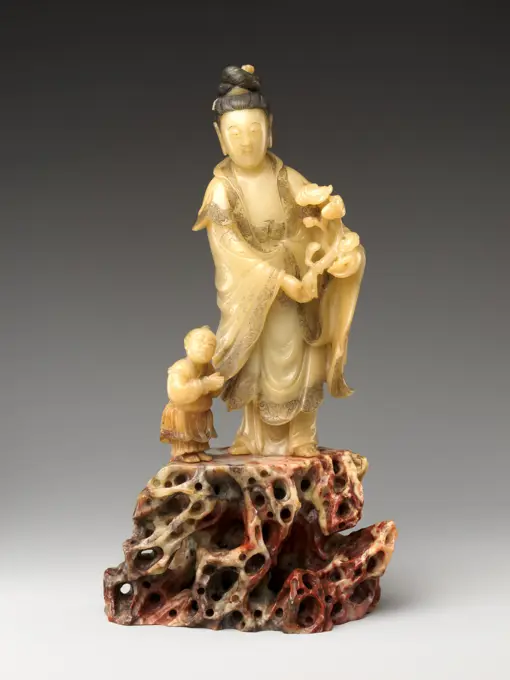
Bodhisattva Guanyin and attendant Sudhana 18th century China. Bodhisattva Guanyin and attendant Sudhana. China. 18th century. Soapstone. Qing dynasty (1644-1911). Hardstone
6145-29241160
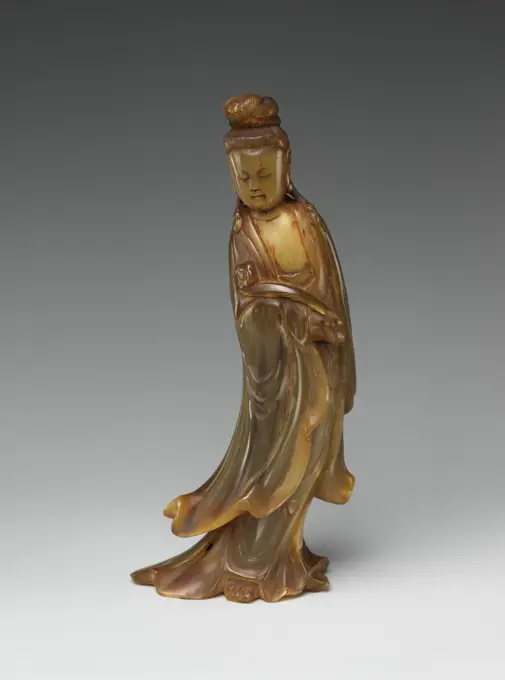
Bodhisattva Guanyin 18th-19th century China. Bodhisattva Guanyin. China. 18th-19th century. Horn. Qing dynasty (1644-1911). Horn
1899-77935977
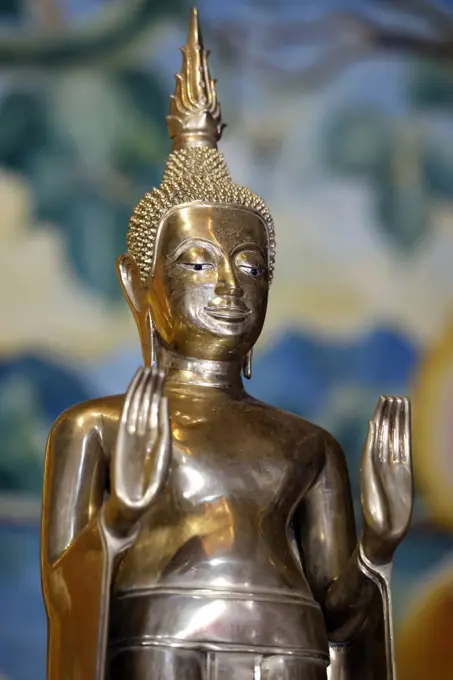
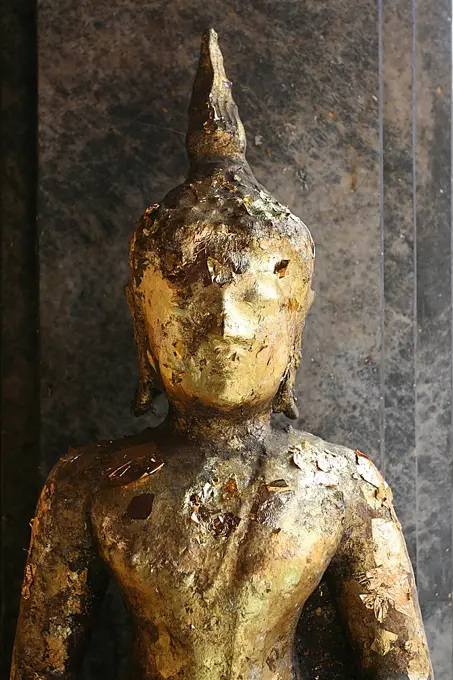
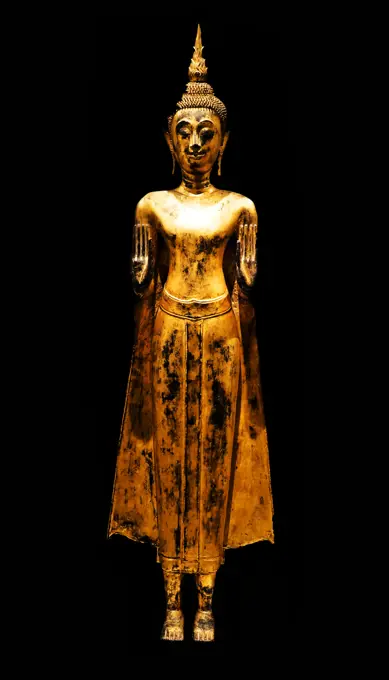
Wat Visounnarath buddhist temple. Wooden Buddha ( calling for the rain position ).  17 th - 18 th century. Wood, lacquer, gold leaf.  Luang Prabang. Laos.
6145-29815853
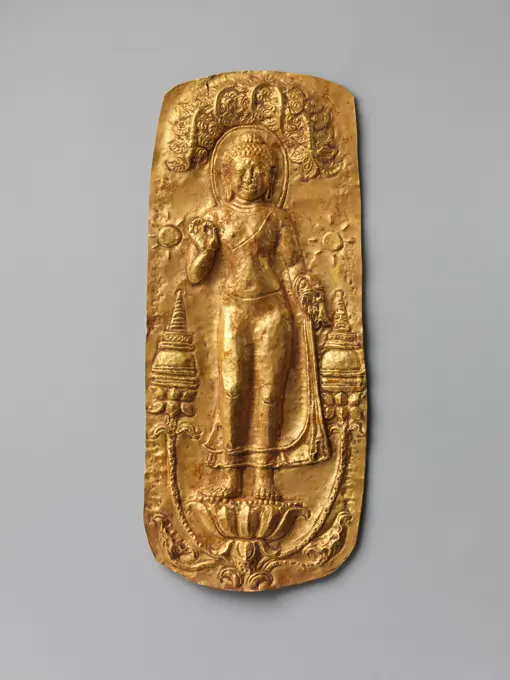
Plaque with Standing Buddha ca. 8th-9th century Thailand This Buddha holds his right hand in a teaching gesture (vitarkamudra) and stands under a tree that alludes to Bodhgaya, the place of his enlightenment. Such gold plaques were sometimes buried as a foundation deposit prior to the construction of a temple.. Plaque with Standing Buddha 61859
6145-29065233
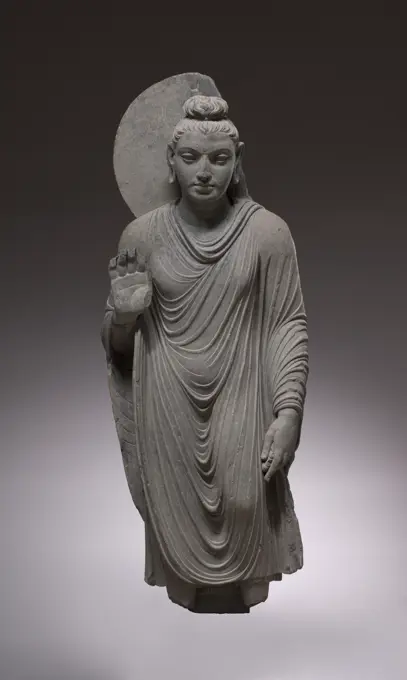
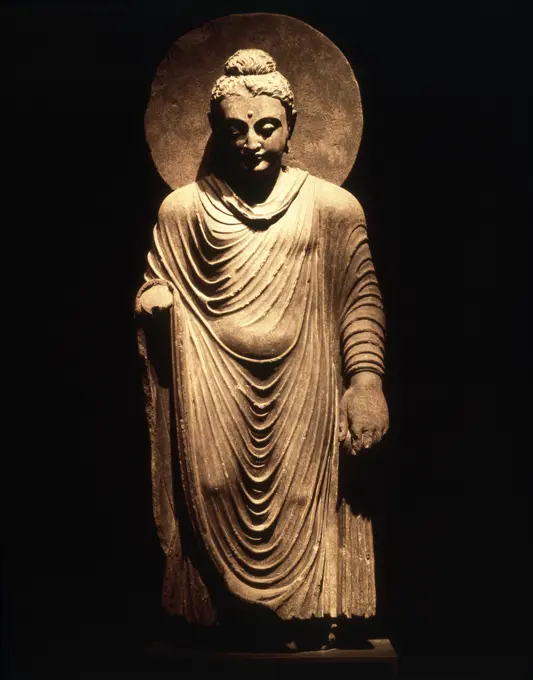
Standing Buddha, AD 150-200. Pakistan, Gandhara, Kushan Period. Schist; overall: 119.7 cm (47 1/8 in.); head: 1.5 x 3.2 cm (9/16 x 1 1/4 in.).
1525-21220371
Buddha
6145-52954072
Head of Buddha Indonesia (Kalimantan) ca. 8th century View more. Head of Buddha. Indonesia (Kalimantan). ca. 8th century. Bronze. Sculpture
6145-29125141
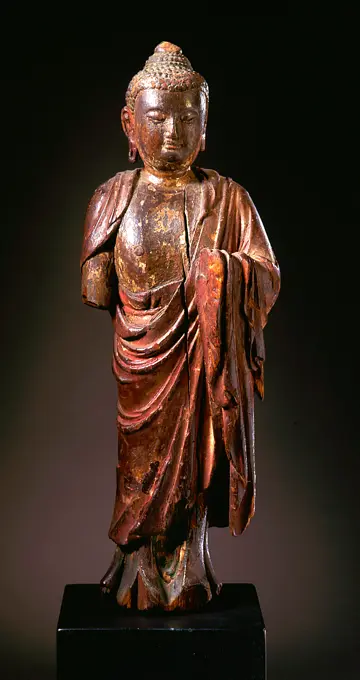
Shakyamuni (Shijiamouni), the Historical Buddha. China, Yuan dynasty, 1279-1368. Sculpture. Carved wood with painted lacquer and gilding
6145-29144271
Buddha dated 717 China. Buddha 61773
6145-58825154
Two Statuettes of Padmapani, anonymous, 850 - 930 Sculpture of a standing Padmapani (Avalokitesvara) with back plate. Indonesia bronze (metal) Sculpture of a standing Padmapani (Avalokitesvara) with back plate. Indonesia bronze (metal)
1746-21109087
Mayan ceramic figurine representing a dwarf. From Mexico. 600-900 AD
1746-21116052
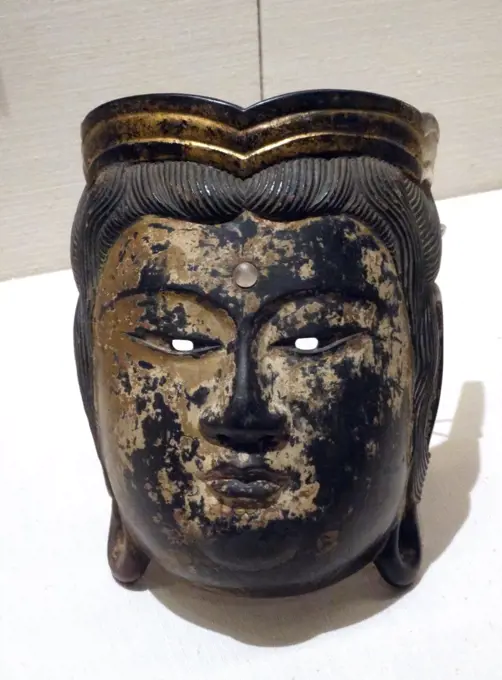
Wooden Bodhisattva Mask. Dated 13th Century
4443-28735443
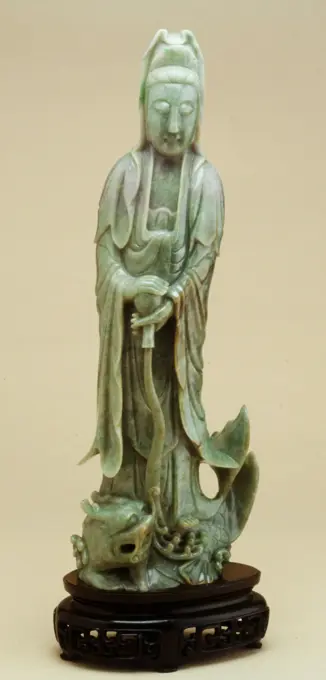
Kwan Yin pouring Flask of Water, 19th century, 19in. (48.3cm), Jade, China, 19th century
6145-30374161
Human Figure(Iginga)
1746-21111313
Wooden and leather puppet of King Akpan Chukwu from the Cross River region of Nigeria. Dated 20th Century
6145-29785714
Head of a Deity 8th century Thailand (probably Ratchaburi province). Head of a Deity 38444
1788-23384
India, Uttar Pradesh, Mathura, figurine of the hindu God Yaksha Manibhadra by Gomitaka (pupil of Kunika from Parkham), Maurya period
1746-21109106
Mayan, ceramic figure, representing a male Shaman or priest. From Jaina, Campeche, Mexico 600-900 AD
6145-29169697
Seal with mantra in Vartu script early 15th century China Written in Vartu script, the six characters engraved on the bottom of this seal read "aa-ra-pa-tza-na-dhi," which is a mantra of Manjusri, the bodhisattva of wisdom. First developed in India, Vartu script was adapted from cursive Sanskrit by Tibetan monks for ritual use from the eleventh century onward.. Seal with mantra in Vartu script 42012
6176-67037052
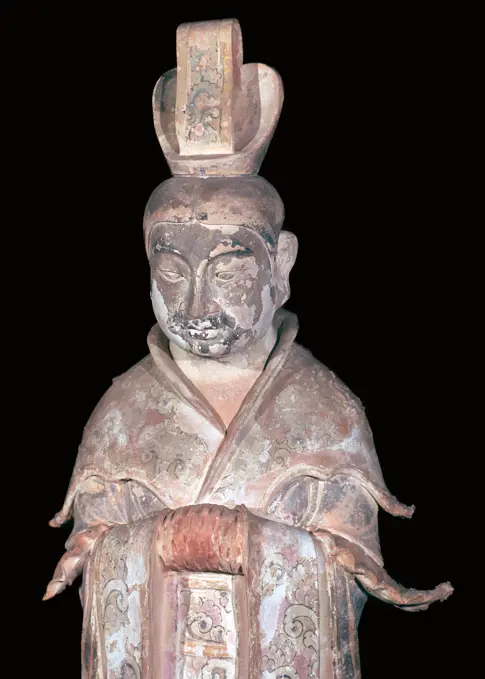
Earthenware Chinese figure of a tomb attendant, 7th century. Artist: Unknown
6145-29769221
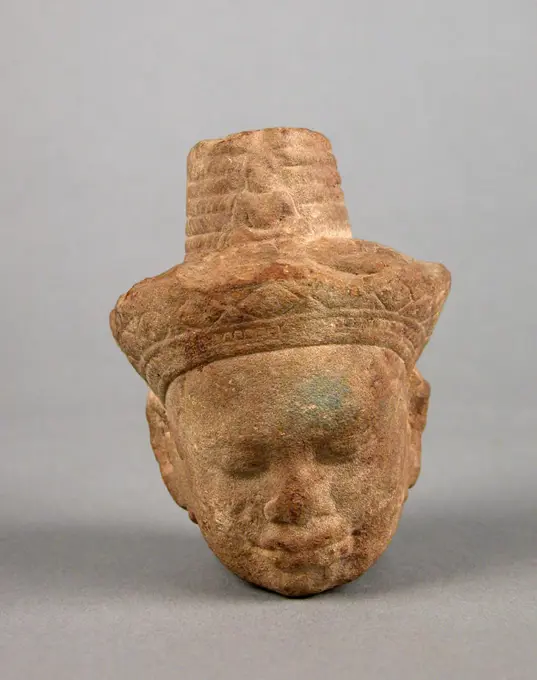
Head of Lokeshvara ca. second half of the 12th century Cambodia. Head of Lokeshvara 38550
4409-63013447
Head of a crowned Buddha. 18th century. Bronze. Ayutthaya. Thai art. Thailand. Museum of World Cultures Barcelona, Catalonia. Spain.
6145-29156477
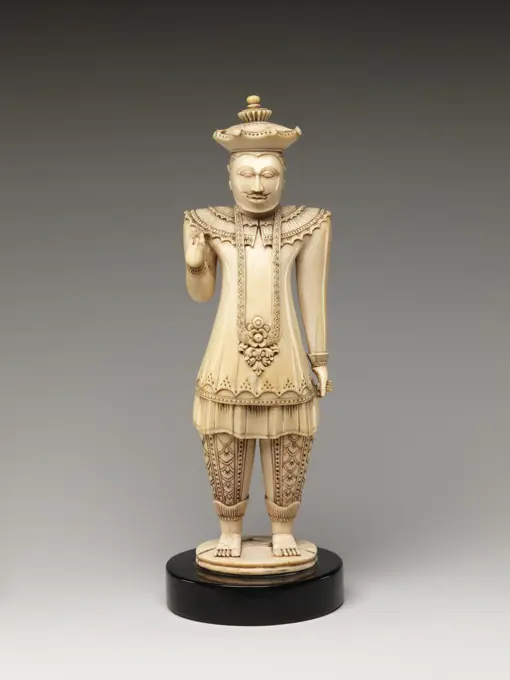
Portrait of the Sinhalese King Sri Vikrama Raja Sinha (r. 1798-1815) early 19th century Sri Lanka, Kandy district This portrait of the last Kandyan king shows him displaying his regalia: the six-pointed crown, a long shirt (kamisiya), a tunic (bo-hettya), and a cape (mante), over which hangs a floral pendant. The hand gestures mimic those of the Buddha: one raised, the other lowered and holding the robe. Such portraits are rare and were probably produced as presentation gifts for visiting diplomats.. Portrait of the Sinhalese King Sri Vikrama Raja Sinha (r. 1798-1815) 75586
1746-28980705
Bronze Thai Budda 17th-18th Century, Thailand
1746-21099137
Bronze Standing Buddha from Indonesia. Dated 8th Century
6145-29775655
Standing Buddha 15th century Thailand. Standing Buddha 39306
6145-29711190
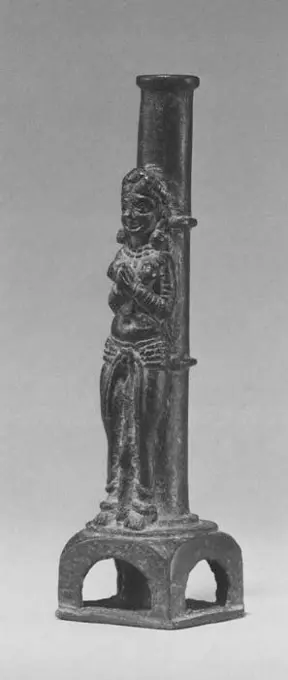
Female Worshipper in Front of a Column Support 1st century B.C.-early 1st century A.D. India This small votive sculpture was most likely designed as the support for a Buddhist emblem, probably a chakra (spoked wheel), here symbolizing the unfolding of Buddhist law. The only other similar object in the literature is a nonfigural chakra with base found at Brahmapuri and now lost. It is known today only through drawings. Our sculpture is in the form of a standing female adorant leaning against a pillar, her hands raised to her breast in anjalimudra, the gesture of adoration. The figure is nude except for elaborate jewelry and a long diaphanous dhoti, which falls in pleats between her legs and ends, uncharacteristically, above her ankles. The pillar is ringed with raised bands at its top and behind the figure's head and hips, and is set on a low double plinth.. Female Worshipper in Front of a Column Support 38925
6145-46522865
Christ as a man of sorrows. Standing christ figure, hands raised, thorns crown on the head. Blood flows from the right side in a chalice.
1899-18720997
The Benin Empire (1440-1897) was a pre-colonial African state in what is now modern Nigeria. It is not to be confused with the modern-day country called Benin (and formerly called Dahomey).
6145-29739404
Standing Bodhisattva 8th-9th century Pakistan. Standing Bodhisattva 38988
6145-44307572
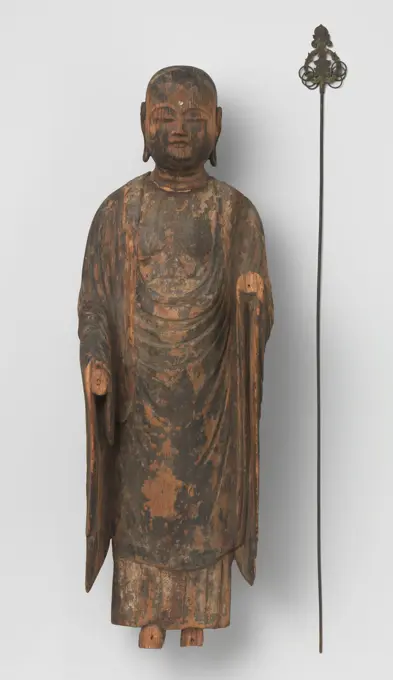
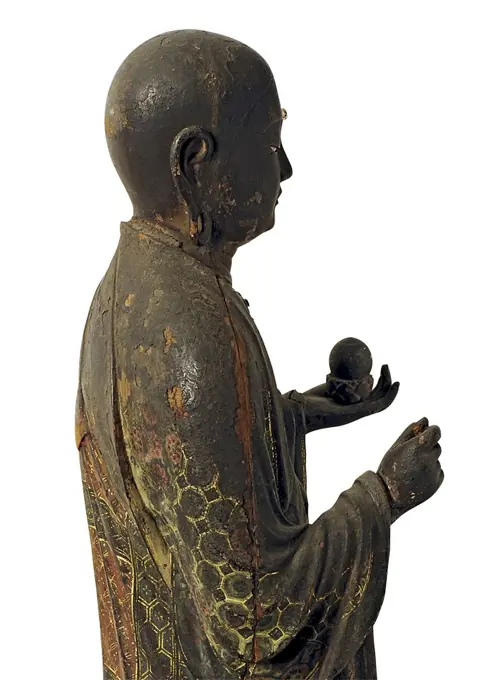
Sculpture of Jizō Bosatsu (Bodhisattva Kshitigararbha). Jiz, Protective God of the Children, counts in Buddhism to the Bodhisattva beings who have already obtained enlightenment and help people in their salvation. Jiz is presented as a hiking monk. In his left hand he carries the wish granting gem. His rights originally wore a rustle rod. Jiz is valid in Japanese popular beliefs To this day, as an embodiment of compassion and helper in need. He frees the souls of the deceased from hell, protects the travelers and protects children from illness and danger. Acquired from funds of the Amsinck Foundation
6145-59065356
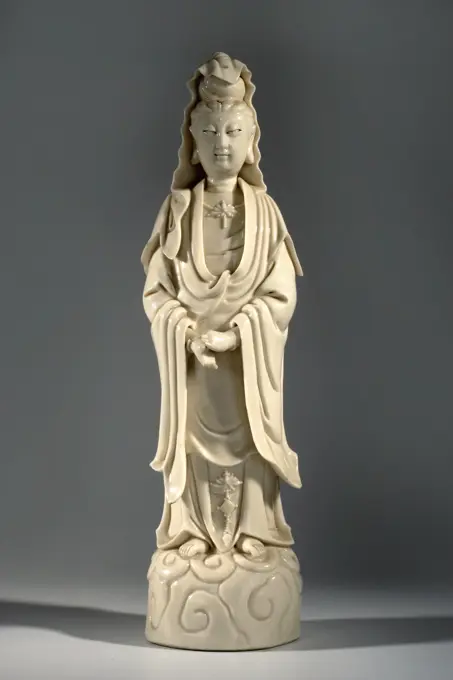
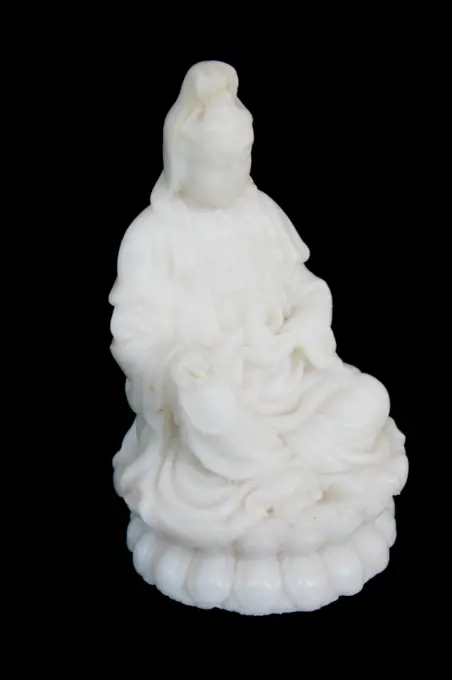
Bodhisattwa Guanyin;  18th century (1701-00-00-1799-00-00);Qing (style), Chinese (culture), figurines, porcelain, porcelain Blanc de Chine, Chinese art
6145-45944931
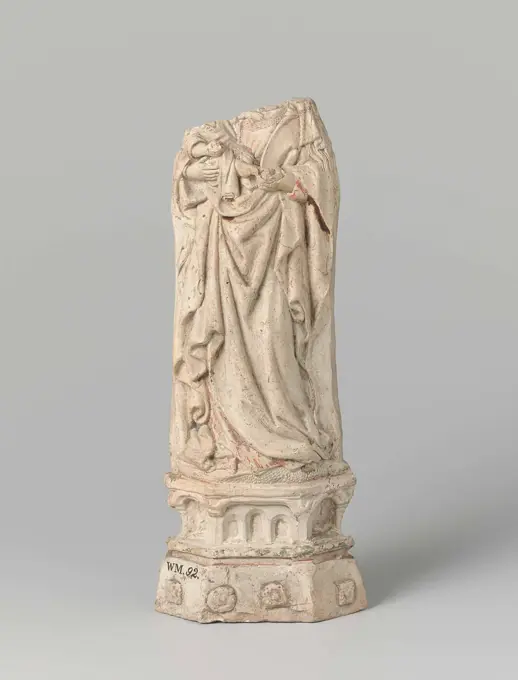
Virgin And Child, Fragment. On a soil, changing in a hexagonal profiled pedestal with arcades and niches, Mary stands with curved left knee. She is wearing the right arm the half-lying Christ child, which she has a foot in the left hand. The child puts his left hand on Maria's bosom and holds a fruit in the other. Maria's hair appears under the veil, which has been deposited with a pleated strip. Her robe, pleated the agent, shows an embroidered round neck deposition. The cloak to the left is included under the right arm. The child's shirt with turned sleeves also has embroidered hems. The front of the pedestal has four rosettes.
1788-6411
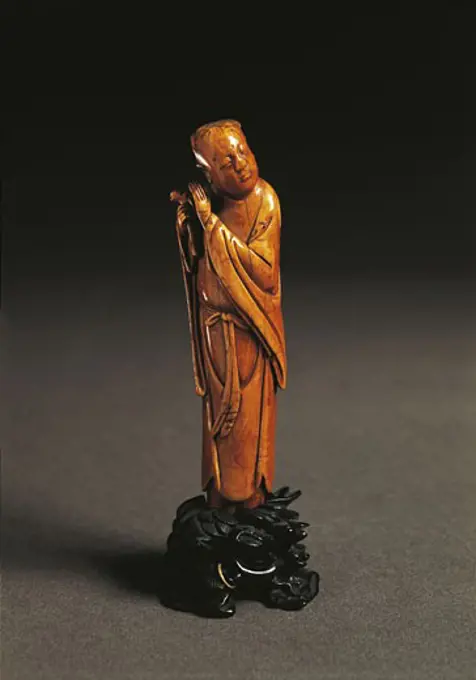
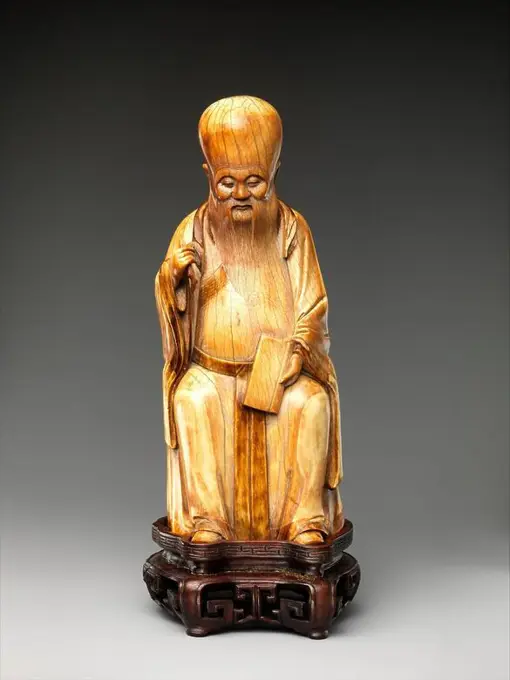
China - Ming period. Ivory statue with a wooden base of a Taoist philosopher having a ling-chin mushroom in hand
6145-29823729
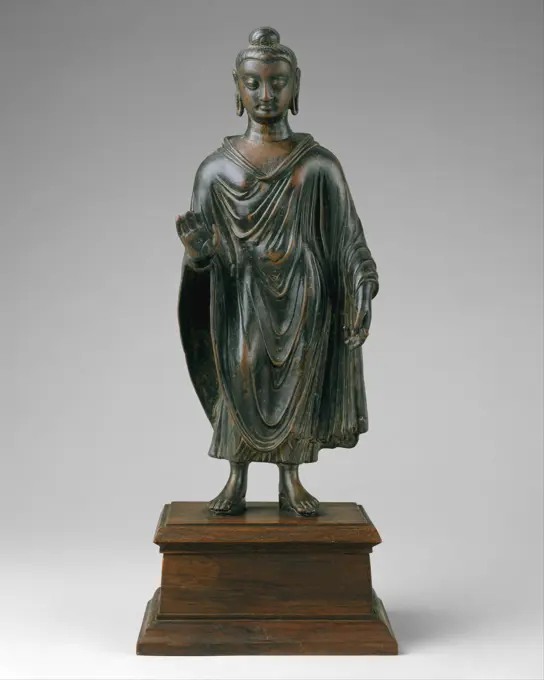
Standing Buddha late 6th century Pakistan (ancient region of Gandhara) or Afghanistan Such portable metal images were important for the spread of the Gandharan style and have been found in Gandhara, Kashmir, and Tibet. The hairstyle of this Buddha is organized in repeating bands, a motif that is found among late Gandharan stuccos as well as images from Kashmir and Sind.. Standing Buddha 72382
6145-43629828
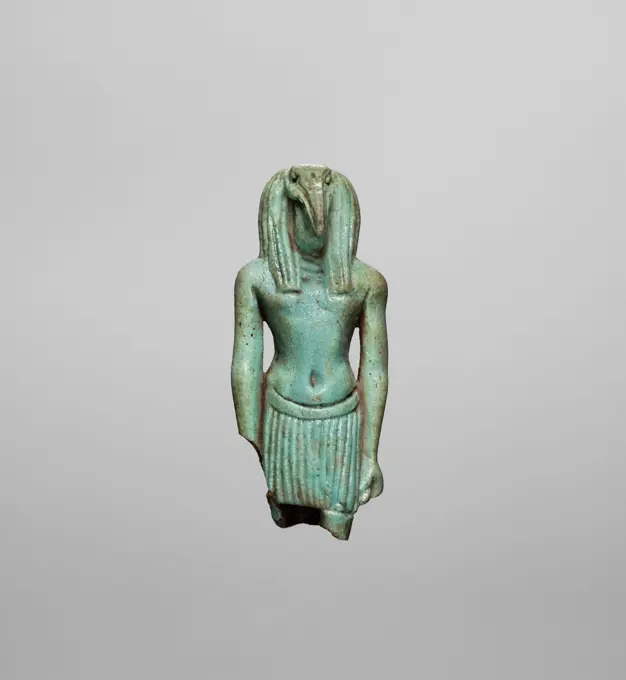
Amulet - bóg Thot. unknown, author
6145-29146527
Figure of Buddhist Divinity 18th century China. Figure of Buddhist Divinity. China. 18th century. Dark green chalcedony. Hardstone
463-6928
Standing Buddha Indian Art Indian Museum, Smpk, Berlin
4443-28739529
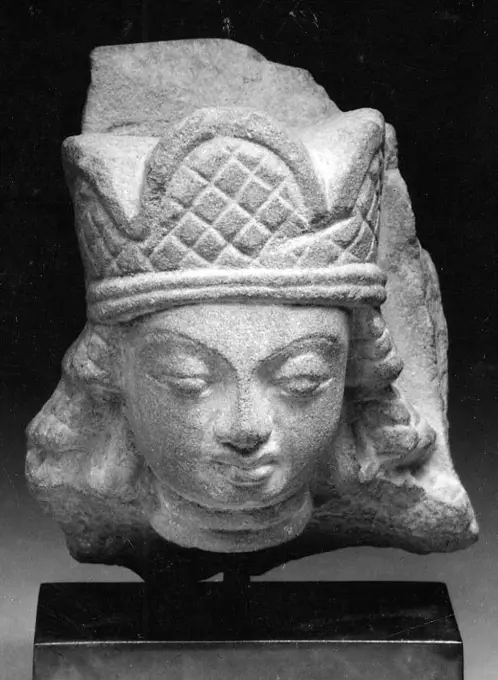
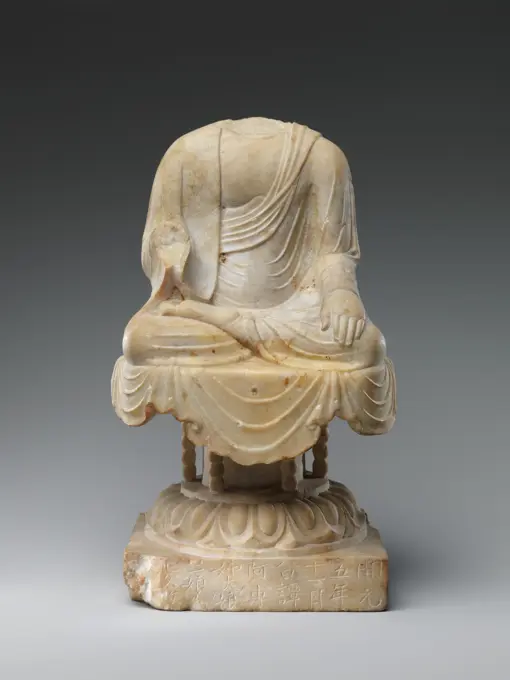
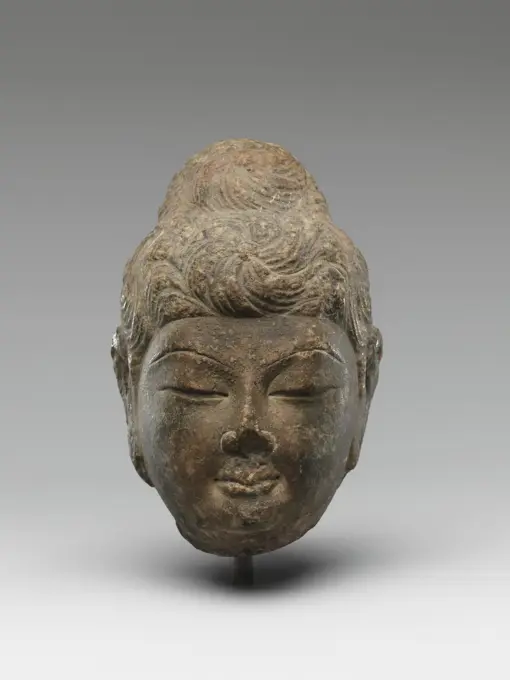
Head of a Buddha, 570-577, 25 7/8 in. (65.72 cm), Black limestone, China, 6th century, This head of a buddha once belonged to a large sculpture that was probably located on the wall of a cave temple. The idea of carving temples and monastic complexes into living rock comes from India, but it became a favorite type of religious architecture in China as well. Often the back wall of a cave was devoted to a large buddha, like this one, flanked by attendant bodhisattvas.
6145-43641034
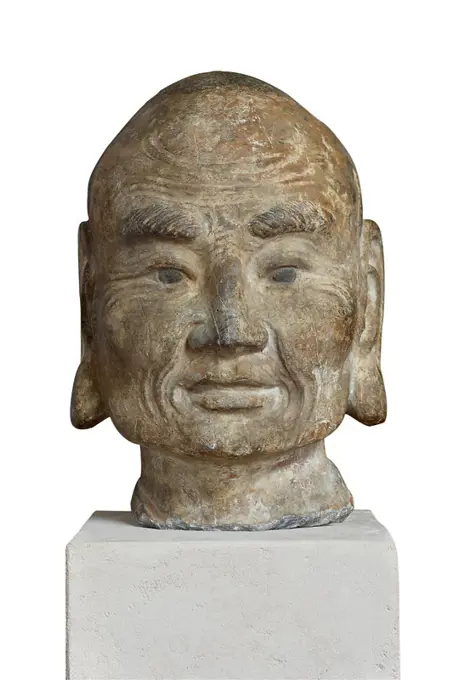
Head of buddhist monk (arhat). unknown, sculptor
6145-29741873
Section of a Diptych in Linga Form, Interior Depicting Parvati, the Consort of Shiva 6th-7th century India (Jammu and Kashmir, ancient kingdom of Kashmir). Section of a Diptych in Linga Form, Interior Depicting Parvati, the Consort of Shiva 38255
6145-30152809
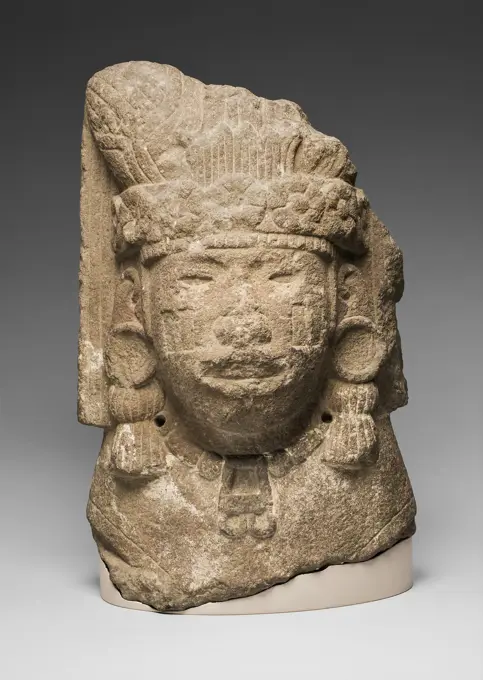
Head of Xilonen, the Goddess of Young Maize 1400-1500 Tenochtitlan. This sculptural fragment represents Xilonen, the youthful Aztec (Mexica) goddess of new maize (corn), who embodies concepts of fertility and renewal. Two large ears of maize rise from her floral headband, with long tassels flowing down her back. In July the Aztecs held a spectacular agricultural festival in Xilonenís honor to celebrate the first fruits of the summer season. During this ritual ceremony, a young girl impersonated thegoddess, dancing to bring forth an abundant harvest. The name Xilonen was Hispanicized in Mexico as elote, meaning ìfresh, tender ear of corn.î. Basalt . Aztec (Mexica)
4409-17279505
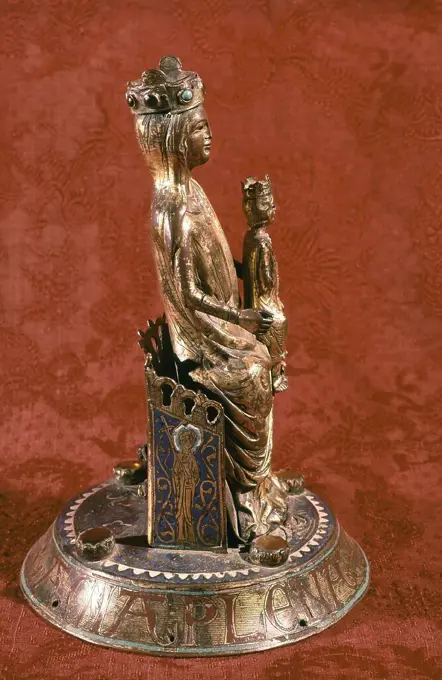
VIRGEN ROMANICA EN PLATA Y ESMALTE. Location: PALACIO EPISCOPAL. Zamora. SPANIEN. VIRGIN MARY.
6145-29826942
Tomb guardian early 8th century China. Tomb guardian 44704
1889-48987101
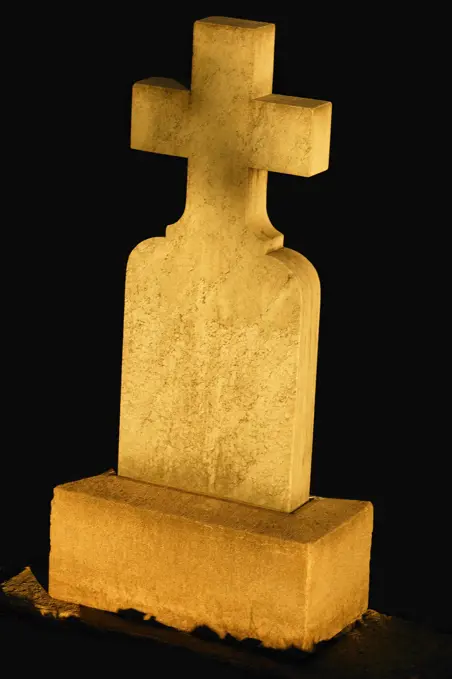
Religious Tombstone
6145-29171823
Christ 18th-19th century Kongo peoples; Kongo Kingdom Kongo artists carefully studied European devotional artifacts and stylized certain features in their own interpretations. In this figure, cast to be attached to a wooden cross, the length of the arms has been given dramatic emphasis and attention has been devoted to the head and wrapper. Deeply incised parallel lines define the beard, moustache, and braided hair.. Christ 318326
4409-64222489
Virgin and Child, late 12th century, church of Santiago de Agüero, carved and polychrome wood, Huesca museum, Aragon community, Spain.
6188-67684101
Jungfrau des Abstiegs von Durró Virgin of the Descent from Durró, 12th century, wood carving with traces of tempera polychromy, Church of the Nativity of Maria de Durro, Boí Valley, MNAC, Barcelona, Catalonia, Spain Copyright: xZoonar.com/Tolox 23146553
6145-30106932
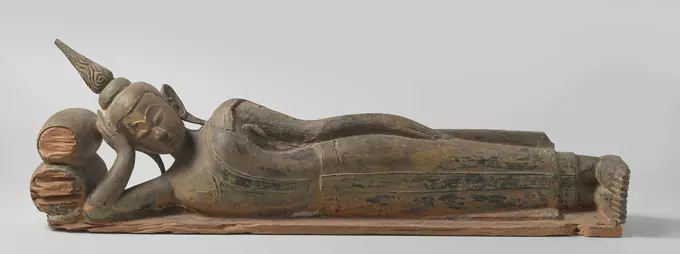
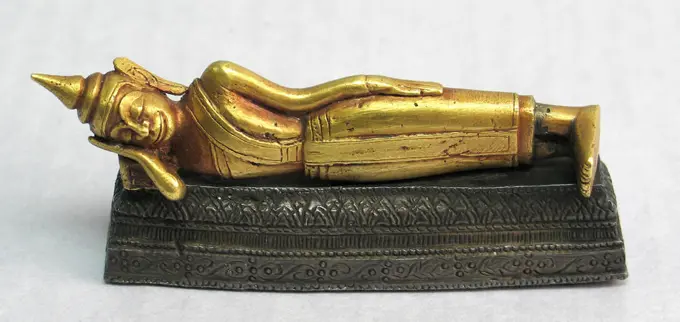
Liggende Boeddha.Landscape Buddha; parinirana (entering into the Nirvana); Head, supported by the right hand, resting on two pillows.
4409-67612583
Christ of Cerdanya, 12th century, wooden carving with traces of tempera polychromy, National Museum of Catalonia, Barcelona, Catalonia, Spain.
6145-29156545
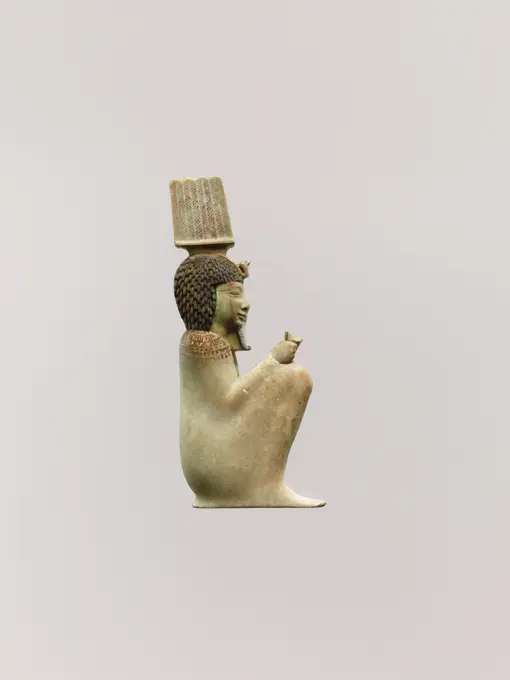
Inlay of the squatting god Anhur (Onuris) 4th century B.C. Late Period-Ptolemaic Period This small crouching figure is the god Onuris. He is distinguished by his crown of four upright feathers.Originally he held a scepter in the fist on his knee. The king Nectanebo II incorporated into his royal names epithets relating him to the god Onuris.. Inlay of the squatting god Anhur (Onuris) 551808
4409-17582466
'Head of a Ststuette of Buddha'. Afghanistan, Hadda, 4th - 5th century. Dimensions: height 10 cm. Museum: State Hermitage, St. Petersburg.
6145-29133215
Head of Buddha Shakyamuni. Thailand, Ayutthaya, 14th century. Sculpture. Sandstone
6145-30176496
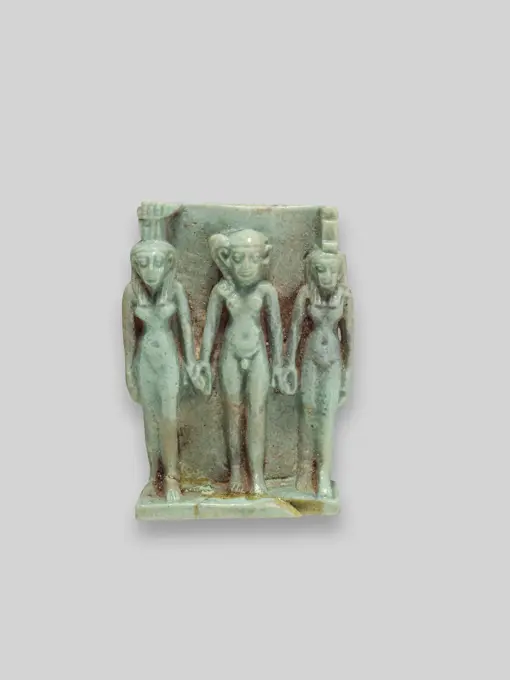
Amulet of Nephthys, Horus the Child, and Isis 664 BCE-525 BCE Egypt. Nephthys and her sister Isis appear in myths as mourners for Osiris. Here, identified by their headdresses, they flank the young Horus, the son of Osiris, symbolizing that from the death of Osiris, comes renewed life. This amulet would assure rebirth in the afterlife.. Faience . Ancient Egyptian
6188-62354608
Archangel San Gabriel Archangel San Gabriel, carving in incarnate wood, stew and polychrome, eighteenth century, colonial museum, Casa de Santo Domingo, ancient temple and convent of Santo Domingo and the Colegio Mayor de Santo Tomás of AquinoAntigua Guatemala, department of Sacatepéquez, Republic of Guatemala, Central America Copyright: xZoonar.com/Tolox 22071570
6145-29167094
Harihara late 7th-early 8th century Southern Cambodia In Harihara imagery, Shiva is represented as the right half of the deity, his vertical third eye, lightly incised into the forehead, truncated at the Vishnu divide. The facial features are undifferentiated, unlike in their Indian counterparts, where a masculine and feminine cast is given to each half. This Harihara makes clear the extent to which the Khmer conception differentiated the two deities only in the partition of the headdress into a combined jatamukuta-miter and in the provision of half of a third eye on Shivas side. The popularity of this hybrid deity was largely confined to the seventh century in Cambodia.cat. no. 92. Harihara. Southern Cambodia. late 7th-early 8th century. Sandstone. pre-Angkor period. Sculpture
4409-17499982
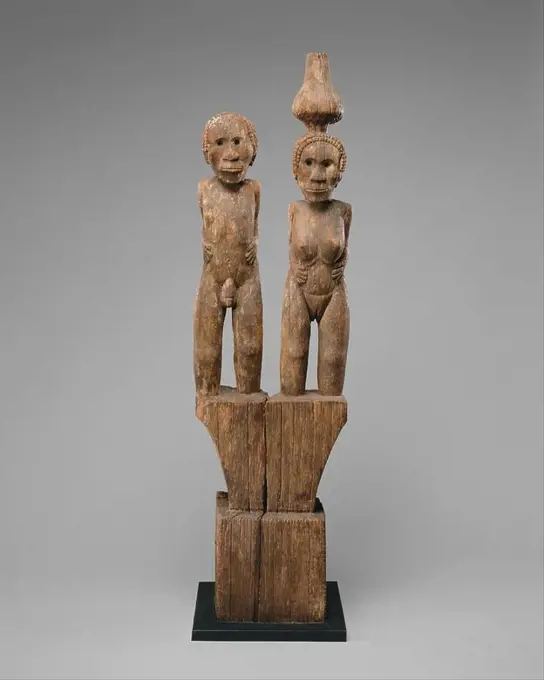
Couple. Culture: Sakalava peoples. Dimensions: H. 39 in. (99.06 cm). Date: 17th-late 18th century.This Madagascar couple ranks as the foremost artistic achievement of a region where African and Pacific Island influences meet. It was created by a Sakalava artist in western Madagascar to grace the pinnacle of a "hazomanga," a tall wooden monument set in a place of honor near the house of a clan elder. It constituted the focal point for prayers, sacrifices, and boys' circumcision ceremonies. Measuring around six feet in height, the hazomanga was a striking element of the architectural landscape and a potent reminder of kinship, both past and present.Set side by side, these figures engage the viewer with their intense expressions and deeply recessed eyes. Their subtle stylization simultaneously unifies them and amplifies what makes them different, producing an eloquent statement on the fundamental complementarity of man and woman. As the centerpiece of circumcision rights performed to pr
6145-29730245
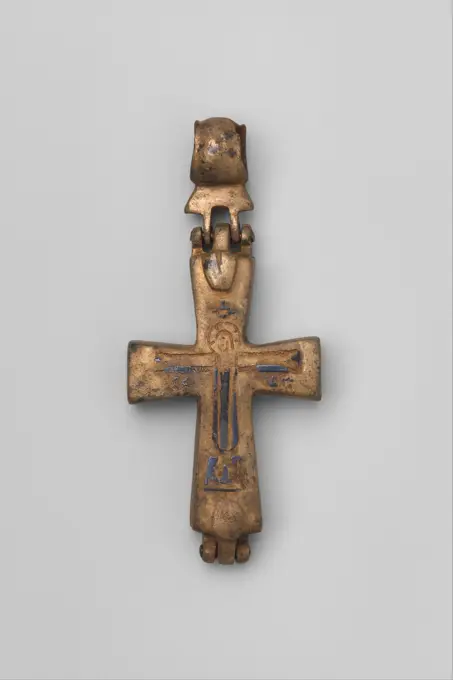
Reliquary Cross with Christ Crucified and the Virgin and Child 11th century Byzantine This cross represents a more refined example of the reliquary crosses common during the middle Byzantine period. The image of the crucified Christ is similar to the one on the reverse of the cross reliquary lid in this case. He wears a colobium (sleeveless or short-sleeve tunic) with two clavi (bands), and his feet are supported by a large footrest (suppedaneum), while his death can be inferred from the slight angle of his head to the left. On the reverse is the Virgin. In front of her body is a medallion with the Christ Child, an image type that stresses Christs divinity.. Reliquary Cross with Christ Crucified and the Virgin and Child. Byzantine. 11th century. Copper alloy, niello. Metalwork-Copper alloy
1746-28978852
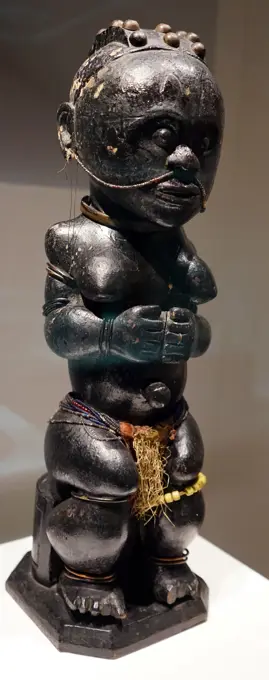
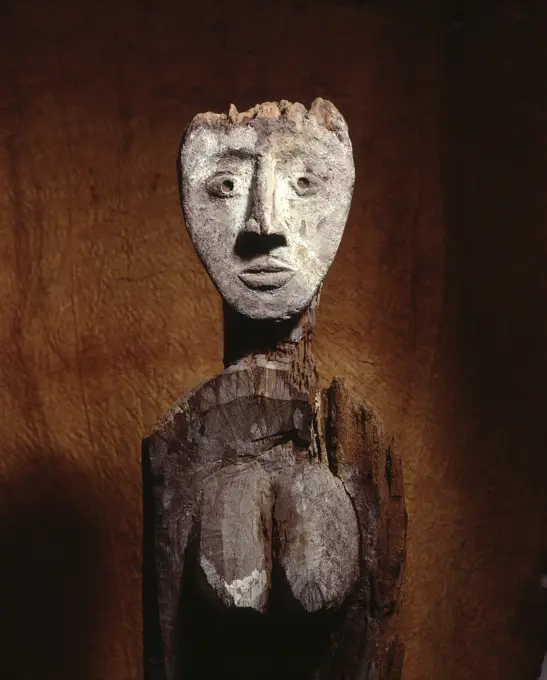
Wooden guardian figure, eyema Byeri; Fang tribe; Okak group; Equatorial Guinea, West Africa.
1746-28980842
Painted bronze Buddha, from Thailand. Dated 17th Century
1788-15595
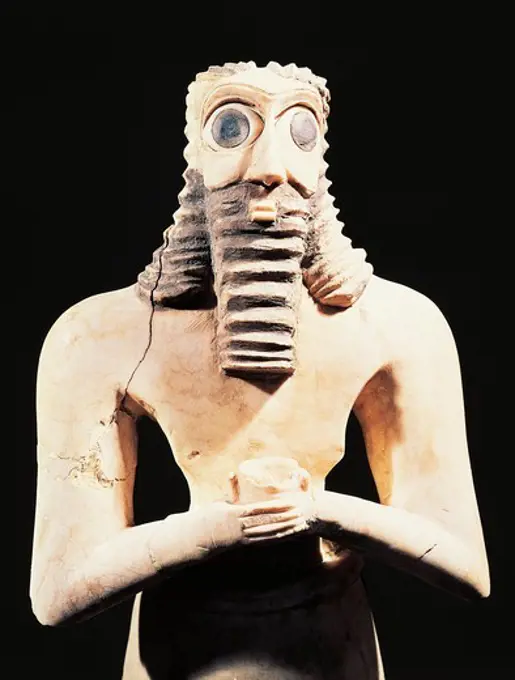
Detail of limestone statuette of praying man, from Tell Asmar, Iraq
1788-41047
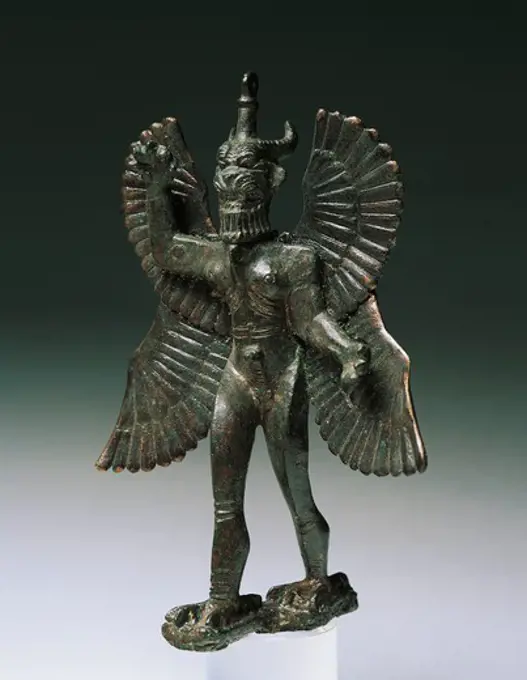
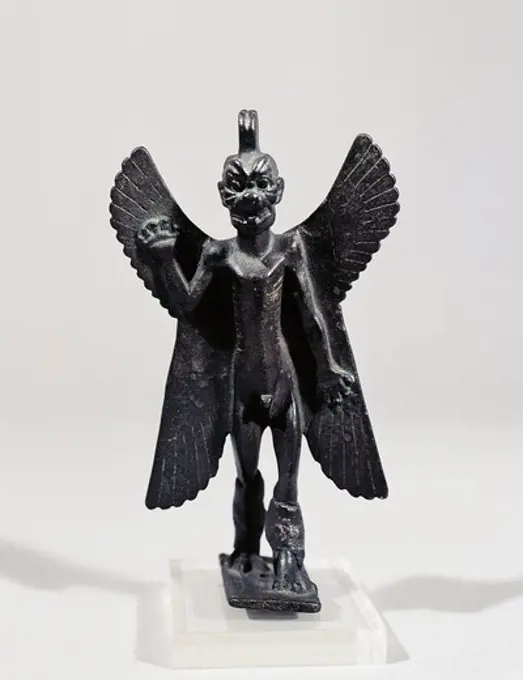
Statue of the demon Pazuzu, artefacts from Tell Sheikh Hamed, Syria. Assyrian civilisation, 17th Century BC.
6145-46202296
Crib with Christ child. .
6145-30390235
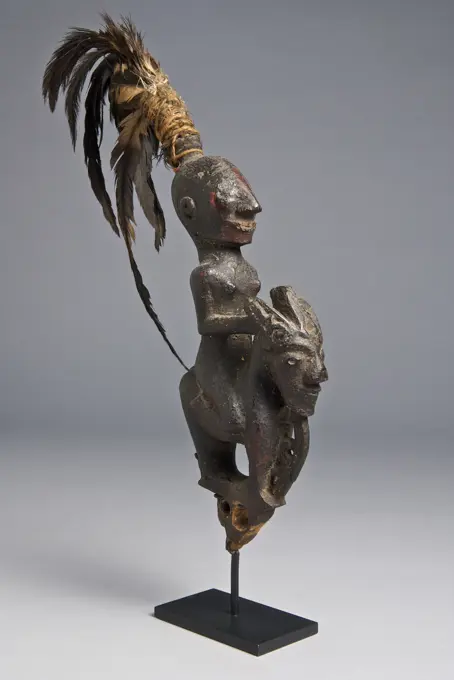
Top of a Priests Staff (Tunggal Panaluan)
4409-17371016
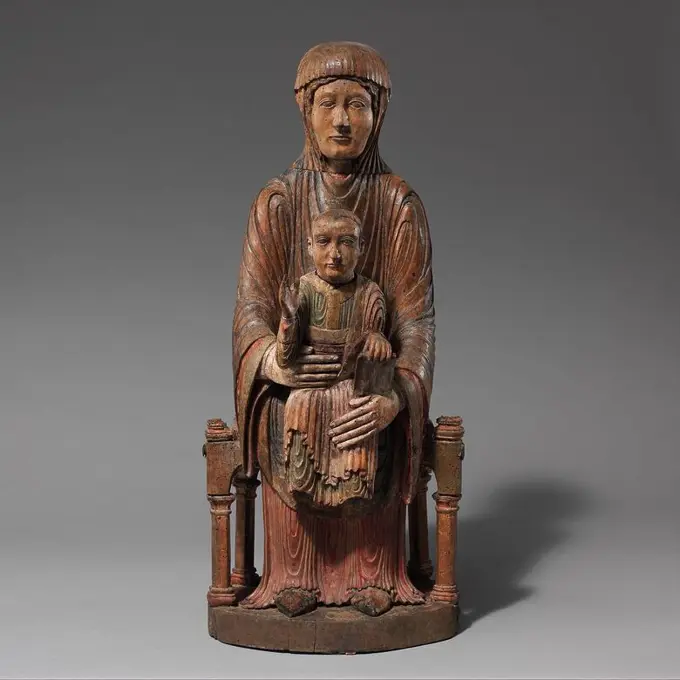
Enthroned Virgin and Child. Culture: French. Dimensions: 27 × 11 1/4 × 11 in. (68.6 × 28.6 × 27.9 cm). Date: 1150-1200.The stark and rhythmic lines of this sculpture are almost modern in their effect. In fact, this seemingly straightforward image of the infant Jesus seated rigidly on the Virgin's lap represents a complex, medieval theological notion known as a Sedes Sapientiae (Throne of Wisdom), in which Mary serves as a throne for Christ, who in turn embodies divine wisdom. Placed on an altar, this imposing group was an object of veneration that could also be carried in procession or incorporated into a theatrical performance within a church. A circular cavity in the Virgin's left shoulder suggests that the sculpture contained a relic. Recent conservation treatment has revealed remains of the original painted and applied metal decoration. A Virgin and Child (16.32.194) probably by the same artist is on view in the Main Building of The Metropolitan Museum of Art. Museum: Metropolitan
1788-17280
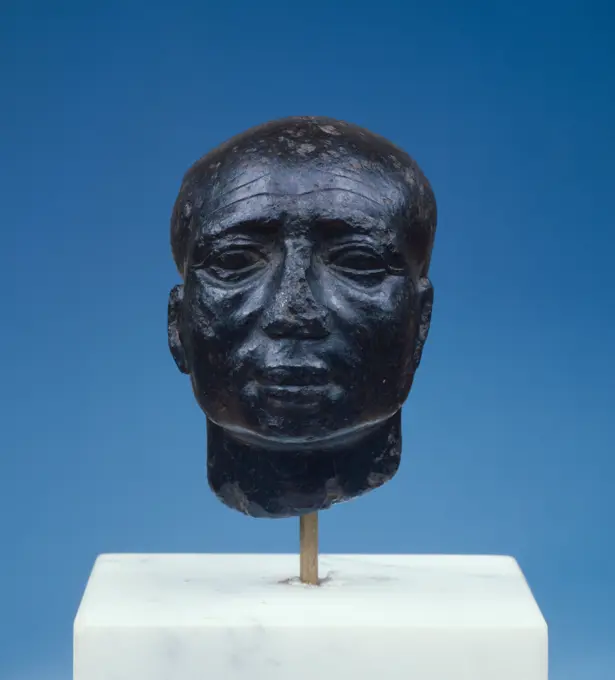
Dark diorite head of priest
4409-6811
VIRGEN CON NIÑO DE GER - TALLA EN MADERA - ROMANICO - S XII - POLICROMADA. Location: MUSEU NACIONAL D'ART CATALUNYA. Barcelona. SPANIEN.
4409-17232482
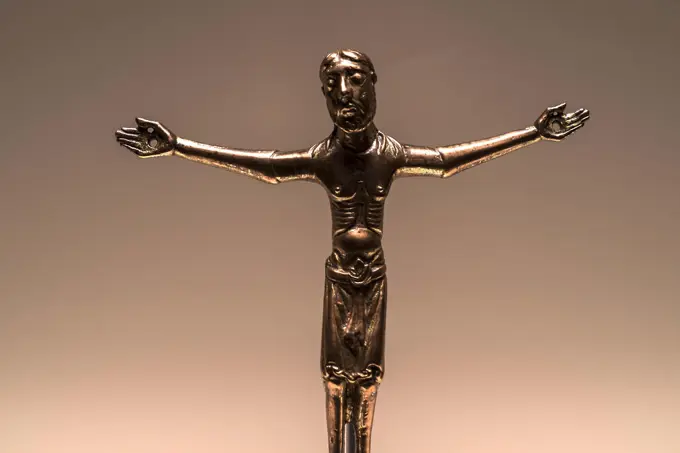
Romanesque art in the National Art Museum of Catalonia,Barcrelona,Christ (1180 AC), cast bronze, chiseled and gilded.
1746-21111360
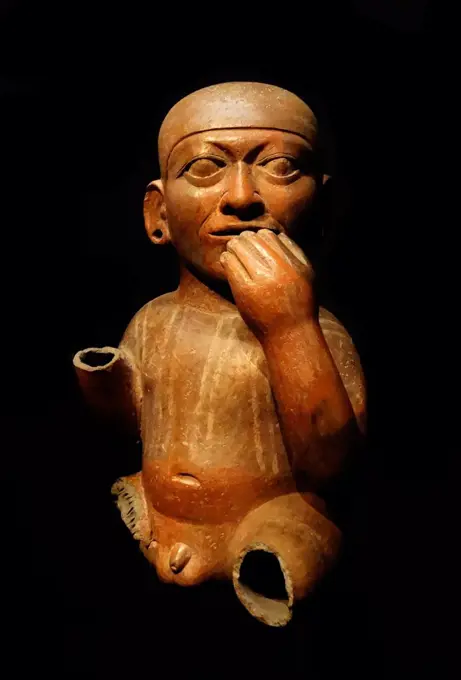
An ancient terracotta statuette of a prisoner, and soon to be sacrificial victim, from the Moche culture, alternatively known as, the Mochica culture, Early Chimu, Pre-Chimu or Proto-Chimu, from the North Coast of Peru. The prisoner sits in the nude, with his hand covering his mouth epitomising his fear. Dated 8th Century
4409-17336773
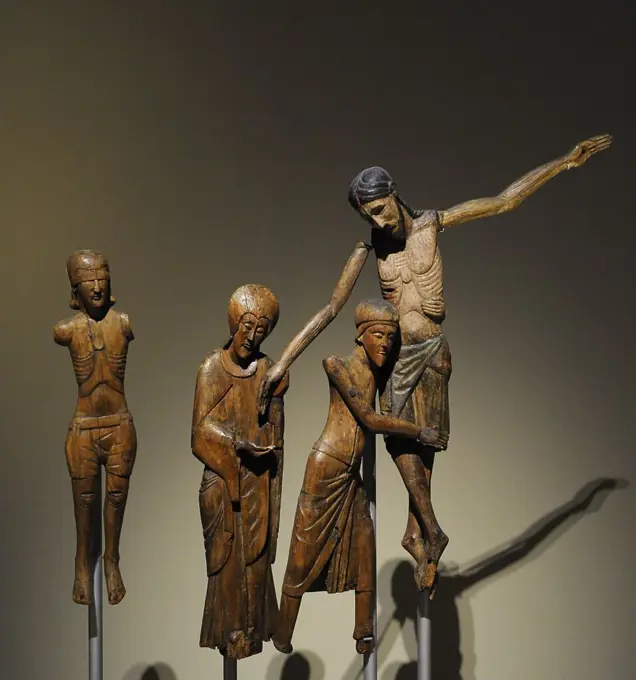
Descent from the Cross from Santa Maria de Taull, 2nd half of 13th century. Figures of Dimes, Virgin Mary, Saint John of Arimathea and Jesus crucified. Wood. Anonymous. Spain. National Art Museum of Catalonia. Barcelona. Catalonia. Spain.
6145-45928102
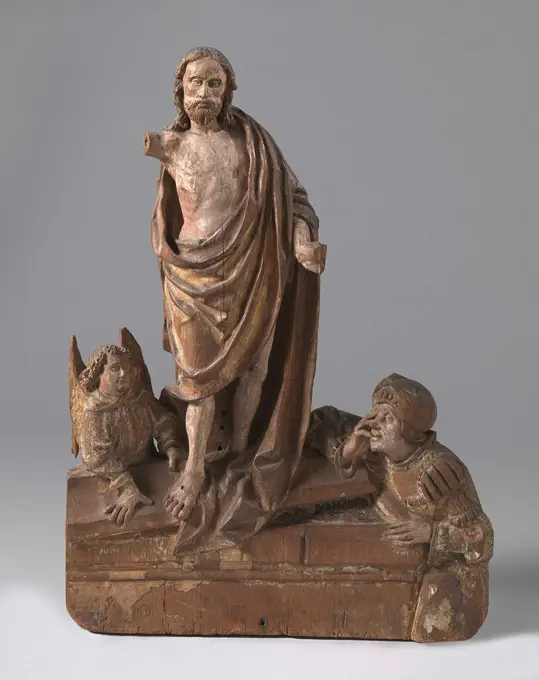
The Resurrection. On a sloping lid of the semi-opened graftombe, Christ is facing the right foot. The remaining header-up arm has been raised as opposed to the dependent left with the hand opposed. Right to the short side of the tomb, a kneeling soldier leans the right arm on the tomb's lid, the eyes of which are half and the mouth open. The left hand includes a corner of the tomb. Left behind the tomb leans an angel with both hands on the lid. The cloak of Christ runs from the left shoulder in a wide arc to the left under the raised right arm, covered the back and then falls over the left arm and left foot over the tomb lid. The soldier is wearing a harness over a jumper with puff sleeves with splits and a helmet-shaped 'learning' () Hat, the angel albe and amicic.
4409-17521341
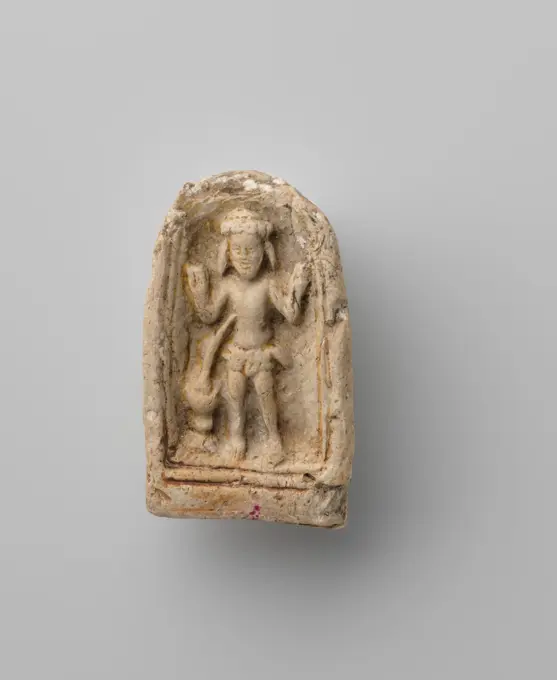
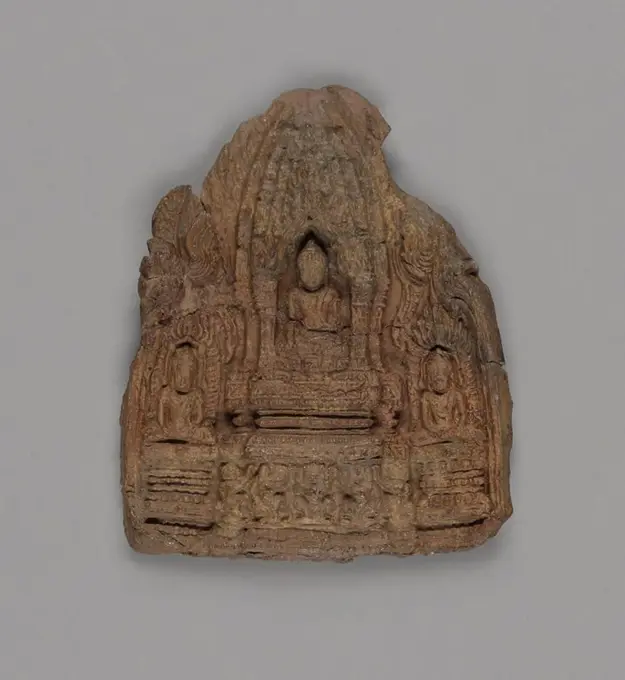
Votive Tablet of Gautama Buddha with Attendant Buddhas. Thailand; Lamphun Province. Date: 1001-1400. Dimensions: 4 × 3 1/4 in. (10.2 × 8.3 cm). Terra-cotta. Origin: Northern. Museum: The Chicago Art Institute, Chicago, USA.
6145-29129225
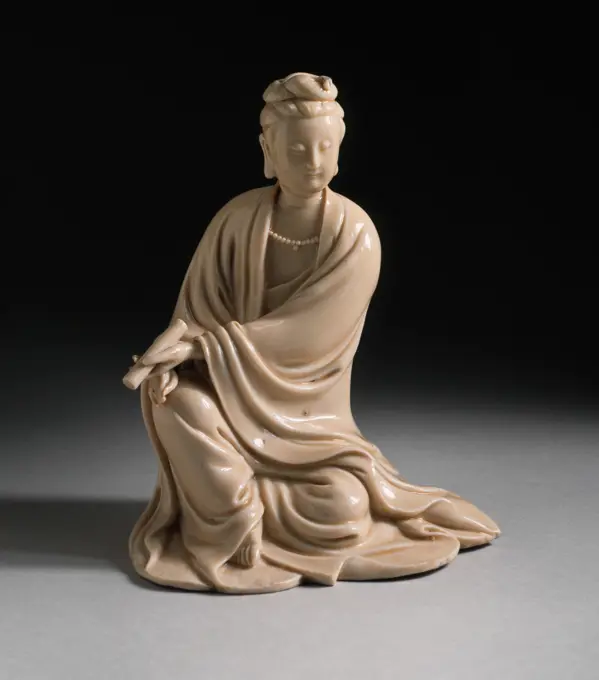
Avalokitésvara (Guanyin), the Bodhisattva of Compassion. China, Fujian Province, Dehua County, Chinese, early Qing dynasty, about 1644-1700. Sculpture. Dehua ware, Molded and modeled porcelain with incised decoration and cream glaze
6145-29842692
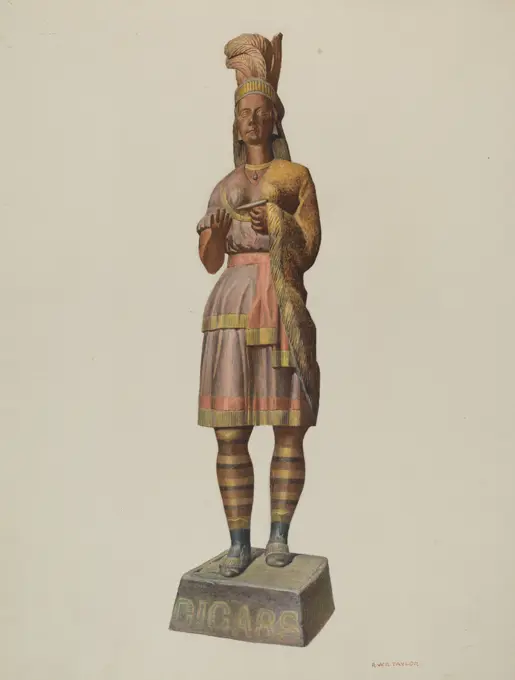
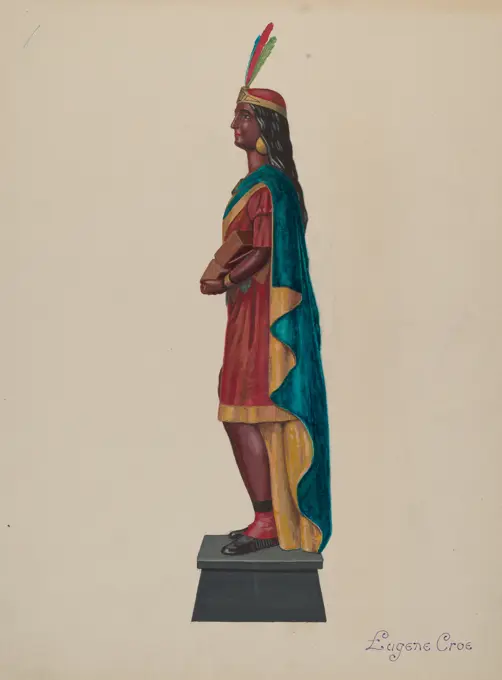
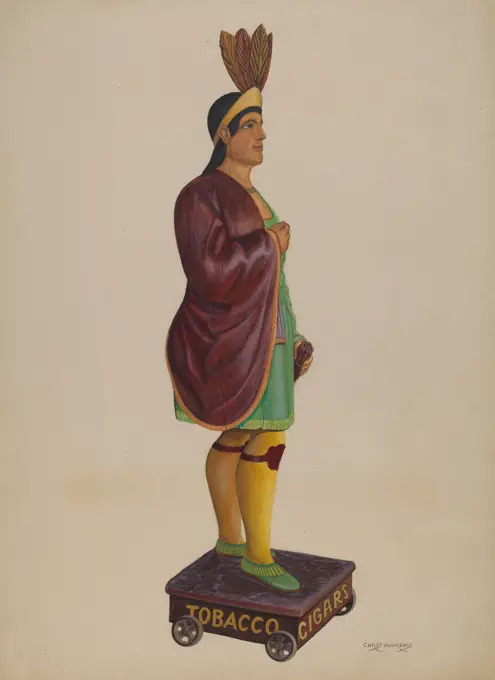
Eugene Croe, Cigar Store Indian, 1935 1942 Cigar Store Indian
1746-21099122
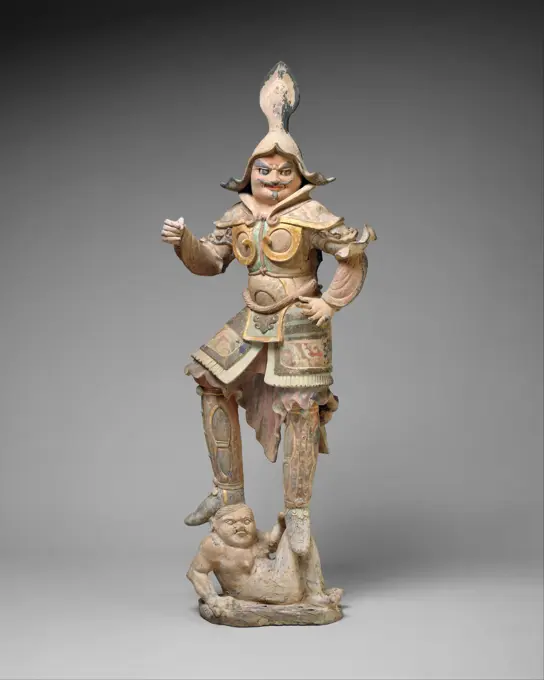
Japanese Temple Guardians. Dated 14th Century.
6145-29833429
Head of Buddha mid-8th century China. Head of Buddha. China. mid-8th century. Limestone with traces of pigment. Tang dynasty (618-907). Sculpture
6145-29735635
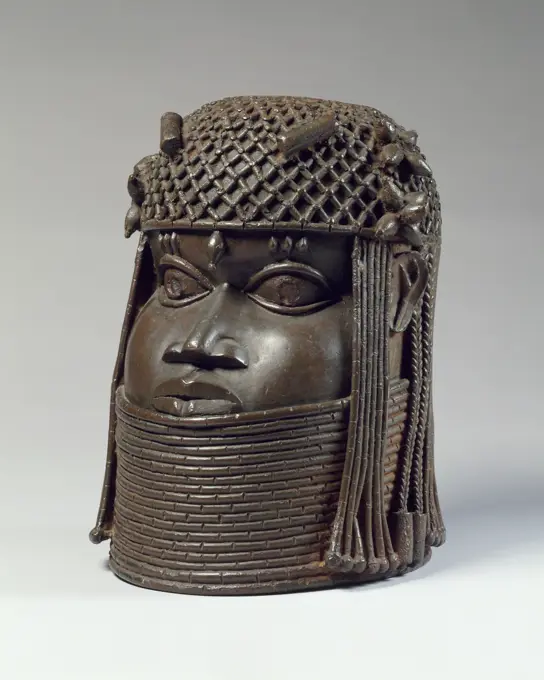
Head of an Oba 19th century Edo peoples At its origins, the centralized city-state of Benin was founded by Edo-speaking peoples. The accounts by official court historians and descriptions provided by visitors evoke a vibrant cultural center continually redefined by its leadership through shifting internal and external power dynamics. According to oral tradition, circa 1300, Edo chiefs are reputed to have reached out to the leader of neighboring Ife, Oranmiyan, to establish a new divinely sanctioned royal dynasty. Since then, the investiture of Benins rulers to the title of obas has conferred upon them at once a role of chief priest officiating in important religious ceremonies and presiding over an elaborate structure of palace officials. During the fifteenth century reign of Oba Ewuare, Benins armies were formed and the fortification of its capital with a massive wall undertaken. In parallel, delegations of Portuguese traders assiduously sought to secure exclusive commercial treatie
6176-67038089
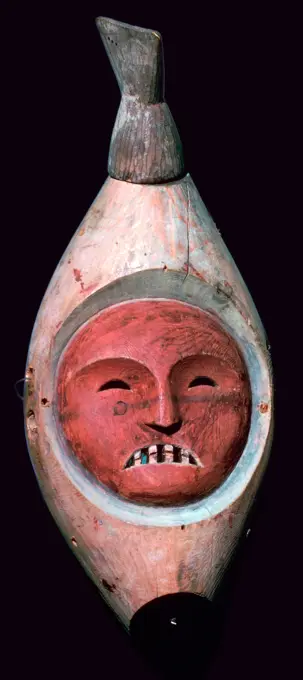
Inuit wooden mask. Artist: Unknown
6145-54681264
Shabti of the High Priest of Thoth Djehutyirdis, born of Nephthysiti Late Period 380-362 BC Djehutyirdis was High Priest of Thoth at Hermopolis, contemporary with Nectanebo I of Dynasty 30. The museum has 3 shabtis of this man, 12.183.9, 12.183.10, and 30.8.187. Two show the text encircling the front of the shabti, and the third uses a newer fashion of text organization in a T-shape. These shabtis presumably derive from his tomb at Hermopolis, where the worship of Thoth, god of wisdom and patron of scribes, was centered. View more. Shabti of the High Priest of Thoth Djehutyirdis, born of Nephthysiti. 380-362 BC. Faience. Late Period. From Egypt; Presumably from Middle Egypt, Hermopolis (Ashmunein; Khemenu), Tomb of Djehutyirdis. Dynasty 30
6145-29865850
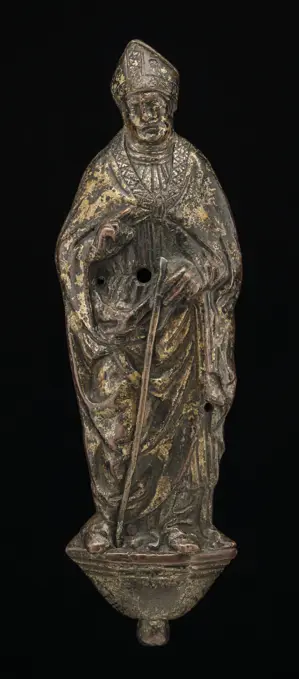
Italian 15th Century, A Bishop (Saint Gebhard), 15th century A Bishop (Saint Gebhard)
1746-21110801
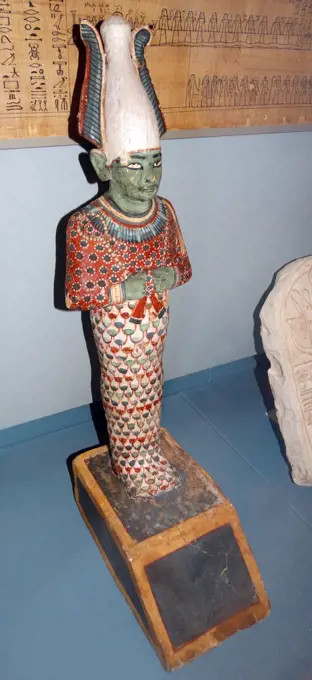
Painted wooden statue of Osiris 20th Dynasty, about 1170 BC From Thebes, Egypt. depicts the god wearing characteristic feathered crown and grasping the royal crook and flail sceptres. The green colouring of the skin reflects the god's associations with vegetation as a metaphor for rebirth.
6145-48529807
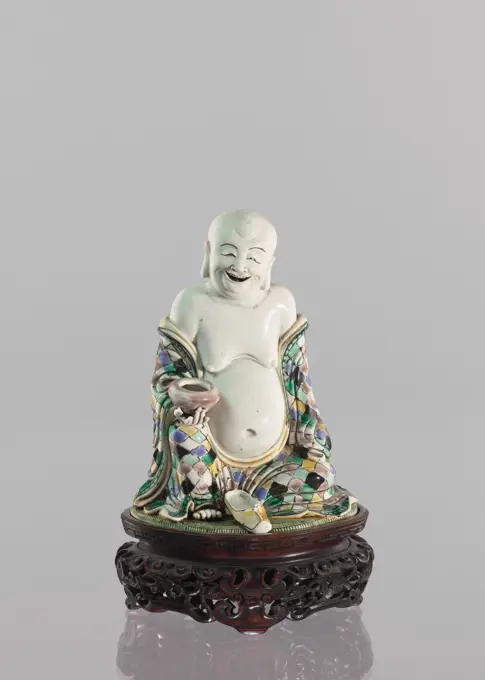
Budai (Laughing Buddha). unknown, craftsman
6145-58866687
Virgin and Child, anonymous, c. 1425 - c. 1450 Maria with child Utrecht pipe clay Maria with child Utrecht pipe clay
6145-30402461
Guardian Figure(Hampatong)
4443-28726905
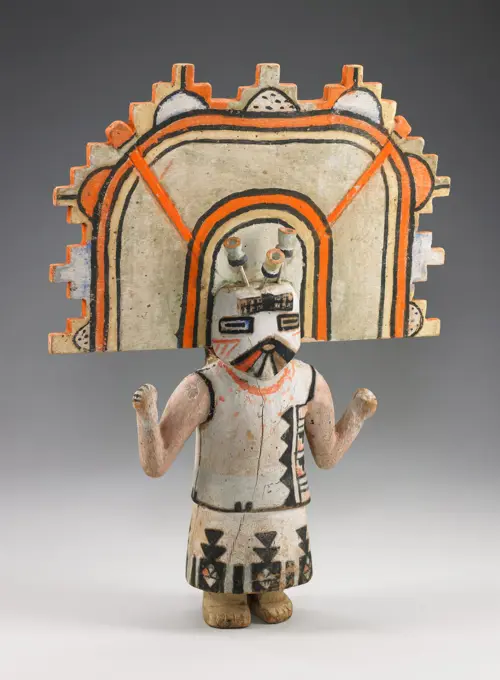
Butterfly Maiden Kachina, 1880-1920, 17 x 13 x 3 11/16 in. (43.18 x 33.02 x 9.37 cm), Wood, pigments, United States, 19th-20th century, In Hopi cosmology, there are over 250 spirits known as kachinas (or katsinas). The kachinas visited this world long ago from the clouds, but now only their representatives appear in Hopi villages from winter solstice to mid-July. These representatives, men dressed in masks and outfits representing the individual kachinas, conduct ceremonies that maintain harmony and teach Hopi values. Traditionally, the kachina dancers gave children small sculptures of the kachinas during the ceremonies. Parents hang them on the wall at home to use as educational tools for teaching Hopi beliefs to their children.
7155-70384377
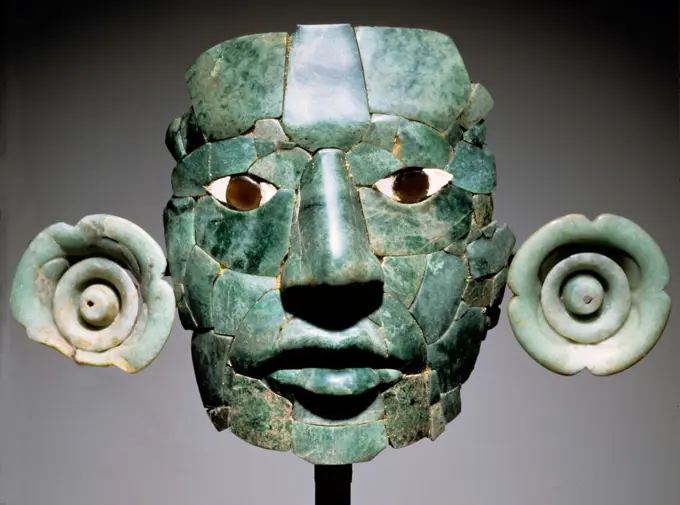
Mayan ceremonial jade mask, 250-900 AD. Mexico.
6145-29828248
The Parinirvana of the Buddha 18th century Thailand. The Parinirvana of the Buddha 37654
6145-29736306
Standing Bodhisattva (Armless) 9th century Indonesia (Java). Standing Bodhisattva (Armless). Indonesia (Java). 9th century. Silver. Sculpture
6145-59085354
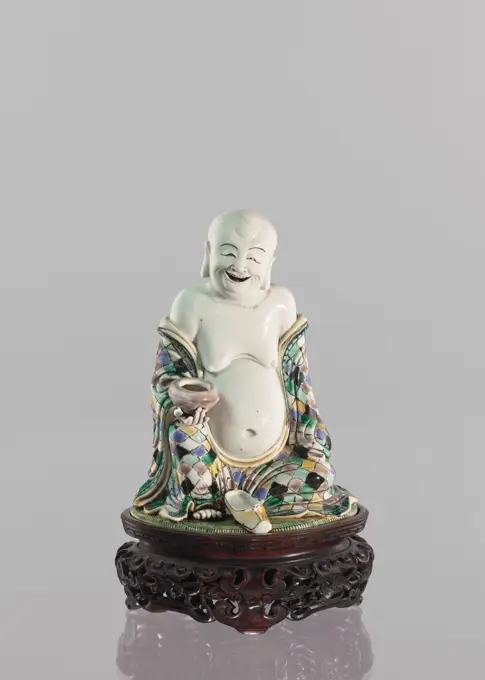
Budai (laughing Buddha);  XVII/18th century (1662-00-00-1722-00-00);
6145-29808834
Figure of Shou Lao, Longevity Deity China. Figure of Shou Lao, Longevity Deity 43822
6145-30404032
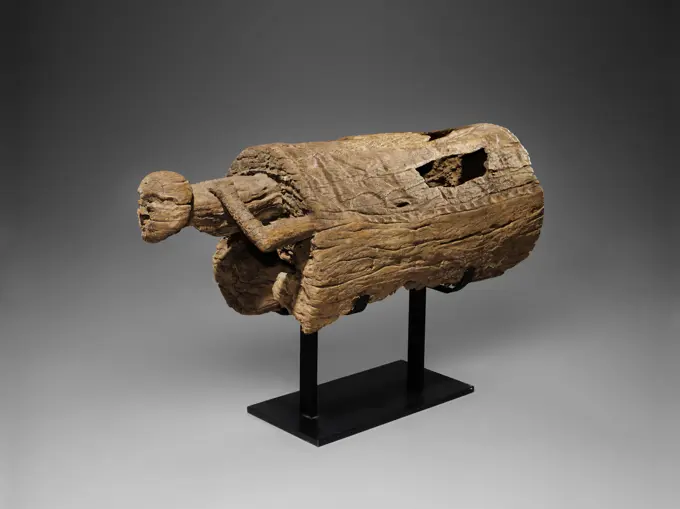
Slit Gong (Idoro) with a HumanTorso
6145-45318307
Saint. Małgorzata on the Dragon Knocznik (before adding decorative leaves and right hand with a cross; doublet with the MNK I G 18) sacristy, cathedral in Wawel, Krakow
1746-19664524
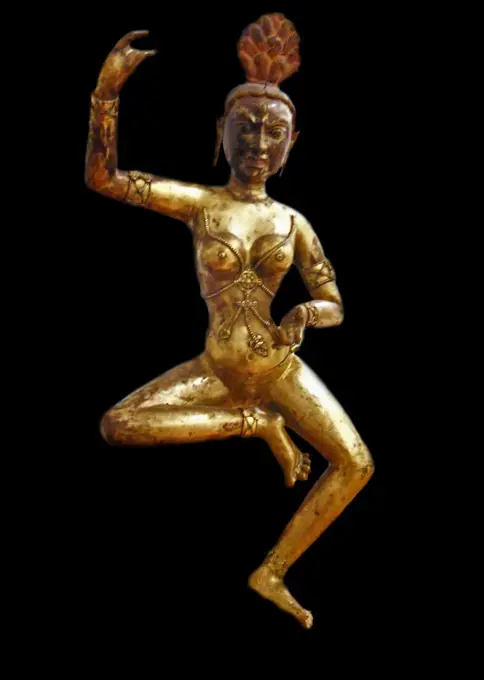
Dakini Dancing. Tibetan Buddhist statue from the XVIIIth Century
4409-6797
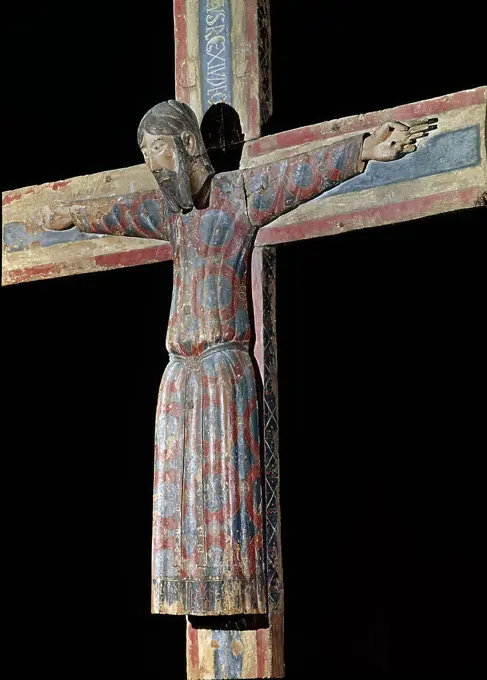
MAJESTAD BATTLO - PROCEDENTE DE LA COMARCA DE OLOT - REALIZADO EN EL SIGLO XII - TALLA POLICROMADA. Location: MUSEU NACIONAL D'ART CATALUNYA. Barcelona. SPANIEN. JESUS. CRISTO CRUCIFICADO. CRISTO EN MAJESTAD.
1890-89888
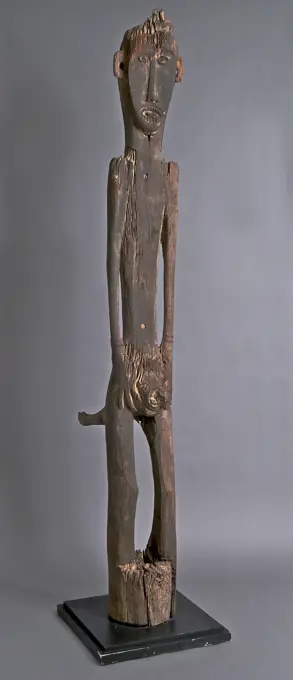
Guardian figures carved in the hardest of wood, found at the junctions of footpaths leading to villages for protection from evil spirits, Sarawak, Bor...
6145-30176449
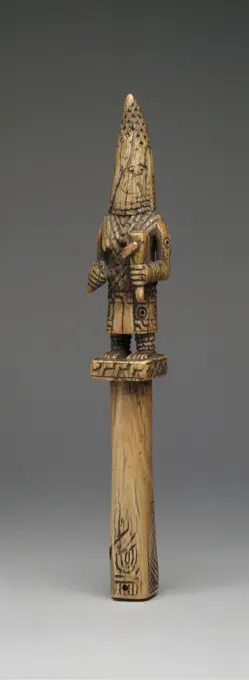
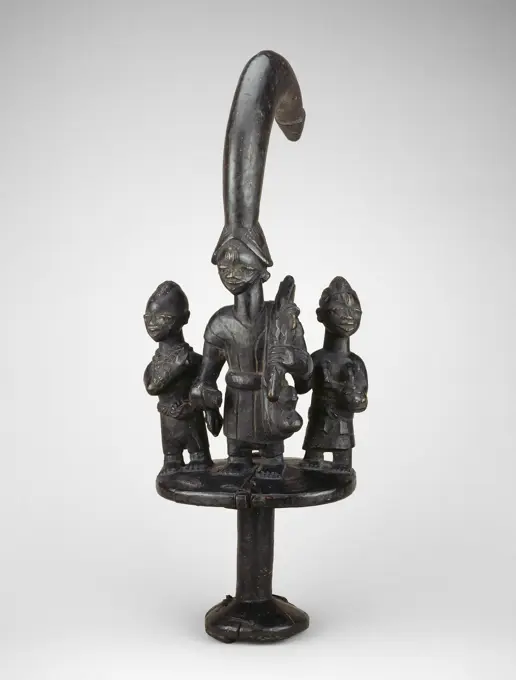
Esu Dance Staff (Ogo Elegbara) 1825-1900 Nigeria. This dance staff for the deity Eshu depicts a warrior flanked by a bound captive and a nursing mother. This work was made during a turbulent period of civil war. The warriorís cap is depicted as a crooked phallus, which is a symbol of Eshuóthe divine messenger, facilitator, and provocateuróand allows for the staff to be hooked over the shoulder.. Wood . Yoruba
1746-21109117
Mayan ceramic figurine of a kneeling female shaman or priestess. From Simojovel; Chiapas, Mexico 600-900 AD
1899-18859252
Tian Hongzheng, courtesy name Andao, formally Duke Zhongmin of Yi, was a general of the Chinese dynasty Tang Dynasty. Under his governance, Weibo Circuit (headquartered in modern Handan, Hebei), which had not been under imperial control for decades, submitted to imperial control.
1916-111839910
Seated Shaivite Saint Karaikkal Ammaiyar, India. Metropolitan Museum of New York, Manhattan, New York City
6145-29799114
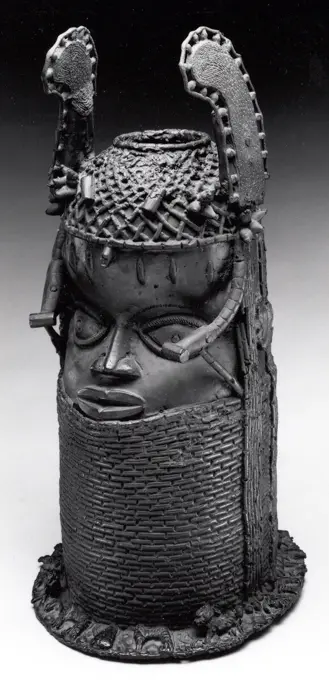
Head of an Oba 1550-1680 Edo peoples At its origins, the centralized city-state of Benin was founded by Edo-speaking peoples. The accounts by official court historians and descriptions provided by visitors evoke a vibrant cultural center continually redefined by its leadership through shifting internal and external power dynamics. According to oral tradition, circa 1300, Edo chiefs are reputed to have reached out to the leader of neighboring Ife, Oranmiyan, to establish a new divinely sanctioned royal dynasty. Since then, the investiture of Benins rulers to the title of obas has conferred upon them at once a role of chief priest officiating in important religious ceremonies and presiding over an elaborate structure of palace officials. During the fifteenth century reign of Oba Ewuare, Benins armies were formed and the fortification of its capital with a massive wall undertaken. In parallel, delegations of Portuguese traders assiduously sought to secure exclusive commercial treaties w
1746-111927261
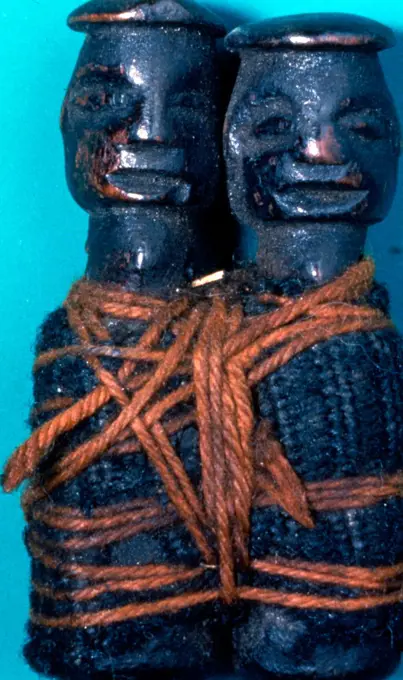
wooden minkisi figures used for divination by the Suku people. Suku is a Bantu tribe of the Democratic Republic of the Congo.
6145-30110563
Worship of kings: bearded man.worship or kings: Bearded man.
1746-28980080
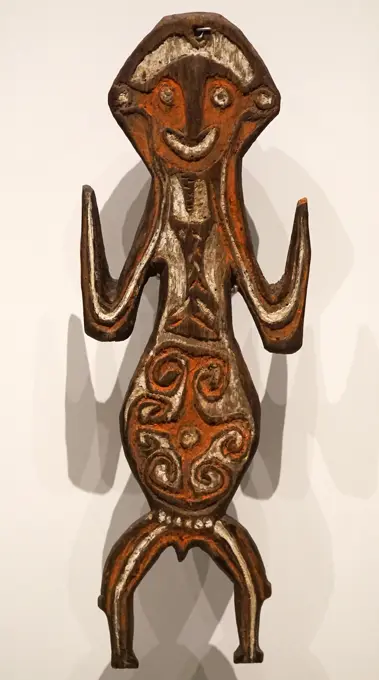
A Papuan Gulf Bioma figure representing an ancestor. Dated 20th Century
6145-30391517
Human-headed Deities Fuxi andNuwa
6145-29066427
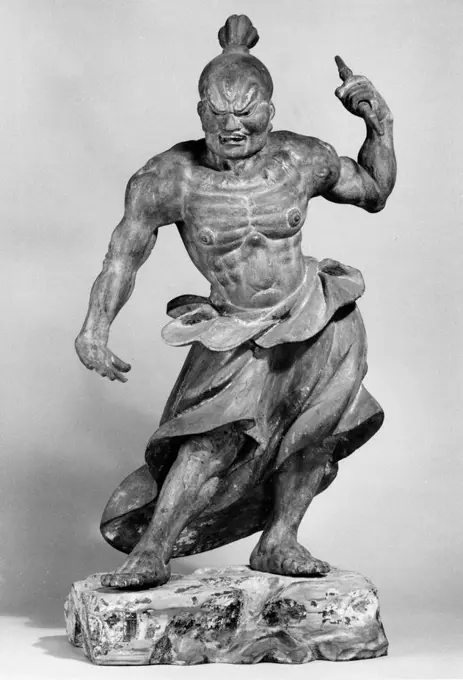
Pair of Guardian Kings (Niō), 1200s. Japan, Kamakura period (1185-1333). Chestnut and cypress wood; overall: 167.9 cm (66 1/8 in.). These wrathful protectors of Buddhism would have once stood within the sides of the main entrance gate to a temple. One has an open mouth that intones the sound ah, and symbolizes the beginning, or life.One has a closed mouth that intones the sound un, and symbolizes the end, or death.
6145-29672023
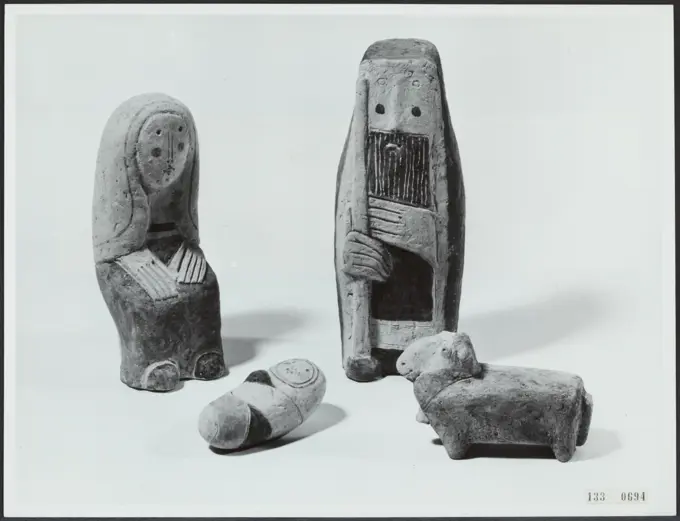
Photo collection Government information service. Paul de Swave: Christmas group with Maria, Josef and the Child Jesus. undated
1746-19676703
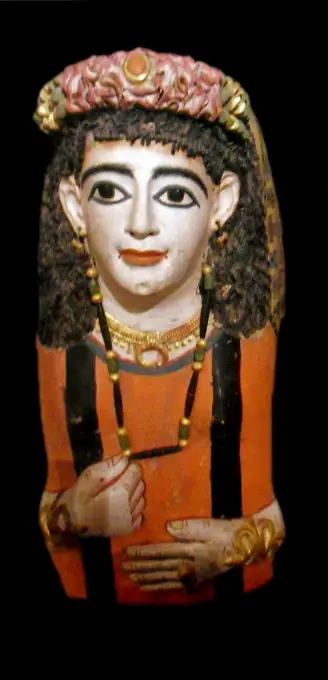
Mummy Mask of a Woman 60 A.D. With a jewelled garland. Meir
6145-29802250
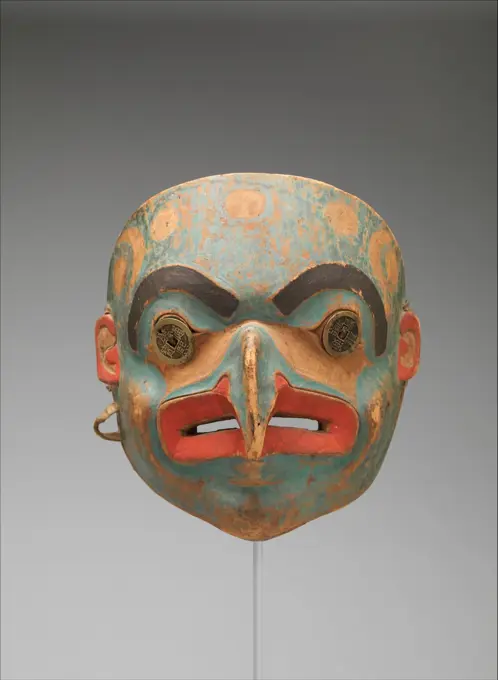
Transformation Mask 1820-30 Tlingit. Transformation Mask 319070
6145-29837573
Chris Makrenos, Cigar Store Indian, c 1937 Cigar Store Indian
6145-46640486
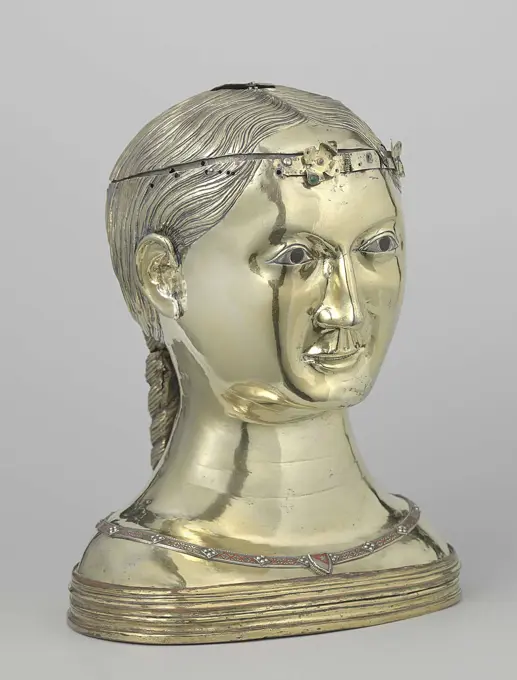
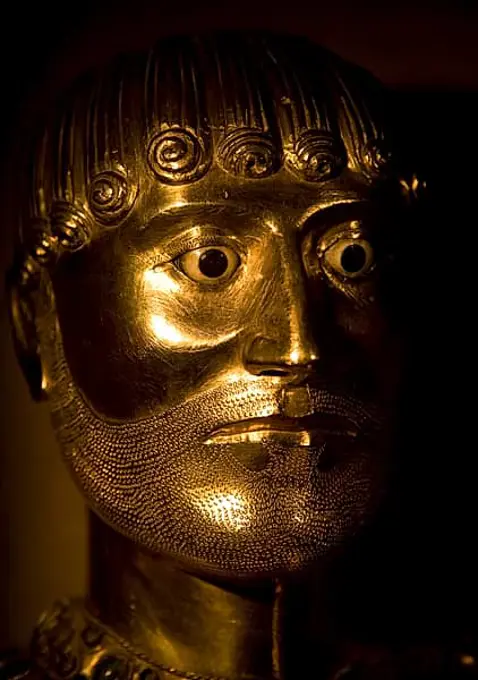
. Saint Thekla was a follower of the Apostle Paul. She miraculously survived various cruel forms of torture. A relic from her body was preserved in this precious reliquary from Basel Cathedral. By giving the reliquary literally the form of a face, it was imbued with far greater expressive power, making it easier for the faithful to venerate the saints remains.
6145-29124534
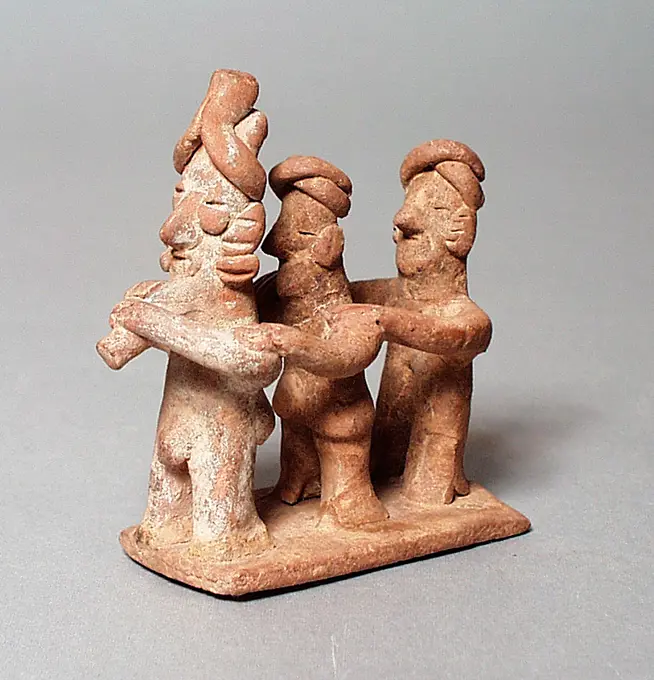
Three Figures in Ritual Procession
6145-29723121
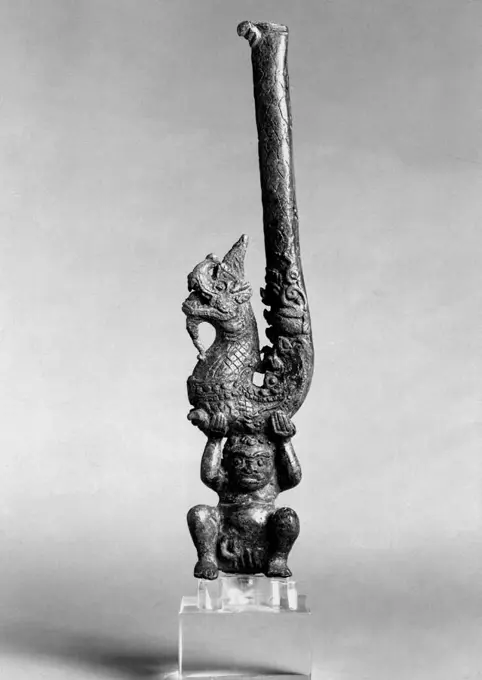
Yaksha Supporting a Naga 12th century Thailand. Yaksha Supporting a Naga. Thailand. 12th century. Bronze with traces of gilt. early Sukhothai period. Sculpture
1746-19665243
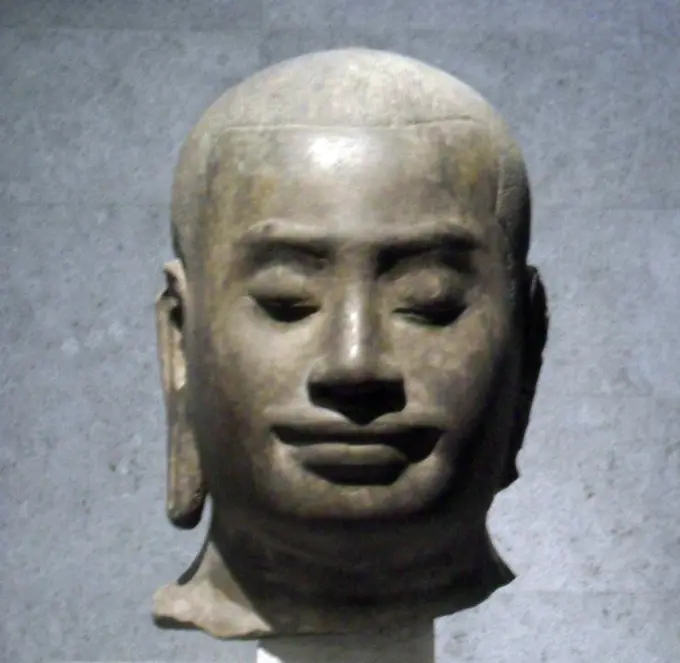
The king is represented meditating humbly with downcast eyes. His lips show the famous smile of Angkor. Late 12th century, early 13th century Bayon style (late 12th-early 13th century) sandstone sculpture from Ta Prohm Temple, Cambodia
1746-29954757
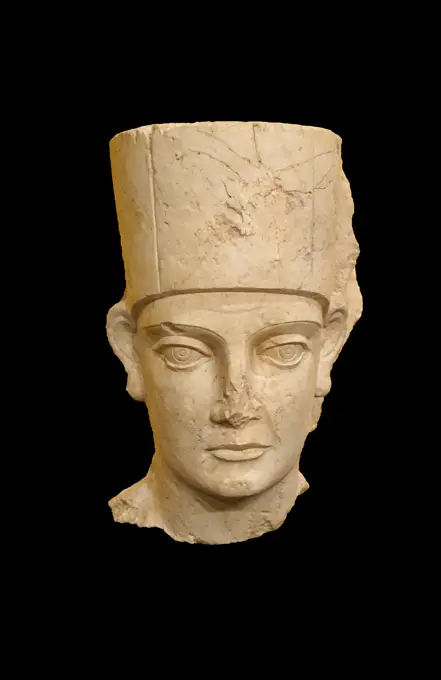
Head of a priest wearing a cylindrical modius. Limestone fine carved in high relief (rear part torn off) 2nd - 3rd century AD. Syria, Palmyra
6145-46444682
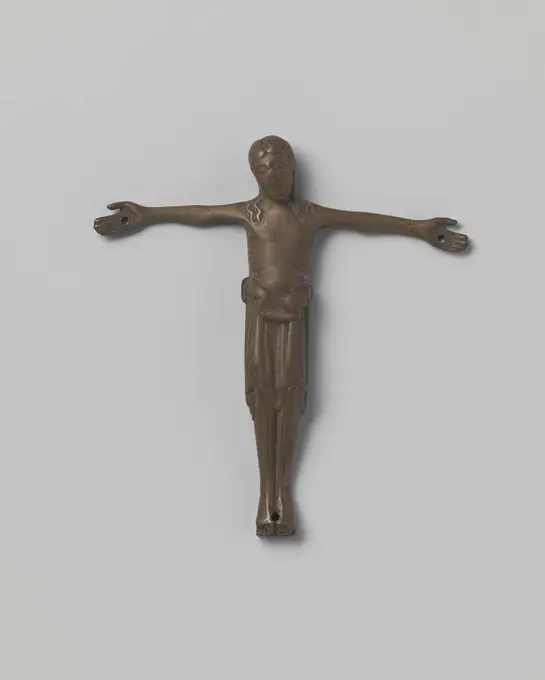
Crucified Christ. The Christ's figure when one whole cast is at the back hollow. He holds the poor with the opened hands stretched in such a way that they are in line with each other. His head hangs slightly to the right. Body and legs are virtually straight stretched. The hair is located in four courses backwards and falls into two lure on both shoulders. The ribs are indicated with shallow grooves. The fairly long miner symmetrically pleated loincloth is draped in such a way that he releases the knees. The feet rest on a pedestal (a suppedanum). Hands and feet are pierced. The figure is worn down. The mouth can hardly see the beard at all.
6145-45660638
Monk Displaying The Varada Mudra, Residential House. Kediri, Kediri District, East Java Province, 13th - 14th Century .. a seated Buddha in a Varada Mudra. The image was placed at the residential house in Kediri.
6176-67051405
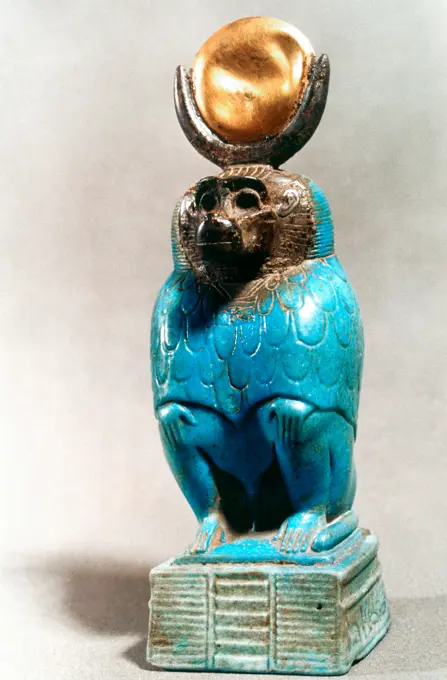
Statue of the Ancient Egyptian god Thoth in baboon form. Artist: Unknown
6145-48885087
Head of a Priest. Unknown
1746-19664417
Figure of a man seated. Sundi or Woyo tribe, Democratic republic of Congo (Zaire), Africa. Woo which has been dyed. 1910
6145-29204909
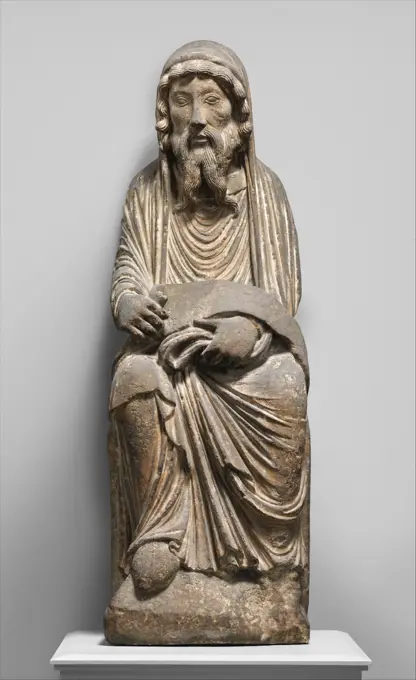
The Priest Aaron ca. 1170 French This sculpture of Aaron and the opposite figure of Moses form part of a rare ensemble of key figures from the Hebrew Bible. They symbolically prefigure the redemption offered through the sacrificial death of Christ, and with other statues originally flanked an enthroned Virgin and Child that still survives in the Gothic cathedral at Noyon. The sculptures are distinguished by garments of weighty fabric arranged in swelling volumes stretched around the body. Here, the Levite priest Aaron covers his head with a veil and holds a scroll. After their removal from the cathedral in the wake of the French Revolution, the sculptures were affected by different environmental conditions.. The Priest Aaron. French. ca. 1170. Limestone. Made in Noyon, Picardy (Oise). Sculpture-Stone
1746-19677285
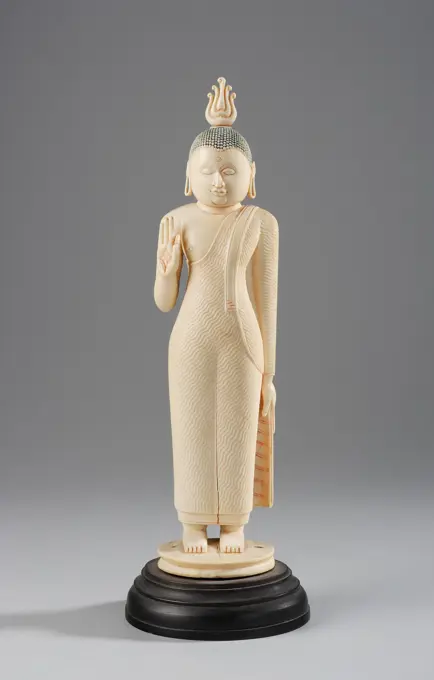
Buddha made from Ivory 8th Century.
1323-997
Statue of Buddha, Hanoi, Vietnam
6145-29719756
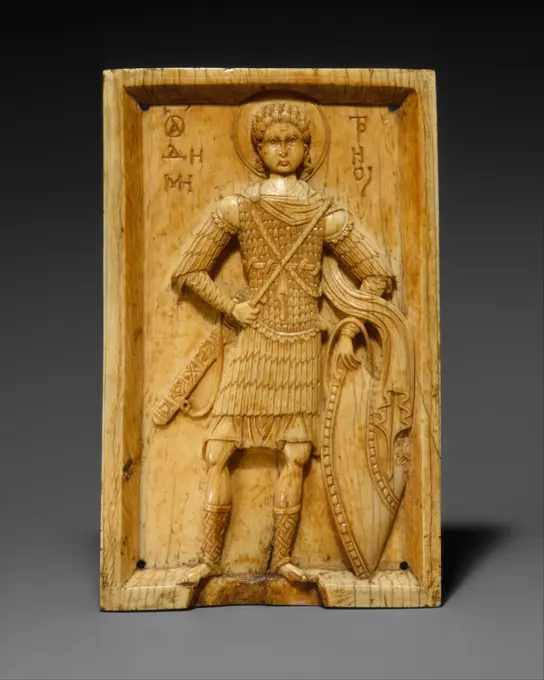
Icon with Saint Demetrios 950-1000 Byzantine Standing erect, a spear in his hand and a shield at his side, Saint Demetrios is shown ready to protect the Christian faithful. The name of the popular Byzantine military saint is inscribed in two parts in Greek. Martyred in Thessalonike, the second most important city of the empire in the early centuries of the church, he has long been the patron saint of that metropolis. Images of saints in military dress are rare in Early Byzantine art (they appear on the chalices of the Attarouthi Treasure) but typical of the Middle Byzantine period. The cleft in the base of the frame may have supported a standard for carrying the image in processions or into battle. The holes drilled through the back indicate that it may have been used in the Latin West as a cover for a book.. Icon with Saint Demetrios. Byzantine. 950-1000. Ivory. Ivories
1746-21126397
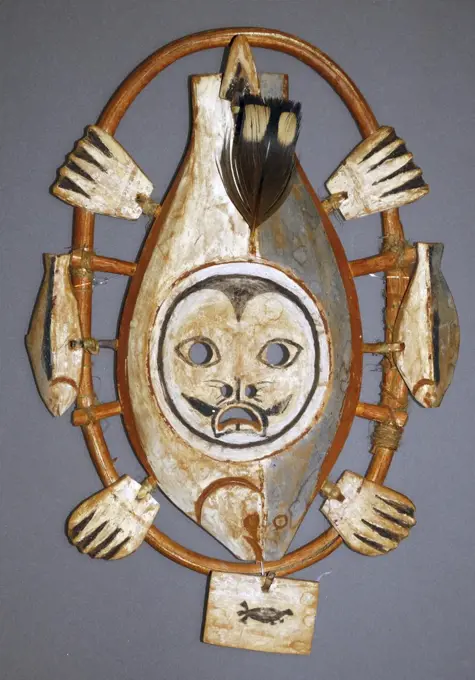
Masks from the Arctic used to reveal inner truth of the wearer, used by Shamans. Dated 19th Century
6145-29753911
Head of a Buddha 5th century Sri Lanka. Head of a Buddha 38975
1788-18250
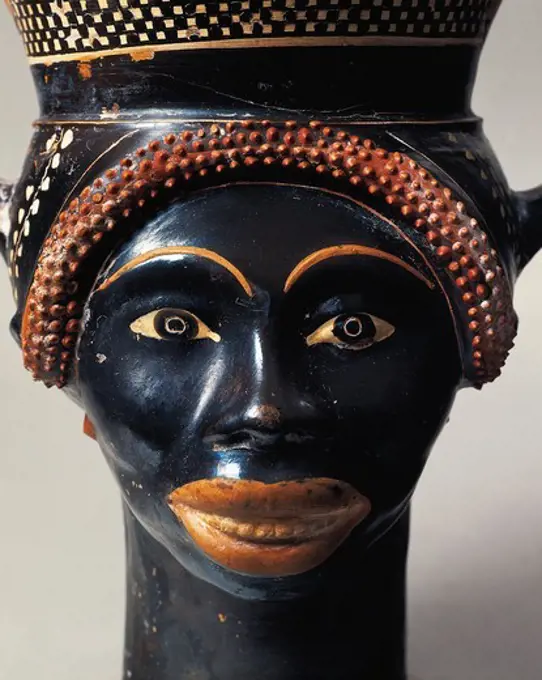
Kantharos in shape of white woman and black woman, Detail of black woman
6145-29759548
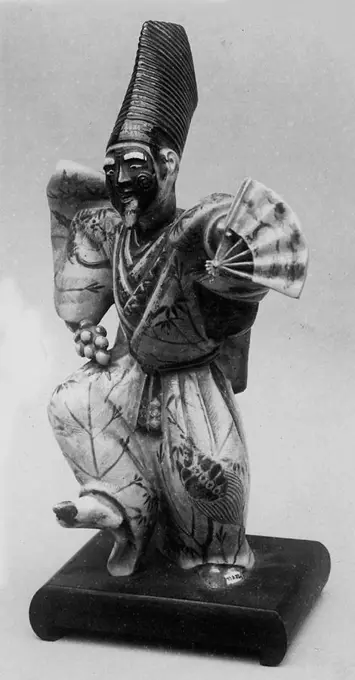
Figure of a Noh Dancer 1750 Japan. Figure of a Noh Dancer 62797
6145-29144421
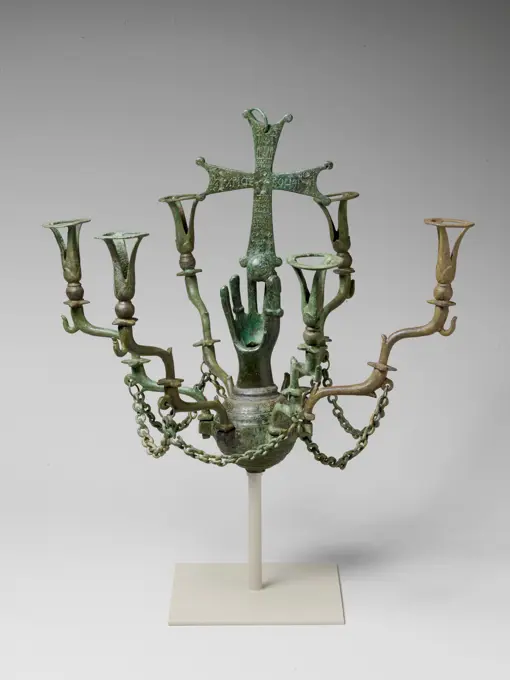
Hanging Lamp with a Hand Holding a Cross made 500-700, restored and possibly reconfigured 1900s Byzantine The flowerlike terminals of the lamp arms held glass vessels full of oil. The hand was probably an offering for a cure as suggested by the large Greek inscription on the cross, Christ help [me,” and by the inclusion of healing saints. Saints Kosmas and Damianos be praised” is inscribed over the twin medical saints whose medical kits are at the base. The other figures are Saint Stephen at the center, flanked by Saints Paul (left) and Peter (right), with the Virgin and Child enthroned above.. Hanging Lamp with a Hand Holding a Cross 471990
4409-62750357
Holy Christ in Majesty, detail, 12th century, monastery of Sant Miquel de Cruilles, Girona art museum, Girona, Catalonia, Spain.
6145-46358491
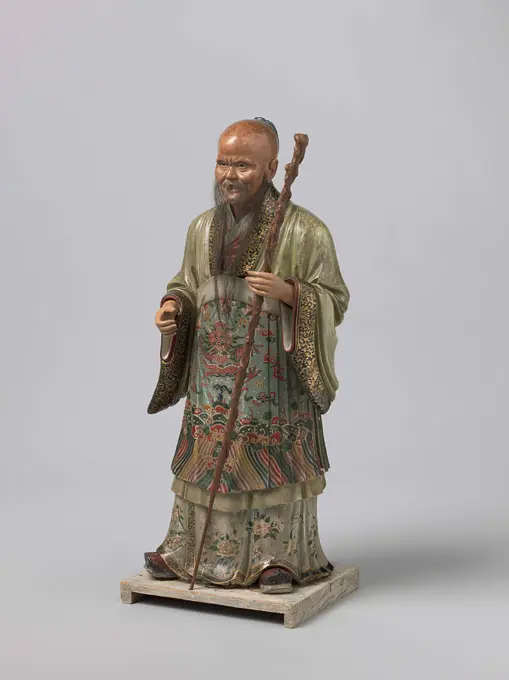
Body of a standing Chinese kinkpop (man). Body of a standing articulated pot. Together with a head, two hands and a staff, forms a Chinese high-quality capacity.
1525-26895888
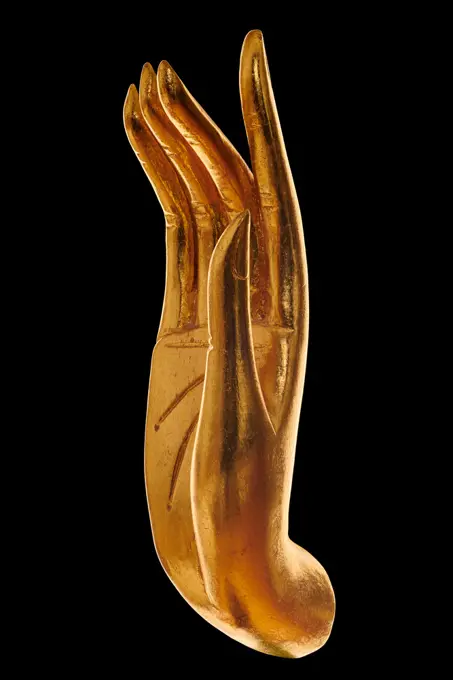
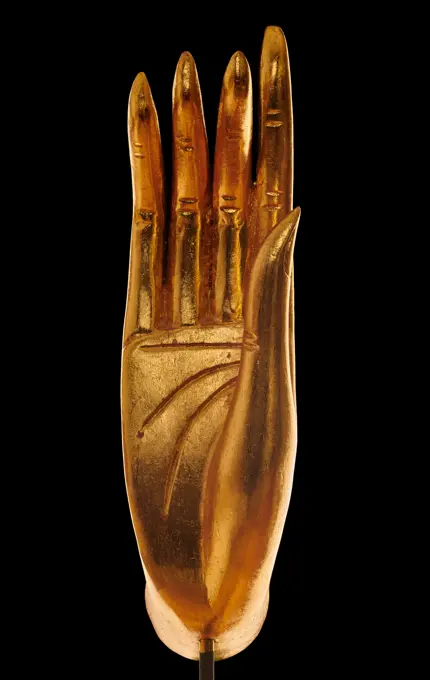
Close up of golden hand of Buddha statue over black background
1890-95702
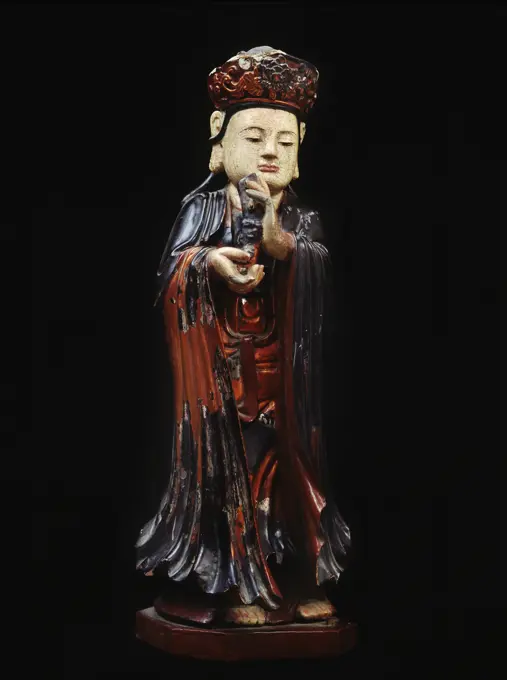
Lacquered image of a deity, 19th century, Saigon National Museum, Saigon, Vietnam, Indochina, Southeast Asia, Asia
1323-392A
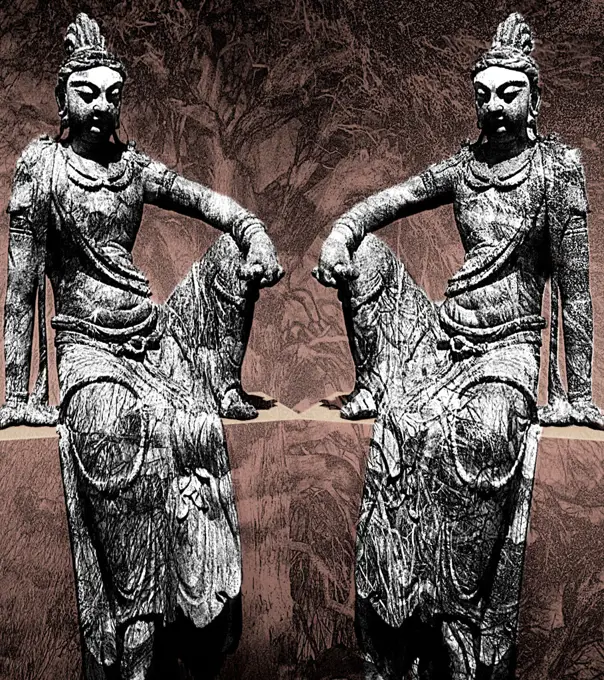
Close-up of two religious figures
1788-18479
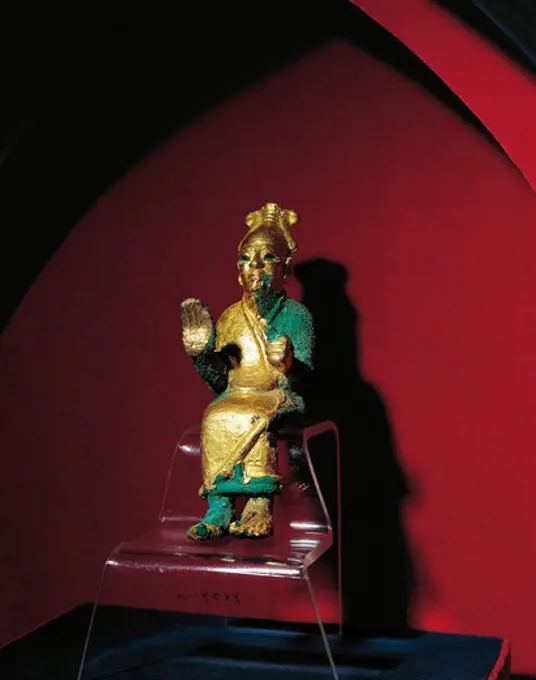
Gold statue of enthroned god El, from Ugarit, Ras-Shamra, Syria
1848-67231576
Former Cistercian nunnery Himmelthal in Spessart. Founded in 1232, the present church dates from 1753 and is now the Elsava School. Late Romanesque depiction of demons from the founding church, St., Sankt, Saint
4409-62772188
virgin mary in polychrome wood, 12th century, Catalan work, Girona art museum, Girona, Catalonia, Spain.
5513-111856178
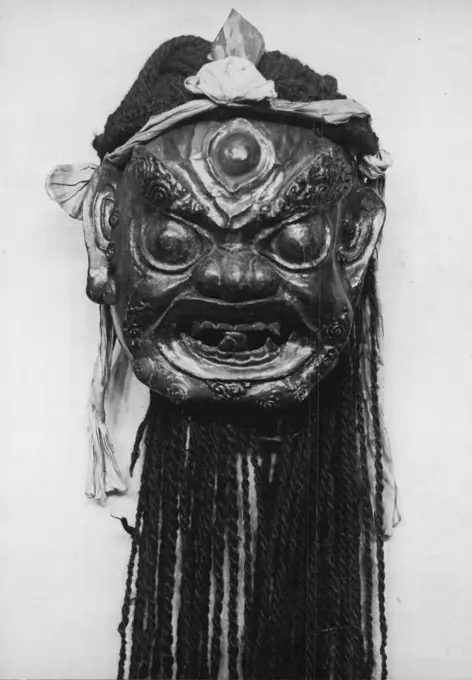
Out Of The East -- Berliners have been admiring this Mongolian mask, which is one of the pieces on show at the Ethnological Museum. November 29, 1933. (Photo by Atlantic Photo).;Out Of The East -- Berliners have been admiring this Mongolian mask, which is one of the pieces on show at the Ethnological Museum.
1788-15576
Bronze statuette portraying Assyrian demon Pazuzu
6188-64617771
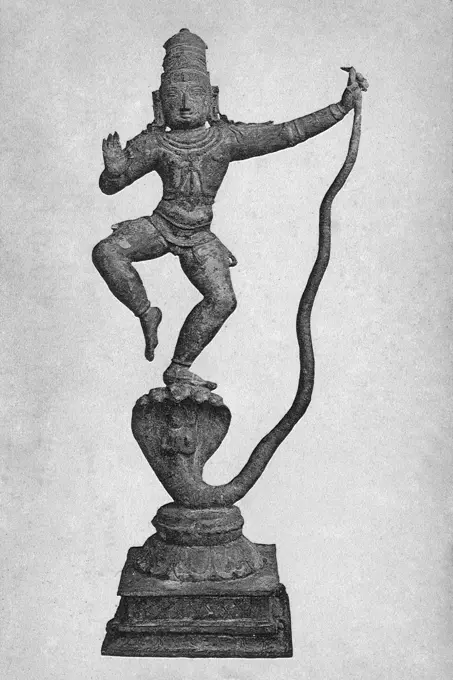
old vintage photo of kaliya krishna madras museum tamil nadu India Copyright: xAjayxGoyal/DinodiaxPhotox
6145-29765317
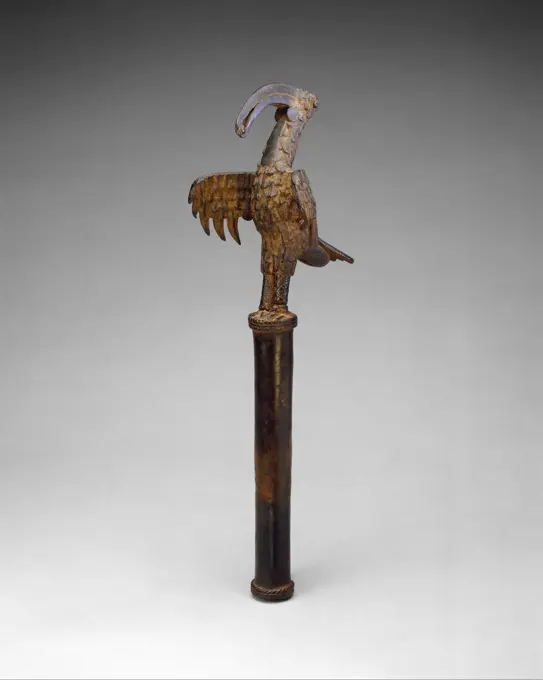
Idiophone: Bird of Prophecy (ahianmwen-oro) 16th-19th century Edo peoples Hand-held clappers are among a vast and varied category of 'self-sounding' musical instruments, known collectively as idiophones, that produce sound without the addition of a stretched membrane or a vibrating string or reed. The most common form of clapper in the Benin corpus consists of a cylindrical shaft surmounted by the figure of a long-beaked bird with outstretched wings, such as this example. They are played by striking the bird figure on its beak with a metal rod.The bird perched with outstretched wings on the finials of this idiophone sounded on the occasions of Ugie Oro court festivals is usually called the "bird of prophecy" (ahianmwen-oro) and sometimes the "messenger of god" (odibosa). Beginning with the reign of King Esigie in the sixteenth century, the sounding of clappers depicting the bird of prophecy at Ugie Oro court ceremonies was regarded as a sign that the kings of Benin were endowed with th
1746-29955523
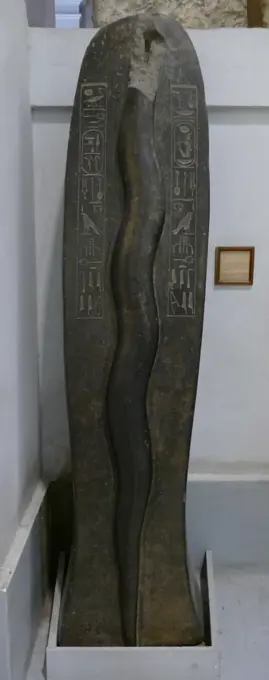
Serpent deity of dark granite dedicated by King Amenophis III, to Har-Khentekhtai, in hs temple at Athribis, near Benha. 18th dynasty.
1848-67229525
Saint Nectaire, Notre-Dame-du-Mont-Cornadore de Saint-Nectaire
6188-63964297
Replica of idol of shree girijatmaj of lenyadri  Pune  Maharashtra  India 2010 Copyright: xNitinxKelvalkar/DinodiaxPhotox
4409-21404111
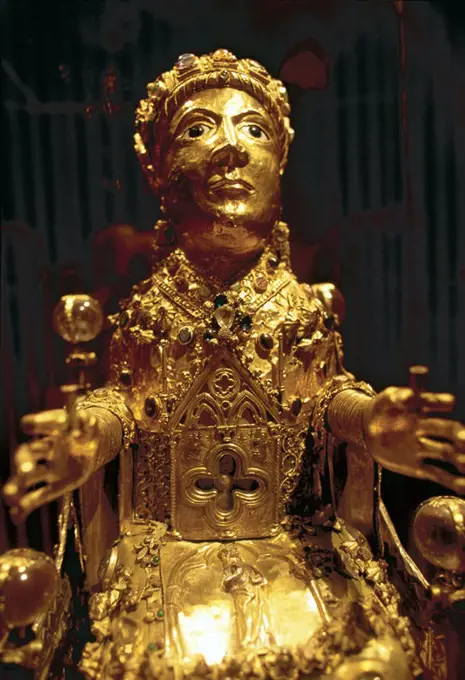
ARTE OTONIANO. SIGLO X. FRANCIA. RELICARIO DE SANTA FE DE CONQUES. Estatua con interior de madera recubierta totalmente de oro, plata y joyas de distinta época. Son notables los esmaltes de la corona con piedras preciosas encastadas. Se identifican materiales del bajo imperio romano, bizantinos y carolingios.
1525-26908384
Close up of golden hand of Buddha statue over black background
4409-17379348
Shouxing, Stellar God of Immortality. Culture: China. Dimensions: H. 8 1/4 in. (21 cm); W. 4 1/16 in. (10.3 cm); H. incl. base 9 7/8 (25.1 cm). Date: 16th century.As one of the personified or embodied stars, Shouxing is associated with the South Pole in Chinese astronomy and is believed to control human life span. Longevity, good fortune, and prosperity are considered the three attributes of a good life in traditional Chinese culture. Museum: Metropolitan Museum of Art, New York, USA.
1848-67096249
Aachen, Minster (Palatinate Chapel), Aachen Cathedral
1899-18854343
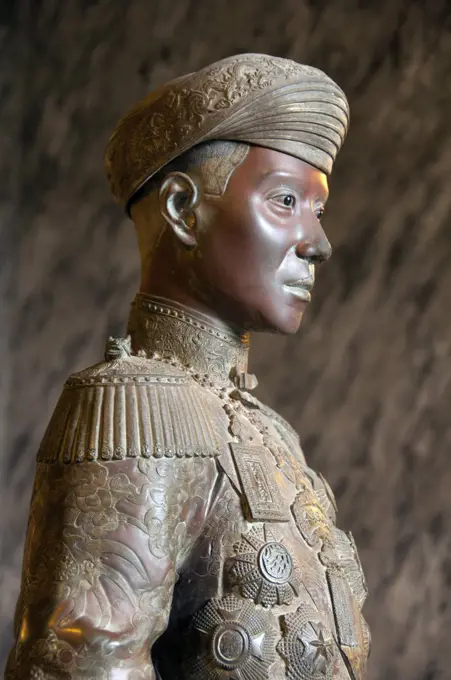
Emperor Khải Định (8 October 1885 - 6 November 1925) was the 12th Emperor of the Nguyễn Dynasty in Vietnam. His name at birth was Prince Nguyễn Phúc Bửu Đảo. He was the son of Emperor Đồng Khánh, but he did not succeed him immediately. He reigned only nine years: 1916 - 1925. Hue was the imperial capital of the Nguyen Dynasty between 1802 and 1945. The tombs of several emperors lie in and around the city and along the Perfume River. Hue is a UNESCO World Heritage Site.
6188-63964294
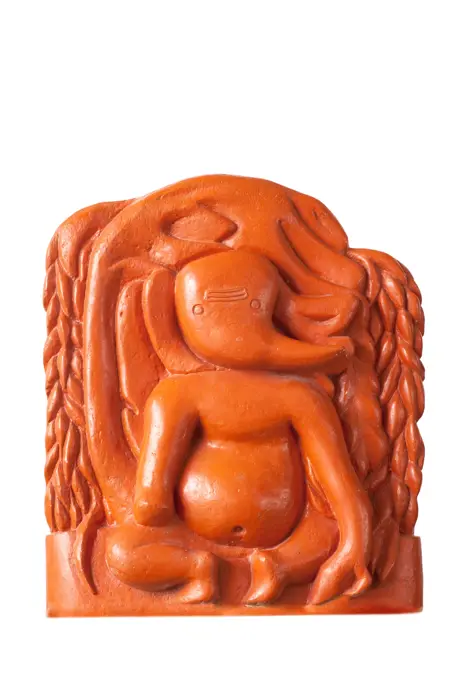
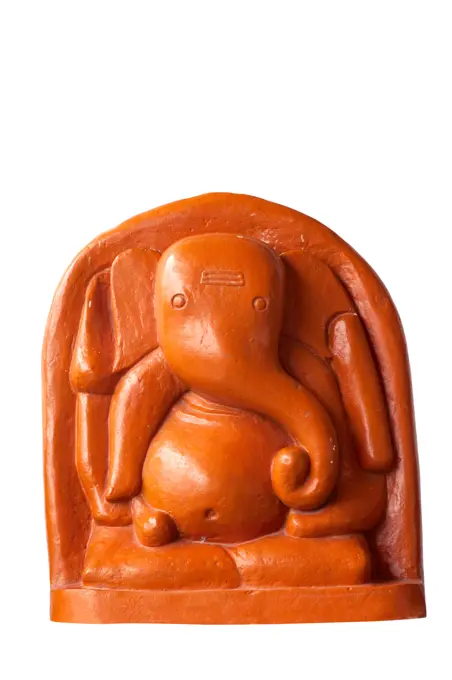
Replica of idol of shree vighneshwar of ozar  Pune  Maharashtra  India 2010 Copyright: xNitinxKelvalkar/DinodiaxPhotox
6188-64686322
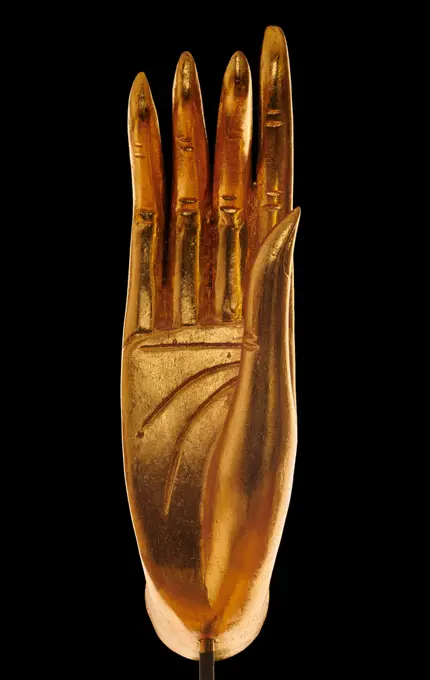
Golden hand of Buddha statue Close up of golden hand of Buddha statue over black background Copyright: xZoonar.com/NIKOLAYxOKHITINx 14749939
4443-28739575
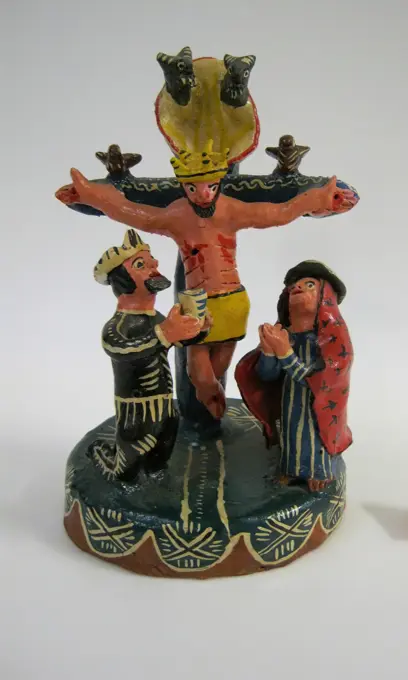
The Crucifixion, mid 20th century, 11-1/8 x 7 x 6-1/2 in. (28.3 x 17.8 x 16.5 cm), Ceramic, pigment, Mexico, 20th century
6145-43608082
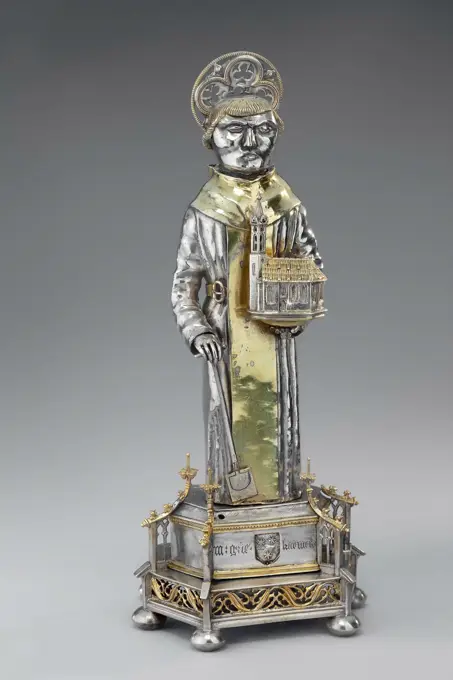
Figure of a saint from the Carmelite Order. unknown, goldsmith
6145-59054734
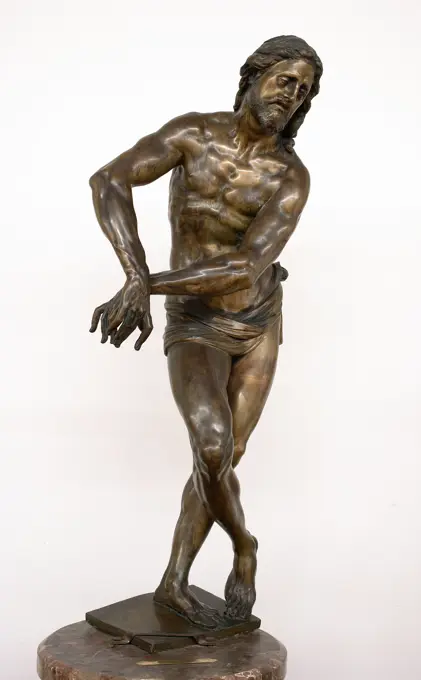
Christ at the column; Vries, Adriaen DE (Ca 1545-1626); 1604 (1604-00-00-1604-00-00);Jesus Christ, Mannerism (style), Bible scenes
6145-43637914
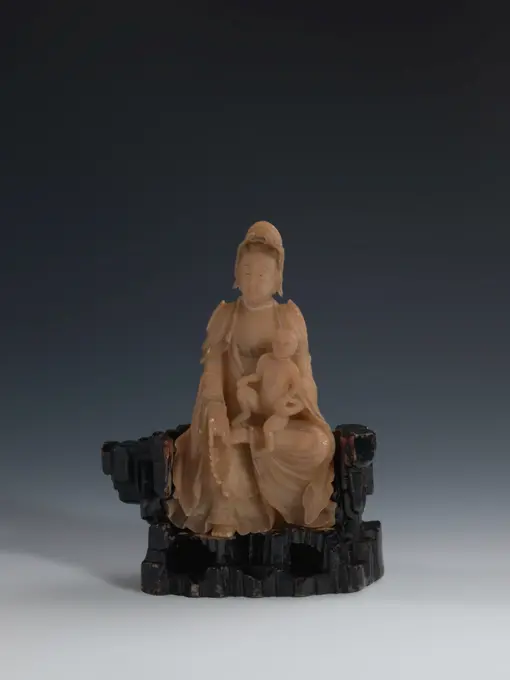
Guanyin obdarzająca synem na skale (podstawce). unknown, sculptor
1525-21776264
Guanyin statues for worship for luck
6145-29728119
Temple Guardian (Nio, one of a pair) early 14th century Japan. Temple Guardian (Nio, one of a pair) 62368
7145-70500457
Asia, Thailand, Suchathai Temple, Budha image