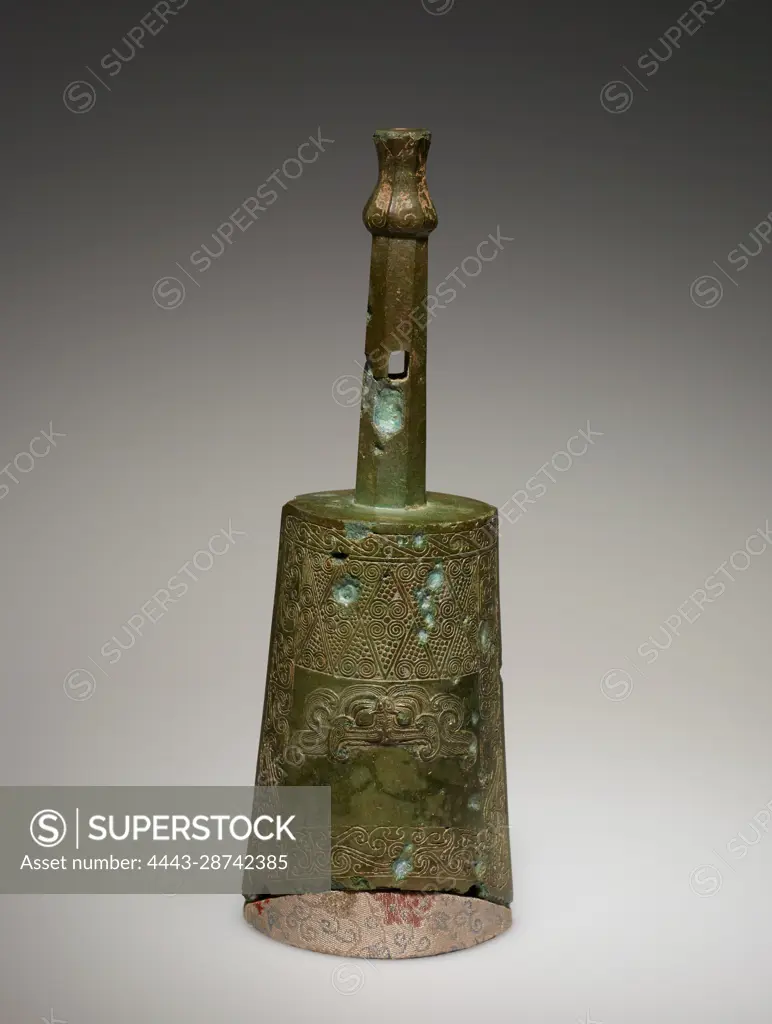
Zheng ritual bell, 5th century BCE, 8 11/16 × 3 × 2 1/2 in., 1.3 lb. (22 × 7.6 × 6.4 cm, 0.6 kg), Bronze, China, 5th century BCE, Although it has the general shape of a small yong bell, this instrument lacks the ring suspension device of the yong as well as the 36 bosses found on most late Zhou bells. And if it were suspended, the composite-animal taotie mask on the body would be upside down. Known as zheng, this type of bell was not used in graduated sets but rather individually, and was held in an upright position. The incised bird and volute, triangular, and running spiral patterns are similar to those found on painted lacquers of the same era, and were prevalent in southern China during the Spring and Autumn (c. 770-476 BCE) and Warring States (c. 475-221 BCE) periods.
SuperStock offers millions of photos, videos, and stock assets to creatives around the world. This image of Zheng ritual bell, 5th century BCE, 8 11/16 × 3 × 2 1/2 in., 1.3 lb. (22 × 7.6 × 6.4 cm, 0.6 kg), Bronze, China, 5th century BCE, Although it has the general shape of a small yong bell, this instrument lacks the ring suspension device of the yong as well as the 36 bosses found on most late Zhou bells. And if it were suspended, the composite-animal taotie mask on the body would be upside down. Known as zheng, this type of bell was not used in graduated sets but rather individually, and was held in an upright position. The incised bird and volute, triangular, and running spiral patterns are similar to those found on painted lacquers of the same era, and were prevalent in southern China during the Spring and Autumn (c. 770-476 BCE) and Warring States (c. 475-221 BCE) periods. by Artokoloro is available for licensing today.
Looking for a license?
Click here, and we'll help you find it! Questions? Just ask!
Click here, and we'll help you find it! Questions? Just ask!
DETAILS
Image Number: 4443-28742385Rights ManagedCredit Line:Artokoloro/SuperStockCollection:Artokoloro Model Release:NoProperty Release:NoResolution:4992×6615