Zheng Huangniu and Yushanzhu early 17th century Kano Naizen Zheng Huangniu, at right, and Yushanzhu, at left, were two legendary Chinese Chan (Japanese: Zen) monks often paired in Japanese painting beginning in the early Muromachi period. Zheng Huangniu (Japanese: Seigy), whose name means “Zheng of the Yellow Ox,” is known for riding a yellow ox to which he attached various objects, such as water jars and books. As is common in later Japanese examples, here Zheng rides his ox backwards. Yushanzhu (Japanese: Ikuzanshu, “Master of Mount Yu”) is said to have gained enlightenment when he fell off his donkey while riding across a bridge. The poetic inscriptions, rendered in a crisp and brusquely brushed style, are by Takuan Sh, one of the most influential Zen monks of his day. Right scroll:A man of the Waysits at ease, without a care,astride a yellow ox, detachedfrom the wind and dust of the world.He has left the hermitageof his garden,and from the ox’s horn hangs a sprigof peony from t
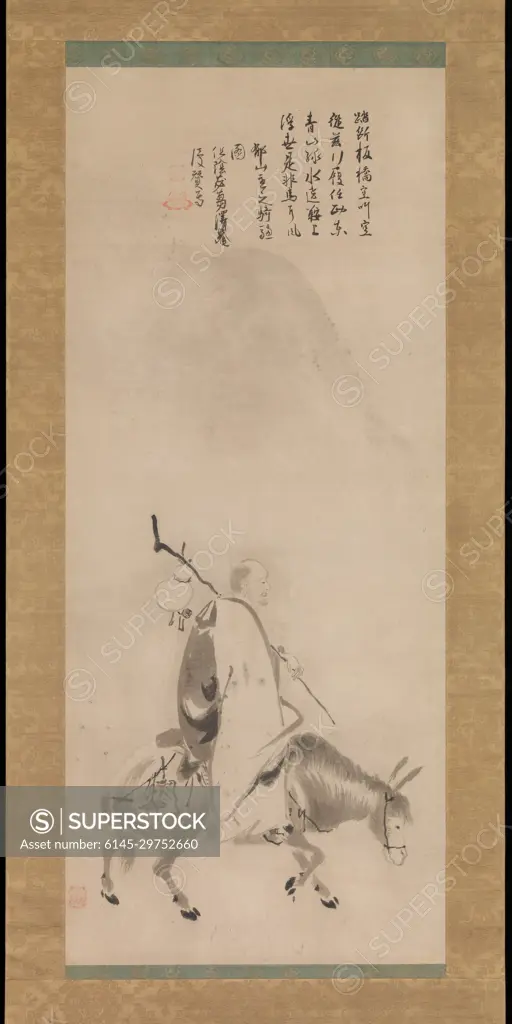
SuperStock offers millions of photos, videos, and stock assets to creatives around the world. This image of Zheng Huangniu and Yushanzhu early 17th century Kano Naizen Zheng Huangniu, at right, and Yushanzhu, at left, were two legendary Chinese Chan (Japanese: Zen) monks often paired in Japanese painting beginning in the early Muromachi period. Zheng Huangniu (Japanese: Seigy), whose name means “Zheng of the Yellow Ox,” is known for riding a yellow ox to which he attached various objects, such as water jars and books. As is common in later Japanese examples, here Zheng rides his ox backwards. Yushanzhu (Japanese: Ikuzanshu, “Master of Mount Yu”) is said to have gained enlightenment when he fell off his donkey while riding across a bridge. The poetic inscriptions, rendered in a crisp and brusquely brushed style, are by Takuan Sh, one of the most influential Zen monks of his day. Right scroll:A man of the Waysits at ease, without a care,astride a yellow ox, detachedfrom the wind and dust of the world.He has left the hermitageof his garden,and from the ox’s horn hangs a sprigof peony from t by Piemags/PL Photography Limited is available for licensing today.
Looking for a license?
Click here, and we'll help you find it! Questions? Just ask!
Click here, and we'll help you find it! Questions? Just ask!
DETAILS
Image Number: 6145-29752660Royalty FreeCredit Line:Piemags/PL Photography Limited/SuperStockCollection:PL Photography Limited Contributor:Piemags Model Release:NoProperty Release:NoResolution:2002×4000