Writing table (table à écrire). Culture: French, Paris. Dimensions: H. 30-3/4 x W. 38 x D. 22-5/8 in. (78.1 x 96.5 x 57.5 cm). Maker: Bernard II van Risenburgh (ca. 1696-ca. 1767). Date: ca. 1755.Letter writing was a much-practiced activity in eighteenth-century Europe. Horace Walpole, a prolific correspondent himself, reported on September 12, 1775, to his friend Anne Liddell, "There have been known here in Paris persons who wrote to one another four times a day; and I was told of one couple, who being always together, and the lover being fond of writing, he placed a screen between them, and then wrote to Madame on t'other side, and flung them over."1 In order to accommodate this incessant writing, a variety of tables à écrire, large and small, were created. Often fitted with a leatheror velvet-covered writing surface, and with one or more drawers for the storage of quills and other paraphernalia, these pieces were generally placed in the private rooms of the house. This particul
This asset has restrictions and cannot be purchased online. Get in touch for more details.
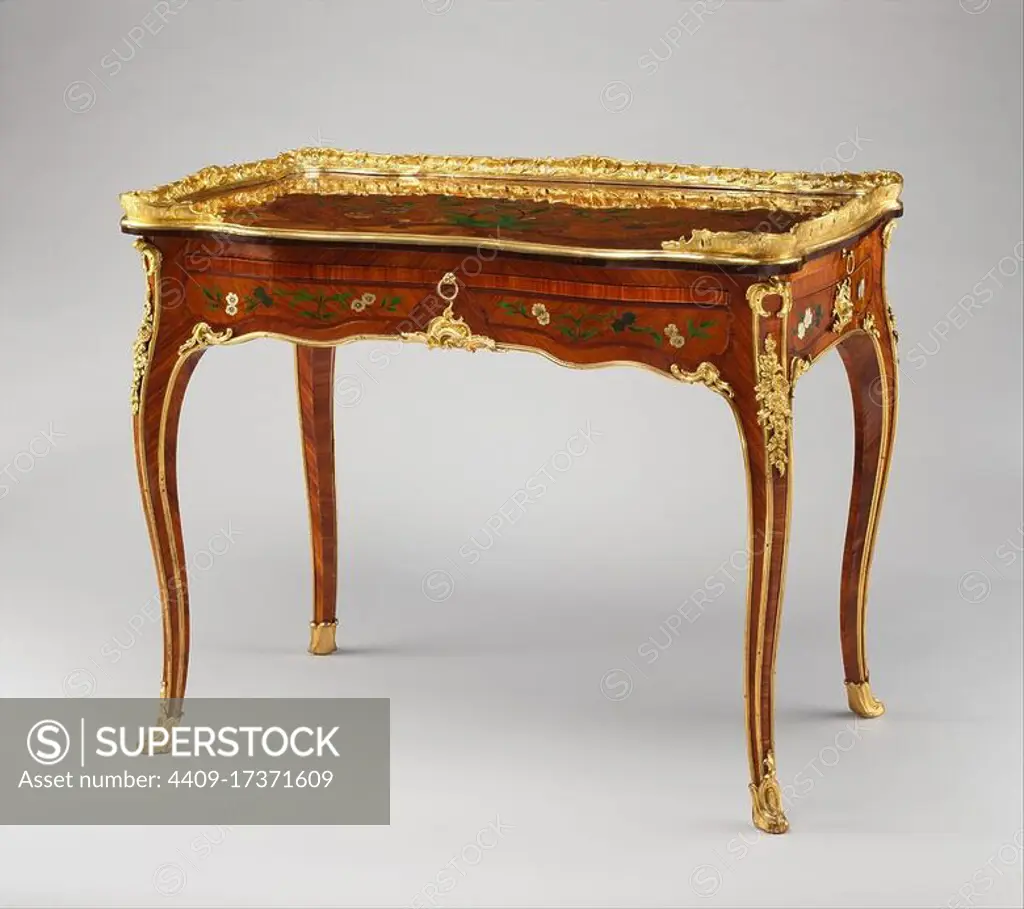
SuperStock offers millions of photos, videos, and stock assets to creatives around the world. This image of Writing table (table à écrire). Culture: French, Paris. Dimensions: H. 30-3/4 x W. 38 x D. 22-5/8 in. (78.1 x 96.5 x 57.5 cm). Maker: Bernard II van Risenburgh (ca. 1696-ca. 1767). Date: ca. 1755.Letter writing was a much-practiced activity in eighteenth-century Europe. Horace Walpole, a prolific correspondent himself, reported on September 12, 1775, to his friend Anne Liddell, "There have been known here in Paris persons who wrote to one another four times a day; and I was told of one couple, who being always together, and the lover being fond of writing, he placed a screen between them, and then wrote to Madame on t'other side, and flung them over."1 In order to accommodate this incessant writing, a variety of tables à écrire, large and small, were created. Often fitted with a leatheror velvet-covered writing surface, and with one or more drawers for the storage of quills and other paraphernalia, these pieces were generally placed in the private rooms of the house. This particul by Album/Metropolitan Museum of Art, NY/Album Archivo is available for licensing today.
Looking for a license?
Click here, and we'll help you find it! Questions? Just ask!
Click here, and we'll help you find it! Questions? Just ask!
DETAILS
Image Number: 4409-17371609Rights ManagedCredit Line:Album/Metropolitan Museum of Art, NY/Album Archivo/SuperStockCollection:Album Archivo Contributor:Album / Metropolitan Museum of Art, NY Model Release:NoProperty Release:NoResolution:4050×3600