A Wren and Chrysanthemums ca. 1830 Utagawa Hiroshige Japanese Intriguingly, the artist borrowed both his depiction of the wren (misosazai) and the accompanying kyka (thirty-one-syllable witty verse) from the poetry book Myriad Birds (Momo chidori, ca. 1790), illustrated by Kitagawa Utamaro and published about four decades before. The poem is about falling in love with a high-ranked courtesan and was composed by Karagoromo Kissh (1743-1802), a samurai-poet who was one of the pioneers of the kyka revival in the late eighteenth century. Taih no takaki kokoro no kimi yue ni uki misosazai yori mo tsukarezu Since your ambition is as lofty as that of Taihthe majestic bird of legendas a wren, even if I fall in love, I cannot hope to soar that high.—Trans. John T. Carpenter. A Wren and Chrysanthemums. Utagawa Hiroshige (Japanese, Tokyo (Edo) 1797-1858 Tokyo (Edo)). Japan. ca. 1830. Woodblock print. Edo period (1615-1868). Prints
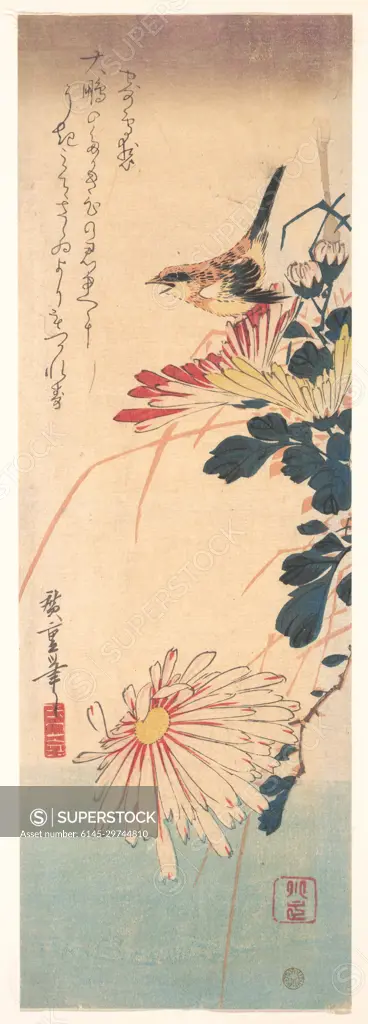
SuperStock offers millions of photos, videos, and stock assets to creatives around the world. This image of A Wren and Chrysanthemums ca. 1830 Utagawa Hiroshige Japanese Intriguingly, the artist borrowed both his depiction of the wren (misosazai) and the accompanying kyka (thirty-one-syllable witty verse) from the poetry book Myriad Birds (Momo chidori, ca. 1790), illustrated by Kitagawa Utamaro and published about four decades before. The poem is about falling in love with a high-ranked courtesan and was composed by Karagoromo Kissh (1743-1802), a samurai-poet who was one of the pioneers of the kyka revival in the late eighteenth century. Taih no takaki kokoro no kimi yue ni uki misosazai yori mo tsukarezu Since your ambition is as lofty as that of Taihthe majestic bird of legendas a wren, even if I fall in love, I cannot hope to soar that high.—Trans. John T. Carpenter. A Wren and Chrysanthemums. Utagawa Hiroshige (Japanese, Tokyo (Edo) 1797-1858 Tokyo (Edo)). Japan. ca. 1830. Woodblock print. Edo period (1615-1868). Prints by Piemags/PL Photography Limited is available for licensing today.
Looking for a license?
Click here, and we'll help you find it! Questions? Just ask!
Click here, and we'll help you find it! Questions? Just ask!
DETAILS
Image Number: 6145-29744810Royalty FreeCredit Line:Piemags/PL Photography Limited/SuperStockCollection:PL Photography Limited Contributor:Piemags Model Release:NoProperty Release:NoResolution:1403×3899