Wrack 1839 William Henry Fox Talbot British This evanescent trace of a biological specimen, among the rarest of photographs, was made by William Henry Fox Talbot just months after he first presented his invention, photographyor "photogenic drawing," as he called itto the public. Talbot's earliest images were made without a camera; here a piece of slightly translucent seaweed was laid directly onto a sheet of photosensitized paper, blocking the rays of the sun from the portions it covered and leaving a light impression of its form.Plants were often the subject of Talbot's early photographs, for he was a serious amateur botanist and envisioned the accurate recording of specimens as an important application of his invention. The "Album di disegni fotogenici," in which this print appears, contains thirty-six images sent by Talbot to the Italian botanist Antonio Bertoloni in 1839-40. It was the first important photographic work purchased by the Metropolitan Museum.. Wrack 282756
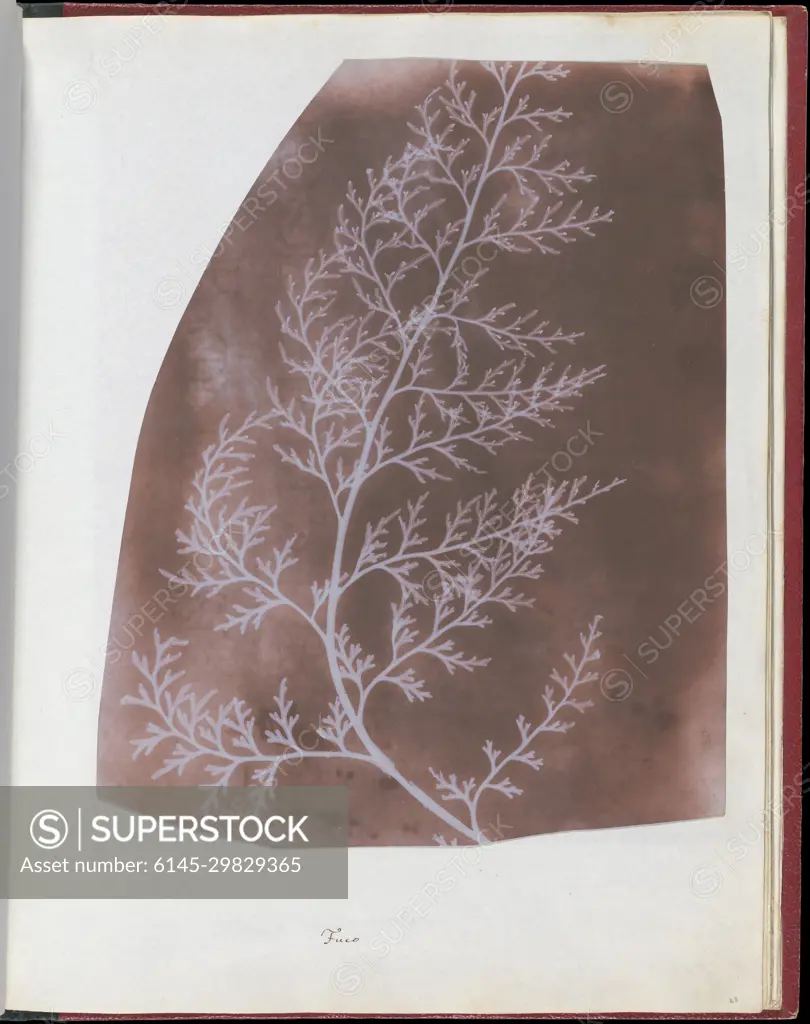
SuperStock offers millions of photos, videos, and stock assets to creatives around the world. This image of Wrack 1839 William Henry Fox Talbot British This evanescent trace of a biological specimen, among the rarest of photographs, was made by William Henry Fox Talbot just months after he first presented his invention, photographyor "photogenic drawing," as he called itto the public. Talbot's earliest images were made without a camera; here a piece of slightly translucent seaweed was laid directly onto a sheet of photosensitized paper, blocking the rays of the sun from the portions it covered and leaving a light impression of its form.Plants were often the subject of Talbot's early photographs, for he was a serious amateur botanist and envisioned the accurate recording of specimens as an important application of his invention. The "Album di disegni fotogenici," in which this print appears, contains thirty-six images sent by Talbot to the Italian botanist Antonio Bertoloni in 1839-40. It was the first important photographic work purchased by the Metropolitan Museum.. Wrack 282756 by Piemags/PL Photography Limited is available for licensing today.
Looking for a license?
Click here, and we'll help you find it! Questions? Just ask!
Click here, and we'll help you find it! Questions? Just ask!
DETAILS
Image Number: 6145-29829365Royalty FreeCredit Line:Piemags/PL Photography Limited/SuperStockCollection:PL Photography Limited Contributor:Piemags Model Release:NoProperty Release:NoResolution:3008×3801