Willow Kannon probably 1810s Sakai Hitsu While Sakai Hitsu is most closely associated with Rinpa (introduced in the next gallery), a dozen or so paintings of Buddhist deities by him and his circle are known today, in polychrome as well as in ink. Here, the miniature Amida Buddha in his tall crown, the willow branch in his right hand, and the vase in his left identify this deity as Willow (Yry) Kannon. The willow branch is believed to ward off evil and illness, while the bottle contains a nectar with healing powers. The outer cape, rendered with compulsive detail, suggests an otherworldly aura. The signature indicates that the painting was based on a model attributed to the Chinese Tang-dynasty master Wu Daozi. Nothing in Wu’s hand survives, however, and his work is known only through later copies and ink rubbings.. Willow Kannon. Sakai Hitsu (Japanese, 1761-1828). Japan. probably 1810s. Hanging scroll; ink, color, and gold leaf on silk. Edo period (1615-1868). Paintings
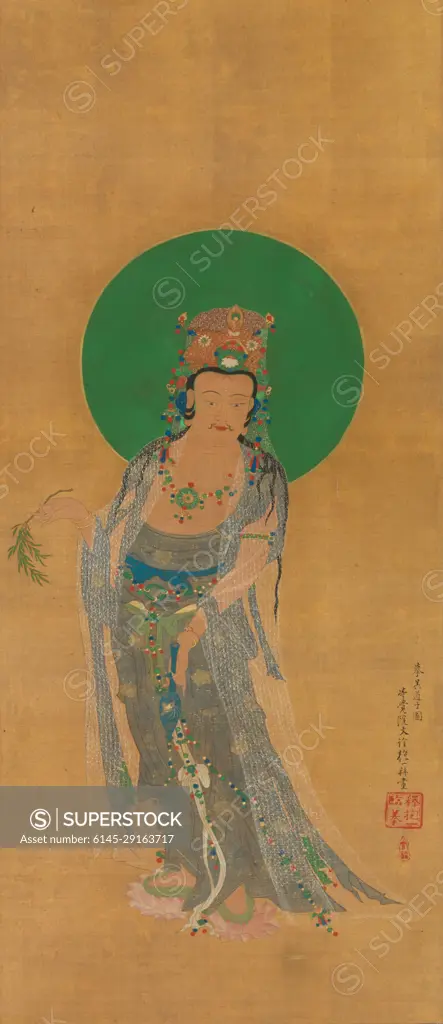
SuperStock offers millions of photos, videos, and stock assets to creatives around the world. This image of Willow Kannon probably 1810s Sakai Hitsu While Sakai Hitsu is most closely associated with Rinpa (introduced in the next gallery), a dozen or so paintings of Buddhist deities by him and his circle are known today, in polychrome as well as in ink. Here, the miniature Amida Buddha in his tall crown, the willow branch in his right hand, and the vase in his left identify this deity as Willow (Yry) Kannon. The willow branch is believed to ward off evil and illness, while the bottle contains a nectar with healing powers. The outer cape, rendered with compulsive detail, suggests an otherworldly aura. The signature indicates that the painting was based on a model attributed to the Chinese Tang-dynasty master Wu Daozi. Nothing in Wu’s hand survives, however, and his work is known only through later copies and ink rubbings.. Willow Kannon. Sakai Hitsu (Japanese, 1761-1828). Japan. probably 1810s. Hanging scroll; ink, color, and gold leaf on silk. Edo period (1615-1868). Paintings by Piemags/PL Photography Limited is available for licensing today.
Looking for a license?
Click here, and we'll help you find it! Questions? Just ask!
Click here, and we'll help you find it! Questions? Just ask!
DETAILS
Image Number: 6145-29163717Royalty FreeCredit Line:Piemags/PL Photography Limited/SuperStockCollection:PL Photography Limited Contributor:Piemags Model Release:NoProperty Release:NoResolution:1731×4000