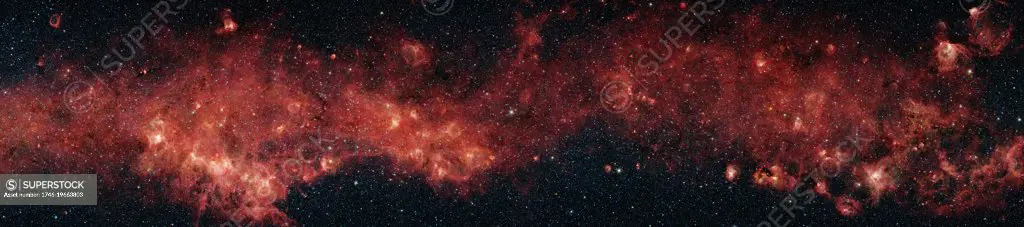
In visible light, the bulk of our Milky Way galaxys stars are eclipsed behind thick clouds of galactic dust and gas. But to the infrared eyes of NASAs Spitzer Space Telescope, distant stars and dust clouds shine with unparalleled clarity and colour. from the Galactic Legacy Infrared Mid-Plane Survey Extraordinaire project, a plethora of stellar activity in the Milky Ways galactic plane, reaching to the far side of our galaxy, is exposed. This image spans 9 degrees of sky (approximately the width of a fist held out at arms length). The red clouds indicate the presence of large organic molecules (mixed with the dust), which have been illuminated by nearby star formation. The patches of black are dense obscuring dust clouds impenetrable by even Spitzers super-sensitive infrared eyes. Bright arcs of white throughout the image are massive stellar incubators. In contrast to the plentiful examples of stellar youth in this montage, Spitzer also sees an object called a planetary nebula (to
SuperStock offers millions of photos, videos, and stock assets to creatives around the world. This image of In visible light, the bulk of our Milky Way galaxys stars are eclipsed behind thick clouds of galactic dust and gas. But to the infrared eyes of NASAs Spitzer Space Telescope, distant stars and dust clouds shine with unparalleled clarity and colour. from the Galactic Legacy Infrared Mid-Plane Survey Extraordinaire project, a plethora of stellar activity in the Milky Ways galactic plane, reaching to the far side of our galaxy, is exposed. This image spans 9 degrees of sky (approximately the width of a fist held out at arms length). The red clouds indicate the presence of large organic molecules (mixed with the dust), which have been illuminated by nearby star formation. The patches of black are dense obscuring dust clouds impenetrable by even Spitzers super-sensitive infrared eyes. Bright arcs of white throughout the image are massive stellar incubators. In contrast to the plentiful examples of stellar youth in this montage, Spitzer also sees an object called a planetary nebula (to by World History Archive/Image Asset Management is available for licensing today.
Looking for a license?
Click here, and we'll help you find it! Questions? Just ask!
Click here, and we'll help you find it! Questions? Just ask!
DETAILS
Image Number: 1746-19663803Rights ManagedCredit Line:World History Archive/Image Asset Management/SuperStockCollection:Image Asset Management Contributor:World History Archive Model Release:NoProperty Release:NoResolution:9000×2000