Two Pheasants on a Rock 19th century China While at first glance this picture of pheasants and a distant landscape looks like a painting, it is actually silk tapestry (kesi). Beginning in the Southern Song dynasty (1127-1279) and continuing into the late Qing, faithful reproductions of paintings were made in kesi. By contrast, tapestry-woven silks with decorative patterns were produced for clothing and furnishings. By the nineteenth century, kesipictures show a change in technique: large areas are tapestry-woven in a single color and then details painted in. Here, for example, the river is a single area with painted waves and ripples. (From China, 1800-1900 A.D.). Two Pheasants on a Rock. China. 19th century. Silk and metallic thread tapestry (kesi) with ink and color. Qing dynasty (1644-1911). Textiles-Tapestries
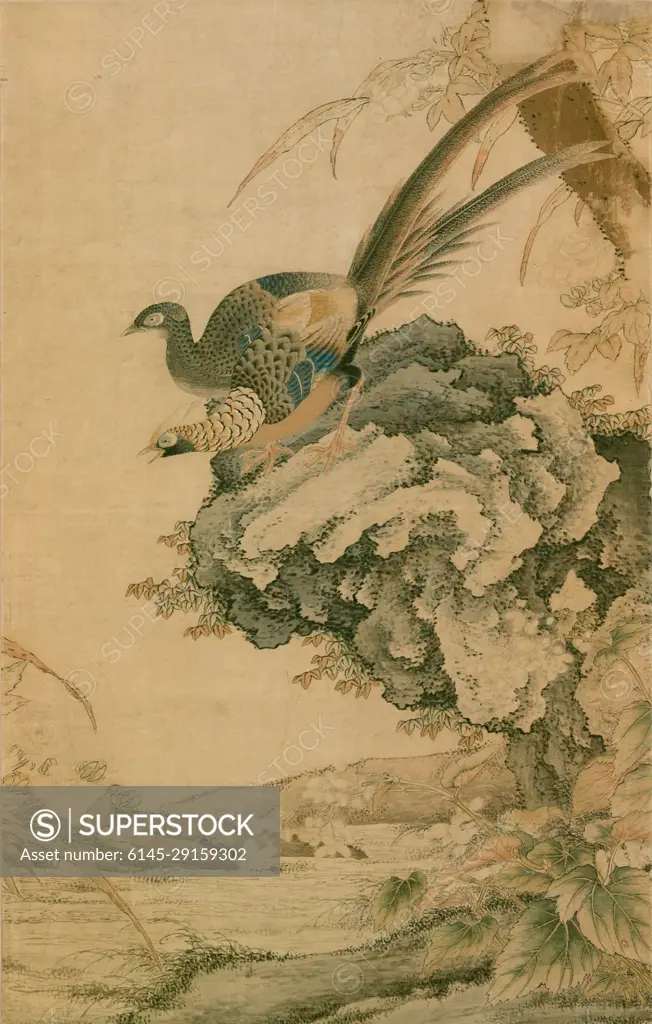
SuperStock offers millions of photos, videos, and stock assets to creatives around the world. This image of Two Pheasants on a Rock 19th century China While at first glance this picture of pheasants and a distant landscape looks like a painting, it is actually silk tapestry (kesi). Beginning in the Southern Song dynasty (1127-1279) and continuing into the late Qing, faithful reproductions of paintings were made in kesi. By contrast, tapestry-woven silks with decorative patterns were produced for clothing and furnishings. By the nineteenth century, kesipictures show a change in technique: large areas are tapestry-woven in a single color and then details painted in. Here, for example, the river is a single area with painted waves and ripples. (From China, 1800-1900 A.D.). Two Pheasants on a Rock. China. 19th century. Silk and metallic thread tapestry (kesi) with ink and color. Qing dynasty (1644-1911). Textiles-Tapestries by Piemags/PL Photography Limited is available for licensing today.
Looking for a license?
Click here, and we'll help you find it! Questions? Just ask!
Click here, and we'll help you find it! Questions? Just ask!
DETAILS
Image Number: 6145-29159302Royalty FreeCredit Line:Piemags/PL Photography Limited/SuperStockCollection:PL Photography Limited Contributor:Piemags Model Release:NoProperty Release:NoResolution:1231×1932