Tupu (pin) 8th-mid-16th century Tiwanaku, Pacajes, or Inca () This object is a tupu, a Quechua word for pin (pithu in Aymara and alfiler in Spanish). Women in the Andes wear tupus in order to fasten textile garments. Tupus, made of metal, usually consist of two parts: a head and a stem. On the present example, the width of the head gradually broadens moving away from the stem. While the long sides of the head are rectilinear, its top edge is circular. The tupu’s stem slightly narrows near its end, farther from the head. The stem may have terminated in a point, a useful feature of tupus for pushing them into the textile garments. Today, the stem appears incomplete. At some stage in this object’s itinerary, the pointed end may have broken off. This end is especially fragile considering the substantial corrosion that is evident. Similar to Metropolitan Museum of Art 64.228.606, there is no perforation visible on the head. This suggests that a person wore this tupu without necessarily thr
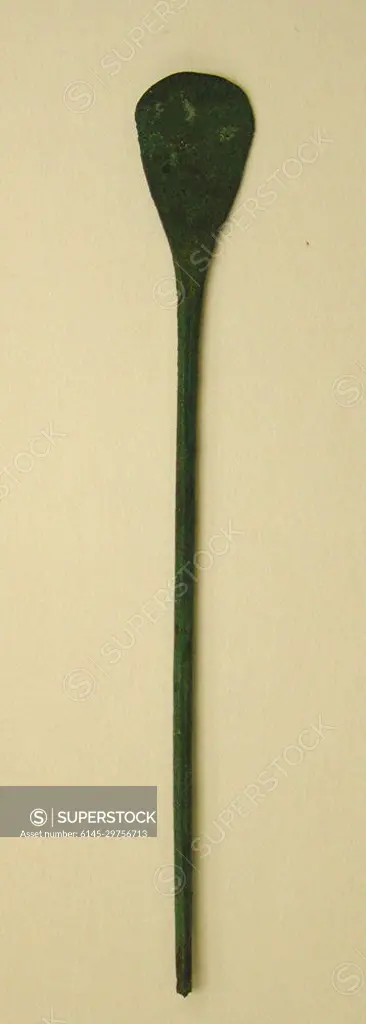
SuperStock offers millions of photos, videos, and stock assets to creatives around the world. This image of Tupu (pin) 8th-mid-16th century Tiwanaku, Pacajes, or Inca () This object is a tupu, a Quechua word for pin (pithu in Aymara and alfiler in Spanish). Women in the Andes wear tupus in order to fasten textile garments. Tupus, made of metal, usually consist of two parts: a head and a stem. On the present example, the width of the head gradually broadens moving away from the stem. While the long sides of the head are rectilinear, its top edge is circular. The tupu’s stem slightly narrows near its end, farther from the head. The stem may have terminated in a point, a useful feature of tupus for pushing them into the textile garments. Today, the stem appears incomplete. At some stage in this object’s itinerary, the pointed end may have broken off. This end is especially fragile considering the substantial corrosion that is evident. Similar to Metropolitan Museum of Art 64.228.606, there is no perforation visible on the head. This suggests that a person wore this tupu without necessarily thr by Piemags/PL Photography Limited is available for licensing today.
Looking for a license?
Click here, and we'll help you find it! Questions? Just ask!
Click here, and we'll help you find it! Questions? Just ask!
DETAILS
Image Number: 6145-29756713Royalty FreeCredit Line:Piemags/PL Photography Limited/SuperStockCollection:PL Photography Limited Contributor:Piemags Model Release:NoProperty Release:NoResolution:358×1000