Tupu (pin) A.D. 1400-1533 () Inca () This object is a tupu, a Quechua term for pin (“pithu” in Aymara and “alfiler” in Spanish).[1 Women in the Andes have used these pins to fasten textile garments, such as the acsu or lliclla (for more information on the use of tupus, please see Metropolitan Museum of Art 64.228.702). Tupus have a basic form that consists of a head and a stem, but there is wide variation in their design. In this case, the head is comprised of a rounded triangular shape from which emerge two spirals at top. Some investigators (e.g., Gibaja et al. 2014) have identified these motifs as floral. Others associate this form of tupu with butterflies, especially nocturnal butterflies (“thaparanku” in Quechua) (Fernández 2015, 35; Vargas-Musquipa 1995). In particular, the spirals are indexical of antennae. Here, the tupu’s head is symmetric in design and shows a circular perforation near where it meets the stem, which is thick and pointed. Indeed, the thickness of the stem s
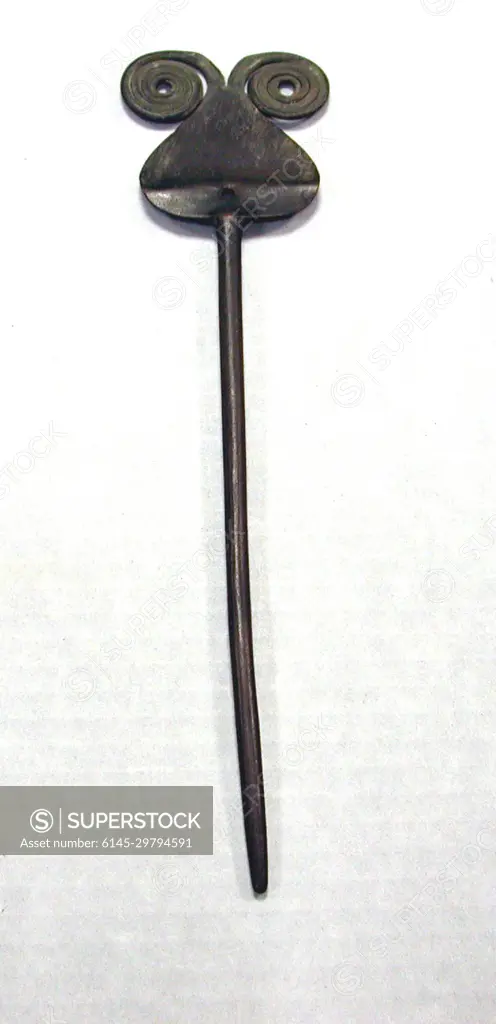
SuperStock offers millions of photos, videos, and stock assets to creatives around the world. This image of Tupu (pin) A.D. 1400-1533 () Inca () This object is a tupu, a Quechua term for pin (“pithu” in Aymara and “alfiler” in Spanish).[1 Women in the Andes have used these pins to fasten textile garments, such as the acsu or lliclla (for more information on the use of tupus, please see Metropolitan Museum of Art 64.228.702). Tupus have a basic form that consists of a head and a stem, but there is wide variation in their design. In this case, the head is comprised of a rounded triangular shape from which emerge two spirals at top. Some investigators (e.g., Gibaja et al. 2014) have identified these motifs as floral. Others associate this form of tupu with butterflies, especially nocturnal butterflies (“thaparanku” in Quechua) (Fernández 2015, 35; Vargas-Musquipa 1995). In particular, the spirals are indexical of antennae. Here, the tupu’s head is symmetric in design and shows a circular perforation near where it meets the stem, which is thick and pointed. Indeed, the thickness of the stem s by Piemags/PL Photography Limited is available for licensing today.
Looking for a license?
Click here, and we'll help you find it! Questions? Just ask!
Click here, and we'll help you find it! Questions? Just ask!
DETAILS
Image Number: 6145-29794591Royalty FreeCredit Line:Piemags/PL Photography Limited/SuperStockCollection:PL Photography Limited Contributor:Piemags Model Release:NoProperty Release:NoResolution:727×1500