Tupu (pin) Before 17th century Tiwanaku () This object is a tupu, a Quechua word for pin (pithu in Aymara and alfiler in Spanish). Women in the Andes wear tupus in order to fasten textile garments. Tupus are made of metal and usually consist of two parts: a head and a stem. This tupu shows a circular head and a long stem that terminates in a point. It is similar in form to Metropolitan Museum of Art 64.228.606. Some scholars (e.g. Andrushko et al. 2006, 69) refer to this form as a "classic" tupu shape. Tupus often have one or two perforations in the head (e.g., 64.228.702 as an example with one perforation) that would allow a person to thread them onto a cord. This could help to further secure them on the person’s clothing. (Please see 64.228.607 for further discussion of the various ways that women in the Andes wear tupus.)To make this tupu, metalworkers likely started with a rod of metal. They may have had access to pre-fabricated rods that they could shape into various forms. (Plea
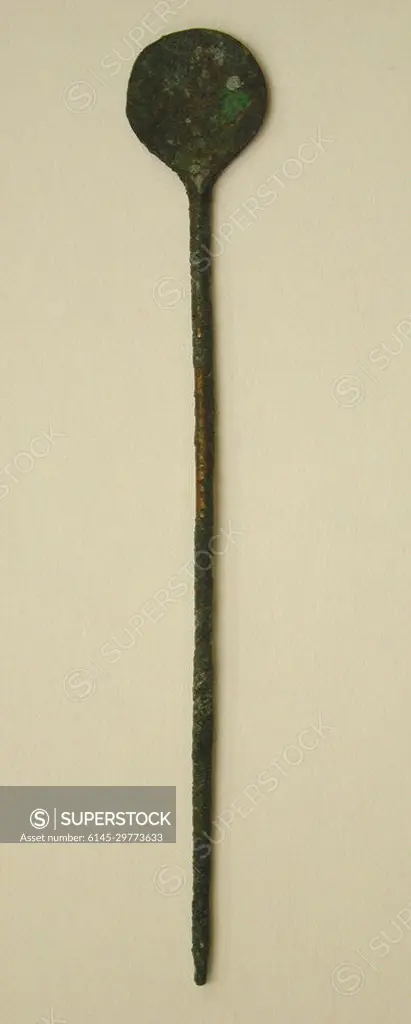
SuperStock offers millions of photos, videos, and stock assets to creatives around the world. This image of Tupu (pin) Before 17th century Tiwanaku () This object is a tupu, a Quechua word for pin (pithu in Aymara and alfiler in Spanish). Women in the Andes wear tupus in order to fasten textile garments. Tupus are made of metal and usually consist of two parts: a head and a stem. This tupu shows a circular head and a long stem that terminates in a point. It is similar in form to Metropolitan Museum of Art 64.228.606. Some scholars (e.g. Andrushko et al. 2006, 69) refer to this form as a "classic" tupu shape. Tupus often have one or two perforations in the head (e.g., 64.228.702 as an example with one perforation) that would allow a person to thread them onto a cord. This could help to further secure them on the person’s clothing. (Please see 64.228.607 for further discussion of the various ways that women in the Andes wear tupus.)To make this tupu, metalworkers likely started with a rod of metal. They may have had access to pre-fabricated rods that they could shape into various forms. (Plea by Piemags/PL Photography Limited is available for licensing today.
Looking for a license?
Click here, and we'll help you find it! Questions? Just ask!
Click here, and we'll help you find it! Questions? Just ask!
DETAILS
Image Number: 6145-29773633Royalty FreeCredit Line:Piemags/PL Photography Limited/SuperStockCollection:PL Photography Limited Contributor:Piemags Model Release:NoProperty Release:NoResolution:402×1000