Tupu (pin) Before 17th century Tiwanaku () This object is a tupu, a Quechua word for pin (pithu in Aymara and alfiler in Spanish). Women in the Andes wear tupus in order to fasten textile garments. Tupus usually consist of two parts: a head and a stem. In this case, the head is circular. Its shape is distinct from tupus like Metropolitan Museum of Art 64.228.702 whose head is more elliptical in shape. Another difference is that a perforation is not seen on the present example. Often, people may wear tupus and other ornaments or tools along a cord or ribbon (see Rowe 1998, fig. 132 and Vetter 2009, fig. 6 for recent examples of this way of wearing tupus and Bjerregaard 2007, 111-13, no. CMA 1795, for an Inca example). The stem of the tupu is circular in cross section. While its end does not appear pointed, corrosion may be masking the shape with which it was designed. The stems of other tupus (e.g., Metropolitan Museum of Art 1987.394.603) clearly become narrower farther from the head,
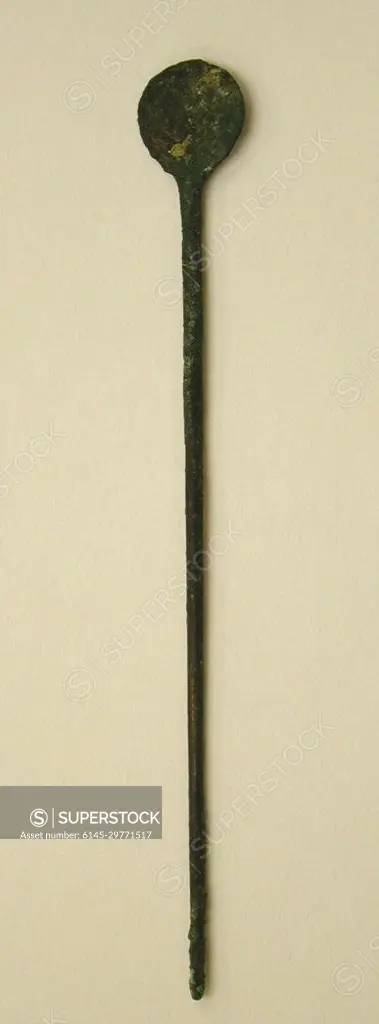
SuperStock offers millions of photos, videos, and stock assets to creatives around the world. This image of Tupu (pin) Before 17th century Tiwanaku () This object is a tupu, a Quechua word for pin (pithu in Aymara and alfiler in Spanish). Women in the Andes wear tupus in order to fasten textile garments. Tupus usually consist of two parts: a head and a stem. In this case, the head is circular. Its shape is distinct from tupus like Metropolitan Museum of Art 64.228.702 whose head is more elliptical in shape. Another difference is that a perforation is not seen on the present example. Often, people may wear tupus and other ornaments or tools along a cord or ribbon (see Rowe 1998, fig. 132 and Vetter 2009, fig. 6 for recent examples of this way of wearing tupus and Bjerregaard 2007, 111-13, no. CMA 1795, for an Inca example). The stem of the tupu is circular in cross section. While its end does not appear pointed, corrosion may be masking the shape with which it was designed. The stems of other tupus (e.g., Metropolitan Museum of Art 1987.394.603) clearly become narrower farther from the head, by Piemags/PL Photography Limited is available for licensing today.
Looking for a license?
Click here, and we'll help you find it! Questions? Just ask!
Click here, and we'll help you find it! Questions? Just ask!
DETAILS
Image Number: 6145-29771517Royalty FreeCredit Line:Piemags/PL Photography Limited/SuperStockCollection:PL Photography Limited Contributor:Piemags Model Release:NoProperty Release:NoResolution:371×1000