Tupu Before 17th century Wari or Inca () This object is a tupu, a Quechua term for pin (pithu in Aymara and alfiler in Spanish). Women in the Andes have used these pins to fasten textile garments, such as the acsu or lliclla (please see below for further discussion of these garments). Tupus have a basic form that consists of a head and a stem, but there is wide variation in their design. In this case, the head is large and almost elliptical: the head’s width (~6 cm) is noticeably greater than its length (~5 cm). There is a circular perforation in the lower portion of the head, closer to the stem. The perforation is found on the central lengthwise axis of the tupu, in line with the stem. The tupu’s head is significantly thinner than its stem. Circular in cross section, the stem terminates in a point. Records in the Department of the Arts of Africa, Oceania, and the Americas at the Metropolitan Museum note that, on its accession to the Museum’s collections, this tupu was identified as m
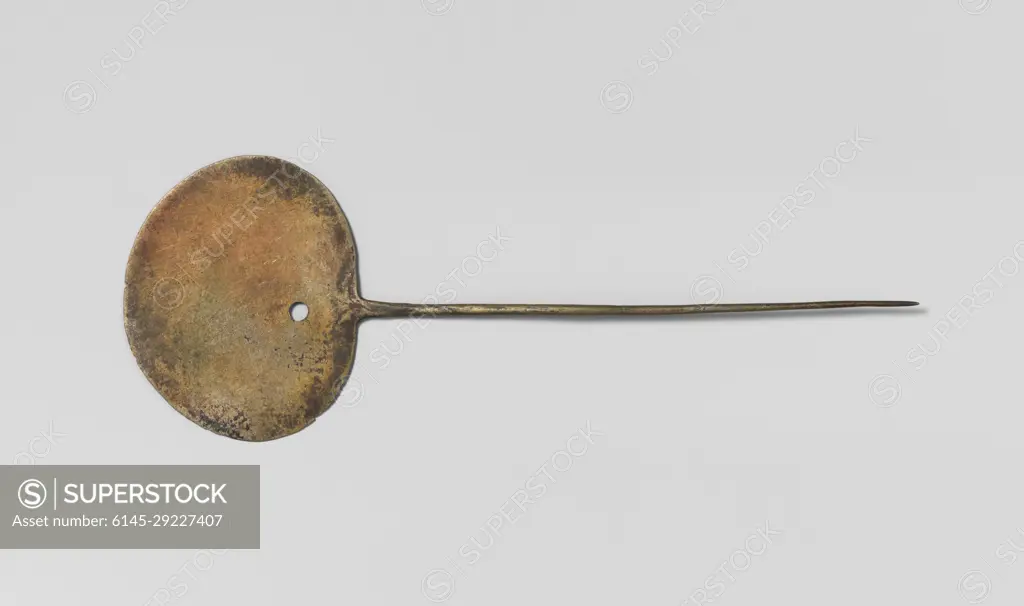
SuperStock offers millions of photos, videos, and stock assets to creatives around the world. This image of Tupu Before 17th century Wari or Inca () This object is a tupu, a Quechua term for pin (pithu in Aymara and alfiler in Spanish). Women in the Andes have used these pins to fasten textile garments, such as the acsu or lliclla (please see below for further discussion of these garments). Tupus have a basic form that consists of a head and a stem, but there is wide variation in their design. In this case, the head is large and almost elliptical: the head’s width (~6 cm) is noticeably greater than its length (~5 cm). There is a circular perforation in the lower portion of the head, closer to the stem. The perforation is found on the central lengthwise axis of the tupu, in line with the stem. The tupu’s head is significantly thinner than its stem. Circular in cross section, the stem terminates in a point. Records in the Department of the Arts of Africa, Oceania, and the Americas at the Metropolitan Museum note that, on its accession to the Museum’s collections, this tupu was identified as m by Piemags/PL Photography Limited is available for licensing today.
Looking for a license?
Click here, and we'll help you find it! Questions? Just ask!
Click here, and we'll help you find it! Questions? Just ask!
DETAILS
Image Number: 6145-29227407Royalty FreeCredit Line:Piemags/PL Photography Limited/SuperStockCollection:PL Photography Limited Contributor:Piemags Model Release:NoProperty Release:NoResolution:4000×2371