The Triumph of Love over Time ca. 1780-90 Clockmaker: Jean-Baptiste Lepaute This clock illustrates the triumph of love over time. The young god of love points to the minutes with his arrow while holding a blazing torch to the celestial globe that contains two revolving rings between its hemispheres, one with the minutes (5-10) and the other with the hours (I-XII). Chronos, or Father Time, sits dejectedly at the right. The figures, modeled by Augustin Pajou (1730-1809), were taken from a more complex design for a clock made by the royal sculptor in 1775 for the prince de Condé and were probably cast by Étienne Martincourt (active 1762-1800). The subject of the relief on the pedestal is a sacrifice to Eros. At this time, the workshop of the Lepaute family consisted of Jean-Baptiste (1727-1802), named horologer du roi in 1775; Pierre, called Henry Lepaute (1749-1806); and Pierre-Bazile, called Sully-Lepaute (1750-1843). The gilt bronze is beautifully finished and the contrast between the
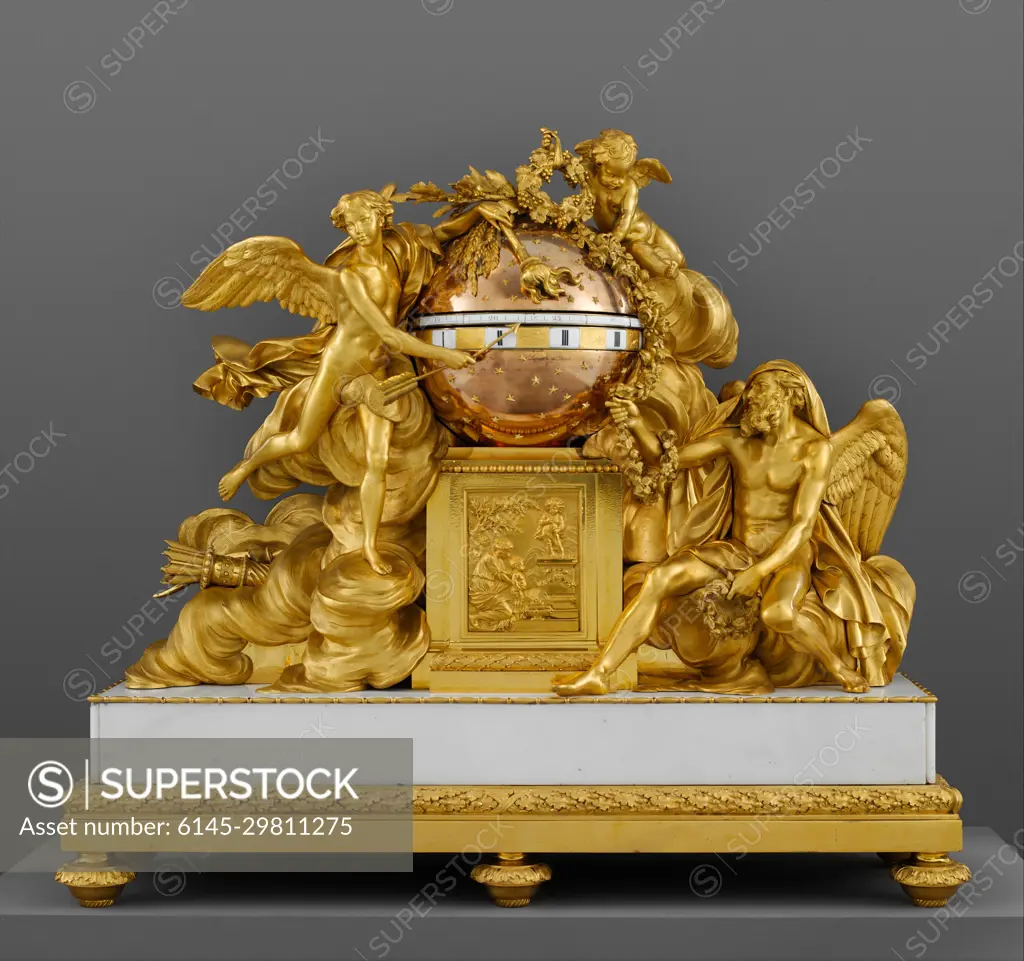
SuperStock offers millions of photos, videos, and stock assets to creatives around the world. This image of The Triumph of Love over Time ca. 1780-90 Clockmaker: Jean-Baptiste Lepaute This clock illustrates the triumph of love over time. The young god of love points to the minutes with his arrow while holding a blazing torch to the celestial globe that contains two revolving rings between its hemispheres, one with the minutes (5-10) and the other with the hours (I-XII). Chronos, or Father Time, sits dejectedly at the right. The figures, modeled by Augustin Pajou (1730-1809), were taken from a more complex design for a clock made by the royal sculptor in 1775 for the prince de Condé and were probably cast by Étienne Martincourt (active 1762-1800). The subject of the relief on the pedestal is a sacrifice to Eros. At this time, the workshop of the Lepaute family consisted of Jean-Baptiste (1727-1802), named horologer du roi in 1775; Pierre, called Henry Lepaute (1749-1806); and Pierre-Bazile, called Sully-Lepaute (1750-1843). The gilt bronze is beautifully finished and the contrast between the by Piemags/PL Photography Limited is available for licensing today.
Looking for a license?
Click here, and we'll help you find it! Questions? Just ask!
Click here, and we'll help you find it! Questions? Just ask!
DETAILS
Image Number: 6145-29811275Royalty FreeCredit Line:Piemags/PL Photography Limited/SuperStockCollection:PL Photography Limited Contributor:Piemags Model Release:NoProperty Release:NoResolution:3857×3620