Tracing Copy of The Song of Everlasting Sorrow” by Bo Juyi possibly circa 1919 copy of a 1614 work After Sh?kad? Sh?j? This deluxe collotype reproduction, over seven meters in length records one of the most revered poems in East Asian literary history, originally written in 806 by one of the most revered poets of the Tang Dynasty. Over 800 years later, it was transcribed by one of the most revered calligraphers of the Momoyama period, and then dedicated by him to one of the most prominent courtiers and cultural arbiters in Kyoto of the time. In this way, this work encapsulates a sweeping history of cultural transmission from China to Japan, and serves as a time capsule revealing the florescence of calligraphy and poetry during the early seventeenth century in Kyoto. The Song of Everlasting Sorrow” composed by the Chinese poet Bai Juyi related the events surrounding the death— during the Anshi Rebellion in 755—of Yang Guifei, the beloved concubine of Emperor Xuanzong of the Tang dynas
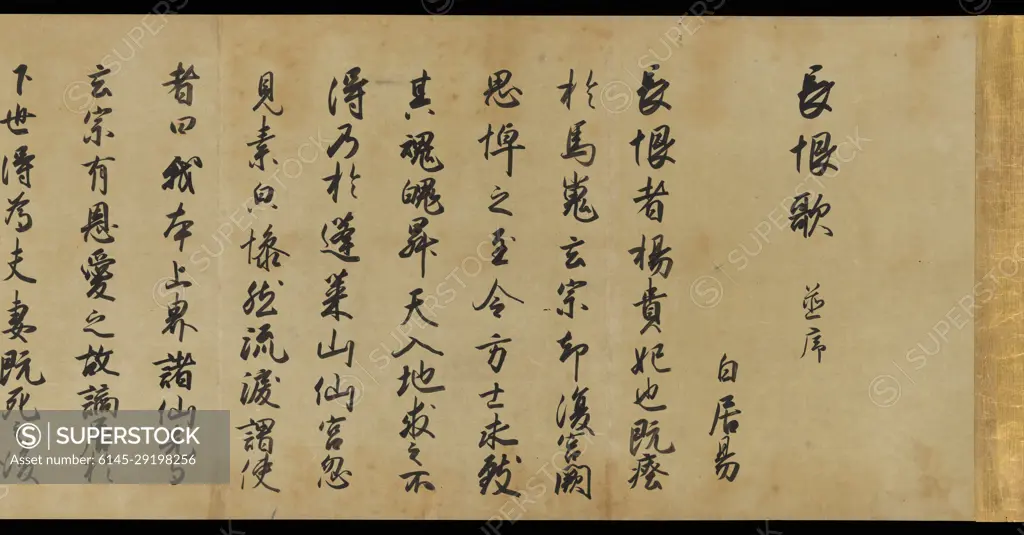
SuperStock offers millions of photos, videos, and stock assets to creatives around the world. This image of Tracing Copy of The Song of Everlasting Sorrow” by Bo Juyi possibly circa 1919 copy of a 1614 work After Sh?kad? Sh?j? This deluxe collotype reproduction, over seven meters in length records one of the most revered poems in East Asian literary history, originally written in 806 by one of the most revered poets of the Tang Dynasty. Over 800 years later, it was transcribed by one of the most revered calligraphers of the Momoyama period, and then dedicated by him to one of the most prominent courtiers and cultural arbiters in Kyoto of the time. In this way, this work encapsulates a sweeping history of cultural transmission from China to Japan, and serves as a time capsule revealing the florescence of calligraphy and poetry during the early seventeenth century in Kyoto. The Song of Everlasting Sorrow” composed by the Chinese poet Bai Juyi related the events surrounding the death— during the Anshi Rebellion in 755—of Yang Guifei, the beloved concubine of Emperor Xuanzong of the Tang dynas by Piemags/PL Photography Limited is available for licensing today.
Looking for a license?
Click here, and we'll help you find it! Questions? Just ask!
Click here, and we'll help you find it! Questions? Just ask!
DETAILS
Image Number: 6145-29198256Royalty FreeCredit Line:Piemags/PL Photography Limited/SuperStockCollection:PL Photography Limited Contributor:Piemags Model Release:NoProperty Release:NoResolution:4000×2092