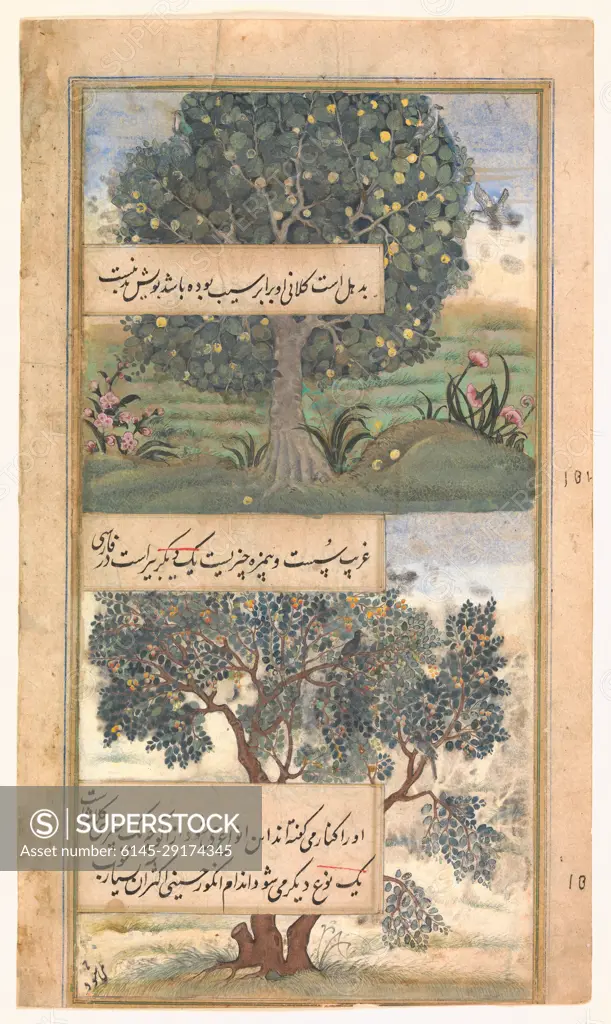
"Three Trees of India", Folio from a Baburnama (Autobiography of Babur) late 16th century The Baburnama, one of the most important texts of the Mughal period, provides insight into the literary, intellectual, and cultural world of Babur (1483-1530), founder of the Mughal empire. The Baburnama is especially celebrated for its observations of India's natural world, an aspect of the text most pleasingly captured in the subject matter here. The page depicts three trees: one on the recto (jackfruit) and two on the verso (monkey jack and lote). Interspersed among the images are texts in nasta'liq Persian script describing the trees and their fruits. During the reign of Babur's grandson Akbar (1556-1605), four imperial copies of the Baburnama were created, each illustrated by leading artists of the royal atelier. This folio comes from the earliest of these copies, the 1589 manuscript, which was likely a model for the later versions. It is thought originally to have contained 191 illustrations
SuperStock offers millions of photos, videos, and stock assets to creatives around the world. This image of "Three Trees of India", Folio from a Baburnama (Autobiography of Babur) late 16th century The Baburnama, one of the most important texts of the Mughal period, provides insight into the literary, intellectual, and cultural world of Babur (1483-1530), founder of the Mughal empire. The Baburnama is especially celebrated for its observations of India's natural world, an aspect of the text most pleasingly captured in the subject matter here. The page depicts three trees: one on the recto (jackfruit) and two on the verso (monkey jack and lote). Interspersed among the images are texts in nasta'liq Persian script describing the trees and their fruits. During the reign of Babur's grandson Akbar (1556-1605), four imperial copies of the Baburnama were created, each illustrated by leading artists of the royal atelier. This folio comes from the earliest of these copies, the 1589 manuscript, which was likely a model for the later versions. It is thought originally to have contained 191 illustrations by Piemags/PL Photography Limited is available for licensing today.
Looking for a license?
Click here, and we'll help you find it! Questions? Just ask!
Click here, and we'll help you find it! Questions? Just ask!
DETAILS
Image Number: 6145-29174345Royalty FreeCredit Line:Piemags/PL Photography Limited/SuperStockCollection:PL Photography Limited Contributor:Piemags Model Release:NoProperty Release:NoResolution:2389×4000