Three Laughers of Tiger Ravine mid-16th century Sekish Shan This painting captures the final moment of a legendary fourth-century encounter between three Chinese gentlemen—the Daoist master Lu Xiujing (406-477), the Buddhist monk Huiyuan (334-416), and the poet Tao Qian (Tao Yuanming ; 365-427). According to the legend, known as “Three Laughers of Tiger Ravine” (in Chinese Huxi sanxiao, and in Japanese Kokei sansh), the monk Huiyuan, who had established the Pure Land Buddhist temple Donglinsi near the storied Lu Mountains in 386 and maintained a decades-old vow to never to leave the mountain temple, was enjoying the company of the Daoist Lu and Confucian Tao, fellow residents of the Lu Mountains area who were purported to be frequent visitors. As Huiyuan saw off his companions at the end of a long day of conversation and wine, the three wandered farther than expected, inadvertently crossing the bridge over Tiger Ravine, which marked the edge of Donglinsi’s sacred p
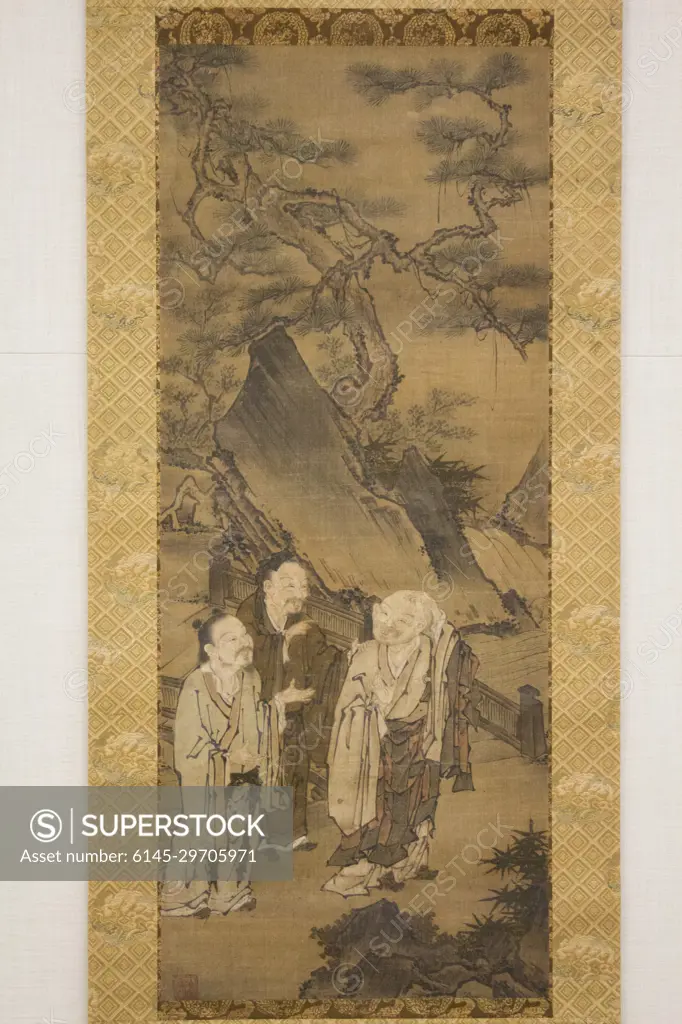
SuperStock offers millions of photos, videos, and stock assets to creatives around the world. This image of Three Laughers of Tiger Ravine mid-16th century Sekish Shan This painting captures the final moment of a legendary fourth-century encounter between three Chinese gentlemen—the Daoist master Lu Xiujing (406-477), the Buddhist monk Huiyuan (334-416), and the poet Tao Qian (Tao Yuanming ; 365-427). According to the legend, known as “Three Laughers of Tiger Ravine” (in Chinese Huxi sanxiao, and in Japanese Kokei sansh), the monk Huiyuan, who had established the Pure Land Buddhist temple Donglinsi near the storied Lu Mountains in 386 and maintained a decades-old vow to never to leave the mountain temple, was enjoying the company of the Daoist Lu and Confucian Tao, fellow residents of the Lu Mountains area who were purported to be frequent visitors. As Huiyuan saw off his companions at the end of a long day of conversation and wine, the three wandered farther than expected, inadvertently crossing the bridge over Tiger Ravine, which marked the edge of Donglinsi’s sacred p by Piemags/PL Photography Limited is available for licensing today.
Looking for a license?
Click here, and we'll help you find it! Questions? Just ask!
Click here, and we'll help you find it! Questions? Just ask!
DETAILS
Image Number: 6145-29705971Royalty FreeCredit Line:Piemags/PL Photography Limited/SuperStockCollection:PL Photography Limited Contributor:Piemags Model Release:NoProperty Release:NoResolution:2667×4000