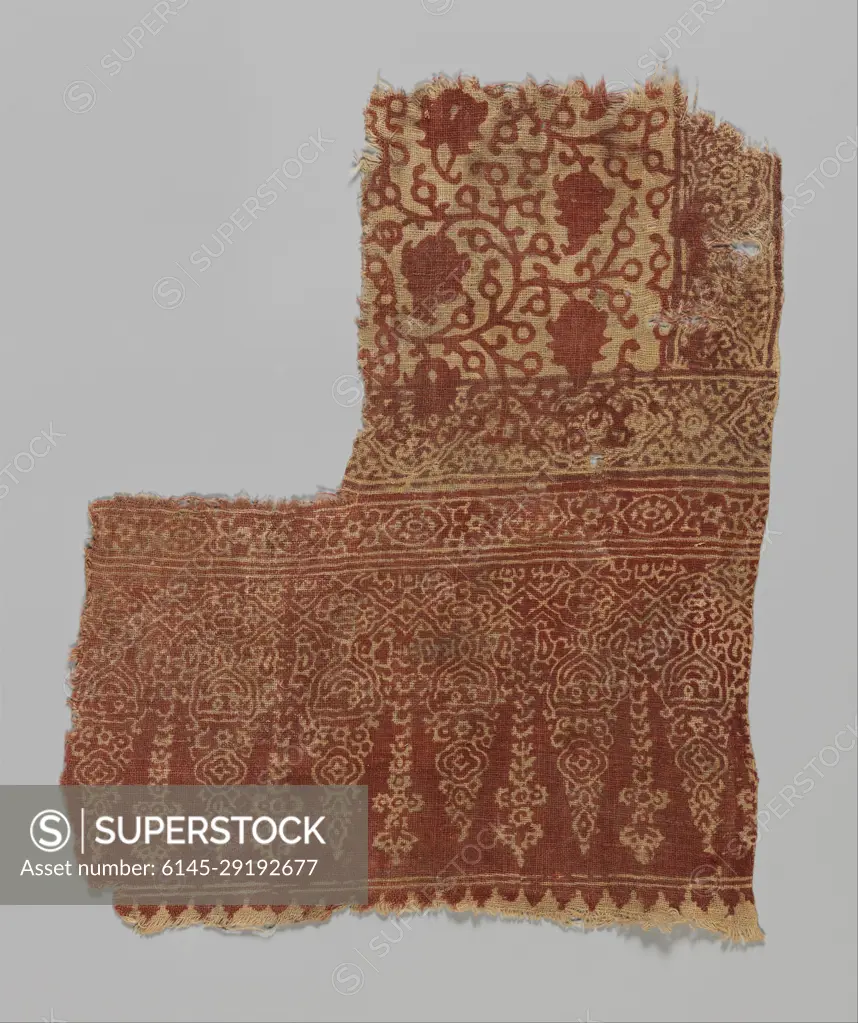
Textile Fragment 13th-14th century Dated to the thirteenth or fourteenth century, this cotton textile uses both block-print and mordant dye techniques to create its dense and ornate designs. The textile is decorated with a center piece of vegetal ogival motifs with emerging stylized tendrils and a series of borders with floriated medallions. The largest border of the textile, closest to the edge, is reminiscent of stylistic motifs which emulate Jain illustrated manuscript paintings and architecture surface ornamentation. This textile, which is one of a larger group of textile fragments found in Fustat, Egypt (known as old Cairo), but produced in Gujarat, India serves as evidence of the maritime trade relations between the two areas. This relationship can be traced as far back as the tenth century and extends into the nineteenth century. Fustats dry and arid climate allowed for the preservation of these textiles unlike the monsoon heavy climate in India which would have caused the dete
SuperStock offers millions of photos, videos, and stock assets to creatives around the world. This image of Textile Fragment 13th-14th century Dated to the thirteenth or fourteenth century, this cotton textile uses both block-print and mordant dye techniques to create its dense and ornate designs. The textile is decorated with a center piece of vegetal ogival motifs with emerging stylized tendrils and a series of borders with floriated medallions. The largest border of the textile, closest to the edge, is reminiscent of stylistic motifs which emulate Jain illustrated manuscript paintings and architecture surface ornamentation. This textile, which is one of a larger group of textile fragments found in Fustat, Egypt (known as old Cairo), but produced in Gujarat, India serves as evidence of the maritime trade relations between the two areas. This relationship can be traced as far back as the tenth century and extends into the nineteenth century. Fustats dry and arid climate allowed for the preservation of these textiles unlike the monsoon heavy climate in India which would have caused the dete by Piemags/PL Photography Limited is available for licensing today.
Looking for a license?
Click here, and we'll help you find it! Questions? Just ask!
Click here, and we'll help you find it! Questions? Just ask!
DETAILS
Image Number: 6145-29192677Royalty FreeCredit Line:Piemags/PL Photography Limited/SuperStockCollection:PL Photography Limited Contributor:Piemags Model Release:NoProperty Release:NoResolution:3223×3846