Textile Fragment 13th-14th century Dated to either the thirteenth or fourteenth century, this plain-woven cotton fragment once belonged to a larger textile. This densely decorated fragment emulates common methods of ornamentation and technique used in the province of Gujarat during the Middle Ages. Its border is decorated with a repeated stylized floral motif. The fragments larger design consists of small ogival motifs enclosed within intertwined tendrils forming larger medallions that run parallel to each other and repeat vertically. The textiles ornamentation is associated to Gujarat as the fragments decorative program borrows heavily from Jain painted manuscript traditions and architecture commonly found and made in the province. The vibrancy of the red dye comes from the Indian mulberry plant, which was commonly used in dye practices also associated with Gujarat.Found near the site of Fustat, Egypt, these textiles have been preserved largely due to the arid and dry climate of th
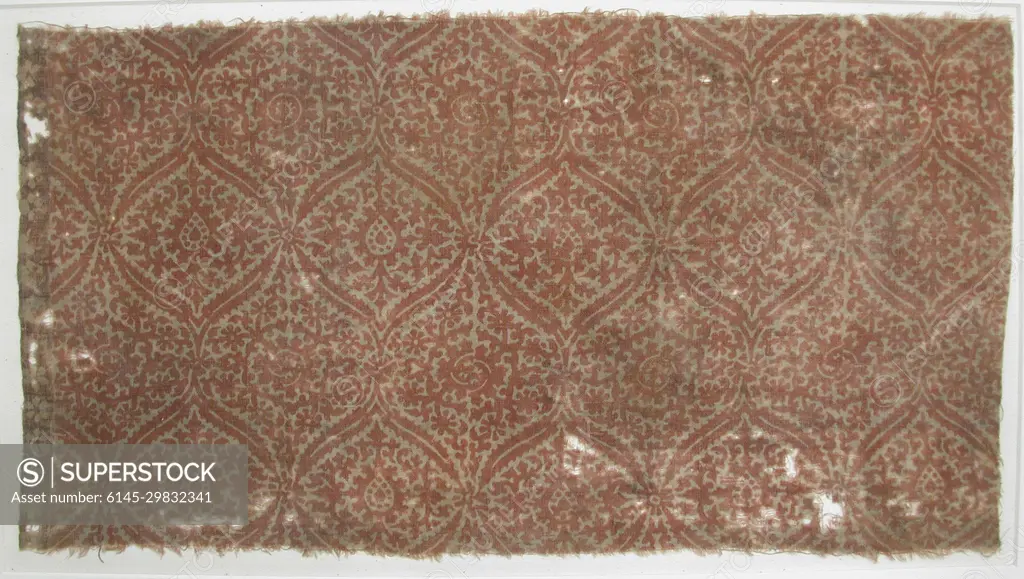
SuperStock offers millions of photos, videos, and stock assets to creatives around the world. This image of Textile Fragment 13th-14th century Dated to either the thirteenth or fourteenth century, this plain-woven cotton fragment once belonged to a larger textile. This densely decorated fragment emulates common methods of ornamentation and technique used in the province of Gujarat during the Middle Ages. Its border is decorated with a repeated stylized floral motif. The fragments larger design consists of small ogival motifs enclosed within intertwined tendrils forming larger medallions that run parallel to each other and repeat vertically. The textiles ornamentation is associated to Gujarat as the fragments decorative program borrows heavily from Jain painted manuscript traditions and architecture commonly found and made in the province. The vibrancy of the red dye comes from the Indian mulberry plant, which was commonly used in dye practices also associated with Gujarat.Found near the site of Fustat, Egypt, these textiles have been preserved largely due to the arid and dry climate of th by Piemags/PL Photography Limited is available for licensing today.
Looking for a license?
Click here, and we'll help you find it! Questions? Just ask!
Click here, and we'll help you find it! Questions? Just ask!
DETAILS
Image Number: 6145-29832341Royalty FreeCredit Line:Piemags/PL Photography Limited/SuperStockCollection:PL Photography Limited Contributor:Piemags Model Release:NoProperty Release:NoResolution:1980×1120