Textile Fragment 13th-14th century This cotton textile fragment uses block-print in its technique which is revealed in the fragments center and shows a horizontal misalignment of the block-printed design. The design which employs a shamsa-like motif pans out into smaller tendrils that link the medallions to one another. The pattern was probably repeated to decorate the center field of the larger textile which was enclosed within a border, a portion of which can be seen in the fragments top right. Dated to either the thirteenth or fourteenth century, this fragment is one of a larger group of textiles which were found in Fustat, Egypt (known as Old Cairo) but made in Gujarat, India. The textiles vibrant dye, which is still noticeable in this fragment highlights Gujarat as an important dye center throughout the centuries and serves as evidence that they were in high demand across regions connected by the Indian Ocean from the tenth through the nineteenth centuries.. Textile Fragment 4
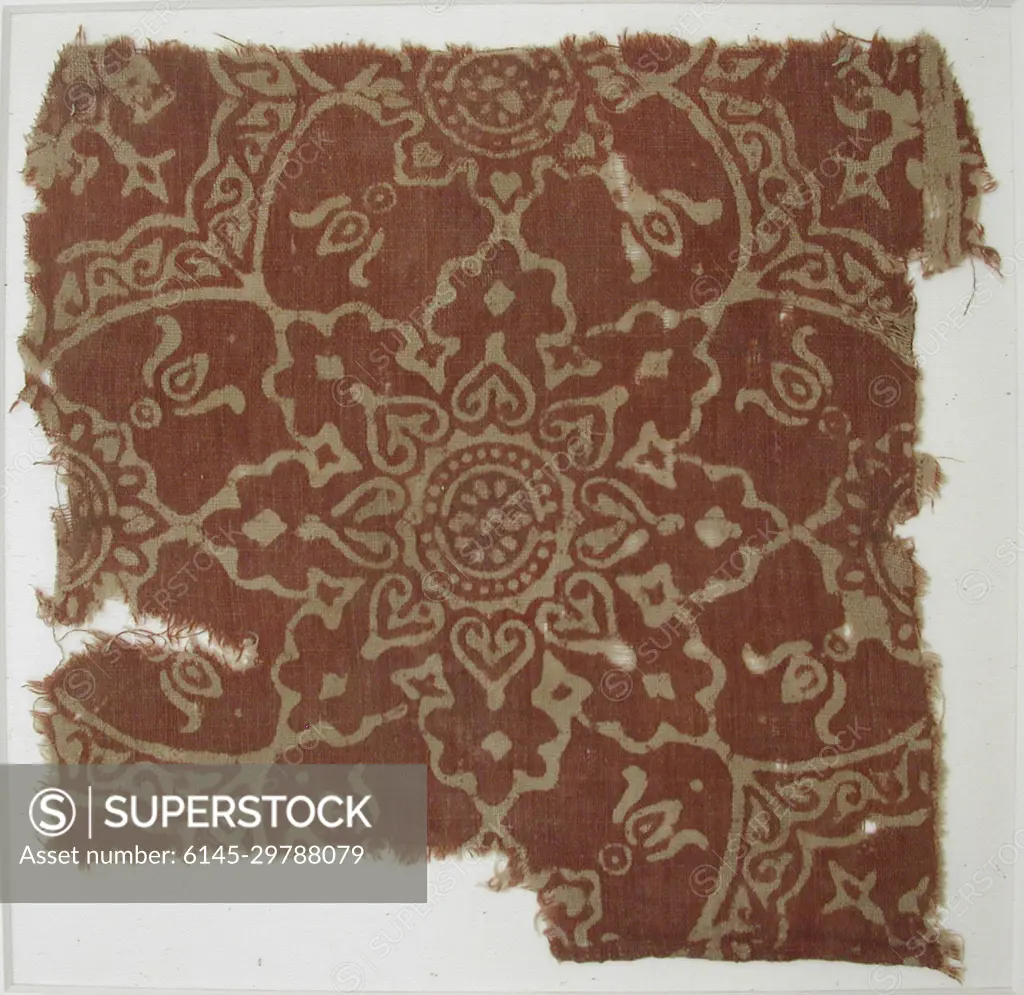
SuperStock offers millions of photos, videos, and stock assets to creatives around the world. This image of Textile Fragment 13th-14th century This cotton textile fragment uses block-print in its technique which is revealed in the fragments center and shows a horizontal misalignment of the block-printed design. The design which employs a shamsa-like motif pans out into smaller tendrils that link the medallions to one another. The pattern was probably repeated to decorate the center field of the larger textile which was enclosed within a border, a portion of which can be seen in the fragments top right. Dated to either the thirteenth or fourteenth century, this fragment is one of a larger group of textiles which were found in Fustat, Egypt (known as Old Cairo) but made in Gujarat, India. The textiles vibrant dye, which is still noticeable in this fragment highlights Gujarat as an important dye center throughout the centuries and serves as evidence that they were in high demand across regions connected by the Indian Ocean from the tenth through the nineteenth centuries.. Textile Fragment 4 by Piemags/PL Photography Limited is available for licensing today.
Looking for a license?
Click here, and we'll help you find it! Questions? Just ask!
Click here, and we'll help you find it! Questions? Just ask!
DETAILS
Image Number: 6145-29788079Royalty FreeCredit Line:Piemags/PL Photography Limited/SuperStockCollection:PL Photography Limited Contributor:Piemags Model Release:NoProperty Release:NoResolution:1438×1398