Textile Fragment 4th-3rd century B.C. Chavin Cloth making began in the Andes at least as early as the third millennium B.C. and remained a medium of artistic expression and carrier of important social, political, and religious information for millennia, preceding ceramics by more than a thousand years in Peru. Many different textile structures were developed. Designs could be woven into the fabric, or embroidered or painted onto a base fabric, as is the case here. Providing a portable and/or wearable surface for the depiction of complex imagery, textiles are thought to have facilitated the spread of Chavín imagery from the north, where it originated, to the southern Peruvian coast, where this fragment is said to have been found. The motifs and painting style closely resemble those of stone carvings at the site of Chavín de Huantar. The figure's clawed hands and feet, serpent hair, and serpent belt relate it to the staff god, one of the main deities worshipped at Chavín de Huantar.. Tex
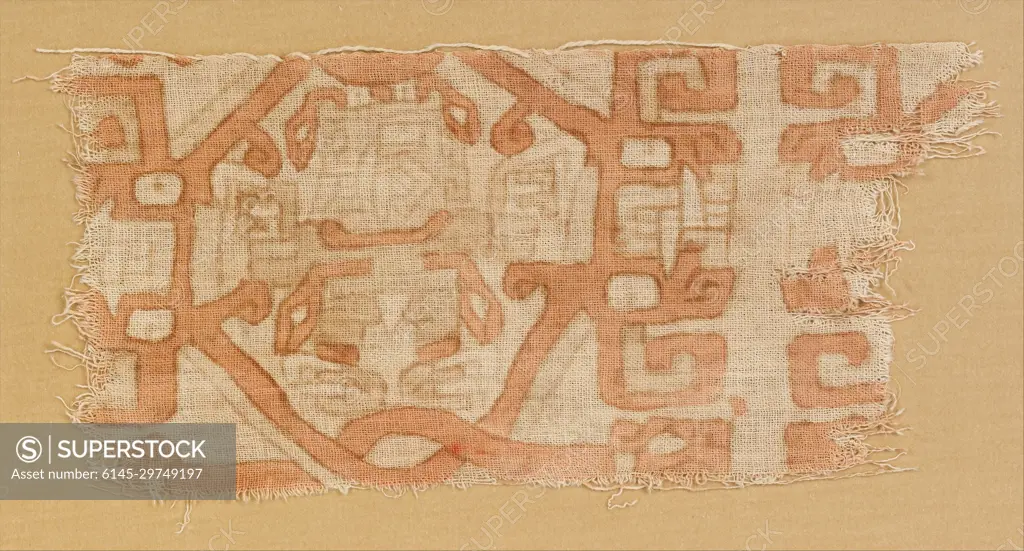
SuperStock offers millions of photos, videos, and stock assets to creatives around the world. This image of Textile Fragment 4th-3rd century B.C. Chavin Cloth making began in the Andes at least as early as the third millennium B.C. and remained a medium of artistic expression and carrier of important social, political, and religious information for millennia, preceding ceramics by more than a thousand years in Peru. Many different textile structures were developed. Designs could be woven into the fabric, or embroidered or painted onto a base fabric, as is the case here. Providing a portable and/or wearable surface for the depiction of complex imagery, textiles are thought to have facilitated the spread of Chavín imagery from the north, where it originated, to the southern Peruvian coast, where this fragment is said to have been found. The motifs and painting style closely resemble those of stone carvings at the site of Chavín de Huantar. The figure's clawed hands and feet, serpent hair, and serpent belt relate it to the staff god, one of the main deities worshipped at Chavín de Huantar.. Tex by Piemags/PL Photography Limited is available for licensing today.
Looking for a license?
Click here, and we'll help you find it! Questions? Just ask!
Click here, and we'll help you find it! Questions? Just ask!
DETAILS
Image Number: 6145-29749197Royalty FreeCredit Line:Piemags/PL Photography Limited/SuperStockCollection:PL Photography Limited Contributor:Piemags Model Release:NoProperty Release:NoResolution:3913×2109