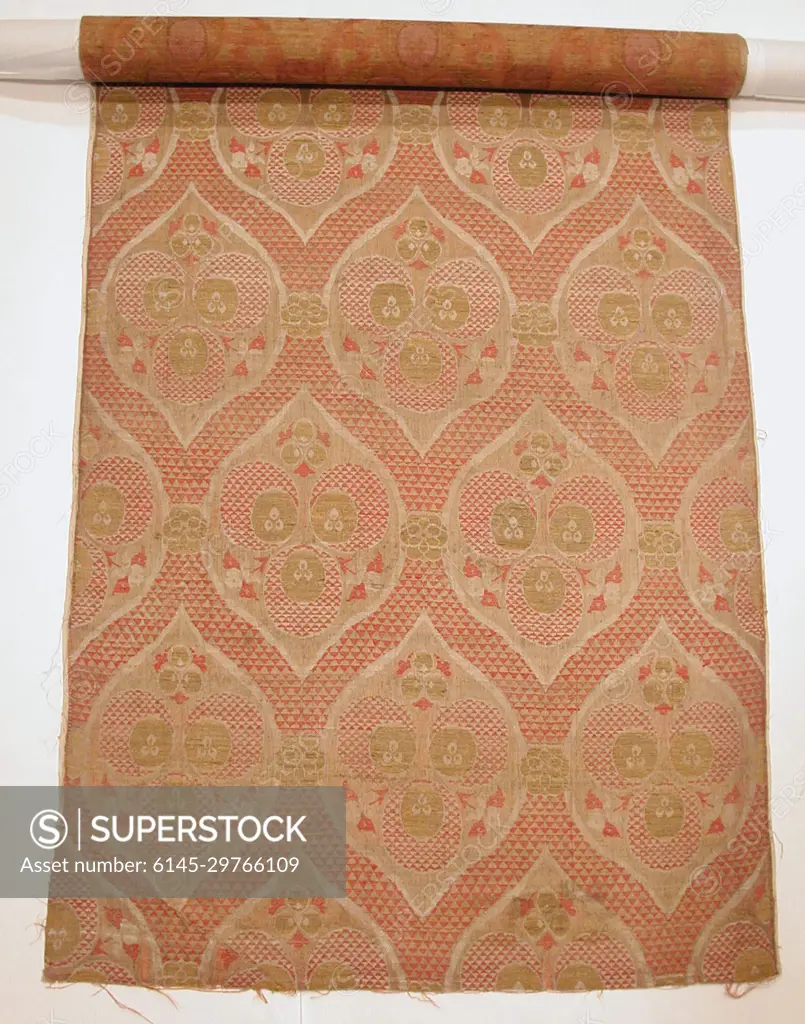
Textile Fragment 16th century This long, rectangular silk fragment features two distinct designs popular in Ottoman artthe ogival pattern and the chintamani motif. Though seen across a wide range of media in Ottoman Turkey, these patterns were especially popular in textile weaving. In this example, the chintamani is repeated in two different sizes as a grouping of three pearl, or closed-crescent, motifs. The chintamani was considered an auspicious symbol, bringing good luck to its wearer. The symbol also became associated with virility and power because of its resemblance to leopard spots and tiger stripes.. Textile Fragment 450517
SuperStock offers millions of photos, videos, and stock assets to creatives around the world. This image of Textile Fragment 16th century This long, rectangular silk fragment features two distinct designs popular in Ottoman artthe ogival pattern and the chintamani motif. Though seen across a wide range of media in Ottoman Turkey, these patterns were especially popular in textile weaving. In this example, the chintamani is repeated in two different sizes as a grouping of three pearl, or closed-crescent, motifs. The chintamani was considered an auspicious symbol, bringing good luck to its wearer. The symbol also became associated with virility and power because of its resemblance to leopard spots and tiger stripes.. Textile Fragment 450517 by Piemags/PL Photography Limited is available for licensing today.
Looking for a license?
Click here, and we'll help you find it! Questions? Just ask!
Click here, and we'll help you find it! Questions? Just ask!
DETAILS
Image Number: 6145-29766109Royalty FreeCredit Line:Piemags/PL Photography Limited/SuperStockCollection:PL Photography Limited Contributor:Piemags Model Release:NoProperty Release:NoResolution:1356×1723