Terracotta krater with lid surmounted by a small hydria ca. 750-740 B.C. Attributed to the Cesnola Painter Said to be from Kourion, CyprusDuring the eighth century B.C., the Geometric style that had originated in Athens spread throughout the Greek-speaking world. This beautifully proportioned vase found on Cyprus differs in a number of ways from the three monumental Geometric kraters from Attica displayed elsewhere in this gallery. The shoulder is subdivided by four handles rather than two, and the carpetlike decoration was applied over a light ceramic slip ground instead of directly onto the clay. Since the 1870s, scholars have debated where the vase was made; current opinion attributes it to a workshop on Euboea, an island just off the east coast of Attica, rather than to the island of Naxos, in the Cyclades. In the center panel, between the handles, two stags or goats rise on their hind legs to nibble at a tree. While the graceful long-legged animals are represented in a typically G
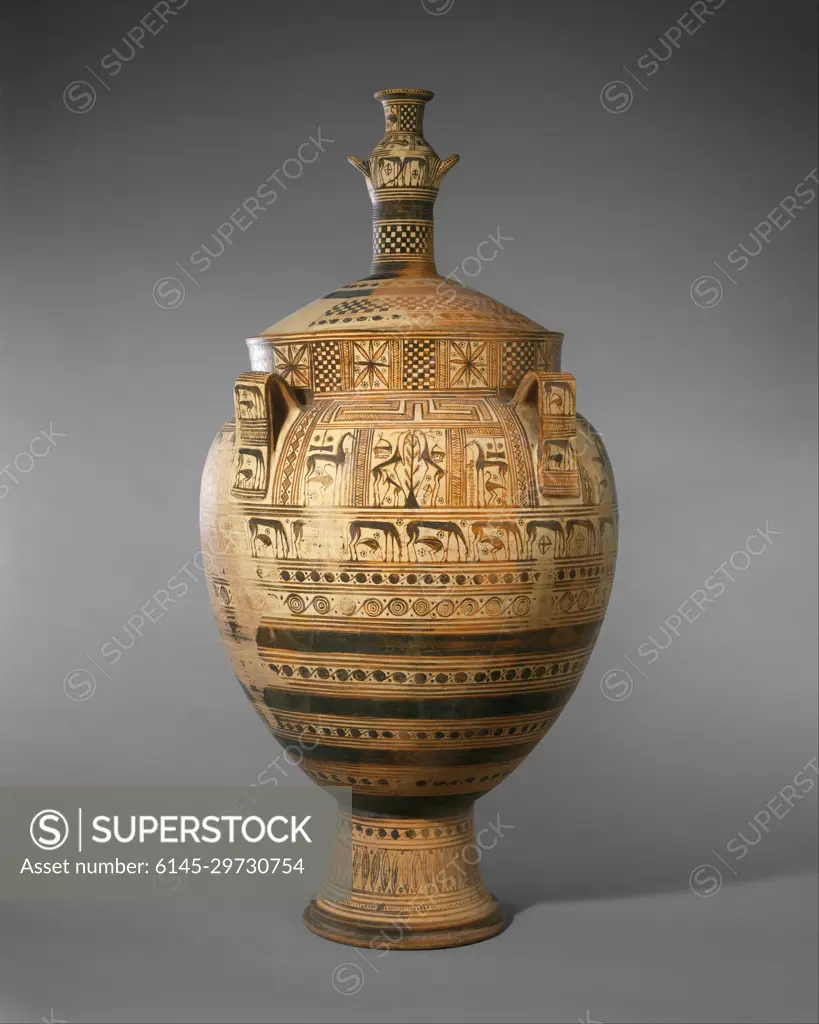
SuperStock offers millions of photos, videos, and stock assets to creatives around the world. This image of Terracotta krater with lid surmounted by a small hydria ca. 750-740 B.C. Attributed to the Cesnola Painter Said to be from Kourion, CyprusDuring the eighth century B.C., the Geometric style that had originated in Athens spread throughout the Greek-speaking world. This beautifully proportioned vase found on Cyprus differs in a number of ways from the three monumental Geometric kraters from Attica displayed elsewhere in this gallery. The shoulder is subdivided by four handles rather than two, and the carpetlike decoration was applied over a light ceramic slip ground instead of directly onto the clay. Since the 1870s, scholars have debated where the vase was made; current opinion attributes it to a workshop on Euboea, an island just off the east coast of Attica, rather than to the island of Naxos, in the Cyclades. In the center panel, between the handles, two stags or goats rise on their hind legs to nibble at a tree. While the graceful long-legged animals are represented in a typically G by Piemags/PL Photography Limited is available for licensing today.
Looking for a license?
Click here, and we'll help you find it! Questions? Just ask!
Click here, and we'll help you find it! Questions? Just ask!
DETAILS
Image Number: 6145-29730754Royalty FreeCredit Line:Piemags/PL Photography Limited/SuperStockCollection:PL Photography Limited Contributor:Piemags Model Release:NoProperty Release:NoResolution:2978×3722