The Tama River at Ide, Yamashiro Province. Artist: Suzuki Harunobu (Japanese, 1725-1770). Culture: Japan. Dimensions: 10 1/4 x 7 3/4 in. (26 x 19.7 cm). Date: probably 1766.The poetry of place and place name has a long and evocative tradition in Japanese literature. Locations, celebrated sites called meisho, often evoked a season, a certain emotion or a famous historical or fictional event. The accumulated associations were so strong that a place name became a synedoche, an indispensable device for infusing the short poetic forms of Japan with broader meaning. Ukiyo-e artists, too, made use of such allusions, both to the place and its use in classical literature, to expand and to play upon meaning.The six Tamagawa ("Jewel Rivers")--Ide, Mishima (or Kinuta), Noji, Koya, Chofu and Noda--were a non-traditional meisho subject that became popular in the early eighteenth century as the theme for poetry, song and dance. Harunobu most likely drew inspiration for this print series from the use
This asset has restrictions and cannot be purchased online. Get in touch for more details.
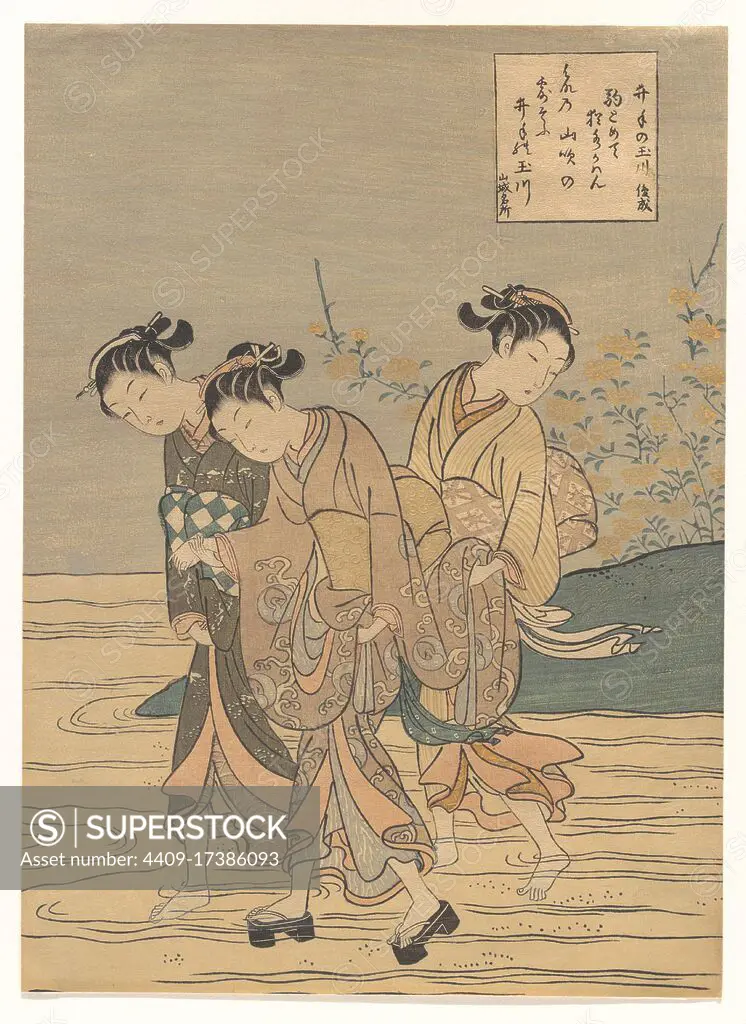
SuperStock offers millions of photos, videos, and stock assets to creatives around the world. This image of The Tama River at Ide, Yamashiro Province. Artist: Suzuki Harunobu (Japanese, 1725-1770). Culture: Japan. Dimensions: 10 1/4 x 7 3/4 in. (26 x 19.7 cm). Date: probably 1766.The poetry of place and place name has a long and evocative tradition in Japanese literature. Locations, celebrated sites called meisho, often evoked a season, a certain emotion or a famous historical or fictional event. The accumulated associations were so strong that a place name became a synedoche, an indispensable device for infusing the short poetic forms of Japan with broader meaning. Ukiyo-e artists, too, made use of such allusions, both to the place and its use in classical literature, to expand and to play upon meaning.The six Tamagawa ("Jewel Rivers")--Ide, Mishima (or Kinuta), Noji, Koya, Chofu and Noda--were a non-traditional meisho subject that became popular in the early eighteenth century as the theme for poetry, song and dance. Harunobu most likely drew inspiration for this print series from the use by Album/Album Archivo is available for licensing today.
Looking for a license?
Click here, and we'll help you find it! Questions? Just ask!
Click here, and we'll help you find it! Questions? Just ask!
DETAILS
Image Number: 4409-17386093Rights ManagedCredit Line:Album/Album Archivo/SuperStockCollection:Album Archivo Contributor:Album Model Release:NoProperty Release:NoResolution:3089×4239