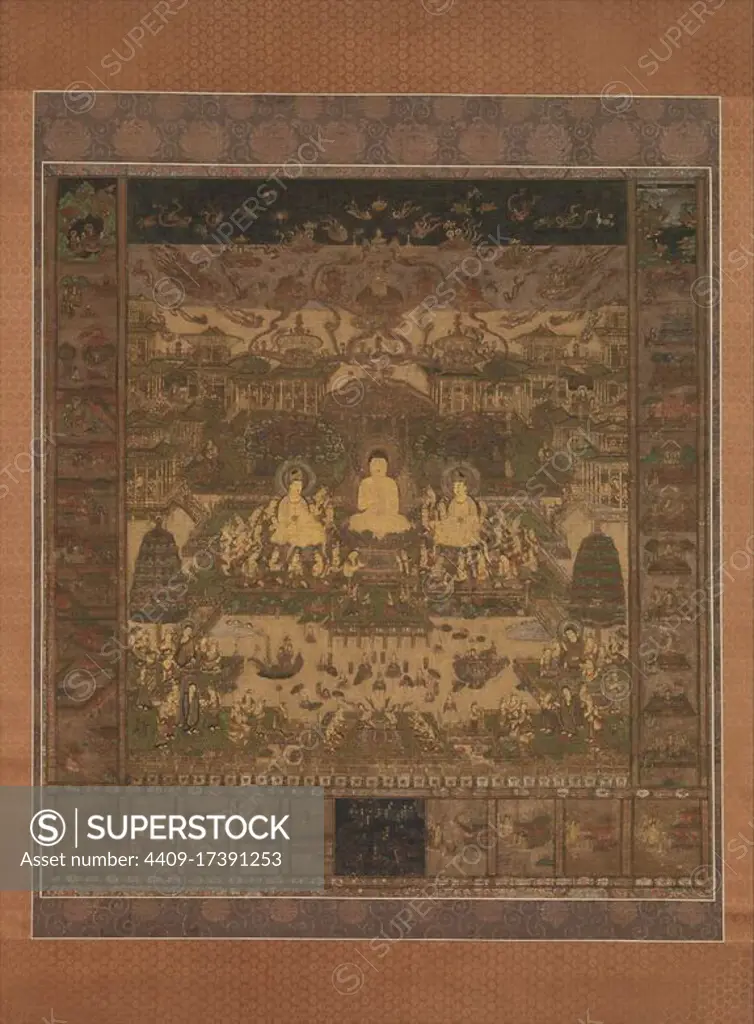
Taima Mandala. Culture: Japan. Dimensions: Image: 52 1/2 x 48 in. (133.4 x 121.9 cm). Date: probably late 14th century.This Taima mandala offers a resplendent vision of the Western Pure Land, a paradise over which Amida presides and to which he welcomes all beings who call upon his name. Amida sits enthroned at the center of the mandala, flanked by the bodhisattvas Seishi and Kannon and surrounded by throngs of musicians, dancers, celestial beings, and pavilions adorned with jewels. In the lower foreground is a lotus pond in which the faithful are reborn. Surrounding this scene are vignettes from the Contemplation Sutra that teach the living how to attain salvation. Mandalas of this type are based on Tang-dynasty Chinese images that were transmitted to Japan along with Pure Land Buddhist teachings during the Nara period (710-94). The earliest Japanese version is an eighth-century brocade approximately four times larger than the present mandala, and the primary object of worship at th
This asset has restrictions and cannot be purchased online. Get in touch for more details.
SuperStock offers millions of photos, videos, and stock assets to creatives around the world. This image of Taima Mandala. Culture: Japan. Dimensions: Image: 52 1/2 x 48 in. (133.4 x 121.9 cm). Date: probably late 14th century.This Taima mandala offers a resplendent vision of the Western Pure Land, a paradise over which Amida presides and to which he welcomes all beings who call upon his name. Amida sits enthroned at the center of the mandala, flanked by the bodhisattvas Seishi and Kannon and surrounded by throngs of musicians, dancers, celestial beings, and pavilions adorned with jewels. In the lower foreground is a lotus pond in which the faithful are reborn. Surrounding this scene are vignettes from the Contemplation Sutra that teach the living how to attain salvation. Mandalas of this type are based on Tang-dynasty Chinese images that were transmitted to Japan along with Pure Land Buddhist teachings during the Nara period (710-94). The earliest Japanese version is an eighth-century brocade approximately four times larger than the present mandala, and the primary object of worship at th by Album/Metropolitan Museum of Art, NY/Album Archivo is available for licensing today.
Looking for a license?
Click here, and we'll help you find it! Questions? Just ask!
Click here, and we'll help you find it! Questions? Just ask!
DETAILS
Image Number: 4409-17391253Rights ManagedCredit Line:Album/Metropolitan Museum of Art, NY/Album Archivo/SuperStockCollection:Album Archivo Contributor:Album / Metropolitan Museum of Art, NY Model Release:NoProperty Release:NoResolution:3145×4268