Tagasode (Whose Sleeves?”) first half of the 17th century Japan In classical love poetry the phrase Tagasode (Whose Sleeves?”) refers to an absent woman whose beautiful robes evoke memories of their owner. A number of screens bearing this sobriquet depict sumptuously patterned kimonos draped over lacquered clothing stands. This example displays fashionable textile patterns of the late sixteenth through early seventeenth century. Some of the robes have delicate tie-dyed patterns (fawn spots,” or kanoko shibori), representing the refinement of Kyoto taste. Beginning in the medieval period, Kyoto was known for its textile industry, centered in what is now the Nishijin district. Empress Consort T?fukumon’in (1607-1678), wife of Emperor Go-Mizunoo (1596-1680), frequently ordered richly ornamented garments from Kariganeya, a textile shop catering to the old aristocracy, and her purchases initiated official imperial patronage of Kyoto textiles.These screens were recently rebuilt and restor
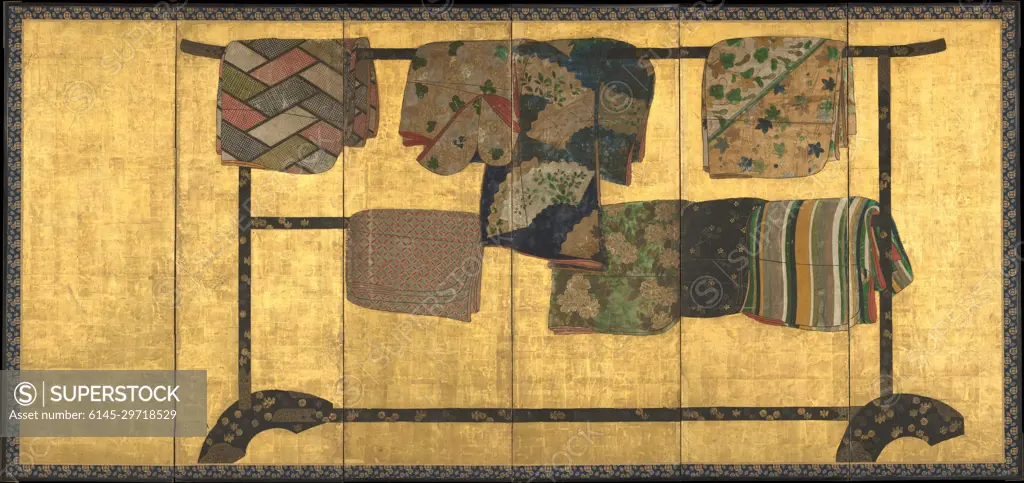
SuperStock offers millions of photos, videos, and stock assets to creatives around the world. This image of Tagasode (Whose Sleeves?”) first half of the 17th century Japan In classical love poetry the phrase Tagasode (Whose Sleeves?”) refers to an absent woman whose beautiful robes evoke memories of their owner. A number of screens bearing this sobriquet depict sumptuously patterned kimonos draped over lacquered clothing stands. This example displays fashionable textile patterns of the late sixteenth through early seventeenth century. Some of the robes have delicate tie-dyed patterns (fawn spots,” or kanoko shibori), representing the refinement of Kyoto taste. Beginning in the medieval period, Kyoto was known for its textile industry, centered in what is now the Nishijin district. Empress Consort T?fukumon’in (1607-1678), wife of Emperor Go-Mizunoo (1596-1680), frequently ordered richly ornamented garments from Kariganeya, a textile shop catering to the old aristocracy, and her purchases initiated official imperial patronage of Kyoto textiles.These screens were recently rebuilt and restor by Piemags/PL Photography Limited is available for licensing today.
Looking for a license?
Click here, and we'll help you find it! Questions? Just ask!
Click here, and we'll help you find it! Questions? Just ask!
DETAILS
Image Number: 6145-29718529Royalty FreeCredit Line:Piemags/PL Photography Limited/SuperStockCollection:PL Photography Limited Contributor:Piemags Model Release:NoProperty Release:NoResolution:3917×1848