Sword, Scabbard, and Belt Hook blade, ca. 16th-17th century; hilt, scabbard, and belt, ca. early 18th-mid-19th century Tibetan The sinuous wood-grain pattern running down the center of the blade is among the most intricate and beautiful on any Tibetan sword in existence. The gold-and-silver decoration of the hilt and scabbard is also of the highest quality for the period. Lieutenant Edward Henry Lenon (1838-1893) captured the sword in China at the Battle of North Taku Fort on August 21, 1860, during the Second Opium War. Lenon was awarded the Victoria Cross for his actions in this battle.This sword is important for the quality and distinctiveness of its pattern welded blade; as an excellent example of a Tibetan sword made to be worn suspended from a sword belt in the Chinese fashion; for its overall state of preservation; and for its interesting provenance. The pattern welding technique used in the forging of the vast majority of traditional Tibetan blades results in a characteristic s
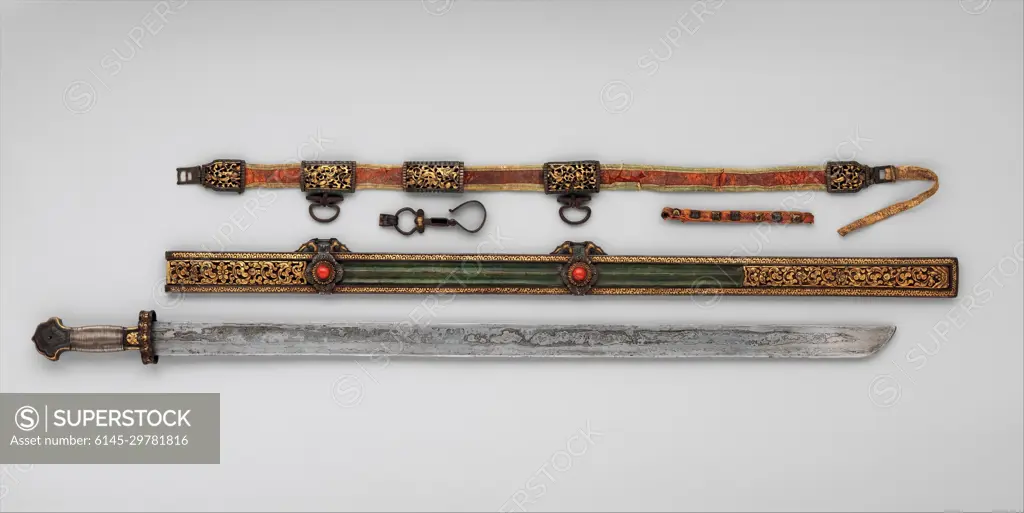
SuperStock offers millions of photos, videos, and stock assets to creatives around the world. This image of Sword, Scabbard, and Belt Hook blade, ca. 16th-17th century; hilt, scabbard, and belt, ca. early 18th-mid-19th century Tibetan The sinuous wood-grain pattern running down the center of the blade is among the most intricate and beautiful on any Tibetan sword in existence. The gold-and-silver decoration of the hilt and scabbard is also of the highest quality for the period. Lieutenant Edward Henry Lenon (1838-1893) captured the sword in China at the Battle of North Taku Fort on August 21, 1860, during the Second Opium War. Lenon was awarded the Victoria Cross for his actions in this battle.This sword is important for the quality and distinctiveness of its pattern welded blade; as an excellent example of a Tibetan sword made to be worn suspended from a sword belt in the Chinese fashion; for its overall state of preservation; and for its interesting provenance. The pattern welding technique used in the forging of the vast majority of traditional Tibetan blades results in a characteristic s by Piemags/PL Photography Limited is available for licensing today.
Looking for a license?
Click here, and we'll help you find it! Questions? Just ask!
Click here, and we'll help you find it! Questions? Just ask!
DETAILS
Image Number: 6145-29781816Royalty FreeCredit Line:Piemags/PL Photography Limited/SuperStockCollection:PL Photography Limited Contributor:Piemags Model Release:NoProperty Release:NoResolution:3927×1969