Stylus or weaving tool ca. 9th-7th century B.C. Assyrian This small worked piece of bone tapers to a sharp point at one end and to a more gradual blunted point at the other. It may have been used as a weaving tool. Previously, it was also thought that this object may have been a stylus, used to write on clay tablets or wax writing boards (for the latter see 54.117.12a, b). However, wear patterns on the tip suggest that it was more likely to have been used in weaving. A similar object in the Museums collection was excavated at the site of Nippur to the south (59.41.66). Built by the Assyrian king Ashurnasirpal II, the palaces and storerooms of Nimrud housed thousands of pieces of carved ivory. Most of the ivories served as furniture inlays or small precious objects such as boxes. While some of them were carved in the same style as the large Assyrian reliefs lining the walls of the Northwest Palace, the majority of the ivories display images and styles related to the arts of North Syria
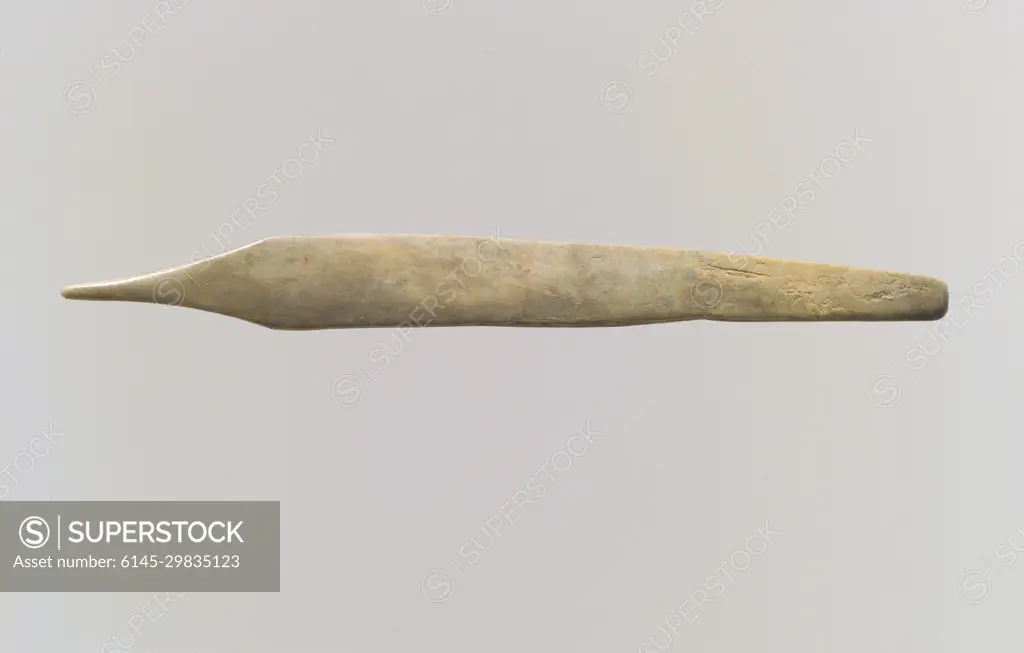
SuperStock offers millions of photos, videos, and stock assets to creatives around the world. This image of Stylus or weaving tool ca. 9th-7th century B.C. Assyrian This small worked piece of bone tapers to a sharp point at one end and to a more gradual blunted point at the other. It may have been used as a weaving tool. Previously, it was also thought that this object may have been a stylus, used to write on clay tablets or wax writing boards (for the latter see 54.117.12a, b). However, wear patterns on the tip suggest that it was more likely to have been used in weaving. A similar object in the Museums collection was excavated at the site of Nippur to the south (59.41.66). Built by the Assyrian king Ashurnasirpal II, the palaces and storerooms of Nimrud housed thousands of pieces of carved ivory. Most of the ivories served as furniture inlays or small precious objects such as boxes. While some of them were carved in the same style as the large Assyrian reliefs lining the walls of the Northwest Palace, the majority of the ivories display images and styles related to the arts of North Syria by Piemags/PL Photography Limited is available for licensing today.
Looking for a license?
Click here, and we'll help you find it! Questions? Just ask!
Click here, and we'll help you find it! Questions? Just ask!
DETAILS
Image Number: 6145-29835123Royalty FreeCredit Line:Piemags/PL Photography Limited/SuperStockCollection:PL Photography Limited Contributor:Piemags Model Release:NoProperty Release:NoResolution:4000×2554