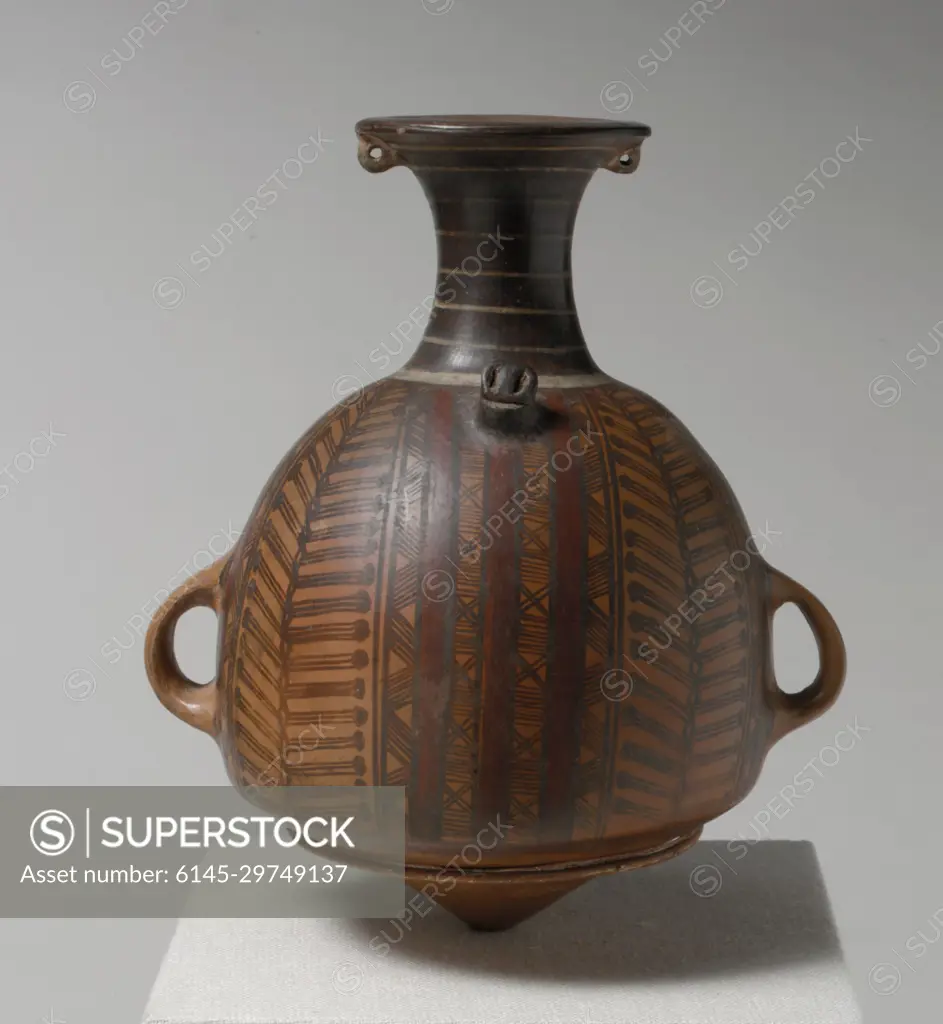
Storage Jar (Aryballos) 15th-early 16th century Inca One of the most distinctive Inca ceramic forms developed in the Cuzco area is the so-called Cuzco bottle, also known as an aryballo because of its similarity to the Greek form. Ranging in size from four to forty-five inches, aryballos (or urpus in Quechua) have big globular chambers, pointed bases, and tall necks with a flared rim. Large urpus were used for the production, storage, and transportation of chicha, a fermented corn beer, as well as other foods. The pointed base of urpus allowed large ones to be set into the earth for stability. On the shoulder of the chamber is usually a central lug, often in the shape of a stylized animal head, as seen here. Ropes were pulled through the handles and secured around the lug for carrying on the backs of porters. Most Cuzco bottles are embellished with polychrome geometric slip designs in black and red on a cream-colored background; representational motifs are rare. On this example, the fro
SuperStock offers millions of photos, videos, and stock assets to creatives around the world. This image of Storage Jar (Aryballos) 15th-early 16th century Inca One of the most distinctive Inca ceramic forms developed in the Cuzco area is the so-called Cuzco bottle, also known as an aryballo because of its similarity to the Greek form. Ranging in size from four to forty-five inches, aryballos (or urpus in Quechua) have big globular chambers, pointed bases, and tall necks with a flared rim. Large urpus were used for the production, storage, and transportation of chicha, a fermented corn beer, as well as other foods. The pointed base of urpus allowed large ones to be set into the earth for stability. On the shoulder of the chamber is usually a central lug, often in the shape of a stylized animal head, as seen here. Ropes were pulled through the handles and secured around the lug for carrying on the backs of porters. Most Cuzco bottles are embellished with polychrome geometric slip designs in black and red on a cream-colored background; representational motifs are rare. On this example, the fro by Piemags/PL Photography Limited is available for licensing today.
Looking for a license?
Click here, and we'll help you find it! Questions? Just ask!
Click here, and we'll help you find it! Questions? Just ask!
DETAILS
Image Number: 6145-29749137Royalty FreeCredit Line:Piemags/PL Photography Limited/SuperStockCollection:PL Photography Limited Contributor:Piemags Model Release:NoProperty Release:NoResolution:1736×1884