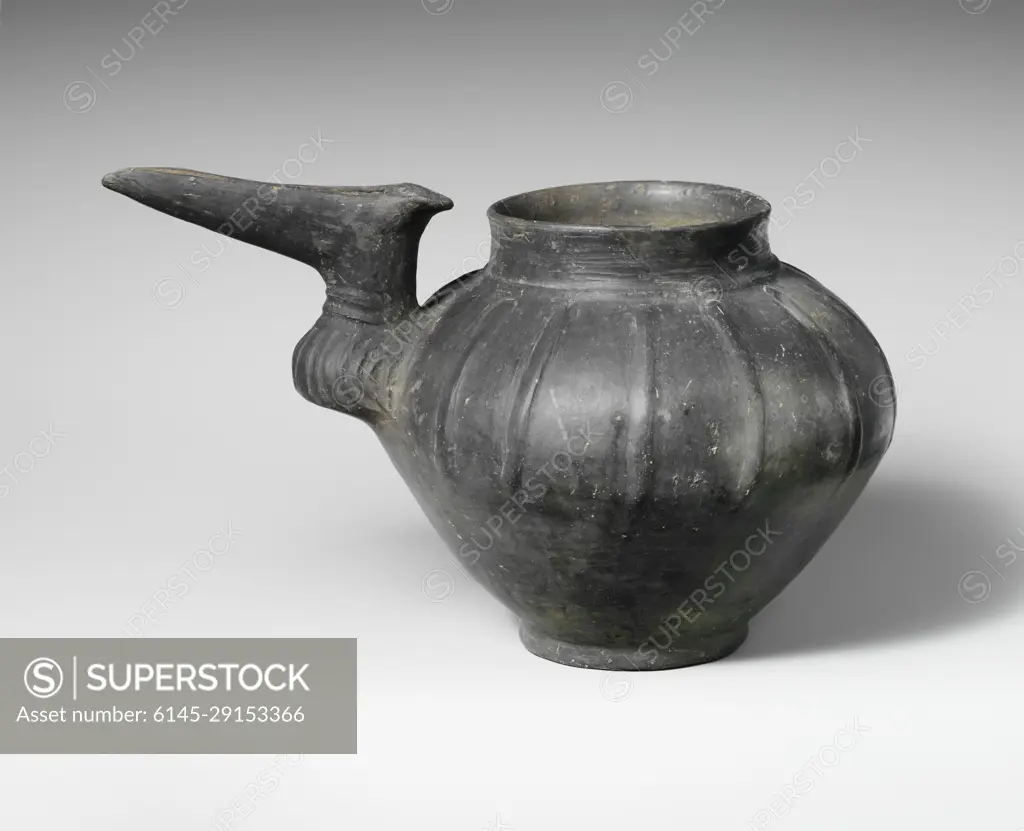
Spouted pitcher ca. 1450-1050 B.C. Iran This pitcher has a globular body, a ring base, and a slightly flared rim. A pointed spout rises vertically from a protuberance on one side of the body before extending outward horizontally. Both the body and the protuberance supporting the spout are decorated with raised ridges. The combination of the pointed spout and protuberance may suggest the form of a bird with a long beak and a crop in its neck. The pitcher is made of burnished grey clay. The body was likely made on a wheel, with the spout and raised decorations added later.This pitcher was excavated from a grave at Dinkha Tepe in northwestern Iran. During the Iron Age Dinkha Tepe was a small settlement, probably ruled by Hasanlu, a major site fifteen miles to the east. Presumably this pitcher was used to pour a liquid containing dregs, such as wine, since the round body and spout would prevent the dregs from ending up in the cup. Possibly it was used in a funerary banquet or ritual before
SuperStock offers millions of photos, videos, and stock assets to creatives around the world. This image of Explore Ancient Artistry: A Close Look at an Orientalizing Etruscan Bucchero Ware Jug, 7th–6th Century B.C. – Unraveling Etruscan Pottery Techniques and Cultural Significance. by Piemags/PL Photography Limited is available for licensing today.
Looking for a license?
Click here, and we'll help you find it! Questions? Just ask!
Click here, and we'll help you find it! Questions? Just ask!
DETAILS
Image Number: 6145-29153366Royalty FreeCredit Line:Piemags/PL Photography Limited/SuperStockCollection:PL Photography Limited Contributor:Piemags Model Release:NoProperty Release:NoResolution:4000×3248