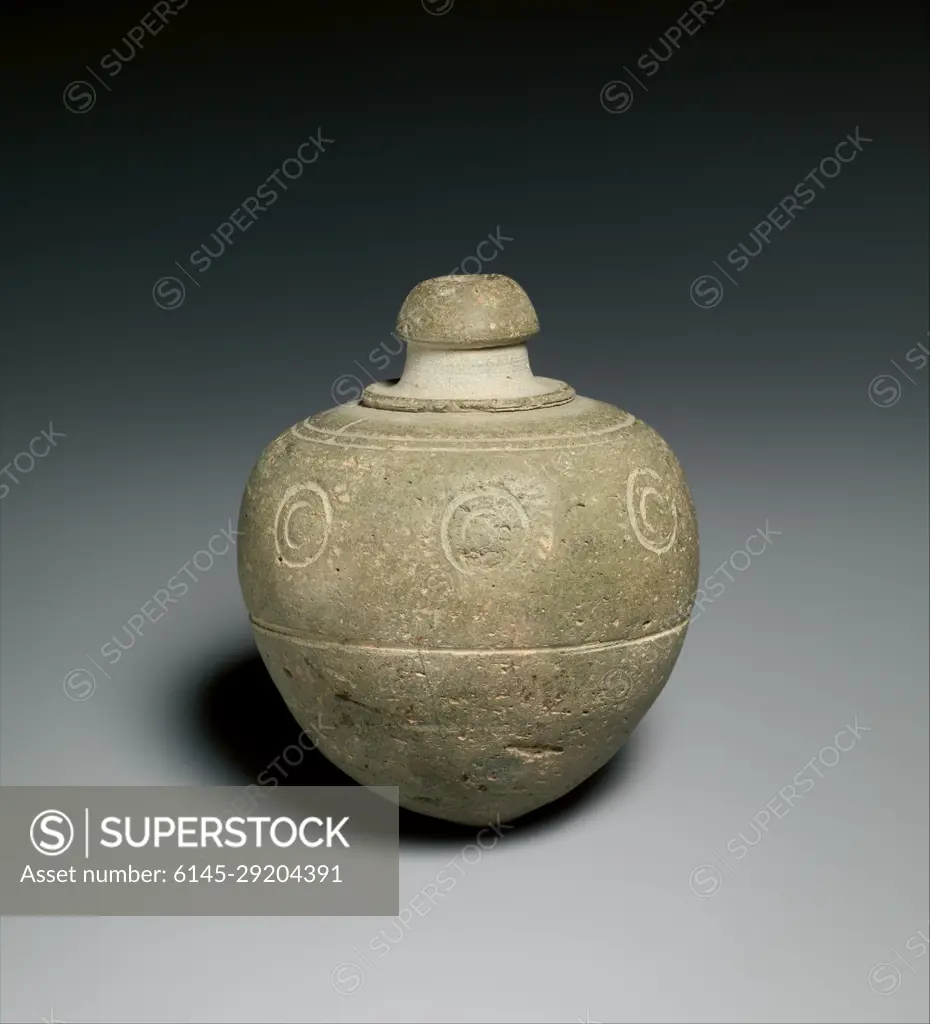
Spheroconical Vessel 9th-10th century This distinctive type of vessel has been excavated in many Islamic countries, and its function has sparked many theories. They are most commonly sphero-conical in shape, which allows their tiny openings to incline upward even when they are lying on their sides. Another common feature is a groove below the lip, presumably for suspension. Although some examples are made of glazed ceramic, stone, and glass, the vast majority of them have thick walls and are made of hard-fired, dense, unglazed earthenware. The most widely accepted theory is that they are vessels for storing, dispensing, and perhaps transporting liquids of various kinds. Several have inscriptions related to drinking; some scholars have suggested that these vessels contained beer, which was described in poetry of the time.. Spheroconical Vessel. 9th-10th century. Earthenware; incised, unglazed. Excavated in Iran, Nishapur. Ceramics
SuperStock offers millions of photos, videos, and stock assets to creatives around the world. This image of Spheroconical Vessel 9th-10th century This distinctive type of vessel has been excavated in many Islamic countries, and its function has sparked many theories. They are most commonly sphero-conical in shape, which allows their tiny openings to incline upward even when they are lying on their sides. Another common feature is a groove below the lip, presumably for suspension. Although some examples are made of glazed ceramic, stone, and glass, the vast majority of them have thick walls and are made of hard-fired, dense, unglazed earthenware. The most widely accepted theory is that they are vessels for storing, dispensing, and perhaps transporting liquids of various kinds. Several have inscriptions related to drinking; some scholars have suggested that these vessels contained beer, which was described in poetry of the time.. Spheroconical Vessel. 9th-10th century. Earthenware; incised, unglazed. Excavated in Iran, Nishapur. Ceramics by Piemags/PL Photography Limited is available for licensing today.
Looking for a license?
Click here, and we'll help you find it! Questions? Just ask!
Click here, and we'll help you find it! Questions? Just ask!
DETAILS
Image Number: 6145-29204391Royalty FreeCredit Line:Piemags/PL Photography Limited/SuperStockCollection:PL Photography Limited Contributor:Piemags Model Release:NoProperty Release:NoResolution:3511×3865