Side chair (one of a pair). Culture: Austrian, Vienna. Dimensions: 37 1/8 x 22 1/8 x 19 in. (94.3 x 56.2 x 48.3 cm). Maker: Circle of Josef Danhauser 's K.K. Priv. Möbel-Fabrik, Vienna. Date: ca. 1815-20.The years between 1815 and 1848 in Germany and Austria were characterized by a conservative political and cultural climate. The period and its style of interior decoration are both called Biedermeier, after a fictional character invented by the poet Ludwig Eichrodt (1827-1892) in the 1850s. Although the term invokes qualities typical of the German bourgeoisie (unpretentiousness, thrift, domesticity), the origin of the Biedermeier furniture style was totally aristocratic. The simple, elegant forms with their clean lines and light-colored wood veneer derived from the ornamentally restrained furniture that had been made for the royal and princely households of Germany, Austria, and France beginning in the late eighteenth century.1 For this market, even Parisian ébénistes, such as Canabas,
This asset has restrictions and cannot be purchased online. Get in touch for more details.
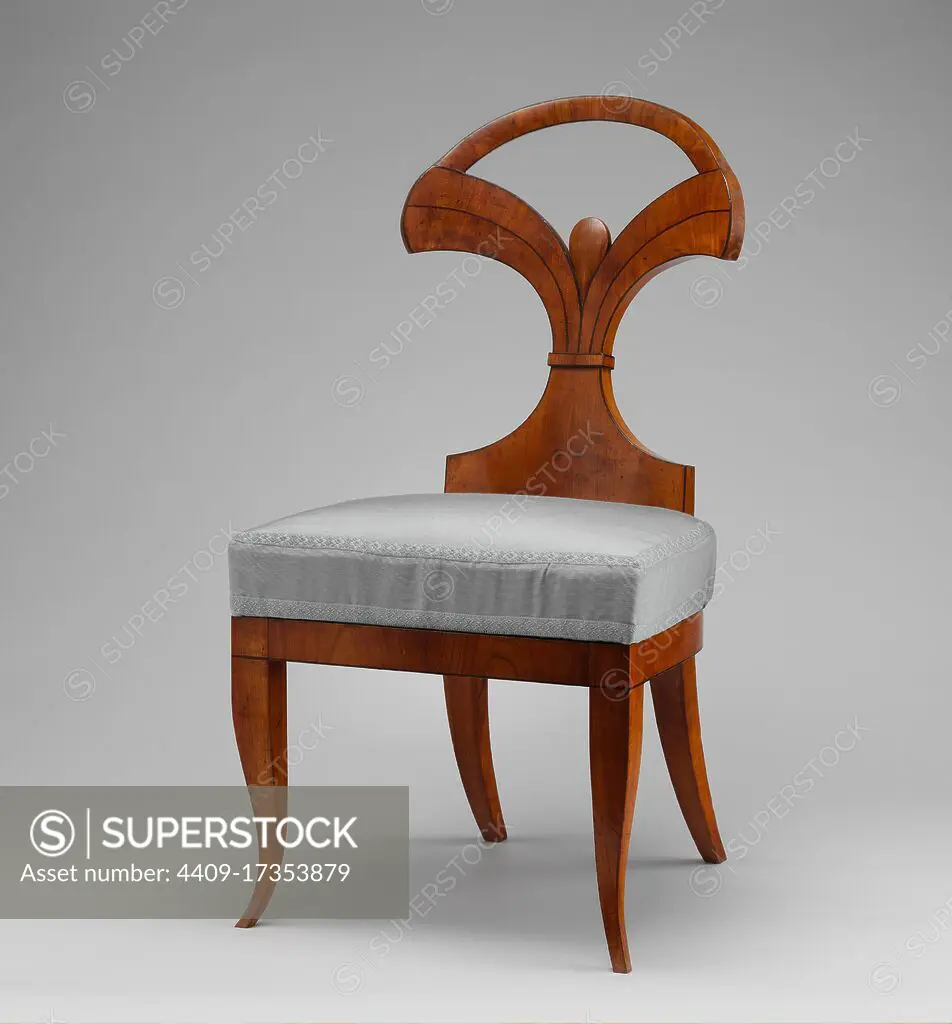
SuperStock offers millions of photos, videos, and stock assets to creatives around the world. This image of Side chair (one of a pair). Culture: Austrian, Vienna. Dimensions: 37 1/8 x 22 1/8 x 19 in. (94.3 x 56.2 x 48.3 cm). Maker: Circle of Josef Danhauser 's K.K. Priv. Möbel-Fabrik, Vienna. Date: ca. 1815-20.The years between 1815 and 1848 in Germany and Austria were characterized by a conservative political and cultural climate. The period and its style of interior decoration are both called Biedermeier, after a fictional character invented by the poet Ludwig Eichrodt (1827-1892) in the 1850s. Although the term invokes qualities typical of the German bourgeoisie (unpretentiousness, thrift, domesticity), the origin of the Biedermeier furniture style was totally aristocratic. The simple, elegant forms with their clean lines and light-colored wood veneer derived from the ornamentally restrained furniture that had been made for the royal and princely households of Germany, Austria, and France beginning in the late eighteenth century.1 For this market, even Parisian ébénistes, such as Canabas, by Album/Metropolitan Museum of Art, NY/Album Archivo is available for licensing today.
Looking for a license?
Click here, and we'll help you find it! Questions? Just ask!
Click here, and we'll help you find it! Questions? Just ask!
DETAILS
Image Number: 4409-17353879Rights ManagedCredit Line:Album/Metropolitan Museum of Art, NY/Album Archivo/SuperStockCollection:Album Archivo Contributor:Album / Metropolitan Museum of Art, NY Model Release:NoProperty Release:NoResolution:3904×4200