Shiva and Parvati Playing Chaupar: Folio from a Rasamanjari Series dated 1694-95 Devidasa of Nurpur This painting belongs to a series illustrating the Rasamanjari (Essence of the Experience of Delight), a fifteenth-century Sanskrit love poem by Bhanudatta devoted to the expression and classification of the moods and emotions of the nayaka (hero-lover) and nayika (heroine-loved). It originated in the first treatise on dramatic arts, Bharata’s Natyashastra. In this highly charged scene, enlivened by bold coloring and spatial ambiguities, Parvati is pleading with her husband, Shiva, who has just cheated her out of a necklace in a game of chaupar. The symbolic use of color and gesture is a signature feature of the Basohli school of this period. Listen to experts illuminate this artwork's story Listen Play or pause #7982. Shiva and Parvati Playing Chaupar: Folio from a Rasamanjari Series Supported by Bloomberg Philanthropies We're sorry, the transcript for this audio track is not availabl
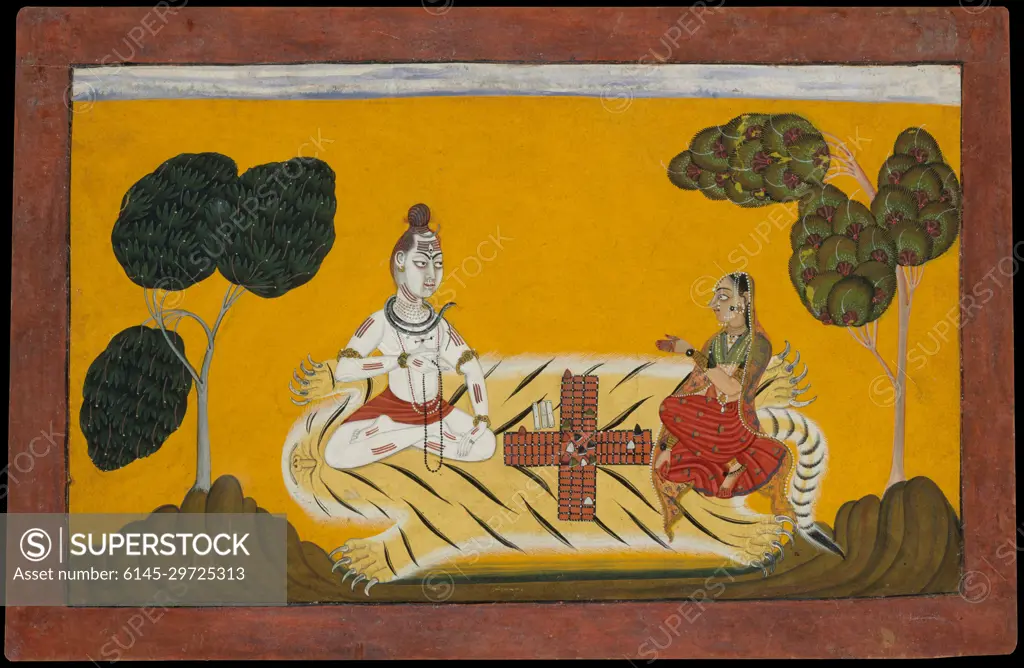
SuperStock offers millions of photos, videos, and stock assets to creatives around the world. This image of Shiva and Parvati Playing Chaupar: Folio from a Rasamanjari Series dated 1694-95 Devidasa of Nurpur This painting belongs to a series illustrating the Rasamanjari (Essence of the Experience of Delight), a fifteenth-century Sanskrit love poem by Bhanudatta devoted to the expression and classification of the moods and emotions of the nayaka (hero-lover) and nayika (heroine-loved). It originated in the first treatise on dramatic arts, Bharata’s Natyashastra. In this highly charged scene, enlivened by bold coloring and spatial ambiguities, Parvati is pleading with her husband, Shiva, who has just cheated her out of a necklace in a game of chaupar. The symbolic use of color and gesture is a signature feature of the Basohli school of this period. Listen to experts illuminate this artwork's story Listen Play or pause #7982. Shiva and Parvati Playing Chaupar: Folio from a Rasamanjari Series Supported by Bloomberg Philanthropies We're sorry, the transcript for this audio track is not availabl by Piemags/PL Photography Limited is available for licensing today.
Looking for a license?
Click here, and we'll help you find it! Questions? Just ask!
Click here, and we'll help you find it! Questions? Just ask!
DETAILS
Image Number: 6145-29725313Royalty FreeCredit Line:Piemags/PL Photography Limited/SuperStockCollection:PL Photography Limited Contributor:Piemags Model Release:NoProperty Release:NoResolution:2000×1305