Shawl. Culture: probably Scottish. Date: 1830-50.This is a particularly intricate pattern woven in one of the European shawl manufacturing centers, probably Paisley, Scotland. The palmette border pattern seems to relate to 16th-century textile vocabulary while the boteh is adapted from the Indian and Persian form. It is unusual to have an outer border in two colorways which gives the appearance of being applied but in fact it is all woven of one piece.The shawl held a place as a high fashion accessory for a relatively large period between the end of the 18th century to the 1870s. These accessories were originally adopted by men with exposure to India and Persia through the Trading Companies. The changing fashions near the end of the 18th century brought a renewed interest in Indian and Persian shawls as a form of warmth over the thin muslins of fashionable Empire silhouette dresses. The shawls came in many designs which generally incorporated the boteh form. This form, which is mostl
This asset has restrictions and cannot be purchased online. Get in touch for more details.
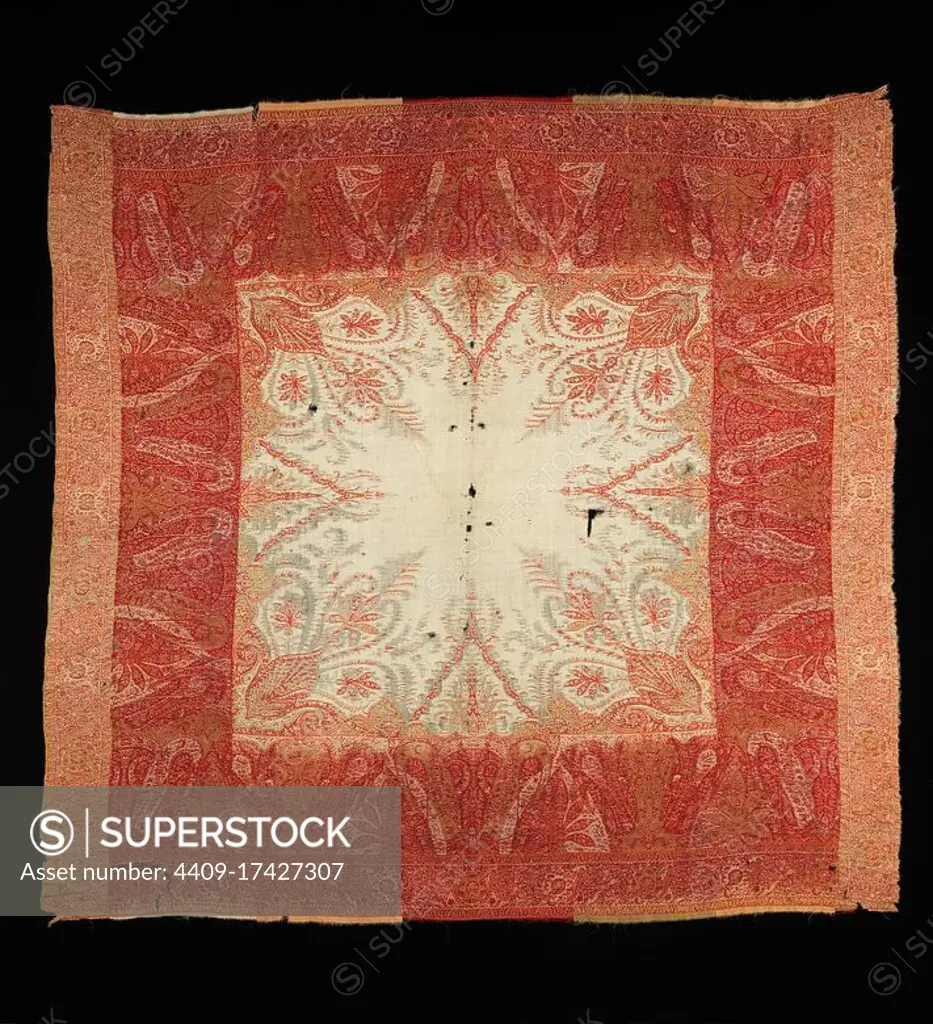
SuperStock offers millions of photos, videos, and stock assets to creatives around the world. This image of Shawl. Culture: probably Scottish. Date: 1830-50.This is a particularly intricate pattern woven in one of the European shawl manufacturing centers, probably Paisley, Scotland. The palmette border pattern seems to relate to 16th-century textile vocabulary while the boteh is adapted from the Indian and Persian form. It is unusual to have an outer border in two colorways which gives the appearance of being applied but in fact it is all woven of one piece.The shawl held a place as a high fashion accessory for a relatively large period between the end of the 18th century to the 1870s. These accessories were originally adopted by men with exposure to India and Persia through the Trading Companies. The changing fashions near the end of the 18th century brought a renewed interest in Indian and Persian shawls as a form of warmth over the thin muslins of fashionable Empire silhouette dresses. The shawls came in many designs which generally incorporated the boteh form. This form, which is mostl by Album/Metropolitan Museum of Art, NY/Album Archivo is available for licensing today.
Looking for a license?
Click here, and we'll help you find it! Questions? Just ask!
Click here, and we'll help you find it! Questions? Just ask!
DETAILS
Image Number: 4409-17427307Rights ManagedCredit Line:Album/Metropolitan Museum of Art, NY/Album Archivo/SuperStockCollection:Album Archivo Contributor:Album / Metropolitan Museum of Art, NY Model Release:NoProperty Release:NoResolution:3831×4200