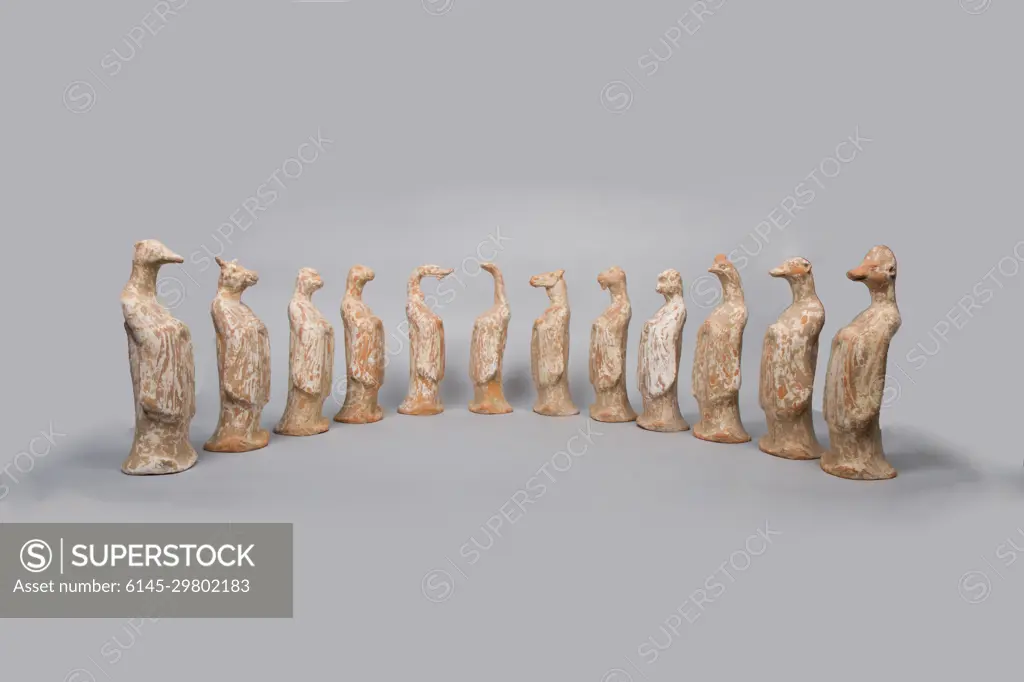
Set of twelve zodiac animals 8th century China By the Eastern Han dynasty (A.D. 9-220), the conventional order of the twelve Chinese zodiac animals was well establishedrat, ox, tiger, rabbit, dragon, snake, horse, ram, monkey, rooster, dog, and pig. Subsequently, they began to be paired with ten other calendrical elements to form a rotating cycle of sixty, which has since remained in use as a way of counting the years. The animals, along with the rotating system, have been adapted and extensively used among many East Asian and Southeast Asian countries.As burial practices became more elaborate, pottery figures of the creatures wearing official robes became popular tomb offerings, presumably as symbols of renewal and regeneration. These figures were once painted with colorful pigments, but only the white slip, which usually served as a base for decoration, has survived.. Set of twelve zodiac animals. China. 8th century. Earthenware with white slip. Tang dynasty (618-907). Ceramics
SuperStock offers millions of photos, videos, and stock assets to creatives around the world. This image of Set of twelve zodiac animals 8th century China By the Eastern Han dynasty (A.D. 9-220), the conventional order of the twelve Chinese zodiac animals was well establishedrat, ox, tiger, rabbit, dragon, snake, horse, ram, monkey, rooster, dog, and pig. Subsequently, they began to be paired with ten other calendrical elements to form a rotating cycle of sixty, which has since remained in use as a way of counting the years. The animals, along with the rotating system, have been adapted and extensively used among many East Asian and Southeast Asian countries.As burial practices became more elaborate, pottery figures of the creatures wearing official robes became popular tomb offerings, presumably as symbols of renewal and regeneration. These figures were once painted with colorful pigments, but only the white slip, which usually served as a base for decoration, has survived.. Set of twelve zodiac animals. China. 8th century. Earthenware with white slip. Tang dynasty (618-907). Ceramics by Piemags/PL Photography Limited is available for licensing today.
Looking for a license?
Click here, and we'll help you find it! Questions? Just ask!
Click here, and we'll help you find it! Questions? Just ask!
DETAILS
Image Number: 6145-29802183Royalty FreeCredit Line:Piemags/PL Photography Limited/SuperStockCollection:PL Photography Limited Contributor:Piemags Model Release:NoProperty Release:NoResolution:4000×2667