Serpent ornament A.D. 1450-1532 Inca () This exquisite three-dimensional textile representation of a serpent is from the South Coast of Peru and was likely fabricated in the 16th century. With a sinuous body, elliptical-concentric eyes, open red mouth, and protruding tongue, the snake threatens us, while at the same time its colorful body, with its lively red, yellow, black, and light brown zigzag lines, engages us. A double-braided rope is tied to the distal end, while a braided ring is inserted on the ventral side near the head, and would be used to secure the effigy snake. Although the function of this serpent is a matter of discussion, early colonial chronicles shed light on its likely use and meaning. For example, the anthropologists Tom Zuidema (1967) and Anne-Marie Hocquenghem (1997, 2008) have written essays about the symbolism of the serpent in the Inca Empire. In a ritual combat known as ayllar, snakes made of wool were used as projectiles. This effigy snake may have been wo
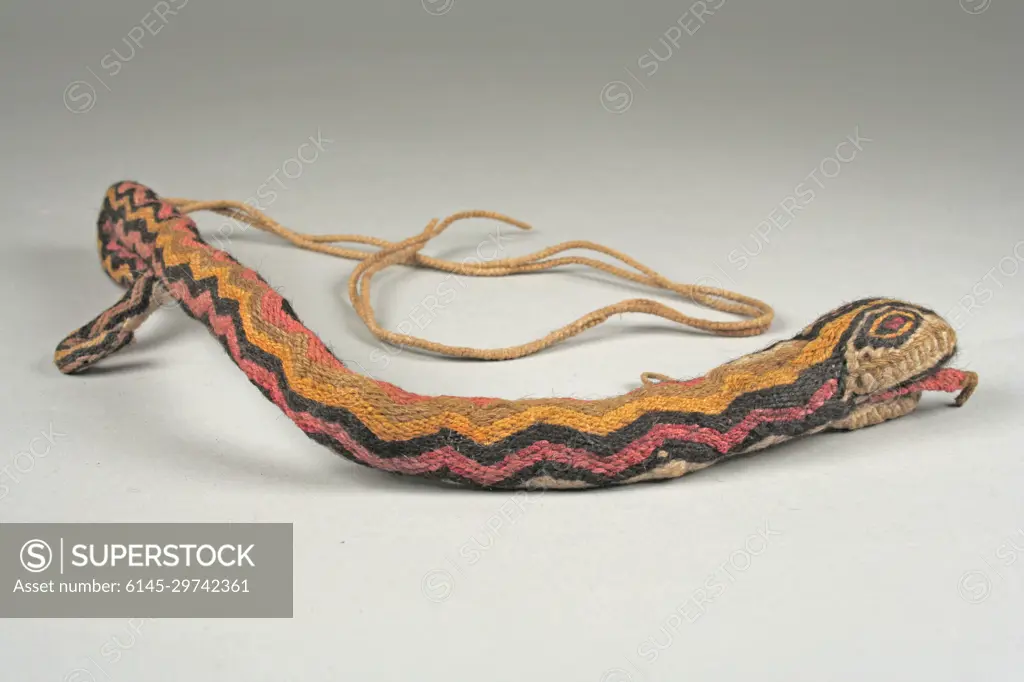
SuperStock offers millions of photos, videos, and stock assets to creatives around the world. This image of Serpent ornament A.D. 1450-1532 Inca () This exquisite three-dimensional textile representation of a serpent is from the South Coast of Peru and was likely fabricated in the 16th century. With a sinuous body, elliptical-concentric eyes, open red mouth, and protruding tongue, the snake threatens us, while at the same time its colorful body, with its lively red, yellow, black, and light brown zigzag lines, engages us. A double-braided rope is tied to the distal end, while a braided ring is inserted on the ventral side near the head, and would be used to secure the effigy snake. Although the function of this serpent is a matter of discussion, early colonial chronicles shed light on its likely use and meaning. For example, the anthropologists Tom Zuidema (1967) and Anne-Marie Hocquenghem (1997, 2008) have written essays about the symbolism of the serpent in the Inca Empire. In a ritual combat known as ayllar, snakes made of wool were used as projectiles. This effigy snake may have been wo by Piemags/PL Photography Limited is available for licensing today.
Looking for a license?
Click here, and we'll help you find it! Questions? Just ask!
Click here, and we'll help you find it! Questions? Just ask!
DETAILS
Image Number: 6145-29742361Royalty FreeCredit Line:Piemags/PL Photography Limited/SuperStockCollection:PL Photography Limited Contributor:Piemags Model Release:NoProperty Release:NoResolution:3456×2304