Salim Chishti (1478 1572) was a Sufi saint of the Chishti Order during the Mughal Empire (1526 - 1757) in South Asia. Chishti's tomb was originally built with red sandstone but later converted into a beautiful marble mausoleum. Salim Chishti's Mazar (tomb) is in the middle of the Emperor's Courtyard at Fatehpur Sikri. The mausoleum was constructed by Akbar as a mark of his respect for the Sufi saint, who foretold the birth of his son, who was named Prince Salim after him and later succeeded Akbar to the throne of the Mughal Empire, as Jahangir. Fatehpur Sikri (the City of Victory) was built during the second half of the 16th century by the Emperor Akbar (r. 1556-1605). It was the capital of the Mughal Empire for 10 years.
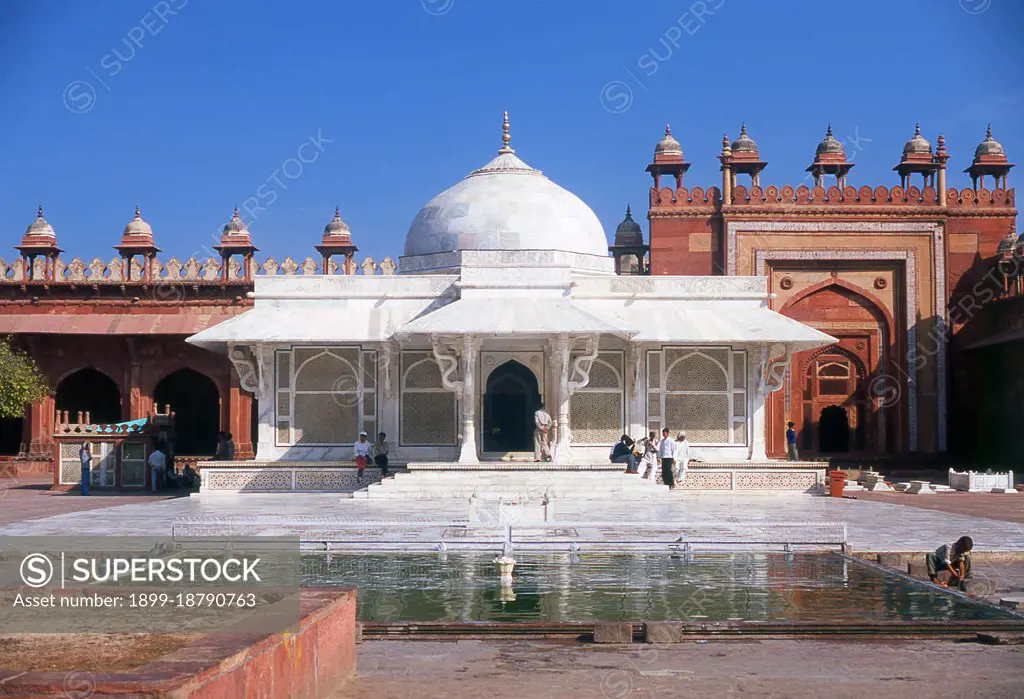
Salim Chishti (1478 1572) was a Sufi saint of the Chishti Order during the Mughal Empire (1526 - 1757) in South Asia. Chishti's tomb was originally built with red sandstone but later converted into a beautiful marble mausoleum. Salim Chishti's Mazar (tomb) is in the middle of the Emperor's Courtyard at Fatehpur Sikri. The mausoleum was constructed by Akbar as a mark of his respect for the Sufi saint, who foretold the birth of his son, who was named Prince Salim after him and later succeeded Akbar to the throne of the Mughal Empire, as Jahangir. Fatehpur Sikri (the City of Victory) was built during the second half of the 16th century by the Emperor Akbar (r. 1556-1605). It was the capital of the Mughal Empire for 10 years.
SuperStock offers millions of photos, videos, and stock assets to creatives around the world. This image of Salim Chishti (1478 1572) was a Sufi saint of the Chishti Order during the Mughal Empire (1526 - 1757) in South Asia. Chishti's tomb was originally built with red sandstone but later converted into a beautiful marble mausoleum. Salim Chishti's Mazar (tomb) is in the middle of the Emperor's Courtyard at Fatehpur Sikri. The mausoleum was constructed by Akbar as a mark of his respect for the Sufi saint, who foretold the birth of his son, who was named Prince Salim after him and later succeeded Akbar to the throne of the Mughal Empire, as Jahangir. Fatehpur Sikri (the City of Victory) was built during the second half of the 16th century by the Emperor Akbar (r. 1556-1605). It was the capital of the Mughal Empire for 10 years. by Pictures From History/Universal Images is available for licensing today.
$24.99
Personal Use
Personal Print and non commercial wall décor use. Not for re-sale.
$99.00
Website
Single non-exclusive Website, App, social media and blog use, for 5 years. Excludes Advertising.
$225.00
Magazines / Books / Educational
Non-exclusive Magazine, Book or Educational use, both print and digital, in any language. Worldwide in Perpetuity. Does not include cover use.
$300.00
Marketing bundle - Small
Single non exclusive use in a marketing campaign, worldwide (excludes advertising). Only available to companies with up to 20 employees for 5 years.
$440.00
Marketing bundle - Large
Single Non exclusive use on print marketing materials up to 50,000 and digital copies, includes: brochure, catalog, flyer, newsletter, and other collateral printed pieces + web usage. Worldwide (excludes advertising) for 5 years.
  • Download your images from the download tab on this page after purchase.
  • Up to 3 downloads
  • Can be used for 365 days after purchase.
$59.99
RM Personal Print 3 Pack
Save $14.98
$20.00
per download
Order a Framed Print
DETAILS
Image Number:  1899-18790763Rights ManagedCredit Line:Pictures From History/Universal Images/SuperStockCollection:Contributor:Model Release:NoProperty Release:NoResolution:5095×3480
|
|
|
|
|
|
|
|
|
|
|
|
|
|
|
|
|
|
|
|
|
|
|