Saddle. Culture: Chinese. Dimensions: H. including textile 13 3/4 in. (34.9 cm); L. 27 3/4 in. (70.4 cm); W. 14 1/2 in. (36.8 cm). Date: 17th-18th century.In terms of quality and style of workmanship this saddle is extremely similar to some of the best imperial Chinese saddles, such as one owned by the emperor Qianlong (r. 1736-96) and preserved in the Palace Museum, Beijing (G.171546). In addition to its very high quality, this saddle is also exceptional for having all of its original parts, including the elaborate seat cover of embroidered silk and the fittings of the saddletree. Although this type of saddle is often identified as Tibetan, the form of the saddle plates, the style of workmanship, and the type of saddletree, along with the similarity to imperial Chinese saddles, indicate it is more likely to be Chinese, perhaps from the imperial workshops. That it was used in Tibet, however, is demonstrated by the Tibetan letter ka, which is branded on the underside of the sadd
This asset has restrictions and cannot be purchased online. Get in touch for more details.
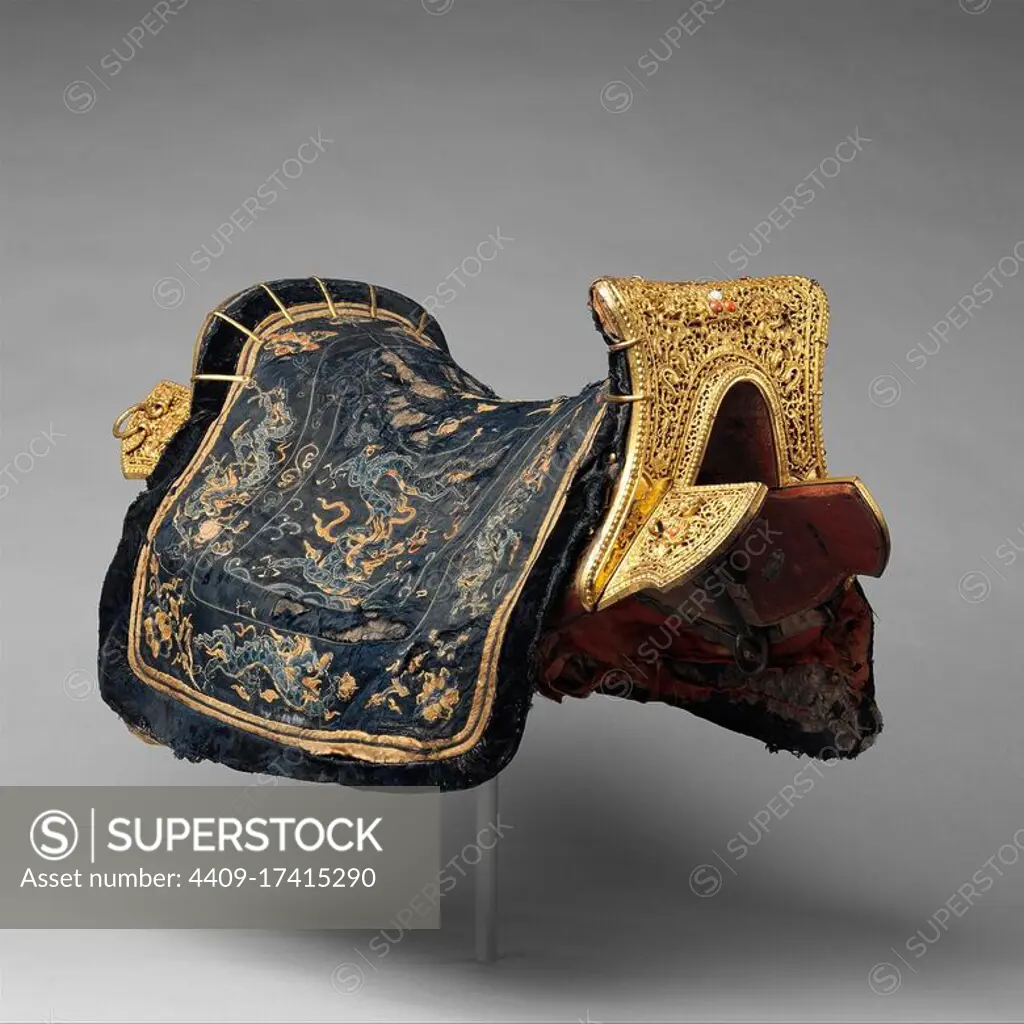
SuperStock offers millions of photos, videos, and stock assets to creatives around the world. This image of Saddle. Culture: Chinese. Dimensions: H. including textile 13 3/4 in. (34.9 cm); L. 27 3/4 in. (70.4 cm); W. 14 1/2 in. (36.8 cm). Date: 17th-18th century.In terms of quality and style of workmanship this saddle is extremely similar to some of the best imperial Chinese saddles, such as one owned by the emperor Qianlong (r. 1736-96) and preserved in the Palace Museum, Beijing (G.171546). In addition to its very high quality, this saddle is also exceptional for having all of its original parts, including the elaborate seat cover of embroidered silk and the fittings of the saddletree. Although this type of saddle is often identified as Tibetan, the form of the saddle plates, the style of workmanship, and the type of saddletree, along with the similarity to imperial Chinese saddles, indicate it is more likely to be Chinese, perhaps from the imperial workshops. That it was used in Tibet, however, is demonstrated by the Tibetan letter ka, which is branded on the underside of the sadd by Album/Metropolitan Museum of Art, NY/Album Archivo is available for licensing today.
Looking for a license?
Click here, and we'll help you find it! Questions? Just ask!
Click here, and we'll help you find it! Questions? Just ask!
DETAILS
Image Number: 4409-17415290Rights ManagedCredit Line:Album/Metropolitan Museum of Art, NY/Album Archivo/SuperStockCollection:Album Archivo Contributor:Album / Metropolitan Museum of Art, NY Model Release:NoProperty Release:NoResolution:3981×3982