Rhyton terminating in the forepart of a wild goat ca. 4th century B.C. Thrace This vessel is called a rhyton’ (from the Greek rheo, meaning flow through’) by scholars because it has a spout at the bottom. Like many rhyta, it consists of a horn-shaped beaker and a hollow sculptural element, in this case in the form of the foreparts of an ibex or wild goat. The beaker has vertical fluting with floral decoration at the top. The rim is folded over and decorated with an egg-and-dart pattern. The goat has extended forelegs, as if galloping. It has a long goatee, a pointed snout, a prominent brow, pointed ears and long curved horns. The pouring spout is on its chest between its legs. The goat’s body was hammered from a single sheet of silver, with the legs, horns and ears attached. The beaker is also hammered.Rhyta originated in the Achaemenid Persian Empire, and this example was originally attributed to Iran. However, recent research has shown that its beaker closely resembles in size and
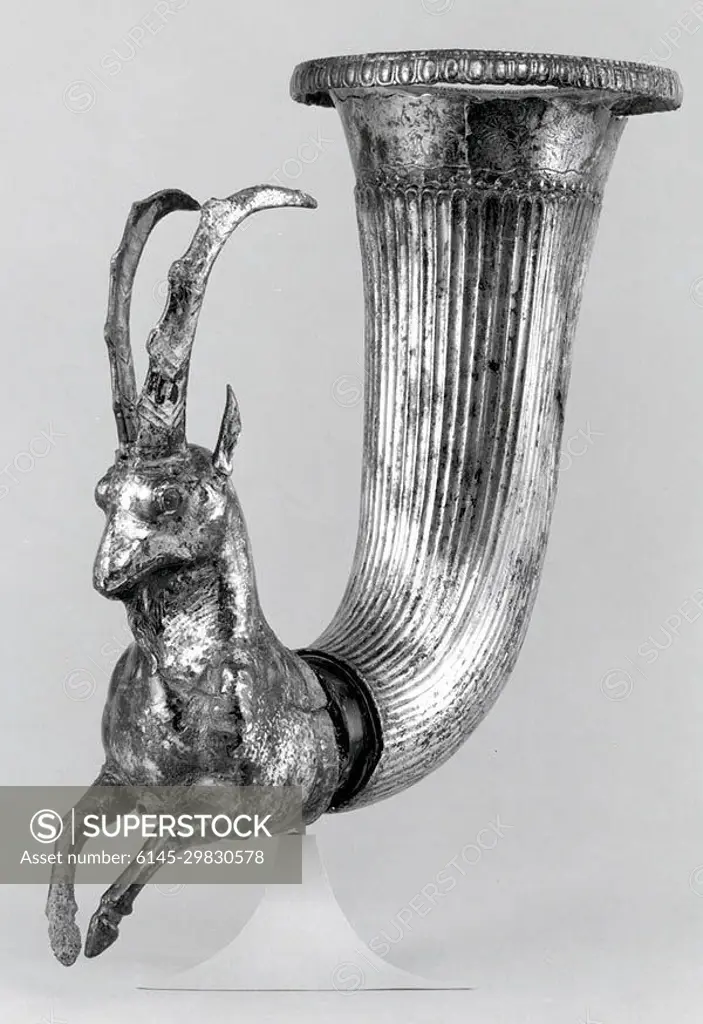
SuperStock offers millions of photos, videos, and stock assets to creatives around the world. This image of Rhyton terminating in the forepart of a wild goat ca. 4th century B.C. Thrace This vessel is called a rhyton’ (from the Greek rheo, meaning flow through’) by scholars because it has a spout at the bottom. Like many rhyta, it consists of a horn-shaped beaker and a hollow sculptural element, in this case in the form of the foreparts of an ibex or wild goat. The beaker has vertical fluting with floral decoration at the top. The rim is folded over and decorated with an egg-and-dart pattern. The goat has extended forelegs, as if galloping. It has a long goatee, a pointed snout, a prominent brow, pointed ears and long curved horns. The pouring spout is on its chest between its legs. The goat’s body was hammered from a single sheet of silver, with the legs, horns and ears attached. The beaker is also hammered.Rhyta originated in the Achaemenid Persian Empire, and this example was originally attributed to Iran. However, recent research has shown that its beaker closely resembles in size and by Piemags/PL Photography Limited is available for licensing today.
Looking for a license?
Click here, and we'll help you find it! Questions? Just ask!
Click here, and we'll help you find it! Questions? Just ask!
DETAILS
Image Number: 6145-29830578Royalty FreeCredit Line:Piemags/PL Photography Limited/SuperStockCollection:PL Photography Limited Contributor:Piemags Model Release:NoProperty Release:NoResolution:600×873